Community Property (copy) (copy)
 Call Kai
 Learn
Learn Practice Test
 Spaced Repetition
 Match
Match Flashcards
 Knowt Play
1/61

There's no tags or description
Looks like no tags are added yet.
Name | Mastery | Learn | Test | Matching | Spaced | Call with Kai | Chat |
|---|
No analytics yet
Send a link to your students to track their progress
62 Terms
Three Principals of the CommProp System
1. Equality principal: Spouses share a “present, existing, and equal interest” in CP;
2. Tracing principal: Property takes on the character of its source upon acquisition;
3. Contractual modification principal: The CP system is a default system that can be modified before marriage, during marriage, and during the dissolution process
California and Community Property, Generally
California (CA) CP system applies to validly married couples and registered domestic partners and comes into existence upon marriage or registration and ends upon date of separation or death.
At Dissolution of Marriage, CommProp v Common Law Approach
• CP: During M, equal ownership and equal management and control; at DV, an equal division (CA, NM, & LA) or equitable distribution (AZ, ID, TX, NV, & WA).
• CL: During M, separate ownership and separate management & control; at DV, equitable distribution, norm is 50%.
At Death of Spouse, CommProp v Common Law Approach
CP: testate (by will), 50% of CP & 100% of separate property (SP) can be bequeathed by Decedent; intestate (without a will), 50% of CP to surviving spouse (total 100%) & 100%, 50%, or 33.3% of SP to surviving spouse depending on survivors.
• CL: testate, elective share, norm of 33% to 50% to surviving spouse; intestate, norm of 33%, 50% or 100% of marital property to surviving spouse
Family Code 770 and 771: Define Separate Property
SP is all property owned before marriage, acquired during marriage by gift or inheritance (lucrative title), and all property generated by SP.
SP is all property acquired after the date of separation, and all property generated by SP. (FC 70. “date of separation”
Family Code 760: Community Property Defined
FC 760. CP is all property, real or personal, wherever situated, acquired by a married person during marriage (onerous title) while domiciled in CA & all property generated by CP.
• The definition of CP is a residual definition.
• During marriage, anything produced by the time, effort, skill, energy, or knowledge of a married person and all property acquired by a married person is presumptively CP (basis of the community property presumption).
Downer v. Bramet
• Even though legally a gift, the appellate court found strong evidence that the transfer of the deed was made by Husband’s (H’s) employer (ER) in recognition of H’s devoted and skillful service rendered during his employment, therefore, compensation for services.
• Earnings or property received in consideration for labor, skill, or effort exerted during marriage are CP.
• If a personal or family relationship existed between H and his ER, the deed might have been motivated by the donor’s disinterested generosity as opposed to the transferee’s service as an employee (EE).
Tracing of Property, Generally
• To determine the character of property (CP or SP or, in part, CP & SP), courts allow tracing to the source of the acquisition of the property:
e.g., although property was acquired during marriage, the property may be SP because it was acquired with premarital property, a gift or inheritance during marriage, or income generated by SP (FC 770); or
e.g., property acquired after the date of separation may be CP because the acquisition can be traced to marital labor (Downer v. Bramet).
• Depending on the circumstances, various methods of tracing have developed to trace the character of property, e.g., property acquired from a commingled bank account or CP labor expended on a SP business.
Fundamental Concepts of Premarital Agreements
FC 1500. The property rights of spouses prescribed by statute may be altered by a premarital agreement or other marital property agreement.
• FC 720. By contract, spouses cannot alter the fundamental nature of marriage, i.e., the obligations of mutual respect, fidelity, and support.
• FC 721(b). Upon marriage, a confidential relationship arises, creating a duty of good faith and fair dealing, which cannot be waived by a marital agreement
• Generally, a premarital agreement is a contract and the rules applicable to the interpretation of contracts have been applied to premarital agreements, e.g., contract defenses of duress, fraud, undue influence, and lack of capacity
Arguments For/Against Premarital Agreements
• Arguments in favor:
1. Freedom of contract principles.
2. Facilitates late or second (or third) marriages.
3. Children born prior to current marriage.
4. State’s interest in encouraging marriage.
• Arguments against:
1. Individuals and relationships change after marriage.
2. One spouse may forego education, career, etc. for the benefit of the community.
3. Unforeseen circumstances: children , health, etc.
4. If a disparity in wealth or earning capacity exists at marriage, premarital agreements often favor the economically superior spouse.
Three Regimes of CommProp Analysis for Premarital Agreements
The application of the law of a particular regime depends on the date a premarital agreement was executed or amended, and the retroactivityof any succeeding legislation.
1. Pre 1986 premarital agreements, enforceability determined by caselaw;
2. CPAA, effective 1986, applicability expressly nonretroactive;
3. CPAA, as amended, effective 2002, retroactivity of amendments at issue.
Marriage of Dawley
Pre-1986: A premarital agreement is enforceable, despite the dictum in Higgason, even if the parties anticipated dissolution of their marriage at the time of execution. The objective language of the agreement is examined and not the subjective intent of the parties.
• The terms of the premarital agreement cannot promote or encourage dissolution of marriage. The court found that nether the reordering of property rights, nor planning that considers the possibility of dissolution, offends the public policy favoring and protecting marriage.
• Citing Higgason, the court states that waivers of support rights, unlike the waivers of property rights, are per se unenforceable because they promote the dissolution of marriage.
CL contract defenses of fraud, duress, and undue influence apply.
Marriage of Noghrey
The agreement did not merely define the character of property acquired during marriage or ensure the SP character of property acquired prior to marriage but required H to give W a very substantial amount of money and a valuable property only upon the occurrence of a DV. PM agreement thus invalid
CPAA (1986)
FC 1601. This chapter is effective on and after January 1, 1986, and applies to any premarital agreement executed on or after that date.
• FC 1610. Definitions:
(a) Premarital agreement is between prospective spouses in contemplation of marriage and effective upon marriage;
(b) Property is an interest present or future, legal or equitable, vested or contingent, in real or personal, including income and earnings.
• FC 1611. Formalities; Consideration: in writing and signed by both parties; enforceable without consideration.
• FC 1613. Agreement Effective Date: effective upon marriage.
• FC 1614. Amendment; Revocation: in writing and signed by both parties.
Subject Matter of a Premarital Agreement
FC 1612(a). Subject Matter of a Premarital Agreement:
(R+O) 1. Rights and obligations in property whenever & wherever acquired or located;
(B/S/U) 2. Right to buy, sell, use, transfer, etc. or otherwise manage and control property;
(S/D/D) 3. Disposition upon separation, divorce, death, etc.;
(Estate) 4. Making of will, trust, etc. to carryout the premarital agreement;
(Life insurance) 5. Ownership rights and disposition of death benefits from a life insurance policy;
(COL) 6. Choice of law;
(Catch all) 7. Any other matter not in violation of public policy or criminal law.
(CS) FC 1612(b). Right to child support cannot be adversely affected.
(SS) FC 1612(c). Spousal Support Waivers, effective 2002
• Marriage of Pendleton & Firemen (2000). CA Supreme Court held that spousal support waivers are not per se unenforceable.
FC 1612(c) (enforcement of spousal support waivers)
• FC 1612(c), effective 2002:
1. Burden of proof rests on the party against whom enforcement is sought.
2. A spousal support waiver is not enforceable if such party is:
• not represented by independent counsel at time of execution; or
• unconscionable at time of enforcement.
• An unenforceable spousal support waiver is severable from an otherwise enforceable premarital agreement.
• Generally, CA courts have interpreted premarital agreements under the law controlling at the time the agreement was signed or amended. Marriage of Melissa (2013)
• FC 1612(c). The requirement of representation by legal counsel has been held not retroactive to agreements entered before 2002. Marriage of Howell (2011)
• Enforcement of spousal support waivers:
1.Waivers executed before 1986 are unenforceable under CA case law;
2.Waivers executed after 1985 & before 2002 have been held subject to the Pendleton dictum; i.e., public policy to ensure fair and sufficient spousal support awards, thus, unenforceable if enforcement would be unjust under the circumstances existing at time of enforcement;
3. Waivers after 2001 are subject to FC 1612(c), i.e., represented by independent counsel at time of execution & not unconscionable at time of enforcement. Marriage of Zucker (2022)
Enforcement of Premarital Agreement pre-2002
FC 1615. Enforcement, pre 2002. A premarital agreement is not enforceable if the party against whom enforcement is sought proves either of the following:
FC 1615 (a)(1). The premarital agreement was not executed voluntarily; or
FC 1615 (a)(2). The agreement was unconscionable, in financial terms, when executed and, before execution, all the following applied to such party:
• Was not provided fair, reasonable, and full disclosure of property or obligations of other party;
• Did not voluntarily waive, in writing, right to disclosure of property or obligations; and
• Did not have, or reasonable could have had, an adequate knowledge of property or obligations.
FC 1615 (c). “Voluntarily” defined, effective 2002.
Meaning of Voluntarily under 1615(a)(1)
• Marriage of Bonds (2000). Californian Supreme Court addressed the meaning of “voluntarily” as required by 1615(a)(1), finding that the burden of proof re voluntariness is on the party against whom enforcement is sought. Substantial evidence supported the trial court’s determination that Sun entered into the agreement voluntarily.
• FC 1615(c), effective 2002. All 5 factors must be satisfied.
• A confidential relationship does not exist prior to marriage. The CPAA was enacted and amended to provide protection to the parties.
• Burden of proof rests on the party against whom enforcement is sought.
• FC 1615(c) is not retroactive. Brewster v. Ferrarese (2003)
• FC 1615(c), effective 2002. All 5 factors required
Representation (1) The party against whom enforcement is sought was represented by independent legal counsel at the time of signing the agreement or, after being advised to seek independent legal counsel, expressly waived, in a separate writing, representation by independent legal counsel. The advisement to seek independent legal counsel shall be made at least seven calendar days before the final agreement is signed.
7-Day Req (2) One of the following:
(A) For an agreement executed between January 1, 2002, and January 1, 2020, the party against whom enforcement is sought had not less than seven calendar days between the time that party was first presented with the final agreement and advised to seek independent legal counsel and the time the agreement was signed. This requirement does not apply to nonsubstantive amendments that do not change the terms of the agreement.
(B) For an agreement executed on or after January 1, 2020, the party against whom enforcement is sought had not less than seven calendar days between the time that party was first presented with the final agreement and the time the agreement was signed, regardless of whether the party is represented by legal counsel. This requirement does not apply to nonsubstantive amendments that do not change the terms of the agreement.
If No Rep (3) The party against whom enforcement is sought, if unrepresented by legal counsel, was fully informed of the terms and basic effect of the agreement as well as the rights and obligations the party was giving up by signing the agreement, and was proficient in the language in which the explanation of the party's rights was conducted and in which the agreement was written. The explanation of the rights and obligations relinquished shall be memorialized in writing and delivered to the party prior to signing the agreement. The unrepresented party shall, on or before the signing of the premarital agreement, execute a document declaring that the party received the information required by this paragraph and indicating who provided that information.
CL Defenses (4) The agreement and the writings executed pursuant to paragraphs (1) and (3) were not executed under duress, fraud, or undue influence, and the parties did not lack capacity to enter into the agreement.
(5) Any other factors the court deems relevant.
Statute of Frauds and Pre-Marital Agreements
A premarital agreement shall be in writing and signed by both parties.
It is enforceable without consideration. FC 1611
Freitas v Freitas (1916)
An executed oral agreement is a defense to the statute of frauds requirement that the premarital agreement be in writing and signed by both parties. An agreement may be inferred from performance.
Transmutations, Generally
A “transmutation” is an interspousal transaction or agreement that works to change in the character of property.
During marriage, spouses are free to change the character of some, or all, of their property.
Pre-1985 Transmutations
• CA Civil Code 5103 provided, “either husband or wife may enter into any transaction with the other. . . which either might if unmarried.”
• Estate of Raphael, p 186. H, now deceased, inherited property from his mother. W argued during the marriage the property was transmuted from H’s SP to CP? The court held that a valid transmutation required a written agreement, an oral agreement, or an agreement implied from the conduct of the parties. The surviving spouse’s testimony, if creditable, and pre 1948 federal tax returns (pre 1953 CA tax returns) were sufficient.
• Pre-1985 transmutations were exceptions to the statute of frauds requirement of a signed writing for the transfer of real property.
Marriage of Jafeman
• At the time of marriage, the residence was H’s SP. W’s use of the residence while married, W’s management of the residence, H’s reference to the residence as “our home,” the use of CP funds to improve the residence, and W’s unrevealed belief that the residence was CP were not sufficient to transmute the character of the residence.
• The court stated that the intent to transmute the character of property, “may be shown by the nature of the transaction or by the surrounding circumstances. . . .In addition, the acts of the parties and their dealing with the property may establish that they intended a community interest.” However, the hidden beliefs of one party is not reflective of the character of the property.
• Written, oral, or implied transmutations, i.e., informal transmutations, are still valid re pre-1985 transmutations.
Post-1984 Transmutations
FC 850. Married persons by agreement or transfer may transmute: CP to SP of either spouse; SP of either spouse to CP; and SP of one spouse to SP of the other spouse.
FC 851. Law of fraudulent transfers apply, i.e., Civil Code 3439: Uniform Voidable Transaction Act (UVTA). The UVTA protects unsecured creditors from transfers that are intended “to hinder, delay, or defraud any creditor of the debtor.” Transfers of cash, property, or the creation of an obligation, or a transfer for less than value even without fraudulent intent, can be voided
FC 852. Requirements of a valid transmutation:
FC 852(a). In writing by an express declaration made, joined in, consented to, or accepted by the spouse whose interest in the property is adversely affected.;
FC 852(b). A transmutation of real property is not effective as to 3rd
parties without notice unless recorded;
FC 852(c). Exception for gifts between spouses;
FC 852(d). Does not affect law re commingled property;
FC 852 (e). Does not apply or effect pre-1985 transmutations.
FC 853. Statement in a will, re character of property, is inadmissible in a proceeding commenced before death of the person who made the will.
New legislation intended to address potential fraud and extensive litigation.
Estate of MacDonald (1990)
According to the Cal. Law Review Commission , “the ‘easy transmutation’ rule generated extensive litigation and unseemly tactics in dissolution cases.
. . . It encouraged spouses to transform a passing comment into an ‘agreement’ or even to commit perjury by manufacturing an oral or implied transmutation.” p 198
The Court interpreted FC 852(a) to require a special kind of writing, signed by the economically disadvantaged party, in which the disadvantaged spouse expresses a clear understanding that the document changes the character or ownership of the property. Extrinsic evidence cannot be used to prove that the writing effected a transmutation
The term transmutation need not be used
the beneficiary designation consent form must include language expressly stating that “decedent was effecting a change in the character or ownership of her interest. . . .” The following language would be sufficient: “I give to the account holder any interest I have in the funds deposit in this account.
Barneson
the CA Supreme Court stated that the word “transfer” is clearly not synonymous with “transmutation.” “A transmutation may be effected by means of a transfer, but a transfer is not necessarily a transmutation. . . .
Starkman & Holtemann Compared
Transmutations effected as part of an estate plan. An estate plan may be revocable, but a valid transmutation is irrevocable. If the couple later divorce and the estate plan is revoked, the transmutation of the character of property is not revoked. A transmutation occurs if the transmutation agreement contains explicit and unambiguous language of a present transmutation. Holtemann
• A revocable living trust stating that all property transferred to the trust is CP unless identified as SP is not a valid transmutation because the provision did not contain unambiguous language that husband intended to presently change the character of his SP to CP. “A party does not step into a transmutation by accident.” Starkman
Confidential Relationship During Marriage
FC 721(b). “ [I]n transactions between themselves, spouses are subject to the general rules governing fiduciary relationships that control the actions of persons occupying confidential relations with each other.
This confidential relationship imposes a duty of the highest good faith and fair dealing on each spouse, and neither shall take any unfair advantage.”
FC 721(b) gives rise to the presumption of undue influence.
Presumption of Undue Influence
• If a spouse gains an advantage over another spouse in an interspousal transaction, a rebuttable presumption of undue influence arises.
• If the presumption of undue influence is raised by the disadvantaged spouse, the burden rests upon the advantaged spouse to rebut the presumption.
• To rebut the presumption, the advantaged spouse must show that the transfer “was freely and voluntarily made, with full knowledge of all the facts, and with a complete understanding of the effect of the transfer . . . .” Delaney
• The presumption of undue influence overcomes all other presumptions that arise as to the characterization of property.
A Gift Between Spouses
• The requirements of FC 852(a) do not apply to gifts between spouses if the gift is:
1. Clothing, wearing apparel, jewelry, or other tangible articles of a personal nature that is used solely or principally by the spouse who received the gift; and
2. Not substantial in value taking into account the circumstances of the marriage.
• If the FC 852(c) gift exception does not apply, the requirements of FC 852(a) must be met for a valid transmutation.
FC 852(c) Examples
The trial court found that the diamond ring acquired with CP funds was substantial in value taking into account the circumstances of the marriage; therefore, the gift of the ring did not fall with in the gift exception of FC 852(c).
Because the “in writing by an express declaration” requirement of FC 852(a) was found by the trial court not to be satisfied by the anniversary/congratulatory card, the character of the ring was not transmuted from CP to the W’s SP. Jones v. Steinberger
• The gift of the Porsche to H did not fall within the FC 852(c) gift exception to the “in writing by an express declaration” requirement of FC 852(a) because the Porsche was not property of a “personal nature.” Buie v. Neighbors
Marriage of Valli (2014)
Generally, a term life insurance policy is the same character as the funds used to pay the premium. If the premiums are paid with CP, the term component of the policy is CP. Thus, each spouse has a one-half interest in the policy proceeds notwithstanding a pay on death designation to someone who is not a spouse.
Further, if the life insurance policy has a saving component (a whole life insurance policy), the savings component is characterized proportionally by the character of the funds that contributed to the saved amount, i.e., tracing principles apply.
Putting the policy solely in W’s name did not change the character of the policy to W’ SP. As the statutory requirements of FC 852(a) were not satisfied, the policy was not transmuted from CP to W’s SP.
• FC 852(a) applies to both interspousal property transactions and property acquisitions from third parties. Court finds the distinction between the two types of transactions arbitrary and irrational.
life insurance policy purchased with community funds during a marriage remains community property, even if the policy is titled solely in the name of one spouse, unless there is a formmental written transmutation agree
Retroactivity
• Generally, new legislation and amendments to existing legislation apply prospectively unless retroactive application is provided for specifically or unless the new legislation or amendment clarify existing law.
• CA Family Code, operative January 1, 1994, provides that the FC and amendments or additions to the FC operate retroactively unless prospective application is provided for specifically. FC 4(c)
• Two exceptions to FC 4(c), generally: 1) FC 4(f) no person is liable for an action taken before the operative date that was proper at the time and the person had no duty to alter the course of action; and 2) FC 4 (h) retroactive application would substantially interfere with the effective conduct of the proceedings or rights of the parties.
Retroactivity and Constitutionality
The retroactive application of new legislation or amendments to existing legislation may violate the due process clause of the Constitution if the retroactive application would impair a vested property interest.
• Nevertheless, the impairment of a vested property interest does not necessarily invalidate retroactive application. The two considerations are the extent of: 1) the significance of state’s interest served by the statute; and 2) the extent of the reliance on the former statute
Titled Property, generally
•Some types of property have title. Real estate is titled property evidenced by the deed creating the estate. Cars, trucks, and boats have title (DMV) as do aircraft (FAA). Stock certificates and bank accounts are a form of title ownership. Most items of personal property are untitled.
•Property titled in one spouse’s name has been treated differently than jointly titled property. The general community property presumption has long applied to property titled in one spouse’s name alone. By tracing, the presumption can be rebutted by the SP proponent. If successful, prorate ownership is established.
•As to joint forms of title, “Spouses may hold property as joint tenants or tenants in common, or as community property, or as community property with a right of survivorship.” FC 750
Joint Forms of Title
•Joint Tenancy with Right of Survivorship—A form of joint ownership by two or more persons in which each owns an equal, undivided interest in the whole. Joint tenancy creates a right of survivorship, i.e., if one joint tenants dies, the property is owned by the remaining joint tenants by operation of law. Title as joint tenancy must be expressly stated. A joint tenancy can be unilaterally severed, becoming a tenancy in common.
•Tenancy in Common—A form of joint ownership in which two or more persons possess property simultaneously with no right of survivorship, i.e., a co-tenant’s interest in property can be passed by will or by intestacy. Tenants in common can own unequal fractional interests in the property, and a tenancy in common can be unilaterally severed.
Note: Joint tenancy and tenancy in common are SP ownership interests.
•Community Property—Each spouse’s interest in CP is present, existing, and equal. FC 751. Generally, CP real property cannot be severed without the consent of the other spouse. (FC 1002) At death, a spouse can make a testamentary disposition of one-half of the CP. If the spouse dies intestacy, the decedent’s one-half interest passes to the surviving spouse. FC 6401(a)
•Community Property with Right of Survivorship (2001)—At death, the decedent’s one-half interest in the CP to the surviving spouse by operation of law. P 120, note 5
Note: Forms of title are mutually exclusive.
Married Woman’s Presumption
applies ONLY to acquisitions and transmutations prior to January 1, 1975.
FC 803
If, prior to January 1, 1975, real or personal property, was acquired by a married woman in a written instrument, the following presumptions apply and are conclusive as to any person dealing in good faith and for a valuable consideration with the married woman:
FC 803(a). Property acquired by a married woman, in an instrument in writing, is presumed to be her SP.
FC 803(b). Property acquired by a married women and another person is presumed held as tenants in common, unless a different intention is expressed in the instrument. (cited in Brace)
FC 803(c). Property acquired by H and W in which they are described as “husband and wife” is presumed CP, unless a different intention is expressed in the instrument.
Note. A joint tenancy between spouses expresses “a different intention” within the meaning of FC 803(b). Siberell (1932) p 109, note 2
Rebutting the Married Woman’s Presumption
•rebutted by evidence of the H’s intention not to make a gift or otherwise change the character of the property. The testimony of the H, if creditable, is sufficient to rebut the Married Woman’s Presumption.
•The Married Woman’s Presumption overcomes the CP presumption, thus, cannot be rebutted by mere tracing.
•The Married Woman’s Presumption is conclusive as to any person dealing in good faith and for a valuable consideration with the married woman, i.e., a bona fide purchaser for value without notice.
Holmes v. Holmes
•Title to real property was placed in W’s name alone. Although purchase price of the property was paid from joint earnings of H and W, the property is presumed W’s SP. The fact that the property was acquired with community funds is not sufficient to overcome the married woman’s presumption [FC 803].
•Community funds may be the subject of a gift from H to W. The H, knowing the effect of the transaction and in absence of evidence to the contrary, it is presumed that H intended to give the property to his wife.
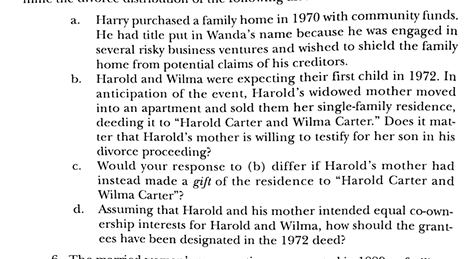
5a.The residence was purchased before 1975 and taken in W’s name alone. The married woman’s presumption applies. W presumptively owns the property as her SP. H must rebut the presumption by testifying that he did not intend a gift. FC 803(a)
5b. As title was taken by name only and not “as H and W,” a 50% SP interest is owned by W and 50% interest is owned by the community estate as tenants in common, i.e., 50% W & 50% CP. Thus, W owns 75% & H owns 25%. FC 803(b), Dunn v Mullan (1931)
5c. As a result of the gift to “Harold and Wilma,” W & H each own 50% SP interests as tenants in common. Gifts during marriage are the SP of the donee spouse. FC 760
5d. For co-ownership, the residence should have been deeded to “H & W as husband and wife” or to “H & W as CP.” FC 803(c)
Character of Titled Property
•Evidence Code 662 created the form of title presumption that “the owner of the legal title to property is presumed to be the owner of the full beneficial title.”
•Excepting the Married Woman’s Presumption (FC 803), property titled in one spouse’s name alone did not establish the character of the property as such title did not evidence a gift or an agreement between the spouses. If title was placed in one spouse’s name alone, the CP presumption applied in determining the character of the property.
In re Brace
•Facts: During marriage, H & W purchased a residence and rental real property with CP funds and took title to each property as joint tenants. H filed a petition under Chapter 7 of the U.S. Bankruptcy Code. W did not join in her H’s bankruptcy petition.
•If property is held as CP, 100% of the value of the property is included in the bankruptcy estate but, if the property is held as joint tenants, only H’s 50% interest in the property is included in the bankruptcy estate as joint tenancy is a separate property interest. FC 910 provides that the community estate is liable for the debt incurred by either spouse before or during marriage.
•Rule: title presumption does not apply if in conflict with the general CP presumption. The court’s rationale for this finding: 1) concurs with the expectations of married couples and 3rd parties (purchasers or creditors); and 2) the consequences of joint tenancy title is not understood by married couples..
Following Brace, title law applicable to three time period
Conclusion: law applicable to three time periods:
1. JT property acquired during marriage before 1975, each spouse’s joint tenancy interest is presumptively SP as the form of title expresses the consent of the parties. FC 803(b)(“unless a different intention is expressed in the instrument”)
2. JT property acquired during marriage with CP funds on or after 1/1/1975, the property is presumptively CP unless a valid transmutation has occurred:
a. If such property is acquired before 1985, a valid transmutation from CP to SP can be shown by oral or written agreement or a common understanding. CC 5103, Raphael & Jafeman
b. If such property is acquired after 1984, a valid transmutation from CP to SP must satisfy the express declaration requirements of FC 852(a). MacDonald
Estate of Bibb
•During marriage, H transferred, by grant deed, his SP apartment building to his W. The court held, since the word “grant” is the historically operative word for transferring real property, the signature on a grant deed transferring property between spouses satisfied the “by an express declaration” requirement of FC 852(a). Interspousal deeds were not addressed in Brace.
•Interspousal transfer deeds contain the following language when creating a SP interest in grantee spouse: “It is the express intent of the grantor, being the spouse of the grantee, to convey all right, title and interest of the grantor, community or otherwise, in and to the herein described property to the grantee as his/her sole and separate property.” form
Summary of Title Presumptions and CommProp Presumption
•Historically, the general CP presumption only applied to property acquired during marriage that was untitled or titled in one spouse’s name alone. As to jointly titled property, the title presumption governed over the general community property presumption whether the property was purchased from a third party or transferred between spouses. The foundation of the general title presumption was that the form of title evidenced a gift or an agreement between the spouses.
•After Brace, titled property acquired during marriage on or after 1/1/1975 with community funds in joint tenancy is presumptively CP unless a valid transmutation has occurred. What constitutes a valid transmutation depends the transmutation requirements on the date of the of acquisition or transfer of the property. If the SP proponent is successful in tracing to SP funds contributed toward the acquisition of the property, the SP proponent can establish a pro rata interest in the property
•Except for the right of survivorship, most spouses have no knowledge of the incidents of ownership of CP and JT. Generally, both represent 50% ownership and shared management and control. The true beneficiaries of the Brace holding are the creditors of the spouses. p 229, note 2
Form of Title Presumption at Divorce, At Death
•FC 2581 (effective January 1987). For the purpose of dissolution of marriage, property acquired in joint form, including tenants in common, joint tenants, and community property, during the marriage is presumed CP. The presumption may be rebutted by either:
(a)A clear statement in the deed or other documentary evidence of title; or
(b)Proof of a written agreement that the property is SP.
•FC 2580. State public policy is to provide uniformity and consistency for the standard of proof in establishing the character of property acquired in joint form during marriage and for the allocation of CP and SP interest in property between spouses.
•FC 2581 overcomes the general CP presumption that property acquired during marriage is CP. FC 2581 must be rebutted by a statement in the deed or a written agreement and not by merely tracing to a SP source. If rebutted by deed or a writing, the SP proponent must then trace to a SP source for reimbursement.
•At death, the title presumption determines the testate and intestate disposition of jointly titled property, e.g., property held in joint tenancy passes to the surviving spouse by right of survivorship.
SP Contributions to the Purchase of Jointly Titled Property
•FC 2640 (effective January 1, 1984). The right of reimbursement applies to SP contributions to the acquisition of jointly titled property that is presumed CP under FC 2581. FC 2640(a) & (b)
•Legislative history: This legislation was enacted to reject the presumption that the SP contribution was gifted to the community. Lucas
•FC 2640 applies to the division of the “community estate,” i.e., property which is 100% CP. If the property is presumed CP under FC 2581, the property is 100% CP. FC 2581 and FC 2640 work in tandem.
•To be reimbursed, the SP proponent must trace contributions to a SP source. FC 2640(b) A SP contribution carries over to property acquired in exchange for the original property. p141,note8
Note: If the general CP presumption applies in the characterization of property, FC 2640 will not apply. If the general CP presumption is rebutted through tracing to a SP source, the property will not be 100% CP but will be characterized in part CP and in part SP.
Improvements to Property, generally
•An “improvement” is a permanent addition that is attached to the property and cannot be sold separately from the property, e.g., a building, a swimming pool, adding a bedroom.
•Personal property affixed to the property that becomes part of the property is called a “fixture,”e.g., built-in appliances, lighting, cabinetry.
•Funds expended to improve land or add fixtures do not change the character of the property and, ordinarily, do not create as ownership interest in the property.
•Two alternative approaches for determining the rights to improvements: 1. consider the improvement a gift, or 2. permit reimbursement for the funds used for the improvement.
Treatment of Improvements to Property
SP to Other Spouse SP
Prior to January 1, 2005, when one spouse used separate property to improve the other spouse’s separate property, no right of reimbursement existed pursuant to the rebuttable gift presumption.
After January 1, 2005, the improving spouse is entitled to reimbursement unless there has been a valid transmutation pursuant to FC 852(a) or a written waiver of the right to reimbursement. The amount of the reimbursement is without interest and cannot exceed the net value of the property at the time of division. FC 2640(c). p 141, note 9
SP to CommProp
When a spouse uses separate property to improve community property, after January 1, 1984, the improving spouse has a right of reimbursement in a divorce proceeding. FC 2640(a) & (b).
CommProp to other Spouse SP
Traditionally, the spouse contributing CP funds to improve the other spouse’s SP had no right of reimbursement, unless agreed upon, pursuant to the gift presumption. The presumed gift was based on management and control over CP funds (pre 1/1/1975 H & post 1/1/1975 H or W).
However, some Courts of Appeal have expressed dissatisfaction with the traditional rule, holding that the community is reimbursed for one-half of the cost of the improvement. “The presumption is simply not grounded in human nature or experience.” Wolf (2001) The community is entitled to either to reimbursement or pro rata interest. Allen (2002) p 285
CommProp to own SP
Unless the other spouse consents, to prevent constructive fraud against the other spouse, the community has a right of reimbursement for the greater of the cost of the improvement or the increase in value of the property due to the improvement. Warren (1972) p 286 The result is based on management and control, whether the improvement was made with CP funds by H pre 1/1/1975 or by H or W post 1/1/1975.
Query: After FC 2640(c) and the Wolfe case, whether reimbursement should be allowed at divorce even with consent?
Note: If a failure to disclose or failure to secure consent, such failure may support a claim for breach of fiduciary duty.
Credit Acquisitions
•During marriage, many consumer purchases are made with borrowed money. The money maybe borrowed from a third-party lender or owed to the seller of the property. Typically, purchase-money debt is secured by the property purchased.
•Property acquired during marriage is presumed to be CP. The SP proponent has the burden of rebutting the general CP presumption by tracing to separate property. If the property is acquired on credit, the SP proponent must trace by using the intent-of-the-lender test. The character of the property acquired with loan proceeds is determined by whether the lender’s intent was to rely on the purchaser’s SP or community assets for repayment of the loan. If the lender intended to rely on community assets for repayment of the loan, the funds borrowed and the unpaid balance of the debt will be characterized as community.
•Personal ability and capacity and credit worthiness are community assets.
Gudelj
•if there is no evidence that the intent of the lender or seller was to rely “primarily” on the purchaser’s separate funds or property in extending credit, the community property presumption is not rebutted thus the entire credit component of the acquisition is community. p 268, note 2
•Held: As no evidence was presented as to the intent of the lender, the value of the property will be apportioned between H’s SP interest, i.e., the down payment traced to SP, and the community’s interest, i.e., the note presumed CP.
$1,500 SP down payment x FMV @ DV = SP interest
$11,500 purchase price
$10,000 CP debt x FMV @ DV = CP interest
$11,500 purchase price
Grinius
Although the restaurant business was CP, a question arose as to the character of the restaurant property, which was purchased in part with loans guaranteed by the Small Business Administration (SBA). Concluding that prior cases, including Gudelj, characterized loan proceeds as SP only if the lender relied “solely” on spouse’s SP in extending the loan, the Court of Appeal restated the applicable standard necessary to overcome the CP presumption. The SP proponent must show that the lender intended to rely “solely” upon the SP of the SP proponent for repayment.
As the Court of Appeal found that important factors in extending the loan were the community’s ability to repay the loan and manage the restaurant, the SBA did not rely solely on the H’s SP for repayment, in fact, only 2 of the 9 conditions referred to H’s SP. As a result, H failed to rebut the CP presumption thus the loans incurred in acquiring the restaurant property were community, therefore, the restaurant property was characterized as CP.
•As lenders rely heavily on creditworthiness, it is extremely difficult for the SP proponent to satisfy the “solely” reiteration of intent-of-the-lender test in Grinius. Even if the lender relied “primarily” on SP for repayment, the SP proponent would fail to rebut the CP presumption if personal ability and capacity and/or credit worthiness are also factors.
•Under FC 910 (a), the community is liable for any debt incurred by either spouse before or during marriage.
Vieux v. Vieux, and formula
If one spouse purchases property on the installment method prior to marriage and community funds are used to pay the installments after marriage, the community estate is entitled to a proportional interest in the property and not a mere right of reimbursement.
Basic Formula:
CP Contribution to Purchase x FMV = CP Interest
Purchase Price
SP Contribution to Purchase x FMV = SP Interest
Purchase Price
Note: In Vieux, the purchase money debt was fully paid.
Marriage of Moore, formula
•CA Supreme Court held that, if CP funds are used to reduce the principal on a SP loan, the community obtains a proportional interest in the SP.
•Despite the language in Vieux, if CP funds are used to reduce the principal on a SP loan and to pay taxes and insurances, only payments of principal on the loan will be included in the calculation of the CP interest because only payments of principal on the loan creates equity in the property.
CP Contribution to Purchase x FMV = CP Interest
Purchase Price
SP Contribution to Purchase x FMV = SP Interest
Purchase Price
•Any loan balance is included in the numerator of the fraction applying the intend-of-the-lender test. The estate that includes the loan balance in the numerator pays the balance of the loan.
When does proportional accounting apply?
•Proportional accounting applies to property acquired during marriage if the general CP presumption is successfully rebutted by the SP proponent through tracing. The property must be acquired during marriage with funds of mixed character and is either untitled or titled in one spouse’s name alone. If the property is jointly titled, the property must be acquired with funds of mixed character after 1/1/1975, unless a valid transmutation has occurred. At the death of a spouse, the title presumption applies, e.g., joint tenancy with right of survivorship. Brace
•If proportional accounting applies, the character of property is based on the relative contributions to the acquisition of property by the community estate and the separate estate of one or both spouses.
•Proportional accounting applies to separately titled property acquired before marriage when community funds have been used to pay purchase money debt. Vieux/Moore/Marsden
•If purchase money was borrowed or if the purchase money debt is outstanding, the separate property proponent has the burden of proof to rebut the community property presumption by tracing to separate sources. As to the borrowed funds or outstanding debt, the separate property proponent must satisfy the intent-of-the-lender test.
•Finally, proportional accounting does not apply to jointly titled property acquired during marriage for the purpose of division at divorce. The jointly titled property is presumed CP, unless rebutted by a clear statement in the deed or written agreement. If successful, the SP proponent receives a right of reimbursement for funds traced to SP contributions, without interest, unless the right of reimbursement is waived in writing. FC 2581 & FC 2640
A sculpture was acquired by Husband and Wife during marriage for $20,000. Wife purchased the sculpture with $5,000 of her separate property funds and $15,000 of community funds. Husband and wife are getting divorced. The value of the sculpture is now $60,000. At divorce, who owns the sculpture?
As sculpture was acquired during marriage, the community property presumption applies, which can be overcome by tracing to separate property contributions to the acquisition of the property. Assuming Wife is successful in tracing to her separate property contribution, Wife has a pro rata, separate property interest in the sculpture.
Wife’s separate pro rata interest:
$5,000 W’s SP/ × $60,000 FMV @ divorce= $15,000 SP Interest
$20,000 cost
Community’s pro rata interest:
$15,000 CP/ × $60,000 FMV @ divorce = $45,000 CP Interest
$20,000 cost
A Porsche was purchased by Husband before marriage for $64,000. He took title in his name alone. Husband paid $16,000 prior to marriage and the $48,000 balance was paid during marriage with community funds. The couple is seeking a divorce. The value of the Porsche is now $128,000. Who owns the Porsche?
The Porsche was acquired before marriage, therefore, the Porsche is Husband’s separate property. Nevertheless, pursuant to Vieux/Moore, the community’s contribution toward acquisition of the Porsche establishes a pro rata interest in favor of the community.
Husband’s separate pro rata interest:
$16,000 down payment x $128,000 FMV @ divorce = $32,000 SP interest
$64,000 purchase price
Community’s pro rata interest:
$48,000 CP contribution x $128,000 FMV @ divorce = $96,000 CP Interest
$64,000 purchase price
Prior to her marriage, Wife purchased a residence for $200,000. She took title in her name alone. Wife paid $40,000 down and borrowed $160,000 from Bank, securing the loan with the residence. During marriage, principal payments of $60,000 were made on the loan with community funds. Assume Wife made minimal principal payments on the loan prior to marriage and the residence did not appreciate prior to marriage. The couple is getting divorced. The value of the residence is appreciated to $1,000,000. At divorce, what is the character of the residence?
The residence was acquired before marriage; therefore, the residence is Wife’s separate property. Nevertheless, pursuant to Vieux/Moore, the community’s contribution toward acquisition of the residence establishes a pro rata interest in favor of the community. As the loan was acquired prior to marriage, the intent of the lender was to rely solely on Wife’s earning capacity, creditworthiness, and assets for repayment.
Wife’s separate pro rata interest:
$40,000 pymt + ($160,000 loan - $60,000 CP pymts) x $1,000,000 FMV @ divorce = $700,000 SP
$200,000 purchase price
W pays Bank the $100,000 loan balance, thus, receives a net amount of $600,000 ($700K - $100K).
Community’s pro rata interest:
$60,000 CP payments___ x $1,000,000 FMV @ divorce = $300,000
$200,000 purchase price
Note: Wife’s SP $600,000 + $300,000 CP + $100,000 to Bank = $1,000,000 FMV
During marriage, Wife purchased a residence for $250,000, taking title in her name alone. Wife paid the $50,000 down payment from an inheritance and borrowed the balance of $200,000 from Bank, securing the loan with the residence. The principal of the debt was reduced by $100,000 during marriage with community funds. The residence is now worth $1,200,000. At divorce, what is the character of the residence?
As Wife took title in her name alone, the community property presumption applies. Assume Wife is successful in tracing to her separate property contribution toward the acquisition of the residence. Also, assume the intent of the lender was not to rely “primarily” or “solely” on W’s separate property assets for repayment.
Wife’s separate pro rata interest:
$50,000 down payment x $1,200,000 FMV @ divorce = $240,000 SP Interest
$250,000 purchase price
Community’s pro rata interest:
$200,000 ($100,000 + $100,000 balance) x $1,200,000 FMV @ divorce = $960,000 CP $250,000 purchase price Interest
Community pays Bank the $100,000 loan balance, thus, receives a net amount of $860,000 ($960K -$100K).
Note: Wife’s SP $240,000 + $860,000 CP + $100,000 to Bank = $1,200,000 FMV
During marriage, Husband and Wife purchased a residence for $250,000, taking title as joint tenants with right of survivorship. Wife paid the $50,000 down payment from an inheritance, and the couple borrowed the balance of $200,000 from Bank, securing the loan with the residence. The principal of the debt was reduced by $100,000 during marriage with community funds. The residence is now worth $1,200,000. During marriage, what is the character of the residence? At divorce, what is the character of the residence?
As the couple purchased the residence from a third party, the community property presumption applies during marriage unless a valid transmutation has occurred. Brace
During Marriage:
Wife’s separate pro rata interest:
$50,000 down payment x $1,200,000 FMV = $240,000 SP Interest
$250,000 purchase price
Community’s pro rata interest:
$200,000 ($100,000 + $100,000 balance) x $1,200,000 FMV = $960,000 CP Interest
$250,000 purchase price
Community pays Bank the $100,000 loan balance, thus, receives a net amount of $860,000 ($960K -$100K).
Note: Wife’s SP $240,000 + $860,000 CP + $100,000 to Bank = $1,200,000 FMV
At divorce:
Family Code § 2581—As the residence was acquired during marriage in joint form, the residence is presumed community property at divorce unless by a clear statement in the deed or a written agreement provides that the residence is separate property.
Family Code § 2640—Assuming the separate property proponent can trace to separate property funds contributed toward the acquisition of the residence, in the division of the “community estate,” the separate property proponent has a right of reimbursement, without interest, unless the right of reimbursement is waived in writing.
Wife’s separate property interest: $50,000 reimbursement, without interest
Community interest: $1,150,000 ($1,200,000 - $50,000)
Time Periods to Remember
Pre-Marital Agreements:
Before 1986
1986 onward
2002 amendment
Transmutations
-1984 and before
-1985 and beyond
Married Woman’s presumption
-Before 1975
Joint title vs. CommProp:
1. Before 1975
2. After 1975