Edit · Honors Biology Unit 3 : Cells (The Ultimate Study Guide)
 Call Kai
 Learn
 Practice Test
 Spaced Repetition
 Match
 Flashcards
 Knowt Play
1/51

There's no tags or description
Looks like no tags are added yet.
52 Terms
3 Parts of Cell Theory
1) All organisms are composed of one or more cells.
2) The cell is the basic unit of structure and organization in organisms.
3) All cells come from pre-existing cells.
Robert Hooke
- discovered the word cell
Anton van Leeuwenhoek
- Redesigned the microscope
- Discovered bacteria and called them animuciles
Zacharius Janssen
- Made first compound microscope
Rudolf Virchow
- Confirmed the 3 points of Theodore Schwann
Matthias Schleiden
- Botanist (Plant Scientist) that discovered plants are made of cells
Theodore Schwann
- Found out all animals are made of cells and cells come from pre-existing cells
Robert Brown
- Botanist
- Described cell nuclei
- Continuous motion of minute particles in solution
Cell Membrane

Ribosome

Cytoplasm

Mitochondria

Nucleolus

Nucleus

Cell Wall
what is the wall on plant cells that protects the cell?

Prokaryotic

Eukaryotic
Vacuole

Vesicle

Centriole

Nuclear Membrane/ Nuclear Envelope

Chromatin
What is the complex mixture of DNA, RNA, and proteins—primarily histones—found in the nucleus of eukaryotic cells.
Flagellum

Rough ER

Smooth ER
carries out lipid synthesis, regulates calcium levels, and detoxifies certain chemicals in the cell
Golgi Apparatus

Cytoskeleton
a dynamic, complex network of protein fibers that extends throughout the cytoplasm of eukaryotic cells
Nucleoplasm
membrane like substance within the nucleus
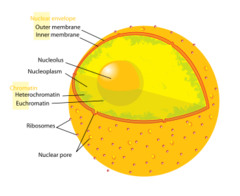
Nuclear Pores
The pores on a nucleus

Endomembrane System (The Protein Journey)
1) Ribosomes are made in the nucleolus
2) Ribosomes travel to the rough ER and start making proteins
3) The proteins travel to the Golgi Apparatus with transport vesicles
4)The Golgi Apparatus packages the proteins to exit the cell through the plasma membrane or stay in the cell
Endosymbiotic Theory
This theory says that the mitochondria and the chloroplasts in eukaryotic cells were once prokarotic cells. The evidence to prove this theory is the similar DNA, the structure is similar, and they both use binary fission to multiply.
no nucleus
prokaryotes
small and simple
prokaryotes
no organelles
prokaryotes
are very abundant
prokaryotes
all are unicellular
prokaryotes
cells have a sticky capsule
prokaryotes
all cells have a cell wall
prokaryotes
were the first cells
prokaryotes
live a wide variety of environments
prokaryotes
all are bacteria
prokaryotes
cells have a nucleus
eukaryotes
cells have organelles
eukaryotes
can be unicellular or multicellular
eukaryotes
have a cytoskeleton
eukaryotes
some have cilia
eukaryotes
includes everything that's not bacteria
eukaryotes
have ribosomes
BOTH prokaryotes and eukaryotes
have DNA
BOTH prokaryotes and eukaryotes
have cytoplasms
BOTH prokaryotes and eukaryotes
have a cell membrane
BOTH prokaryotes and eukaryotes
some have flagella
BOTH prokaryotes and eukaryotes