Unit 3 Behavior Analysis
 Call Kai
 Learn
 Practice Test
 Spaced Repetition
 Match
 Flashcards
 Knowt Play
1/58

There's no tags or description
Looks like no tags are added yet.
59 Terms
Continuous Reinforcement
every response gets a reinforcer
Intermittent Reinforcement
not every response gets a reinforcer
Fixed Ratio Schedule
specific number of responses gets a reinforcer
FR(3)
reinforcer given after every 3 responses
Variable Ratio Schedule
number of responses required varies around an average number
VR(3)
on average every 3rd response is reinforced
VR Schedules have the __ number of response rates
highest
FR Schedules have a post
reinforcement pause

What schedule of reinforcement is this
Fixed Ratio

What schedule of reinforcement is this
Variable Ratio
Characteristics of FR schedules
High constant responding
post reinforcement pause
makes stair step pattern
Characteristic of VR schedule
High constant responding
highest response rates
Interval Schedules
first response after some period of time has elapsed
Fixed Interval (FI) Schedule
first response after a constant period of time has elapsed produces the reinforcer
FI schedule … the first response after ….
time passes is reinforced
Why use FI schedules
allow us to evaluate an organisms perception of time
FI Characteristics
Behavior increases as time nears reinforcer availability
makes scalloped pattern

What schedule of reinforcement is this
Fixed Interval
Variable Interval
first response after a variable period of time has elapsed is reinforced
VI (30s)
first response after, on avg 30s has passed
VI Characteristics
Steady moderate rates
no post-reinforcement pause
Punisher…
any event that follows, and decreases behavior
Negative Punishment
removal of desired stimulus which results in decrease in behavior
Positive Punishment
the addition of an aversive stimulus is added which results in a decrease in behavior
Example of positive punishment
spanking
Example of negative punishment
loss of money
Two types of negative punishment
Time Out and response cost
What is time out
suspension of positive reinforcement contingencies
What is response cost
removal of specific reinforcer
Consequence comes
after behavior
Antecedent comes
before behavior
Three-term contingency
Antecedent, behavior, consequence
SD stands for
Discriminative stimulus
SΔ stands for
S delta
SD
increases behavior
why does SD increase behavior
behavior has been reinforced in the presence of that stimulus
SΔ
decreases behavior
Why does SΔ decrease behavior
because behavior has not been reinforced in the presence of that stimulus
Stimulus Control
Change in behavior when SD or SΔ is present
Discrimination training
One behavior
two antecedent stimulus
Differential Reinforcement
Two behaviors
One stimulus
Novel Stimulus
new stimulus
Generalization gradient
Increase in responding as the novel antecedent stimulus more closely resembles the SD
Generalization
novel stimulus resembling SD evokes the response
Choice
Voluntary behavior emitted in a context in which alternative behaviors are possible
Impulsive Choice
choosing a smaller-sooner reinforcer over a larger-later reinforcer
Self-controlled choice
choosing a larger-later reinforcer over a smaller-sooner reinforcer
What affects choice
Reinforcement over no consequence
larger/better reinforcer over smaller/lower quality
less effort over more effort
immediate over delayed
Delayed Reinforcers are discounted….
hyperbolically
What does “discounted hyperbolically” mean
delayed reinforcers lose value quickly
Crossing of lines in delay discounting
preference reversal
Steep delay discounting is indicative of
impulsive behaviors
how to influence delay discounting
make a commitment response at T2
What’s a commitment response
making selection or the larger-later reinforcer more likely
Concurrent Schedule
2 independent schedules are available simultaneously
The matching law
Behavior (B) matches prediction (R)
Formula for the matching law
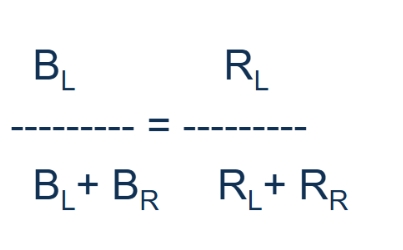
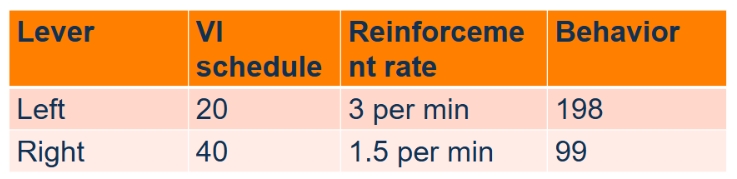
Find prediction using matching law
0.66

Find behavior using matching law
0.66