Chapter 1: The Human Body - Orientation
 Call Kai
 Learn
Learn Practice Test
 Spaced Repetition
 Match
Match Flashcards
 Knowt Play
1/49

There's no tags or description
Looks like no tags are added yet.
Name | Mastery | Learn | Test | Matching | Spaced | Call with Kai | Chat |
|---|
No analytics yet
Send a link to your students to track their progress
50 Terms
anatomy
the study of the structure of body
physiology
the study of the function of the body’s structural machinery
consider the operation of specific organ systems
divisions of anatomy - gross anatomy
regional - all structures in one part of the body (such as abdomen or leg)
systemic - gross anatomy of body studied by system
surface - study of internal structures as relating to overlying skin (this is where the appendix/intestine/stomach - like that)
divisions of anatomy - microscopic anatomy
cytology - study of cell
histology - study of tissues (tissue - so many cells grouped together/ look and work the same)
divisions of anatomy - developmental anatomy
traces structural change throughout life
embryology - studies from fertilization to birth ONLY ; study of developmental changes of the body from fertilization to birth
principle of complementarity
anatomy & physiology complement each other
function always reflects structure
what a structure can do depends on its specific form
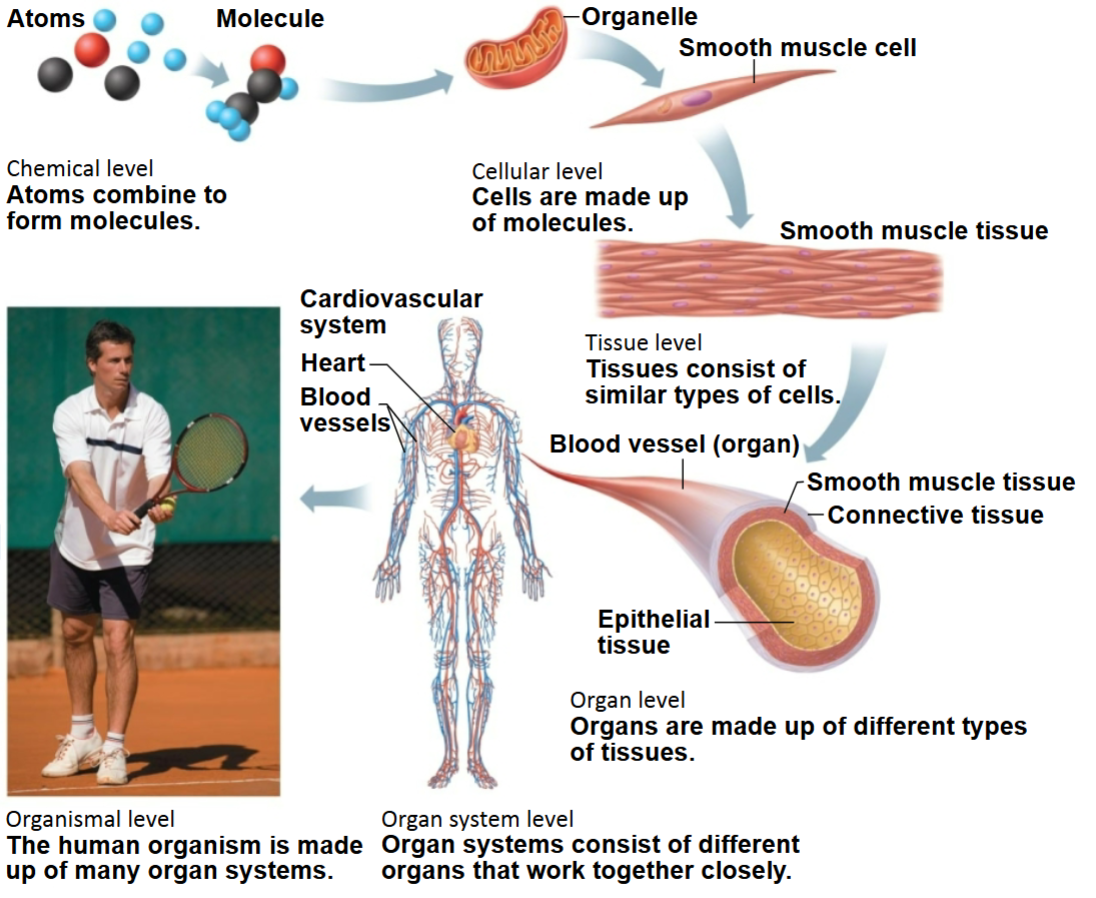
level of structural organization
chemical - atoms combined to form molecules
cellular - cells are made of molecules
tissue - consists of similar types of cells
organ - made up of different types of tissues
organ system - consists of different organs that work closely together
organismal - made up of the organ systems
necessary life functions -
? = the internal environment separated from the external environment
? = cellular level
? = organismal level
maintaining boundaries
cell membrane
skin
necessary life functions -
? = locomotion, propulsion (peristalsis), and contractility
movement
necessary life functions -
? = ability to sense changes in the environment and respond to them
responsiveness
necessary life functions -
? = breakdown of ingested foodstuffs
digestion
necessary life functions -
? = all the chemical reactions that occur in the body
? = a process of breaking down complex molecules to simple ones
? = a process of making complex molecules from simple ones
metabolism
catabolism
anabolism
necessary life functions -
? = removal of wastes from the body
excretion
necessary life functions -
? = cellular and organismal levels
? = an original cell divides and produces 2 identical daughter cells (mitosis - getting taller/gaining weight)
? = sperm and egg unit to make a whole new person
reproduction'
cellular
organismal
necessary life functions
? = increase in size of a body part or of the organism
growth
survival needs -
? = needed for energy and cell building
nutrients
survival needs -
? = necessary for metabolic reactions
oxygen
survival needs -
? = provides the necessary environment for chemical reactions
water
survival needs -
? = necessary for chemical reactions to occur at life-sustaining rates (**important for enzymatic protein function)
normal body temperature
survival needs -
? = required for proper breathing and gas exchange in the lungs (**b/c higher pressed makes it harder to breathe)
atmospheric pressure
? = ability to maintain a relatively stable internal environment (the internal environment of the body is in a dynamic state of equilibrium)
homeostasis
homeostasis is maintained by which 2 body systems?
nervous system & endocrine system
homeostatic control mechanisms -
the 3 interdependent components of control mechanisms:
? = monitors the environments and responds to changes (stimuli)
? = determines the set point at which the variable is maintained
? = provides the means to respond to stimuli
receptor
control center
effector
what are the 2 types of feedback mechanism? what are those processes?
negative feedback mechanism: response —> negative feedback —> stop response
positive feedback mechanism: response —> positive feedback —> continue response

what happens during a negative feedback mechanism/loop? give examples
most popular
the output shuts off the original stimulus
examples:
regulation of body temperature
regulation of blood volume by ADH (an endocrine mechanism)
anti-diuretic hormone = to increase blood volume, retains water

what does a positive feedback loop/mechanism include?
response enhances/exaggerates the original stimulus
may exhibit a cascade or amplifying effect
usually controls infrequency events like: enhancement of labor contractions by oxytocin or platelet plug formation and blood clotting

blood clotting is an example of what feedback loop?
positive feedback loop

anatomical position
body standing/erect
face forward
palms forward
feet forward
arms by side
superior (cranial) and inferior (caudal)
above & below from the head respectively
ex.
head is superior to abdomen
navel is inferior to chin
anterior (ventral) and posterior (dorsal)
toward the front and back of body
ex.
breastbone is anterior to the spine
heart is posterior to the breastbone
medial and lateral (& intermediate)
towards midline and away from midline
between a more medical and a more lateral structure
ex.
heart is medial to arm
arms are lateral to chest
collarbone is intermediate between breastbone and shoulder
proximal and distal
towards and away from origin of body part (mainly referring to limbs)
ex.
elbow is proximal to wrist
knee is distal to thigh
superficial (external) and deep (internal)
closer and away from body surface
ex.
skin is superficial to skeletal muscles
lungs are deep to skin

anterior/ventral
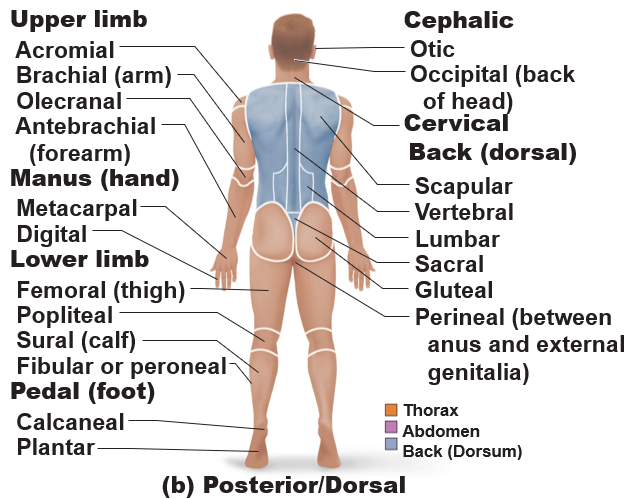
posterior/dorsal
body planes -
? = divides body into right and left parts
? = divides body into equal left and right parts
? = divides body into unequal left and right parts
sagittal
midsagittal
parasagittal
body planes -
? = divides body into anterior and posterior parts
frontal/coronal
body planes -
divides body into superior and inferior parts
transverse/horizontal
*how can you see both kidneys?
frontal & transverse
body cavities
cranial cavity
vertebral cavity
thoracic cavity
abdominopelvic cavity
above hips - abdominal
below hips - pelvic
no line separates both
what are the 2 groups of body cavities and which cavity is both in both
ventral/anterior body cavity
thoracic & abdominopelvic
dorsal/posterior body cavity
cranial & vertebral
dorsal body cavities function/purpose
protects nervous system and is divided into 2 subdivisions
cranial cavity
vertebral cavity
cranial cavity
within the skull houses the brain
vertebral cavity
runs within the vertebral column houses the spinal cord
ventral body cavity function/purpose
house the internal organs (viscera) and is divided into 2 subdivisions:
thoracic
abdominopelvic
thoracic cavity
subdivided into 2 pleural cavities, mediastinum cavity, and the pericardial cavity:
mediastinum cavity - contains the pericardial cavity and superior mediastinum
superior mediastinum - contains the great vessels and trachea
pericardial cavity - encloses the heart
plueral cavity - each houses a lung
abdominopelvic cavity
separated from the superior thoracic cavity by the dome-shaped diaphragm
it is composed of 2 subdivisions:
abdominal cavity - contains the digestive organs
pelvic cavity - lies within the pelvic and contains the reproductive organs, rectum, and bladder
body can be separated into 4 quadrants called?
right upper quadrant RUG
right lower quadrant RLQ
left upper quadrant LUQ
left lower quadrant LLQ

abdominopelvic regions
right hypochondriac region
epigastric region (epi=up)
left hypochondriac region
right lumbar region (loin)
umbilical region (belly buttom)
left lumbar region (loin)
right iliac (inguinal) region
hypogastric region (pubic) (hypo=down)
left iliac (inguinal) region
*what is the region that is lateral to the epigastric region?
hypocondriac
organs in each subdivision
right hypochondriac region - liver and gallbladder
epigastric region - parts of stomach
left hypochondriac region - spleen & parts of stomach
right lumbar region - ascending colon of large intestine
umbilical region - small intestine
left lumbar region - transverse colon of large intestine
right iliac (inguinal) region - cecum & appendix
hypogastric (pubic) region - urinary bladder & rectum
left iliac (inguinal) region - initial part of sigmoid colon