Practical / Lab #2 - Appendicular Skeleton
 Call Kai
 Learn
 Practice Test
 Spaced Repetition
 Match
 Flashcards
 Knowt Play
1/110

Earn XP
Description and Tags
Shoulder Joint & Shoulder Girdle; Landmarks of the Scapula, Clavicle, & Humerus; Major Muscles of the Shoulder Joint & Shoulder Girdle
111 Terms
Acromioclavicular Joint (AC)
The joint where the acromion of the scapula meets the clavicle, allowing for movement of the shoulder. Define what’s covered in red!

Sternoclavicular Joint (SC)
The joint where the sternum meets the clavicle, playing a crucial role in shoulder mobility and stability. Define what’s covered in red!

Clavicle
A long bone that connects the arm to the body, serving as a strut between the shoulder blade and the sternum, and playing a key role in shoulder function. Define what’s covered in red!

Acromioclavicular joint (AC) and Sternoclavicular joint (SC)
The clavicle, also known as the collarbone, is a long bone that connects the arm to the body. Define what’s in red, then follow with what is purple!

Right Scapula
This side of the scapula, or shoulder blade, is a flat, triangular bone located at the back of the shoulder, providing attachment points for muscles and forming part of the shoulder girdle. What side of the bone are we looking at here (right/left) and what bone is it?

Spine of the Scapula
This part of the scapula is a prominent ridge that runs diagonally across the posterior surface of the scapula, serving as an important landmark for muscle attachment and division between the supraspinatus and infraspinatus muscles. Define what’s covered in red!

Posterior
You’ll always fine the spine of the scapula on the blank side?

Infraspinous Fossa
This fossa is the concave area located inferior to the spine of the scapula, serving as an attachment point for the infraspinatus muscle. Define what’s covered in red!
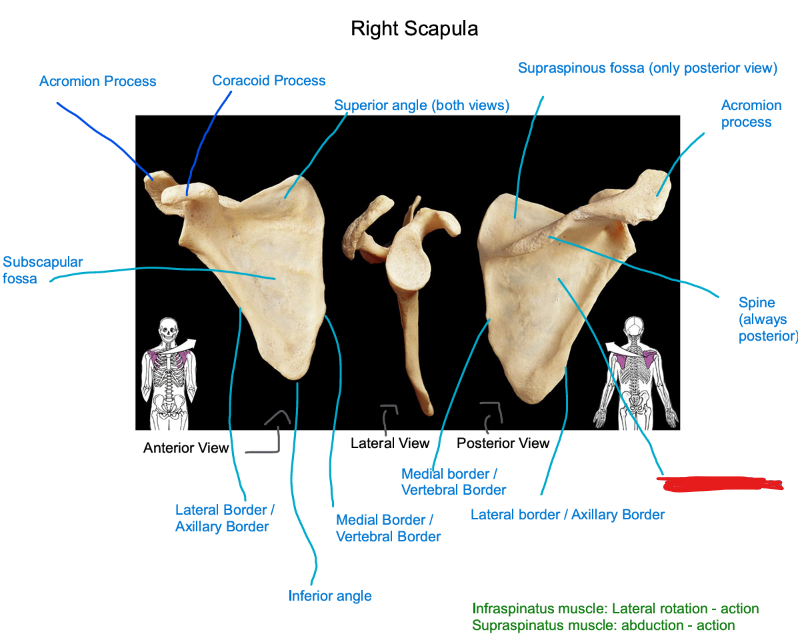
Supraspinous Fossa
This fossa is the concave area located superior to the spine of the scapula, providing an attachment point for the supraspinatus muscle. **Can only be seen in posterior view. Define what’s covered in red!

Subscapular Fossa
This fossa is a shallow concave surface on the anterior side of the scapula, serving as an attachment point for the subscapularis muscle. Define what’s covered in red!

Acromion Process
The bony projection on the scapula that extends laterally from the spine, forming the highest point of the shoulder and serving as an attachment for muscles and ligaments. Define what’s in red!
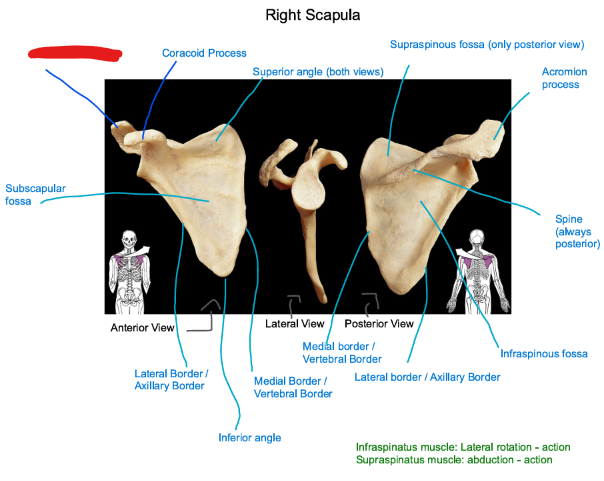
Coracoid Process
The bony projection on the scapula that extends anteriorly, providing attachment for muscles and ligaments, including the pectoralis minor and the short head of the biceps brachii. Define what’s covered in red!

Medial border / Vertebral border
The edge of the scapula that faces the vertebral column, providing attachment points for muscles such as the rhomboids and serratus anterior. Define what’s covered in red!

Lateral border / Axillary border
The edge of the scapula that faces away from the vertebral column, providing attachment points for muscles such as the teres major and minor. Define what’s covered in red!

Superior angle
The uppermost point of the scapula, formed by the intersection of the medial and lateral borders. It serves as an important landmark for muscle attachment and orientation. Define what’s covered in red!

Inferior angle
The lowermost point of the scapula, formed by the meeting of the medial and lateral borders. It is crucial for determining the orientation and stability of the shoulder joint. Define what’s covered in red!

Head of the humerus (Humeral head)
The rounded, proximal end of the humerus that articulates with the glenoid cavity of the scapula, forming the shoulder joint. It is crucial for shoulder mobility and stability. Define what’s covered in red!

Greater tubercle
The prominent, lateral projection on the proximal humerus, serving as an attachment site for the rotator cuff muscles. It is important for shoulder stability and movement. Define what’s covered in red!

Lesser tubercle
The smaller, anterior projection on the proximal humerus, providing an attachment site for the subscapularis muscle. It plays a role in shoulder stability and movement. Define what’s covered in red!

Intertubercular groove
The groove located between the greater and lesser tubercles of the humerus, serving as a passage for the biceps brachii tendon. It is important for the movement and stability of the shoulder joint. Define what’s covered in red!

Deltoid tuberosity
The roughened area on the lateral surface of the humerus, serving as an attachment site for the deltoid muscle. It contributes to arm abduction and shoulder stabilization. Define what’s covered in red!

Medial epicondyle
The bony protrusion on the inner side of the humerus, providing attachment for the muscles of the forearm. It is involved in flexion and pronation of the forearm. Define what’s covered in red!

Lateral epicondyle
The bony protrusion on the outer side of the humerus, providing attachment for muscles in the forearm. It plays a role in extension and supination of the forearm. Define what’s covered in red!

Olecranon fossa
The deep notch located at the distal end of the humerus, accommodating the olecranon of the ulna during elbow extension. It allows for joint movement and stability. **Can only see in posterior view. Define what’s covered in red!

Coronoid fossa
The shallow depression located at the distal end of the humerus, accommodating the coronoid process of the ulna during elbow flexion. It facilitates joint movement and function. Define what’s covered in red!
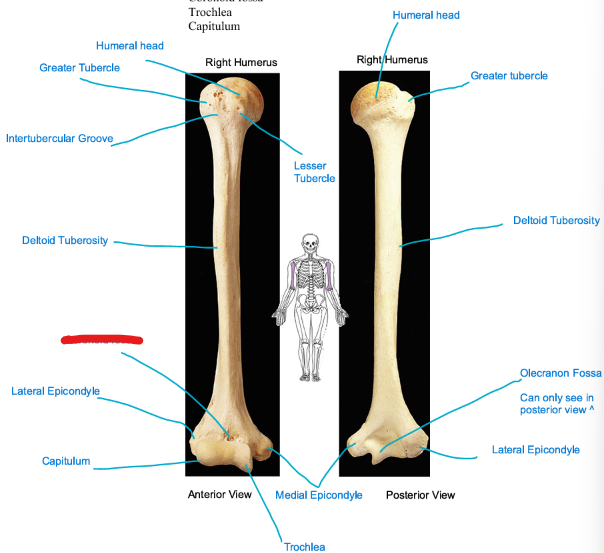
Trochlea
A spool-shaped structure on the distal end of the humerus, interacting with the ulna. It enables flexion and extension of the elbow joint. Define what’s covered in red!

Capitulum
A rounded, knob-like structure on the distal end of the humerus that articulates with the head of the radius. It facilitates movements of the forearm, particularly during flexion and extension. Define what’s covered in red!

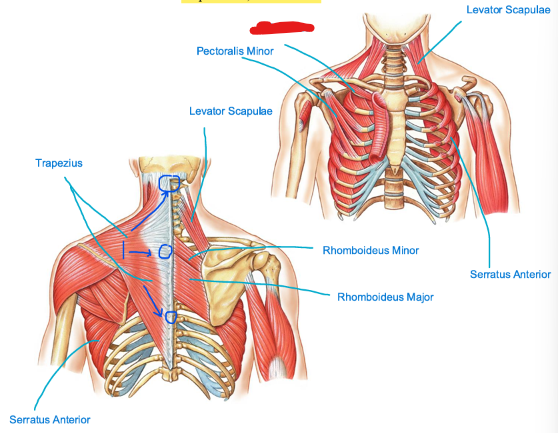
Trapezius
A large, triangular-shaped muscle located in the upper back, responsible for moving, rotating, and stabilizing the shoulder blade (scapula). It plays a crucial role in shoulder and neck movement. This muscle is part of the shoulder girdle. Define what’s covered in red!
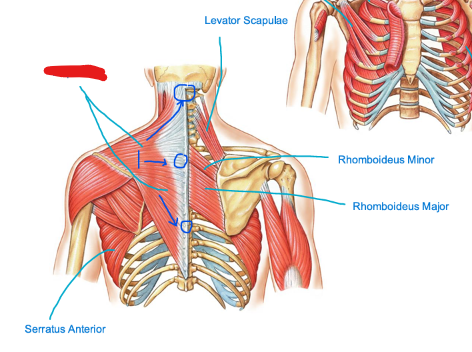
Serratus Anterior
A muscle located on the lateral aspect of the thorax, it originates from the upper ribs and inserts on the medial border of the scapula. It plays a key role in protracting and stabilizing the scapula against the thoracic wall. This muscle is part of the shoulder girdle. Define what’s covered in red!

Pectoralis Minor
A thin, flat muscle located beneath the pectoralis major, originating from the third to fifth ribs and inserting on the coracoid process of the scapula. It assists in stabilizing the scapula and can also aid in forced inspiration. This muscle is part of the shoulder girdle. Define what’s in red!

Rhomboideus Major
A muscle located in the upper back, beneath the trapezius. It originates from the spinous processes of the upper thoracic vertebrae and inserts on the medial border of the scapula, functioning to retract and elevate the scapula. This muscle is part of the shoulder girdle.

Rhomboideus Minor
A muscle located in the upper back, above the rhomboideus major. It originates from the spinous processes of the cervical vertebrae and inserts on the medial border of the scapula, aiding in the retraction of the scapula. This muscle is part of the shoulder girdle. Define what’s in red!

Levator Scapulae
A muscle located at the back and side of the neck. It originates from the transverse processes of the upper cervical vertebrae and inserts on the superior angle of the scapula, functioning to elevate the scapula and assist in neck movements. This muscle is part of the shoulder girdle. Define what’s in red!

Subclavius
A small muscle located beneath the clavicle. It originates from the first rib and inserts on the inferior surface of the clavicle, functioning to stabilize and depress the clavicle. This muscle is part of the shoulder girdle. Define what’s in red!
Glenoid fossa (cavity)
A shallow depression located in the scapula that articulates with the head of the humerus to form the shoulder joint. This cavity allows for a wide range of motion in the arm. Part of the scapula bone. Define what’s in red!

Clavicle
A long, curved bone that connects the arm to the body, located between the sternum and the scapula. It plays a crucial role in supporting the shoulder and facilitating arm movement. Define what’s shown in the image!

Pectoralis Major
A large, fan-shaped muscle located in the upper chest. It plays a key role in shoulder flexion, adduction, and internal rotation. This muscle is part of the shoulder joint (glenohumeral). Locate what’s in red!

Latissimus Dorsi
A large, triangular muscle that extends from the lower back to the humerus, responsible for shoulder extension, adduction, and internal rotation. It is crucial for movements that involve pulling the arms down and back. This muscle is part of the shoulder joint (glenohumeral). Locate what’s in red!
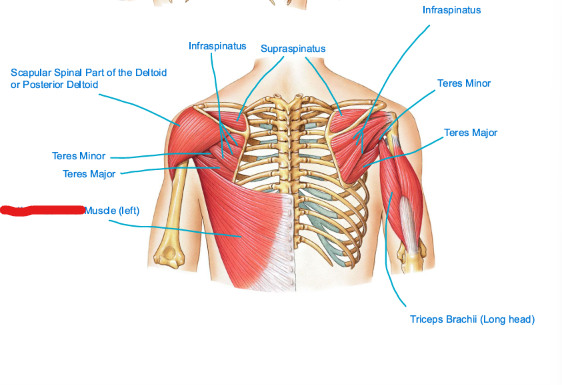
Scapular Spinal Part of the Deltoid or Posterior Deltoid
A rounded, triangular muscle located on the outer aspect of the shoulder. It is primarily responsible for shoulder abduction, flexion, and extension. This muscle is part of the shoulder joint (glenohumeral). Locate what’s in red!
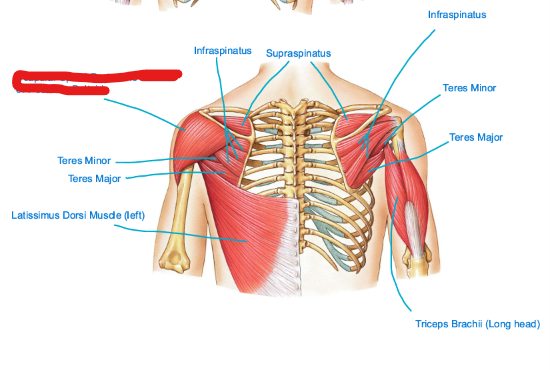
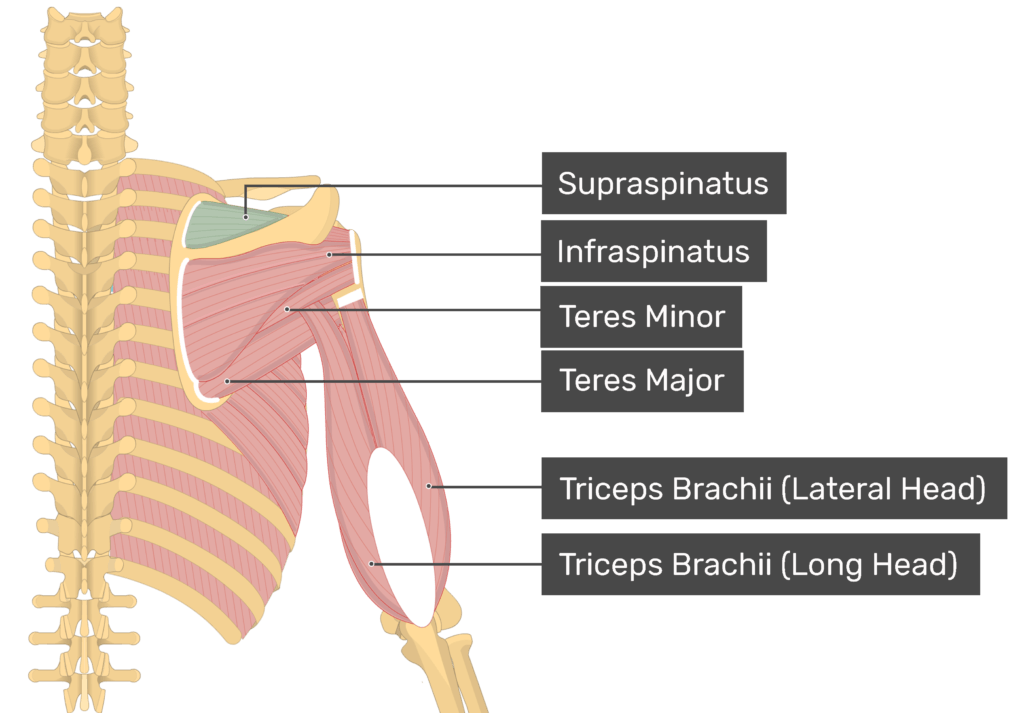
Supraspinatus
A small muscle located above the spine of the scapula, it is responsible for shoulder abduction and stabilization of the humeral head within the glenoid cavity. This muscle is part of the shoulder joint (glenohumeral). Locate what’s in red!
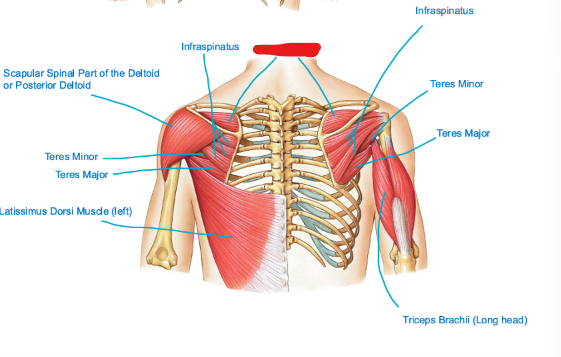
Infraspinatus
A rotator cuff muscle located below the spine of the scapula, it plays a crucial role in shoulder external rotation and stabilization of the humeral head within the glenoid cavity. This muscle is part of the shoulder joint (glenohumeral). Locate what’s in red!

Teres minor
A small rotator cuff muscle located just below the infraspinatus, it assists in shoulder external rotation and stabilization of the humeral head within the glenoid cavity. This muscle is part of the shoulder joint (glenohumeral). Locate what’s in red!

Subscapularis
A large rotator cuff muscle located on the anterior surface of the scapula, it is primarily responsible for shoulder internal rotation and stabilization of the humeral head within the glenoid cavity. This muscle is part of the shoulder joint (glenohumeral). Locate what’s in red!
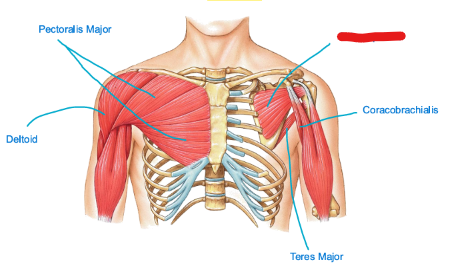
Teres major
A muscle located below the teres minor, it aids in shoulder adduction, extension, and internal rotation. This muscle is involved in the shoulder joint (glenohumeral). Locate what’s in red!

Coracobrachialis
A muscle located in the upper arm, the coracobrachialis assists in shoulder flexion and adduction. It plays a role in stabilizing the shoulder joint (glenohumeral). Locate what’s in red!

Triceps brachii (long head)
A muscle located on the back of the upper arm, the triceps brachii (long head) is responsible for elbow extension and also assists in shoulder extension and adduction. It is part of the shoulder joint (glenohumeral). Locate what’s in red!

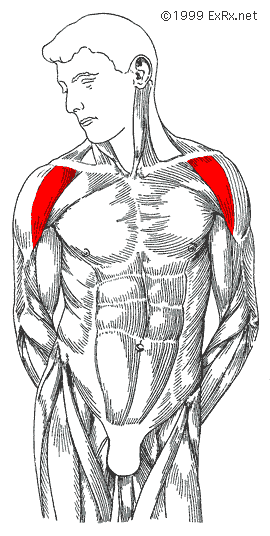
Deltoid
A large, triangular muscle covering the shoulder, the deltoid is responsible for shoulder abduction, flexion, and extension. It is a key muscle in the shoulder joint (glenohumeral). Locate what’s in red!

Teres Major
A muscle located below the teres minor, it aids in shoulder adduction, extension, and internal rotation. This muscle is involved in the shoulder joint (glenohumeral). Locate what’s in red!
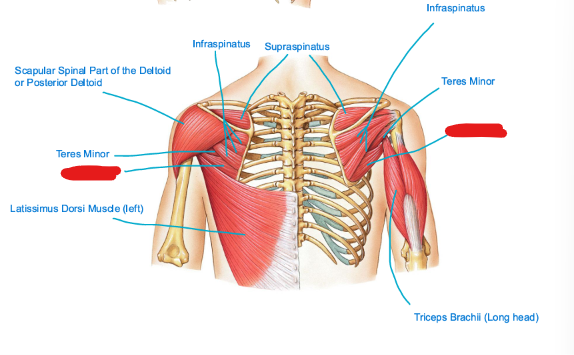
Elevate, retract, and depress the scapula; elevates clavicle
The trapezius does… (action)

Protraction
The Serratus Anterior does…(action)

protraction; depression
The Pectoralis Minor does…(action)

Elevation; retraction
The Rhomboideus Major and Minor does…(action)

Elevation; Cervical lateral flexion - same
The Levator Scapulae does…(action)

Depression; Protraction
The subclavius does…(action)

Flexion; horizontal/vertical adduction; medial rotation
The Pectoralis Major does…(action)
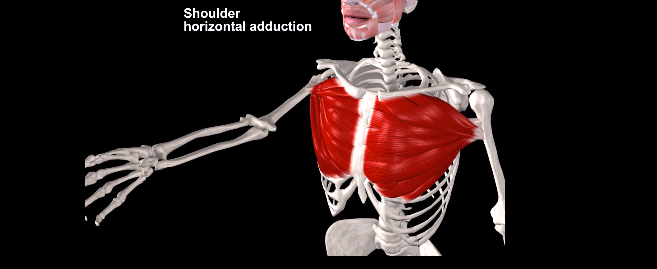
Extension; adduction; medial rotation
The Latissimus Dorsi does…(action)
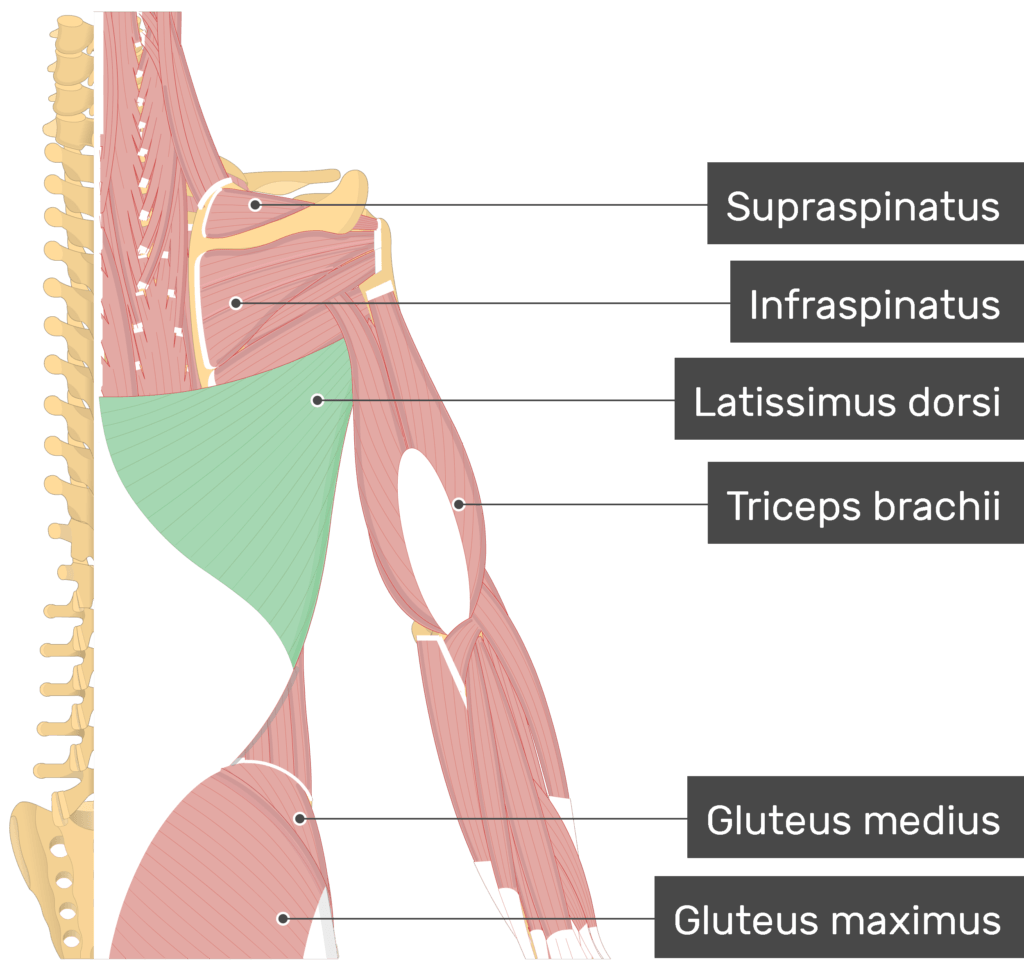
Abduction
The entire deltoid does…(action)

Abduction
The supraspinatus does…(action)
Flexion; medial rotation
The deltoid on the anterior side does…(action)
Extension; lateral rotation
The deltoid on the posterior side does…(action)

Lateral rotation
The Infraspinatus does…(action)

Lateral rotation
The teres minor does…(action)

medial rotation
The subscapularis does…(action)

Extension; adduction; medial rotation
The teres major does…(action)

Flexion; adduction
The coracobrachialis does…(action)

Extension
The triceps brachii (long head) does…

Potential hydrogen or power hydrogen
pH =
pH scale
Measures the strength of an acid or base by quantifying the concentration of hydrogen ions in a solution, ranging from 0 to 14.
7
A solution is neutral if its pH is…?
0 to 14
The pH scale ranges from what to the acidic end to what on the basic end?
ten-fold
The difference between a pH of 1 and 2 is actually…?
100-fold
The difference between a pH of 1 and 3 is…?
diseases
Our bodies cannot fight what off if our body pH is not properly balanced.
Acidosis
a condition where the body fluids contain excess acid, leading to a lower pH level. It can impair bodily functions and lead to serious health issues.
Salivary pH
….is the acidity level of saliva, typically ranging from 6.2 to 7.6, which is essential for proper digestion and oral health. It tells us what the body retains and is a fair indicator of the extracellular fluids and their alkaline mineral reserves.
Urinary pH
….is the acidity level of urine, typically ranging from 4.5 to 8.0, which reflects the body's metabolic state and helps regulate acid-base balance. Indicates how the body is working to maintain the proper pH of the blood.
Eat raw fruits and veggies in the most alkaline range
How can you balance your pH with food?
string acidifiers from the diet (sodas, caffeine, alcohol, red meat)
You can you balance your pH by removing…?
Drink ionized or mineral water
How can you balance your pH with drinking water?
Buffer
A solution that minimizes changes in pH upon the addition of small amounts of acids or bases. Buffers are crucial in maintaining the pH balance in biological systems.
to maintain stable pH levels in biological systems, allowing enzymes and other biochemical processes to function optimally
Why do we need a buffer?
acidic
Diseases are promoted if you’re more…?
Supraspinatus, Infraspinatus, Teres minor, Subscapularis
List 4 rotator cuff muscles (SITS)
Deltoid muscles and supraspinatus
List 2 muscles that do abduction
Teres major, Subscapularis, Latissimus dorsi, Deltoid (anterior), and Pectoralis major
List 5 muscles that do medial rotation
Pectoralis Major, Anterior deltoid, Coracobrachialis
Which 3 muscles do shoulder flexion?
Trapezius, Rhomboideus major and minor
Which 3 muscles in the shoulder girdle retract?
Serratus anterior, Pectoralis minor, Subclavius
Which 3 muscles do protraction?
Teres major, Triceps brachii, Latissimus dorsi, Deltoid (posterior)
Which 4 muscles do extension on the shoulder joint?
Clavicle and scapula
What is the shoulder girdle made up?

Humerus and scapula
What is the shoulder joint made up of?
Acids
…dissociate when they are dissolved in water to produce hydrogen ions and a negative ion (anion). It then increases the concentration of hydrogen ions (H+). EX: HCl will dissolve into H+ +CL-
base/alkaline
blank/blank substances that dissociate in water to produce hydroxide ions (OH-) and increase the concentration of OH- in solutions. EX: NaOH will dissolve into Na+ + OH-.
base
Opposite of an acid. A substance that generates hydroxide ions (OH-) in solution and can neutralize acids, effectively lowering hydrogen ion concentration.
alkaline
A term often used interchangeably with base, referring to substances that increase the concentration of hydroxide ions (OH-) in aqueous solutions and can neutralize acids. All of these types of solutions are basic, yet not all bases are blank.
water
Alkaline bases are bases that dissolve in and react vigorously with…
neutral
Water is neutral, acidic, or basic when it ionizes because the number of H+ equals the number of OH-. H2O dissociates into OH- + H+
Buffer
A solution that prevents the pH of a solution from changing upon the addition of acidic or basic components. It is able to neutralize small amounts of added acid or base, thus maintaining the pH of the solution relatively stable. They do this by either accepting hydrogen ions if the solution becomes acidic or by releasing hydrogen ions if the solution becomes basic.
Buffer
The blank is important for processes and/or reactions which require specific and stable pH ranges. These solutions have a working pH range and capacity which dictate how much acid/base can be neutralized before pH changes, and the amount by which it will change.
Slight
Even a what change in your pH value can have a great impact on your internal environment and, ultimately, your health.