Bio unit 2 flashcards
 Call Kai
 Learn
Learn Practice Test
 Spaced Repetition
 Match
Match Flashcards
 Knowt Play
1/39

There's no tags or description
Looks like no tags are added yet.
Name | Mastery | Learn | Test | Matching | Spaced | Call with Kai | Chat |
|---|
No analytics yet
Send a link to your students to track their progress
40 Terms
Antagonistic interactions
interactions in which one individual or species benefits, while the other individual or species is harmed.
Competition
Competition is an interaction between organisms or species in which both require one or more resources that are in limited supply (such as food, water, or territory).
Intraspecific Competition
An ecological interaction where members of the same species compete for limited resources like food, water, space, or mates
Interspecific competition
An ecological interaction where individuals of different species compete for the same limited shared resources in an ecosystem
Competitive exclusion
An ecological rule stating that two species with the exact same needs cannot live together in the same place if resources are limited
Resource partitioning
An ecological process where competing species use limiting resources differently to reduce competition and coexist in the same habitat
Predation
a biological interaction where one organism (the predator) kills and consumes another organism (the prey) for energy and survival
Parasites
living organisms that survive on or inside a host organism, getting food at the host's expense and causing harm.
Herbivory
Herbivory is a form of consumption in which an organism principally eats autotrophs [6] such as plants, algae and photosynthesizing bacteria.
Commensal interaction
Commensalism is a biological interaction where one species benefits while the other is completely unaffected—neither helped nor harmed
Parasitic interaction
Parasitism is a biological interaction where one species benefits at the expense of it’s host.
Mutualistic relationship
An ecological interaction between two or more species where every participant benefits
Antagonistic relationship
an interaction between organisms where one organism benefits at the expense of another, like herbivory or predation.
Competitive relationship
A relationship between organisms or species where both require a shared resource that is in limited supply, resulting in a negative impact on the fitness, growth, or survival of at least one participant
Keystone species
An organism that has a massive, crucial impact on its ecosystem relative to its low population or abundance, usually divided into predators, ecosystem engineers, or mutualists.
ecological disturbance
Any relatively discrete event in time and space that disrupts the structure of an ecosystem, community, or population, and changes resource availability or the physical environmen
Hectares
A hectare is a metric unit of land area equal to 10,000 square meters
population density
The number of individuals of a species living per unit of land, usually calculated by total population over total land area.
logistic growth equation
The logistic growth differential equation models population growth that slows down and levels off as it reaches a maximum.

latitudinal diversity gradient
The pattern of having lots of species at the equator with diversity dwindling off towards the poles is known as the Latitudinal Diversity Gradient
First law of thermodynamics
Energy cannot be created or destroyed, only changed from one form to another
Second law of thermodynamics
The entropy (disorder) of an isolated system always increases over time during any spontaneous process
Third law of thermodynamics
The entropy of a system approaches a constant minimum as its temperature approaches absolute zero
Nitrogen cycle

Heterotrophs
A heterotroph is an organism that cannot produce its own food, instead taking nutrition from other sources of organic carbon, mainly matter from other organisms.
Autotrophs
An autotroph is an organism that can convert abiotic sources of energy into stored energy in organic compounds
Early successional species
The first hardy plants and animals that colonize barren or freshly disturbed land, initiating the process of ecological succession.
Late successional species
organisms that dominate an ecosystem during the final, stable stages of ecological succession.
species eveness
The relative abundance and distribution of individuals among the different species.
phosphorous cycle
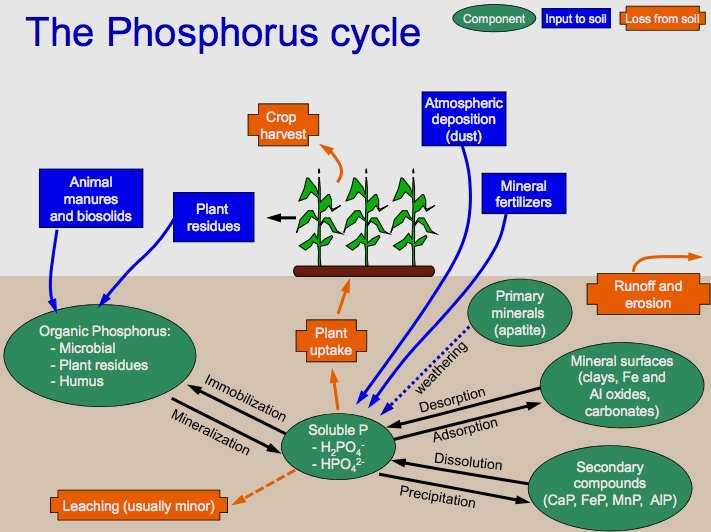
Liebig's law of the minimum
Plant growth and crop yield are dictated by the scarcest limiting resource—such as an essential nutrient or water—rather than by the total amount of available resources
latitudinal diversity gradient
Biodiversity is highest at the equator and lowest at the poles
Fundamental niche
A fundamental niche is the full range of environmental conditions that a viable population of species could occupy and theoretically use
Realized niche
The realized habitat a species or population occupies, always smaller than the fundamental niche due to exterior factors.
aerobic respiration
the process where cells use oxygen to break down glucose and turn it into usable energy
chemical reservoirs
Things like the ocean, the ground, ect that stores chemicals like nitrogen or carbon
Bacteria and archaea
Increase biodiversity, converts biologically unusable Nitrogen to N2, can make up both primary producer and consumer in harsh environments.
commensalism
One species benefits and another is neutral
Continuous Exponential Growth
If no outside force acts upon a population and demands are met, then a population would theoretically increase exponentially