Flashcards Microbial Genetics Chapter 11: DNA Replication, Protein Synthesis & Gene Transfer
 Call Kai
 Learn
 Practice Test
 Spaced Repetition
 Match
 Flashcards
 Knowt Play
1/25

There's no tags or description
Looks like no tags are added yet.
26 Terms
What is the importance of understanding microbial genetics?
It helps track and predict outbreaks, understand host-pathogen relationships, improve diagnosis, and develop new antimicrobial treatments.
What is the structure of DNA?
DNA is a double-stranded helix that serves as the blueprint of the cell and encodes for proteins.
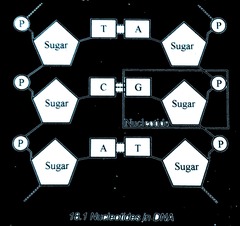
What are the components of a nucleotide?
A nucleotide consists of a phosphate group, a sugar (deoxyribose in DNA), and a nitrogenous base.
What are the two types of nitrogenous bases in DNA?
Purines (adenine and guanine) and pyrimidines (cytosine and thymine).
What is complementary base pairing?
It refers to the specific pairing of nitrogenous bases: adenine with thymine and guanine with cytosine.

What is the directionality of DNA strands?
DNA strands are oriented in opposite directions, with one end being 5' and the other 3'.
What is the difference between DNA and RNA?
DNA is double-stranded and serves as the genetic blueprint, while RNA is single-stranded and acts as an intermediary in protein synthesis.

What is the role of mRNA in protein synthesis?
mRNA carries the genetic information from DNA to the ribosome for protein synthesis.
What are the steps of DNA replication?
Initiation, elongation, and termination.
What enzymes are involved in DNA replication initiation?
Topoisomerase and helicase.

What is the function of DNA polymerase?
DNA polymerase synthesizes new DNA strands by adding nucleotides complementary to the template strand.

What are Okazaki fragments?
Short segments of DNA synthesized on the lagging strand during DNA replication.

What is transcription?
The process of synthesizing mRNA from a DNA template.

What are the steps of transcription?
Initiation, elongation, and termination.
What is a codon?
A codon is a three-nucleotide sequence on mRNA that encodes for an amino acid or signals the start/stop of translation.
What is the role of tRNA in translation?
tRNA carries amino acids to the ribosome and matches them to the mRNA codons.
What are the three sites in a ribosome during translation?
A Site (aminoacyl), P Site (peptidyl), and E Site (exit).
What is a mutation?
A change in the nucleotide base sequence of DNA.

What are the types of mutations?
Point mutations, frameshift mutations (deletion and insertion).
What is vertical gene transfer?
The transfer of genes from parents to offspring during reproduction.
What is horizontal gene transfer?
The transfer of genetic material between bacteria of the same generation.
What is transformation in bacteria?
The uptake of naked DNA from the environment and incorporation into a microbe's genome.
What is transduction?
The transfer of DNA from one bacterium to another via a bacteriophage.
What is conjugation in bacteria?
The direct exchange of DNA between bacteria through a sex pilus.
What are bacteriocins?
Toxins produced by bacteria that harm other bacteria, often encoded by plasmids.
What is the significance of superbugs?
Superbugs are bacteria that have developed resistance to multiple antibiotics, posing a significant public health threat.