W6 Infection Control
 Call Kai
 Learn
 Practice Test
 Spaced Repetition
 Match
 Flashcards
 Knowt Play
1/20

There's no tags or description
Looks like no tags are added yet.
21 Terms
Why is infection control important?
Requirement of GOS contract
Prevents px from unnecessary infections
Prevents practitioner from unnecessary infections
What are some examples of Law and Infection control?
Abiding to GOS contract in England- appropriate arrangements for infection control and decontamination
Management of HSE at work regulations (1999)- practice owner has the responsibility to ensure working environment is safe
Opticians Act- duty of care towards patients
What is involved in a risk assessment?
Identify hazards to the patient/practioner
Degree of risk of each activity and action plan to minimise risk
Staff training
What are the main types of microbes?
Bacteria
Fungi
Protozoa
Viruses
What is the chain of infection in order?
Infectious agent
Reservoir (on equipment)
Portal of exit (reusable equipment)
Mode of transmission (direct/indrect, hands)
Portal of entry (broken skin)
Susceptible host
ARP TES

What are examples of routes of transmission?
Airborne
Sneezing
Dust
Contact
Hands and equipment (indirect)
Approx how many particles are in a cough?
100,000- with a sneeze having 20 times more
What is the NICE recommendation for hand washing?
…

What are hand hygiene requirements according to NICE 2003?
…

When do we use hand washing agents such as soap?
Before and after direct contact w px in clinical settings where there’s an outbreak of anti microbial resistant micro-organisms
When there’s heavy microbial contamination or before invasive procedures/minor operations
When do you use an alcohol based antibacterial hand rub?
When handwashing and drying facilities are inadequate
Cannot be used if hands are visibly dirty or contaminated
When must gloves be worn?
Invasive procedures (not including CL fitting)
Practioner has cracked hands
Px has infective condition
What are examples of hand contact points?
Amsler grids
Reading charts
Spouse button
What are examples of direct contact points?
CL
Reusable tonometer prisms
Chin/forehead rests
Examination chairs
How do you decontaminate equipment?
Cleaning- detergent removes visible contamination
Disinfection- requires heat/chemicals, reduces micro-organisms
Sterilisation- removal/destruction of all micro-organisms
Which chemicals may damage gonio lenses?
Acetone, alcohol and hydrogen peroxide
What do we not use to clean volk lenses?
Alcohol- dissolves cement holding lens in place
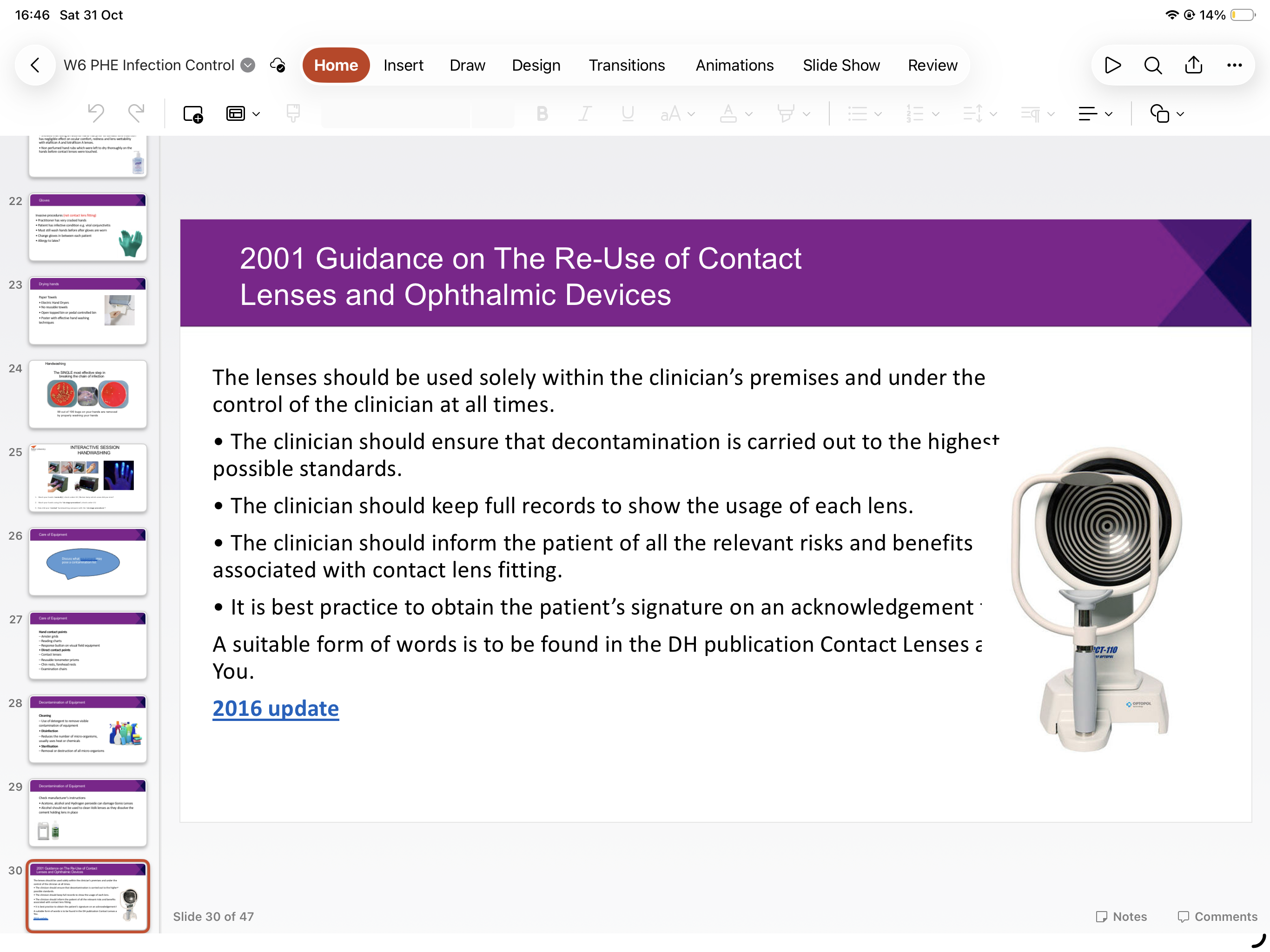
What’s the guidance on the reuse of contact lenses?
…
What is the process of decontaminating contact lenses?
Soaked in sodium hypochlorite solution for 1 hour
Remove from solution and shake residual solution off
Rinsed from normal sterile saline solution or freshly boiled water at room temperature
Disinfect the normal way
Where should drugs be stored?
In a fridge with no food or drink
2-8 degrees optimal
Lockable door
Records of temperature and medicine should be available for audit
What are examples of clinical waste?
Human/animal tissue
Bodily fluids
Drugs
Swabs
Syringes
Excretion