nontrad Machining & Thermal Cutting Processes
 Call Kai
 Learn
 Practice Test
 Spaced Repetition
 Match
 Flashcards
 Knowt Play
1/30

There's no tags or description
Looks like no tags are added yet.
Name | Mastery | Learn | Test | Matching | Spaced | Call with Kai | Chat |
|---|
No analytics yet
Send a link to your students to track their progress
31 Terms
nontrad machining
processes that remove excess material by techniques involving mechanical, thermal, elec., or chem energy (or combinations of these energies). Do not use a sharp cutting tool in the conventional sense
Importance of Nontrad. Process
Need to machine hard and non-metals with special properties that make them difficult or impossible to machine by conventional methods
Mechanical nontrad. process
mech. erosion of work material by a high velocity stream of abrasives/fluid (or both)
Electrochemical nontrad process
electrochem energy to remove material (reverse of electroplating)
thermal nontrad. process
thermal energy applied to small portion of work surface causing that portion to be fuse and/or vaporized
Ultrasonic Machining (USM)
abrasive particles contained in a slurry are driven at high velocity against work by a tool vibrating at low amplitude and high frequency (20kHz). Tool oscillation is perpendicular to work surface
USM Applications
- Hard, brittle work materials such as ceramics, glass, and carbides
- Also successful on certain metals, such as stainless steel and titanium
- Shapes include non-round holes, holes along a curved axis
- "Coining operations" - pattern on tool is imparted to a flat work surface
Would USM be effective for ductile materials?
Bad, it is intended to microchip small particles, using micro-cracks to remove ductile material tends to deform rather than break.
Does material have to be electrically conductive for USM appl.?
No
Benefits of USM?
a. capable of machining hard / non-conductive materials
Downsides of USM?
Low material removal rate, and tool wear
Water Jet Cutting (WJC) Process
uses high pressure, high velocity stream of water directed at work surface for cutting.
Usually automated by CNC (comp numerical control) / indust. robots to manipulate nozzle along desired trajectory
Water Jet Cutting Use
Used to cut narrow slits in flat stock such as plastic, composites, floor tile, carpet leather and cardboard. (not suitable for brittle material (glass)
water jet cutting (WJC) advantages
no crushing or thermal damage of work surface, min material loss, no environmental pollution, ease of automation
Abrasive Water Jet Cutting (AJWJC)
When WJC is used on metals/hard materials abrasive particles usually are added to jet stream. Such as aluminum oxide, silicon dioxide, and garnet (silcate mineral).
Abrasive Jet Machining (AJM)
high velocity gas stream containing small abrasive particles
abrasive jet machining notes
normally used as a finishing / deburring process rather than cutting process
Abrasive Flow Machining notes
Abrasive particle mixed in viscous polymer/medium are forced to flow through and around part surfaces and edges
what must work material be for electrochemical machining processes?
must be a conductor
Electrochemical machining (ECM)
Material removal by anodic dissolution, using electrode (the tool) in close proximity to work but separated by a rapidly flowing electrolyte
ECM Operation
material is depleted from anode workpiece (positive pole) and transported to cathode tool (negative pole) in an electrolyte bath
what shape does the tool have for ECM ?
tool has complementary / negative shape, and must allow for the work gap
Electrolyte in ECM:
flows rapidly between two poles to carry off depleted material so it does not plate onto cathode
ECM Applications
die sinking
multiple hole drilling
holes that are not round
deburring
Advantages of ECM
little or no tool wear in ECM
surface finishes achieved by ECM are very good
no residual stresses or thermal damage remain on the part surface
Disadvantages of ECM
high specific energy consumption is required for the process
high capital investment is required for the equipment
How can we remove burr inside many holes?
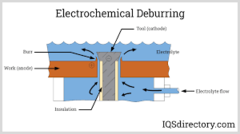
Electrochemical Deburring ECD
Electrochemical Deburring
Adaptation of ECM to remove burrs or sharp corners or on holes in metal parts produced by conventional through-hole drilling
Electrochemical Grinding (ECG)
form of ECM in which grinding wheel with conductive bond material augments anodic dissolution of metal part surface
Applications of Electrochemical Grinding (ECG)
sharpening of carbide tools
grinding of surgical needles and other thin-wall tubes and fragile parts
Advantages of Electrochemical Grinding
Deplating responsible for 95% of metal removal
Because machining is mostly by electrochem. action, grinding wheel wear is extremely low