Scapula, Clavicle, & Bony Thorax Anatomy & Bone Structure w/ Matching & Labelling (RAD 1101)
 Call Kai
 Learn
Learn Practice Test
 Spaced Repetition
 Match
Match Flashcards
 Knowt Play
1/166

There's no tags or description
Looks like no tags are added yet.
Name | Mastery | Learn | Test | Matching | Spaced | Call with Kai | Chat |
|---|
No analytics yet
Send a link to your students to track their progress
167 Terms
Scapula
posterior to the bony thorax (triangular shaped)
The scapula is composed of 3 angles:
- inferior
- medial (superior)
- lateral
inferior angle of the scapula
point at which the medial and lateral borders meet
medial (superior) angle of scapula
point at which superior and medial borders meet
lateral angle of scapula
located at the junction of the superior and lateral borders of the scapula
The scapula is composed of 3 borders:
- vertebral (medial)
- axial (lateral)
- superior
vertebral (medial) border of scapula
on the side closest to the vertebrae (medial edge of the scapula)
axial (lateral) border of scapula
lateral edge of the scapula
superior border of scapula
upper most border on the upper edge of the scapula
The scapula is composed of 3 processes:
- glenoid
- coracoid
- acromion
(NOTE: all better seen in the lateral view)
The processes of the scapula are all better seen in the _________ view
lateral
glenoid process of scapula
head of the process and helps to form the shoulder joint (of the scapula on the lateral anterior process)
coracoid process of scapula
beak-like anterior process and serves as the attachment for ligaments and tendons
acromion process of scapula
blunt-rounded posterior lateral process that is an extension of the scapular spine and is the highest and most posterior point of the shoulder and connects to the clavicle
scapular notch of scapula
depression at the base of the coracoid process
glenoid fossa (cavity) of scapula
depression on the glenoid process and is the articulation with the head of the humerus
neck of scapula
constriction below the glenoid process
scapular spine of scapula
ridge of bone on the posterior aspect that ends at the acromion
body of scapula
main portion (surface) of the scapula
supraspinous fossa of scapula
depression above the scapular spine on the posterior aspect
infraspinous fossa of scapula
depression below the scapular spine
subscapularis fossa of scapula
depression (dip) on the anterior aspect (above the body of the scapula)
Clavicle
part of the appendicular skeletal system
The clavicle is _____ shaped
S-shaped
The clavicle has 2 curves
- anterolateral
- anteromedial
anterolateral curve of clavicle
concave curve
anteromedial curve of clavicle
convex curve
The clavicle articulates with the __________ and ___________
acromion and manubrium
The clavicle articulates with the acromion at the _________ joint
acromioclavicular
acromioclavicular joint
holds the upper extremity to the rest of the body and forms the shoulder girdle
The clavicle articulates with the manubrium at the _________ joint
sternoclavicular
sternoclavicular joint
medial end of clavicle that connects to the sternum
Shoulder Girdle
formed by the clavicle and scapula
The shoulder girdle is _________
weight bearing
Shoulder Joint
formed by the scapula and humerus
What forms the glenoid fossa?
head of the humerus and the shoulder joint
Bony Thorax
The bony thorax is composed of the:
- sternum
- 12 thoracic vertebrae
- 12 pairs of ribs (24 ribs)
- 12 pairs of costal cartilage (sits right at front)
Sternum
breastbone located in the center of the chest
The sternum is composed of the:
- manubrium (suprasternal notch, articulations)
- sternal angle
- gladiolus (body) (articulations)
- xiphoid (ensiform)
- costal notches
manubrium
proximal or superior end portion of the sternum
suprasternal notch of manubrium
aka jugular notch or manubrial depression at the superior end of the sternum at the level of T-2 or T-3
The manubrium articulates with...
clavicles and first two pairs of ribs
sternal angle
aka "angle of lewis" which is the junction of the manubrium and the body at the level of T-4 or T-5
gladiolus (body)
center part of the bone and is the largest
The gladiolus (body) articulates with...
2nd-7th pairs of ribs which this occurs at the costal notches
xiphoid (ensiform)
pointed, distal or inferior end at the level of T-9 or T-10
costal notches
depressions that articulate with the costal cartilage of the ribs
Ribs
The ribs are composed of the:
- vertebral end (head, neck, tubercle)
- body
- sternal end
vertebral end
posterior portion
head of the vertebral end of the ribs
rounded, posterior end that articulates with the body of the vertebrae
neck of the vertebral end of the ribs
constriction below the head
tubercle of the vertebral end of the ribs
prominence that articulates with the transverse processes of the vertebrae
body of the rib
main portion
sternal end
anterior and articulates with the costal cartilage
Ribs extend downward to midaxillary line then obliquely and anteriorly
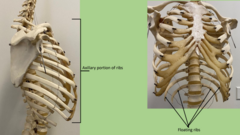
Ribs are divided into 2 groups:
- true ribs
- false ribs (floating ribs)
true ribs
first 7 pairs of ribs (1st-7th); direct costal cartilage with the sternum
false ribs
8th-12th pairs; costal cartilage fuses with the 7th rib
floating ribs
11th & 12th
costal cartilage of ribs
12 pairs
All ribs have costal cartilage on the _________ end which most attach to the sternum
anterior
Thoracic Articulations
- costalvertebral
- costotransverse
- sternocostal
- sternoclavicular
- costochondral
costalvertebral
between the head of the ribs and body of the vertebrae
costotransverse
between tubercle of the rib and transverse process of the vertebrae
sternocostal
between sternum and costal cartilage
sternoclavicular
between the sternum and clavicle
costochondral
between true ribs and costal cartilage
Surface Markings for Vertebrae
- Inferior angle of scapula - arms up - ____
arms down ____
- Suprasternal notch - _______
- Sternal angle - _________
- Xiphisternal junction -__________
inferior angle of scapula - arms up - ____
T-6
inferior angle of scapula - arms down - ____
T-8
suprasternal notch - _______
T2-T3
sternal angle - _________
T4-T5
xiphisternal junction -__________
T9-T10
Clavicle Diagram

Anterior Scapula Diagram
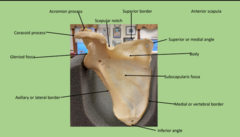
Posterior and Lateral Scapula Diagram

Ribs Diagram

Floating Ribs

In this AP sternum, what structure is at 1?
suprasternal or manubrial or jugular notch

In this AP sternum, what structure is at 2?
manubrium

In this AP sternum, what structure is at 3?
sternal angle

In this AP sternum, what structure is at 4?
body/gladiolus

In this AP sternum, what structure is at 5?
xiphoid
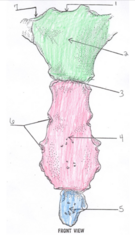
In this AP sternum, what structure is at 6?
costal notches
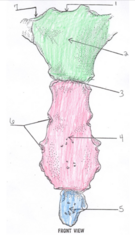
In this AP sternum, what structure is at 7?
space for clavicle

In this lateral sternum, what structure is at 8?
space for clavicle

In this lateral sternum, what structure is at 9?
manubrium

In this lateral sternum, what structure is at 10?
body or gladiolus
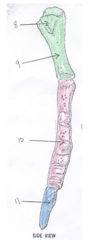
In this lateral sternum, what structure is at 11?
xiphoid

In this posterior scapula, what structure is at 1?
coracoid process

In this posterior scapula, what structure is at 2?
acromion process

In this posterior scapula, what structure is at 3?
glenoid fossa
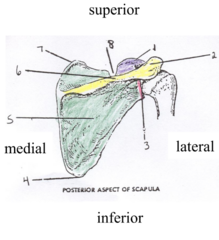
In this posterior scapula, what structure is at 4?
inferior angle

In this posterior scapula, what structure is at 5?
body

In this posterior scapula, what structure is at 6?
scapular spine
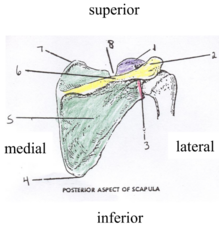
In this posterior scapula, what structure is at 7?
superior or medial angle
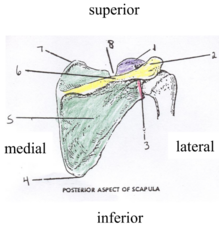
In this posterior scapula, what structure is at 8?
scapular notch

In this lateral scapula, what structure is at 1?
superior or medial angle