Evolutionary process
 Call Kai
 Learn
Learn Practice Test
 Spaced Repetition
 Match
Match Flashcards
 Knowt Play
1/33

There's no tags or description
Looks like no tags are added yet.
Name | Mastery | Learn | Test | Matching | Spaced | Call with Kai | Chat |
|---|
No analytics yet
Send a link to your students to track their progress
34 Terms
How are parents needed for a gene pool
contribute to a pool of gametes.
How are gametes needed for a gene pool?
fertilise one another.
How are zygotes needed in a gene pool?
become parents of the next generation.
Define haploid
Haploid cells contain only a single, unpaired set of chromosomes
Define diploid
cells contain two complete sets of chromosomes
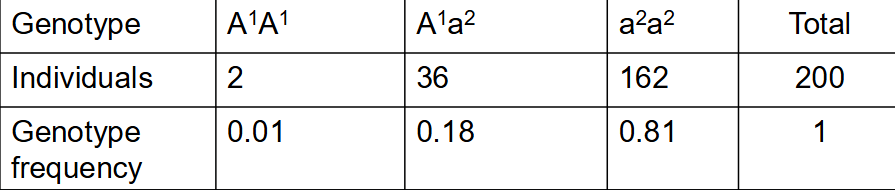
How to calculate allele frequencies from genotype frequencies
Take the frequency of homozygotes and half the frequency of heterozygotes
Add the frequency of homozygote plus frequency of heterozygote/2
A=A1A1+A1a2/2 a=a2a2+A1a2/2
=0.81+0.18/2 =0.01+0.18/2
=0.01+0.09 =0.81+0.09
=0.9 =0.1
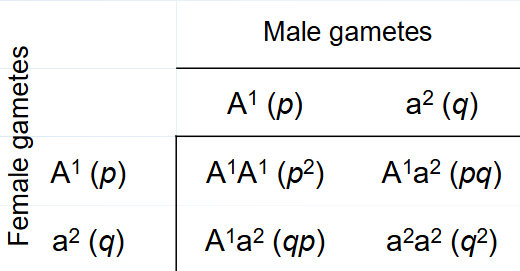
How to predict genotype frequencies from allele frequencies?
0.1 X 0.1 = 0.01
0.1 X 0.9 = 0.09 0.09X2 = 0.18
0.9 X 0.9 = 0.81

What is the Hardy Weinberg formula?
(p+q)(p+q)=p2+2pq+q2
Where p=frequency of A1, q=frequency of a2 and p+q=1
Describe how you could test for genetic equilibrium
1) Calculate allele frequencies in parents
• From parental genotypes
2) Calculate allele frequencies in offspring
• From offspring genotypes
3) Calculate expected offspring allele frequencies from Hardy- Weinberg equation
• Expected offspring allele frequencies=parental allele frequencies
4) Test for significant difference between observed and expected offspring allele frequencies
• Use χ2 test or another appropriate statistical test depending on data
5) If there is no significant difference then population may be at genetic equilibrium
What are the hardy Weinberg assumptions?
No net migration
Population is large
Random mating
No natural selection
No net mutations
If there is net migration what happens
an allele decrease or increase in a population
Describe what might happen if the population is too small?
A person will make up a large portion of the population and may have a rare gene, when this population grows the gene will soon be extremely common. An example of this happening is Pingalap Atoll
• Small, low-lying pacific island
• Bottleneck - Typhoon in 1780’s killed all but 30 people
• Sampling error - One of the survivors carried a rare allele for achromatopsia (extreme colour blindness)
• Genetic drift - 10% of the population is now colourblind (homozygous for achromatopsia allele). - Allele frequency of approximately 0.32
Describe what might happen if there is non-random mating
Pigeons have assortative mating when it comes to size, but dissociative mating with regard to colour meaning in size they are more likely to produce homozygous offspring but colour will have heterozygous offspring
Describe what might happen if there is natural selection?
A certain phenotype may be selected against in nature, meaning this genotype may be erased from the gene pool. E.g mice with pale coats will not camouflage as well as mice with brown coats, meaning they are more likely to be hunted and unable to produce offspring meaning they will not have a large enough portion of the population
What might happen if there are net mutation
There will be a random change in the gene meaning a random change in the protein. This means the organism is less likely to survive to reproduce, or rarely increase their ability to survive and reproduce. Either way this will change the portion of the population that organisms will usually have.
Is natural selection the only way evolution can occur?
No. Natural selection is the only adaptive way evolution can occur. Genetic drift is another example of how evolution occurs without the presence of natural selection.
Are allele frequencies always the same as the population?
No, allele frequencies are likely to vary from the population itself
How does the size of the population affect allele frequency during genetic drift?
The smaller the sample the greater the variation so it is more likely to vary further from the
allele frequency.
Direction of change Cannot be predicted
Over time Alleles go extinct and Genetic diversity declines
Occurs more quickly in smaller populations which Reduces ability to evolve
Populations diverge genetically

What are the two extreme cases of genetic drift caused by a small population?
Founder effect
Bottleneck
Describe the founder effect
Small group of individuals leaves original population to found new one
Describe bottleneck
Random event Wipes out most of the population leaving only a small group
Why is genetic diversity important?
Because if a selection pressure occurs that one gene is susceptible to only a small portion of the population will be wiped out making it unlikely for the population to go extinct.
What is heterozygosity?
What is the difference between the observed and expected heterozygosity suggest?
Non-random mating
How do you calculate the number of alleles averaged across loci (Across a gene)
Total number of alleles over all genes / number of genes

What are the two forms of local adaptations
Mutation and local environment
Describe mutation
Random process that generates genetic diversity within populations
Describe local environment
Selects phenotypes that are best adapted
• Causes local changes in allele frequencies
• Results in genetic differences between populations
What are the two types of speciation?
Genetic drift/ local adaptation
Cessation of flow of genes
Describe Genetic drift/ local adaptatio
Produces reproductive isolation between populations
• May be caused by a genetic trait: Polyploidy, inversions, other genetic incompatibilities
• May be caused by a phenotypic trait: Mate choice criterion, Chemical, visual, acoustic, gonad/flower morphology, etc. , Time or place of reproduction, Host plant or animal, Flowering time, mating season
Describe cessation of flow of genes
Cessation of gene flow
• Allows species to evolve independently
• Accumulate different adaptations