ASTRO 2110 - Exam Two
 Call Kai
 Learn
 Practice Test
 Spaced Repetition
 Match
 Flashcards
 Knowt Play
1/38

Earn XP
Description and Tags
Covers Lectures 10-9; Chapters 1, 2, 3 and 5.1-5.4 of the textbook (Ryden & Peterson)
39 Terms
One Angstrom
= 10^-10 m
Tilt of the Earth
23.5*
frequency (nu) is equal to what?
Speed of ligiht (3.00×10cm/s) (C) divided by wavelength (lambda)
Energy (E) (ergs, eV, joules) is equal to what?
Frequency (nu, Hz, GHz, s^-1) times planck’s constant (h)
Describe the Electromagnetic Spectrum (order of waves, wavelengths for visible light, and how energy, frequency, and wavelength change throughout the spectrum)
Order (highest frequency to lowest, highest energy to lowest, lowest wavelength to highest): Gamma, X-ray, Ultra-Violet, Visible (400-700nm), Infrared, Microwave, Radio)
What are the different wavelengths associated with each part of the electromagnetic spectrum?
<10 pm = Gamma
10 nm - 10 pm = X-ray
10 nm to 400 nm = UV
380-700 nm = Visible
800 nm = Near Infrared
750 - 1mm = Infrared
1mm - 10 cm = Micro
10 cm - 100000 KM = Radio
What are the two mechanisms for which photons are emitted?
Acceleration of charged particles (such as protons, ions, and electrons).
Atoms radiating photons when electrons drop from a higher energy level to a lower energy level.
What is perihelion? Aphelion? Kepler’s 2nd law?
Perihelion is when a planet’s orbit is closest to the Sun, and Aphelion is when a planet is furthest from the Sun along its orbit. Kepler’s 2nd law states that planets move faster closer to the star they are orbiting (planets move faster at Perihelion).
In Kepler’s 3rd law, what are the units for each component? What does each variable represent? How would you solve for the semi-major axis of an orbit?
P²=a³; where P is in years, and a is the semi-major axis in AU. ALSO: to get the semi-major axis, solve for major axis, and then remember that half of major is the semi-major axis. semi-major axis = (r_p + r_a)/2
Defintion of parsecs in terms of parallax angle
The distance at which a star has a parallax angle of 1 arcsecond
What is Newton’s version of Kepler’s 3rd law? What does it account for? (given on formula sheet)
P²=4pi²a³/G(M+m), accounting for the total mass of a two-body system
What is the formula for the mean energy per particle and is it dependent on mass?
3/2kT - mean energy per particle; is not dependent on mass
True or False, and why?: In thermal equilibrium, more massive particles move more slowly.
True. Since the kinetic energy (1/2mv^2) is the same for all particles at a given temperature, particles with a larger mass (m) must have a lower velocity (v) to maintain that same average energy compared to lighter particles.
What is doppler shift? How does it relate to lign of sight velocity?
Light moving towards you has a higher frequence (blueshifted)
Light moving away from you has a lower frequency (reshift)
(Blue to You)

What is optical depth?
Optical depth is how opaque a medium is, and we typically see down to τ ∼ 1, which is the photosphere.
How does optical depth produce absorption lines when temperature decreases outward and emission lines when it increases outward.
If a cooler outer layer absorbs light from a hotter inner layer, we see absorption lines. If the outer layer is hotter than the background, it emits more than it absorbs, creating emission lines.
radiative transfer equation
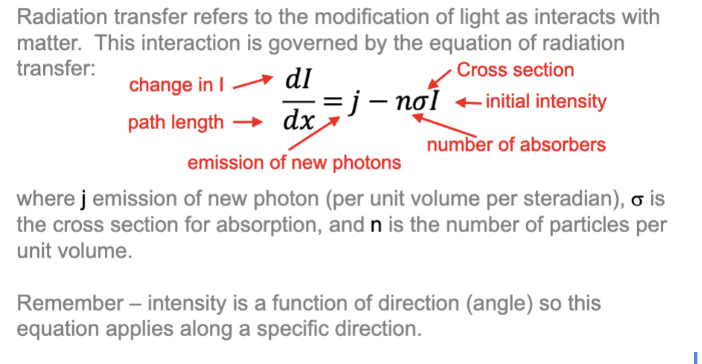
What is local thermodynamic equilibrium (LTE)?
Temperature is proportional to energy per particle in a gas. When different species of gas particles have the same kinetic energy per particle (same T), they are in local thermodynamic equilibrium. Local simply means that temperature can vary with location and time.
When collisions are frequent, gases of different species usually reach equilibrium quickly. However, LTE only occurs when both the particles and radiation share a common temperature – this does not always happen when photons interact weakly with matter.
Boltzmann excitation ratio
tells you the ratio of atoms in different excitation states (energy levels)

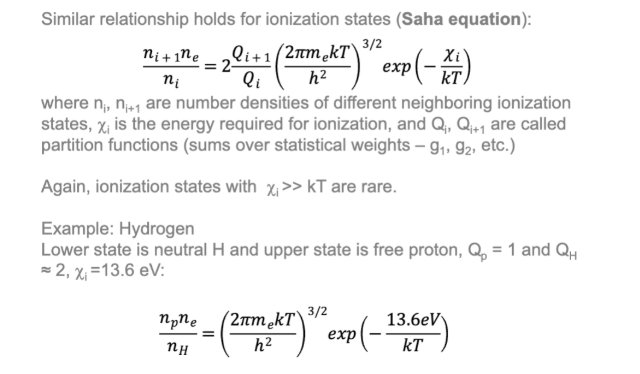
Saha ionization equation
tells you the ratio of atoms in different ionization states (how many electrons are stripped off) based on temperature and density
What is the Planck function?
The Planck function describes the exact distribution of light and energy emitted by a black body across different wavelengths at a given temperature.
What is a blackbody?
A blackbody is a theoretical, idealized physical object that absorbs all electromagnetic radiation that falls on it, regardless of frequency or angle of incidence, reflecting and transmitting no radiation back.
What are the properties of the Planck function?
Properties of the Function:
Shifts to higher frequencies (lower wavelengths) as T increases
Overall emissivity increases as T increases
Spectrum only depends on T (and fundamental constants)
Terms blackbody and Planck function used interchangeably
Wien’s law for the peak
dictates that the peak wavelength of emission is inversely proportional to temperature (peak wavelength is proportional to 1/T).
States that as an object gets hotter, the peak wavelength of its emitted radiation shifts to shorter wavelengths (for example, shifting from infrared to red, yellow, and blue light.)
Stefan–Boltzmann law
gives the total energy flux emitted by a blackbody surface.
Proves that the total energy (power) radiated per unit surface area of a black body is directly proportional to the fourth power of its absolute temperature.
Why are total solar eclipses only visible from a narrow track?
Total solar eclipses are visible only from a narrow track because the Moon’s umbral shadow is small, this means that the shadow covers only a very small, localized spot on the Earth's surface at any given moment. As the Earth rotates and the Moon continues along its orbit, this narrow shadow sweeps across the globe, creating a thin path of totality.
Why are total lunar eclipses visible from the entire night sky?
Total lunar eclipses are visible from the entire night side because Earth casts a massive shadow on the moon, so anyone located anywhere on the night hemisphere of the Earth who can see the Moon in the sky will be able to watch the eclipse happening at the exact same time.
Why does the eclipsed moon appear red?
The light falling on the Moon is refracted (bent) by the Earth’s atmosphere. As light passes through the atmosphere the blue light is preferentially absorbed/scattered (Rayleigh Scattering) giving the transmitted light a reddish hue (as in sunsets).
What is the Rayleigh criterion? How does resolution change with wavelength and aperture? How is the criterion different for an interferometer?
The Rayleigh criterion defines the minimum angular separation (min) two point sources can have and still be resolved as distinct. Resolution improves (gets smaller/sharper) with a larger aperture (D) and worsens with longer wavelengths. θmin = 1.22λ/D for a circular aperture
For an interferometer the resolution is set by the baseline, θ = λ/B, with no factor of 1.22, and that a pair of apertures only resolves along the direction of its baseline.
What is seeing? Roughly how large is it at a “good” site? Why does it ilmit large ground based telescopes at visible wavelengths, and how does adaptive optics fix this?
Atmospheric seeing refers to the blurring and twinkling of starlight caused by turbulent pockets of air with varying temperatures and densities in Earth's atmosphere. At a good site, this blurs the image by 1 arcsecond. Because this is much larger than the theoretical diffraction limit of a large telescope at visible wavelengths, seeing ruins ground-based resolution unless adaptive optics (deformable mirrors that correct wavefront distortions in real time) are used.
Use a bright nearby “guide star” to measure the fluctuations. This is done with a very fast camera called a wavefront sensor. Then the deformable telescope mirror adjusts shape to correct for atmospheric distortions. Distortions move across the mirror at ~50 milliseconds. Correction occurs ~10 times faster. Still only possible in the near IR. Need Hubble for shorter wavelengths.
How do detectors count photons? What is background?
In general, detectors measure photons from sources other than the source of interest (the signal). These photons are called the background. Examples include the sky, other stars behind or near the object, photons scattered in the telescope, thermal radiation from the telescope (IR), etc. These unwanted counts contribute to the noise and lower S/N
Signal is the quantity measures, the number of photons
Noise is statistical uncertainties and systematic errors from the detection system
What is limb darkening?
Because a star is a sphere, looking toward its edge (the "limb") means your line of sight hits the atmosphere at an angle, meaning you can't see as deep into the hot interior (1 is reached at a higher, cooler layer). Because the outer layers are cooler, the limb emits less total light (fainter) and shifts its peak emission to longer wavelengths (redder).
Light coming from the limb has to travel through more material for a given depth, so it is more likely to be absorbed closer to the (cooler) surface.
Why are sunspots cool?
Sunspots are cool because the total pressure inside and outside the sunspot has to be the same (equilibrium). Inside a sunspot, a strong magnetic field provides a high magnetic pressure (PB), which means the gas pressure must drop. Lower gas pressure leads to a lower density and lower temperature, making the region look dark and cool compared to the surrounding photosphere.
What is the relationship between magnetic field and pressure?
Stronger magnetic field means stronger pressure
P=B^2/8pi in cgs
Why is there a critical (“potato”) radius below which bodies are irregular?
Small bodies (like small asteroids or comets) have weak self-gravity, so the rigid chemical bonds of their rocky/icy material easily maintain irregular, jagged shapes (like a potato). Once a body grows large enough, its self-gravity exceeds the material's structural strength, pulling the mass into a rounded, hydrostatic equilibrium shape (spherical planets or dwarf planets).
There is a critical radius (“potato radius”), observed to be about Rcrit ~ 200-300km, below which asteroids/moons/etc are observed to be irregularly shaped, and above which they are pretty spherical.
Obliquity vs Inclination
The angle between the Earth’s orbital plane (the ecliptic) and the planets is called its inclination. The inclination of the Earth’s orbit is zero by definition.
The angle between the planet’s spin axis and orbital plane is called its obliquity. The obliquity of the Earth is 23.44o. Obliquity of 90o means the spin axis is perpendicular. Greater than 90 means the planet rotates in the opposite sense from its orbit.
Regularities of solar system orbits
Most planets orbit in nearly the same plane (low inclination), in nearly circular paths (low eccentricity), and revolve counter-clockwise around the Sun when viewed from the north (prograde orbits and spins). Obliquity refers to the axial tilt of a planet relative to its orbital plane.
How did the solar system form?
The solar system formed from a rotating giant molecular cloud that collapsed under its own gravity. As it collapsed, conservation of angular momentum caused it to spin faster and flatten into a circumstellar disk. Dust grains condensed out of the gas and stuck together through low-velocity collisions, growing into planetesimals and eventually planets.
From Slides:
A huge gas cloud, many parsecs in size, collapses under its own gravity (still not entirely understood how this works)
Gas heats up and rotates faster as it falls in, forming an accretion disk
Gas flows through the disk toward the star
Lots of little rocks condense out of the gas in the disk
These merge to form rocky planets
Some rocky planets continue to accrete gaseous envelopes
Called the “Nebular Theory”: a nebula is a gas cloud so this model says that the sun and planets were formed from the gravitational collapse of a gas cloud
What evidence do we have the the solar system formed in a disk?
Evidence for disk formation includes
All planets orbit in same direction, in a thin plane, with nearly circular orbits
Most planets rotate in same direction as they orbit, and moons orbit in the same direction as planets spin
Almost all the mass is near the center (Sun) and almost all the angular momentum is on the outside (mostly in Jupiter)
And modern astronomical observations that directly image dusty protoplanetary disks surrounding newborn stars.