Lecture 8: Intro to HACCP + Food Safety Management in Canada
 Call Kai
 Learn
Learn Practice Test
 Spaced Repetition
 Match
Match Flashcards
 Knowt Play
1/42

There's no tags or description
Looks like no tags are added yet.
Name | Mastery | Learn | Test | Matching | Spaced | Call with Kai | Chat |
|---|
No analytics yet
Send a link to your students to track their progress
43 Terms
***What are FSEP, PCP + PRP?
FESP (food safety enhancement program): Canadian program to help food processors, especially smaller ones, implement food safety systems based on HACCP principles through strong prerequisite programs and support.
PCP (Preventative Control Plan): Formal written food safety plan required by Canadian regulations for controlling hazards. It incorporates HACCP principles and preventative measures to proactively control food safety hazards and ensure products are safe for consumption and trade.
PRP (Prerequisite Programs): Foundational activities + practices such as sanitation, hygiene, equipment maintenance, pest control, that create the safe environment needed for HACCP and PCP to work effectively. Must be in place before you can implement a HACCP plan
****What is a HACCP? how does it differ from FSEP, PCP + PRP?
Hazard Analysis and Critical Control Point
In simple terms, it is a smart, step-by-step safety plan used by food businesses to stop people from getting sick from food
focuses on preventing problems before they ever happen
core scientific methodology/ foundational framework, while FSEP, PRPs, and PCPs represent the programs, components, and modern regulatory vehicles used to implement it
*****how do FSEP, PCP + PRP relate to HACCP?
HACCP focuses on specific hazard analysis and controls at critical points in the process where hazards can be prevented, eliminated, or reduced to safe levels.
PRP = Foundation - prevent contamination or hazards from entering the process and maintain good operational conditions
PCP = Integrate HACCP principles plus broader preventative measures covering all foreseeable hazards, including allergens, foreign material, and regulatory requirements under Safe Food for Canadians Regulations
FSEP = a program that supports building strong PRPs + HACCP systems, making HACCP easier and more effective, esp. for smaller processors
*****Why do FSEPs, PRPs and PCPs matter?
FSEPs strengthen the basic blocks of food safety eg. PRPs
Without good PRPs HACCP can’t succeed.
PCPs = modern regulatory approach - formalize hazard prevention plans required for trade and export. PCP is a direct physical/written legal obligation for many food businesses operating or importing into Canada
Understanding these systems helps food businesses of all sizes maintain safe operations + meet Canadian regulatory requirements
Shift focus from reactive testing to prevention improving food safety + protecting public healht
******What 3 questions does HACCP answer?
What are the HAZARDS associated with my product
WHERE do these hazards occur
HOW can I CONTROL or ELIMINATE these hazards to acceptable levels
***What are the HAZARDS: What are some categories of the possible hazards?
What are some sources for hazard identification
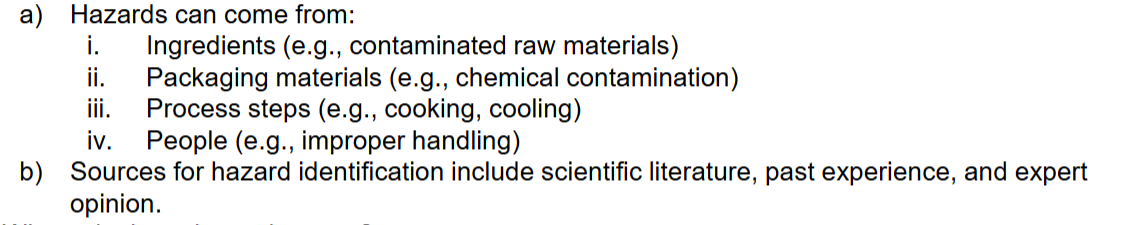
****Where do? hazards come from? Where do they originate?
What helps to find critical points where hazards are likely?

****What are possible Control of Hazards?

*****What are the 7 PRINCIPLES OF HACCP********
Conduct a Hazards Analysis
Determine Critical Control Points
Establish critical Limits
Establish Monitoring procedures
Establish Deviation precedures
Establish verification procedures
Establish record keeping (for principles 1-6)
*****What does it mean by Conduct a Hazards Analysis
What does it entail
Analysis to look for food safety hazards (3 main categories) + Evaluation of said hazards
*****Conduct a Hazards Analysis: What are the 3 categories of food safety HAZARDS
BIOLOGICAL (e.coli, salmonell, listeria, norovirus, giardia)
PHYSICAL (glass, metal, plastic)
CHEMICAL (cleaning chemicals, allergens, toxins)
*****What are 2 questions to ask when evaluating a hazard?
What is the LIKELYHOOD of hazard occurring
What are the RISKS IF the hazard does occur
*****What does it mean by Critical Control Points?
What is a CPC?
CPC’s are points in production where action can be taken to PREVENT, ELIMINATE or REDUCE a food safety hazard to an acceptable level
one of the LAST CHANCES you have to be sure the food will be safer when you serve it
*****What does it mean by Establish Critical Limits
What is a Critical limit?
What is an EXAMPLE
Critical limit is the limit at which a hazard is acceptable without compromising food safety. The absolute measurable boundary that separates safe food from unsafe food at a Critical Control Point (CCP).
Measurable Value: It is a precise scientific measurement/value
Safety Boundary: It defines the point where a biological, chemical, or physical hazard is successfully controlled, eliminated, or reduced to a safe level. [1, 2]
Mandatory Action: If this limit is missed or breached, corrective action (like reheating, rejecting, or discarding the product) must happen immediately
EX: specific minimum cooking temperature, maximum cooling time, or target pH level
*****What does it mean by Establish Monitoring procedures
Methods of monitoring
Examples
What does it help with
Ensures it meets critical limits: You have strict safety rules. Monitoring is the act of checking to prove you hit that target.
helps identify problems in the operation
Methods:
Taking measurements (pH, temperature)
Observational checks: (formation of ice crystals = potential temperature abuse; discoloration = potential temperature abuse)
must be REAL TIME measurements that action can be taken on
*****What does it mean by Establish Deviation procedures
Actions taken to bring production process back on track if monitoring indicates deviation from critical limit
Correcting the problem before the end-stage of production is more effective (saves time, money, and product, while keeping the final output safe)
*****What does it mean by Establish Verification procedures
Applying methods, tests, and reviews—other than routine daily monitoring—to confirm that your food safety plan is operating effectively and as intended. Determine if the control measure in a CCP is or has been operating as intended
Check or confirmation that steps in the plan are working
*****What does it mean by Establish Record Keeping
What must records document
For principles 1 through 6
To demonstrate the effective application of the CCP and assist with official verification (ie. CFIA)
Records must document monitoring and verification as well as response to deviations
Ensures operational transparency, regulatory compliance, and a reliable history of activities
*****What are the 12 STEPS to develop + implement HACCP?
1-4 = Building HACCP plan
Assemble the HACCP team
Describe the product
Identify the product’s intended use and consumers
Construct a detailed process flow diagram
5-7 = Hazards + Controls
Verify the process flow diagram
Below = the 7 principles of HACCP in order
Conduct a hazard analysis (Principle 1)
Determine critical control points (CCPs) (Principle 2)
8-10 = Controlling + monitoring
Establish critical limits for CCPs (Principle 3)
Establish monitoring procedures for CCPs (Principle 4)
Establish corrective actions (Principle 5)
11-12 = Verification + records
Establish verification procedures (Principle 6)
Establish record-keeping and documentation procedures (Principle 7)
****Elaborate on Steps 1-4 (Building the HACCP plan)
What is done at each step. Give examples of what you would do in each step
1. Assemble the HACCP team: Gather a group with food safety expertise to build and run the plan.
Example: A bakery includes its manager, a safety supervisor, and a head baker to develop the HACCP plan.
2. Describe the product: Define what is made, what’s in it, and how it’s processed.
Example: The bakery lists ingredients (flour, eggs, milk), describes packaging, and notes the bread is sold fresh
3. Identify intended use and consumers: Clarify how and by whom the product will be used.
Example: The bread is intended for home consumption and will be eaten without reheating.
4. Construct a process flow diagram: Map every step, from receiving ingredients to finished product.
Example: The diagram shows receiving → mixing → baking → cooling → packaging → storage → delivery.
****Elaborate on Steps 5-7 (Hazards + Control)
What is done at each step. Give examples of what you would do in each step
5. Verify the process flow diagram: Double-check the process map to match real production.
Example: Team watches production, confirming that cooling before packaging is included in the diagram.
6. Conduct a hazard analysis (Principle 1): Identify food safety risks at every step.
Example: They spot risks like Salmonella from raw eggs or metal fragments from equipment.
7. Determine critical control points (CCPs) (Principle 2): Pinpoint where safety controls are essential.
Example: Baking is a CCP because proper temperature kills bacteria; a metal detector is a CCP for physical hazards.
****Elaborate on Steps 8-10 (Controlling + monitoring)
What is done at each step. Give examples of what you would do in each step
8. Establish critical limits for CCPs (Principle 3): Set measurable safety boundaries (like temperature, time).
Example: Bread must reach at least 75°C in the centre; detector sensitivity is set for metal pieces above 2 mm.
9. Establish monitoring procedures for CCPs (Principle 4): Decide how and when to check CCPs.
Example: Staff record oven temperature for each batch; metal detector tests occur before each shift.
10.Establish corrective actions (Principle 5): Prepare plans for fixing safety issues if limits aren’t met.
Example: If bread doesn’t reach 75°C, it’s re-baked or discarded; failed metal detector triggers product hold and repair
****Elaborate on Steps 11-12 (Verification + Records)
What is done at each step. Give examples of what you would do in each step
11. Establish verification procedures (Principle 6): Plan ways to confirm the HACCP system works, such as audits or product tests.
Example: Supervisor reviews temperature logs weekly; samples go to a lab for testing twice a month.
12.Establish record-keeping and documentation procedures (Principle 7): Keep detailed logs of checks, actions, and reviews.
Example: All temperature logs, detector checks, batch numbers, and corrective actions are filed for inspection.
HACCP examples: What are the Key risks to focus on + examples
FRESH PRODUCE
Manage risks from soil, water, and handling mainly via wash water quality and preventing cross-contamination.
Example: Produce wash water is regularly tested and sanitized; separate equipment is used for raw and ready-to-eat products
HACCP examples: What are the Key risks to focus on + examples
READY TO EAT PRODUCTS
Focus on allergen management, sanitation, and temperature controls during processing and packing.
Example: Dedicated lines prevent cross-contact with allergens; refrigeration is maintained to control microbial growth.
HACCP examples: What are the Key risks to focus on + examples
MEAT PROCESSING PLANTS
Monitor key steps like cooking, chilling, and handling to control pathogens such as Salmonella and E. coli O157:H7.
Example: Meat is cooked to a minimum internal temperature to destroy harmful bacteria, and chilling is carefully controlled to prevent bacterial growth.
HACCP examples: What are the Key risks to focus on + examples
DAIRY FACILITIES
Control pasteurization temps/times, hygienic milking practices, and cold storage to ensure safety.
Example: Milk is pasteurized at 72°C for 15 seconds to eliminate pathogens, with strict hygiene during milking to prevent contamination.
Define EPIDEMIOLOGY in food borne diseases
Epidemiology is the study of health outcomes and diseases in specific populations.
The study of how often foodborne illnesses occur, who they affect, and why they spread within populations
***What 3 things does Epidemiology address/ explain
Identify CAUSE
Determine MODE OF TRANSMISSION
Evaluate METHODS OF CONTROL
****What are the Sequence of Events for Foodborne Disease?
Organism must contaminate food
One of following must happen:
Organism or toxin must survive storage and processing
Organism allowed to multiply
Sufficient quantities of contaminated food are eaten
*****JACK IN THE BOX
What was the Pathogen
What was the cause
WHAT DID IT CHANGE
E. coli
Cause: Jack in the box cooked burger to 55 internal instead of the Washington state require 71
CHANGE:
Clinton legislated ZERO TOLERANCE for E. coli O157:H7 in ground meat (1998)
This was then expanded to all non-intact meats and different serotypes of EHEC (2012)
(probs not too important) Food borne illness in Canada 1 in how many people get sick each year from contaminated foods?
1/8
(probs not too important) Food borne illness in Canada How many deaths each year?
240
*****What are the 5 COMMON CULPRITS of food borne illnesses in CANADA?
Norovirus (leading cause of illness + hospitalization)
Listeria (leading cause of death)
Salmonella
E.coli O157
Campylobacter
4 food safety tips?
CLEAN hands + surfaces with warm soapy water
SEPERATE raw + cooked, fruits and veg = avoid cross contamination
COOK food to temps
CHILL within 2 hours
****Info dump What was an Outbreak that changed government guidelines
Time
WHICH PATHOGEN
What happened/what product
CFIA response
May 2017 - 2019 = 18 outbreaks of SALMONELLOSIS (common bacterial infection that affects your intestinal tract and causes digestive illness)
584 cases, 97 hospitalizations
Linked to consumption of CHICKEN products
CFIA response = New requirements for manufacturers
Reduce Salmonella to below detectable levels in par-fried chicken products
****CFIA response: What were the 4 specific steps taken to Reduce Salmonella to below detectable levels in par fried chicken?
Fully cook (7 log reduction) = Ready-to-eat product
Test raw chicken mixture = no detectable Salmonella (if +ve, must be fully cooked or destroyed)
Implement a test and hold program for finished product and test for presence prior to release
Include a process or combination of processes that achieve a 2- log reduction in Salmonella and implement sampling plan for raw product (must be negative or product must be fully cooked)
******What is the MAIN LOCATION of Foodborne illness outbreak/ sources in CANADA
eg. home, retail, processing, Food services, social events etc.
FOOD SERVICES
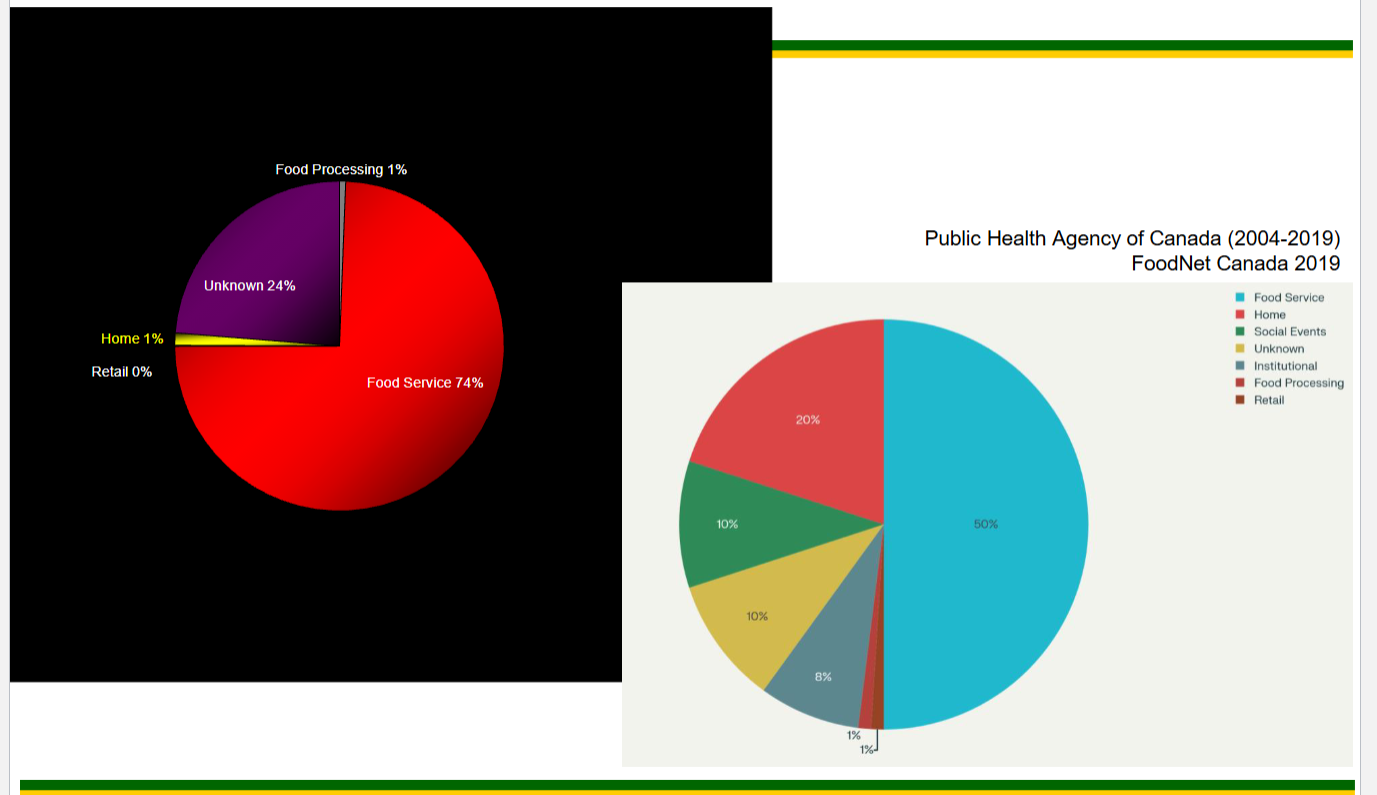
*****Percent of cases of food borne disease from Different sources
in the year 1973-1987 what was the MAIN SOURCE of disease (ANIMAL, PLANT or SEAFOOD)
Animal
*****Percent of cases of food borne disease from Different sources
CURRENTLY what was the MAIN SOURCE of disease (ANIMAL, PLANT or SEAFOOD)
PLANT
Why (not mentioned in slides): Stricter Meat Regulations: In the 1990s, regulatory bodies introduced HACCP (Hazard Analysis Critical Control Point)
Rise in Ready-to-Eat Produce: Consumer demand shifted heavily toward raw, pre-packaged, and pre-washed plant foods (such as bagged leafy greens, bagged salads, and sprouts).
Lack of a "Kill Step": Unlike meats, fresh produce is can be consumed completely raw.

****RECALL ALERT: ENOKI MUSHROOMS
What years
WHY? (main pathogen)
What were recalls triggered by?
From 2022→2025 due to LISTERIA MONOCYTOGENES contamination
Recalls were triggered by the Canadian food inspection agency test results
*****What are the MAIN FACTORS that are associate/cause Foodborne disease in Canada?
Improper Cooling 27%
12 or more hours between prep + eating
Infected person
Contaminated raw food ingredient
Inadequate cooking
Inadequate hot holding
Inadequate reheat
Unsafe sources
Cross contamination
Inadequate sanitation
Use of left overs

