Advanced Medical-Surgical Exam 1
 Call Kai
 Learn
 Practice Test
 Spaced Repetition
 Match
 Flashcards
 Knowt Play
1/48

There's no tags or description
Looks like no tags are added yet.
49 Terms
Burns: First Action
Minor: first aid, cool water 3-5 min, do not use ice water or ice packs, avoid hypothermia (impede healing), burns with chemicals or tar require longer cooling time, clean with mild soap and water, cover with antimicrobial ointment + absorbent dressing, and comfort with OTC pain med
Ensure airway is patent and breathing is adequate in rate and depth, then determine if fluid resuscitation is needed
Adults older than 14: 500 mL of LR/hr
Severe: urinary catheter, gastric decompression w/ NG or OG tube, monitor perfusion (compartment syndrome), HOB elevation, may require debridement or excision of nonviable tissue
Regular dressing changes
Active range of motion exercise (some with skin grafts may have movement restrictions)
Burns: Hydration

Burns: Rule of Nines
Common areas of the body are approximately 9% of the body
Front leg: 9% Only the thigh: 4.5%
Entire arm: 9%
Chest: 18%
Palm: 1%
Burns: Surgical Escharotomy
Necessary to relieve the tension caused by nonviable stiff eschar
Cuts through the eschar, stiff dead skin, to allow the tissues below to expand
Eschar tissue that surrounds and extremity or torso can cause constriction, resulting in compartment syndrome
Burns: Non-emergent
Burns: Smoke Inhalation Risk
Highest risk with a house fire
Respiratory status takes priority over other injuries
Impending loss of airway: hoarseness, drooling, audible wheezing or stridor, and/or difficulty swallowing
Burns: Electrical
Can burn from the inside out, skin over bones may initially appear non-burned & within a few days appear as a full-thickness injury
Do not touch the client until electrical source has been removed
Consultation for follow-up in burn center to screen for delayed manifestation onset and vision issues
Will need electrocardiogram
Burns: Chemical
Treatment: apply a topical enzyme after daily dressing change to break down and remove dead tissue
Interventions:
Never try to neutralize
Remove contaminated clothing
Flush with water for 20-30 min, up to hrs for alkali burns
Burns: Opioid Administration
Adverse Effects: respiratory depression, drug tolerance, drug dependence, use smaller doses with older adult client
Client Teaching: dependence can occur, avoid prolonged use, assess pain before and after use, and may cause drowsiness
Benner’s Stages
Novice: no previous experience, cannot draw on their own judgment, struggles to decide which tasks are most relevant
Advanced Beginner: can recognize patterns and recurrent situations, issue with remembering and following the rules and guidelines, needs clinical support to set priorities
Competent: able to prioritize based on past experience, may not function at the same speed or ease of change as proficient, can recognize patterns more quickly and accurately
Proficient: can understand the bigger picture or desired outcomes, improved decision making, able to respond to changing situations and modify plans in diff events
Expert: extensive experience and knowledge in complex client conditions, must have self-confidence and trust their intuitive sense, knows what needs to be done and perform it well
Code Team Roles & Room Placement
Following the code: team organizes transfer to a critical care unit, CCU will continue interventions to stabilize client
One-three nurses
1: Client’s nurse; manages the environment and communicates with family if present
2: Recorder of events
3: Ensure IV access and administer medications
A nurse and other members of the team will rotate to perform chest compressions
Respiratory therapist or anesthesia provider: ventilation
Medical provider (anesthesiologist, an intensivist, a hospitalist, or a surgical resident): extras will act as helpers or runners to obtain equipment or carry lab specimens
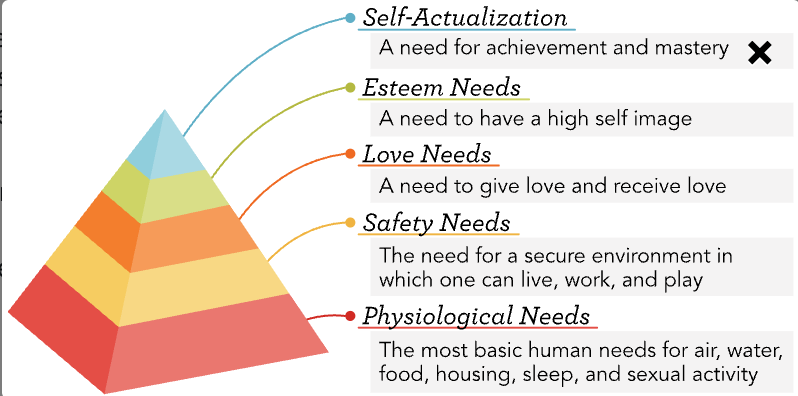
NCLEX Prioritization frameworks: Maslow
Five categories of needs that motivation human beings:
Physiological: needs required for survival; food, water, air, shelter, sleep, clothing, warmth + rest, and reproduction; more than one unmet needs = person will likely try to meet physiological need before fulfilling other needs
Safety: individuals like order, certainty, and having control in their lives
Love and belonging: behavior is motivated by the need for social relationships and sense of connection; met through interactions
Self-esteem: desire to feel good about self and having respect of others; may develop sense of uselessness leading the feelings of inferiority
Self-actualization: all deficiencies are met, humans attempt to reach their full potential; may be restless or unhappy if goal is not met
Base of pyramid: basic needs
Middle: psychological needs
Peak: self-fufillment
Needs located lower in the pyramid must be met first
Nurse priority is to address client’s fundamental physiological needs
Mechanical Ventilation Weaning Criteria
Spontaneous Awakening Trials
For clients who are receiving mechanical ventilation
Daily stopping of sedatives and opioids if possible
Depends on the client’s assessed pain scale
Found to decrease the time a client requires mechanical ventilation
Spontaneous Breathing Trial (SBT)
The stopping of mechanical ventilation to allow the client to breathe spontaneously
Help predict whether the client will be able to breathe on their own without the assistance of the mechanical ventilator
Ordered by the provider, completed and documented by nurse and/or RT
If an oral odor is noted or suction secretions demonstrate a change in color or quality, notify the provider
Failure:
Increase in RR to 35/min +
Increase in HR 140/min +
Cardiac dysrhythmia
Oxygen saturation of 89% or less
Main Modes & Strategies of Mechanical Ventilation
Assist-control (ACV): each patient or time-triggered breath received a set tidal volume or pressure, with a backup rate
SIMV/IMV: set number of mandatory breathing + spontaneous breaths between, optionally with pressure support; synchronization improves comfort and limits dynamic hyperinflation
Pressure-support ventilation (PSV): fully patient initiated; each effort is assisted by a preset pressure until flow cycles off; unsuitable with unstable drive
CPAP/PEEP: continuous positive pressure to maintain FRC, recruit alveoli, and improve oxygenation; essential in ARDS/ALI and peds hypoxemic failure
Pain in Critical Care
Pain comes from:
Suctioning
Turning
Wound care
Scale:
0 to 10 numerical
Behavioral Pain Scale (BPS)
Critical-Care Pain Observational Tool (CPOT)
Nurses must advocate for appropriate pain management and relaxation
Sedative Therapy
To counter-act fear, anxiety, and pain
Benzodiazepines:
Midazolam (Versed) to reduce anxiety
Opioids:
Morphine
Paralytic Therapy
Used when complete control of ventilation is required
Acute lung injury or ARSD
Med:
Rocuronium (Zemuron)
Triage Categories
Emergent (life-threatening: cardiac arrest, severe respiratory distress, major trauma, active seizures, or anaphylaxis)
Urgent (treat within 2 hr: chest pain suggestive of MI, severe fractures, high fever, or deep wounds)
Non-urgent (can delay: minor rashes, small sprains, mild earaches, or basic medical questions)
Mass Casualty Categories: Color Coding
Red: high priority treatment or transfer (massive hemorrhage, tension pneumothorax, etc.)
Yellow: medium priority (isolated simple femur fracture, etc.)
Green: ambulatory patients (isolated abrasions, contusions, sprains, etc.)
Black: dead or minimal chance of survival (massive head injuries, 95% coverage with third degree burns, etc.)
Mass Casualty Categories: Urgent/Emergent
Emergent: higher priority; patient must be seen within minutes
Immediate threat to life, limb, or organ function if treatment is delayed
Urgent: lower priority; condition is painful or distressing and could possible worsen, but there is no immediate danger of death
Stable
Can wait 1-2 hr
Mass Casualty Categories: Number of Services
1: limited to physician and nursing care
2: limited to physician and one other
3: physician and several other services (pharm and lab)
4: extensive time and services required
Nurse Practice Act
A body of state laws enacted by each individual state’s legislature that establishes the legal scope of practice for nurses within that state’s jurisdiction
Scope: defines what RNs, LPNs, and APRNs can and cannot legally do
Board of Nursing Authority: grant’s the state’s Board of Nursing the power to make administrative rules, issue licenses, and enforce the law
Licensure requirements: outlines the qualifications needed to obtain, renew, or maintain a nursing license
Disciplinary grounds: defines what constitutes professional misconduct, negligence, or incompetence, and establishes the process for suspending or revoking a license
Health Insurance Portability and Accountability Act (HIPAA)
Focus: protects individual health insurance coverage and private information of clients, deter inappropriate use of client health care information
Purpose: protect client’s privacy and personal health information from security breaches
The Emergency Medical Treatment and Active Labor Act (EMTALA)
Focus: prevent refusal of care to uninsured clients, ensures any client who has a medical or psychiatric condition who brings themselves in or is brought in must be evaluated or stabilized before discharge or transfer
Hospitals can lose Medicare funding if violated
COVID Impact: allows for the ability to send clients to an alternative location for required screenings and permits the transfer of clients who are not totally stable
Primary Survey in the ED
ABCDE assessment performed in the ED to assess for life-threatening injuries
Airway
Breathing
Circulation
DIsability
Exposure/Environment
Secondary Survey in the ED
A methodical head-to-toe assessment performed to discover any additional injuries not addressed in the primary survey; for severe trauma
Chest Trauma
High number from MVA and falls
Blunt: injury to thoracic cavity without penetration (ball, bat, club, MVC), vascular/cardiac/or pleural space injury must be present
Diagnostic: CT (detect more subtle change)
Penetrating: open injury to the cardiothoracic region that may affect the cardiopulmonary system
High velocity: rifle
Medium velocity: handgun
Low velocity: knives
Chest Flail
Cause: multiple rib fractures (usually neighboring), ribcage not able to maintain bellows action
Care: monitor ABGs, mechanical ventilation
Manifestation: pleuritic pain, tracheal deviation, reduced or absent breath sounds, dull percussion
Chest Tube
Used to drain fluid or remove air from the intrapleural space (between the lungs and chest wall)
Indicated for clients who have pneumothorax, lung infections with fluid accumulation, or after heart and lung surgeries
RN can delegate monitoring and dressing change to another RN or LPN, not an UAP
Chest Tube Air Leak
Can be indicated by continuous bubbling in the water seal, can originate from the client’s pleural space or from an external mechanical issue (loose connection or poor insertion-site)
Chest Tube Water-Seal
Allows air to exit from the pleural space of exhalation and stops air from entering the lungs with inhalation
Tidaling is expected, cessation signals lung re-expansion or an obstruction
Continuous bubbling indicates an air leak
Check water-seal level every 2 hr
Chest Tube Tidaling
Water level responds to changes in pressure caused by respirations; indicates a good seal
Tension Pneumothorax
Air collects between the parietal and visceral pleura, resulting in a collapsed lung and a mediastinal shift; air is pushed outside of the lung but remains in the thoracic cavity — leads to compromise of cardiopulmonary function, life-threatening
Risks: iatrogenic procedures (lung biopsy, tracheostomy, bronchoscopy, intercostal nerve blocks, pacemaker placement, and cardiopulmonary resuscitation), and positive pressure mechanical ventilation (causes high volumes of oxygen and overexpansion of the lungs)
Clinical presentation: sharp pleuritic pain that radiates to the back or shoulder (key manifestation), increased HR, decreased BP, JVD, dyspnea, cyanosis
Pulmonary Embolism
Occurs when a substance (solid, gaseous, or liquid) enters venous circulation and forms a blockage in the pulmonary vasculature
More common in women than men
Expected findings: anxiety, feelings of impending doom, sudden onset of chest pressure, pain upon inspiration and chest wall tenderness, and/or air hunger
Interventions: assess resp. status every 30 min, compare BP in both arms, monitor for LOC change
Meds: anticoagulants (warfarin, LMP, enoxaparin)
Wound Care: Evisceration Dehiscence
Dehiscence: the partial or total separation of surgical wound layers
Evisceration: total separation of wound layers PLUS the protrusion of internal organs through the open wound (SEVERE MED EMERGENCY)
Interventions:
Call for help immediately
Position the patient in low fowlers
Protect the organs with sterile dressings moistened with sterile NS
Prevention:
Splinting: firmly hold a pillow against their abdomen when coughing, deep breathing, or moving
Abdominal binders: use supportive binders as ordered
Stool softeners: administer softeners to prevent straining during bowel movements
Wound Care: Pressure Injuries & Staging
Stage 1: erythema of intact that does not blanch
Stage 2: partial thickness loss with exposed dermis
Stage 3: full-thickness loss involving damage to the epidermis, dermis, and subcutaneous tissue, but not the muscle or bone
Stage 4: full-thickness skin and tissue loss, only it involves deep tissue necrosis of muscle, fascia, tendon, joint capsule, and sometimes bone
Unstageable: involve full-thickness loss but are impossible to accurately stage because the wound bed being obscured by eschar or excessive slough
Deep Tissue: may be intact or non-intact, deep red, maroon, or purple, does not blanch, blood-filled blister, thin blister that overlies a dark wound bed, eschar under blisters
Wound Care: Phases of Wound Healing
Inflammatory: wound is fresh and includes both hemostasis and phagocytosis
Reconstruction “Proliferation”: wound begins to heal and lasts about 21 days after injury
Maturation “Remodeling”: wound contracts, scar strengthens
Wound Care: Types of Wound Closures
Primary: clean, with little tissue loss (example: surgical incision) edges are approximated, wound is sutured, glued, stapled, or stitched closed
Secondary: greater tissue loss, wound edges irregular, edges cannot be brought together
Tertiary: wound left open for time to allow granulation tissue to form, then will be sutured closed
Wound Care: Shear Injuries
Occurs when the patient’s skin moves in opposite directions than items the patient is on
Prevention: remove linens from underneath a patient by rolling them to one side and folding the linens to the center of the bed, then roll the patient to the other side and remove linen completely
Wound Care: Factors Affecting Wound Healing
Age: wound contracts more slowly, strength of scarred area decreased, skin less elastic, collagen replacement impaired
Chronic Illness
Diabetes Mellitus: decreased circulation due to narrowed peripheral blood vessels, increased blood glucose interferes
Hypoxemia: decreased oxygen delivered to the wound by the bloodstream, oxygen necessary for wounds to heal
Lifestyle Choices: smoking decreases the oxygen content of blood and constricts blood vessels, excessive alcohol intake = poor nutrition, obesity increases risk of infection and dehiscence
Lymphedema: circulation to and from the wound is impaired
Medications: delays healing and can mask symptoms of inflammation and infection
Multiple Wounds: each wound competes for available protein and substrates for repair
Nutrition and hydration: lack of calories and protein impairs tissue growth, vitamin A, C and zinc deficiency, inadequate fluid intake causes wound to dry = restricting granulation of tissue
Radiation Exposure: breakdowns underlying connective tissue
Wound Tension: can lead to ischemia and necrosis
Wound Care: Wound Vac
Used to assist in wound contraction, decreasing edema, increasing vascularization and provide debridement and removal of exudate; applies (negative pressure) suction
Removes drainage
Reduces bacterial counts
Promotes granulation
Helps speed up wound-healing time
DO NOT USE:
In an area with skin cancer
Clients on anticoagulant therapy
Have poor tissue health
Clients with exposed vessels, nerves, or organs within the wound
Wound Care: Documenting & Measuring Wounds
Site: anatomical location
Type: open or closed
Closure: sutures, staples, Steri-Strips, approximation
Size: width, length, and depth
Wound bed condition: color, texture, eschar, sloughing, presence of granulation tissue, undermining, sinus tracts
Surrounding skin: color, texture, maceration
Pain: rate discomfort/tenderness
Drainage: amount, type/color, odor
Violence
Contributing factors: emergent situations, stress, anxiety, substances, mental illness, long wait times, fear of diagnosis/outcome, crowded waiting rooms
Care of Violence Victim:
Provide emotional support
Evaluate injuries
Carries out forensics exam (SA)
Collects evidence using a SA evidence kit
Infectious Disasters
Endemic: disease is constantly present at a steady, predictable rate within a specific region/group of people
Malaria in certain parts of Africa
Seasonal flu
Epidemic: a sudden, unexpected jump in the number of disease cases above what is normal in specific community
Unexpected local spike of Ebola
Severe regional measles outbreak
Pandemic: an epidemic that has spread across multiple countries or continents, affecting massive numbers of people worldwide
COVID-19
1918 influenza
Nurses Role in Disasters
Apply the nursing process through clinical judgment function
Prepare ahead for disaster response
Use the triage system caring for clients
Use effective communication
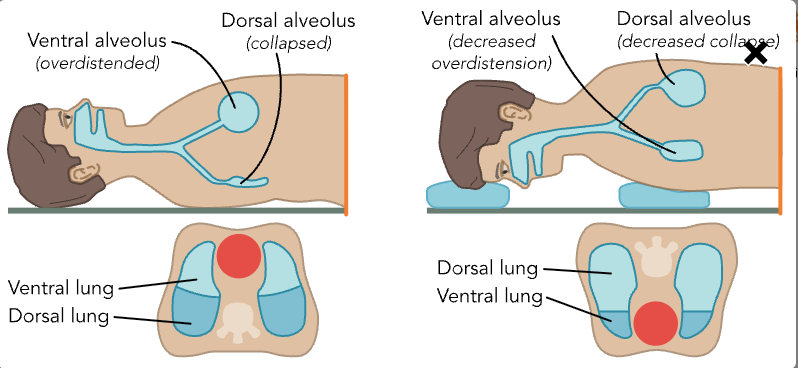
ARDS Prone
Modify the distribution of transpulmonary pressure and improve gas exchange
Ventilation + perfusion matching improve because the prior dependent lung receives most of the blood flow and alveoli reopen

ARDS Supine
Worsens lung injury and impairs oxygenation due to gravitational and mechanical forces