Derivative Rules
 Call Kai
 Learn
 Practice Test
 Spaced Repetition
 Match
 Flashcards
 Knowt Play
1/20

There's no tags or description
Looks like no tags are added yet.
21 Terms
Derivative of sin(x)
cos(x)
Derivative of cos(x)
-sin(x)
Derivative of csc(x)
-csc(x) ⋅ cot(x)
Derivative of tan(x)
sec2(x)
Derivative of h(x) = f(x) ÷ g(x)
(g(x) ⋅ f’(x) - f(x) ⋅ g’(x)) ÷ g(x)2
Derivative of ax
ax ⋅ ln(a)
Derivative of ln(x)
1/x
Derivative of sec(x)
sec(x) ⋅ tan(x)
Derivative of cot(x)
-csc2(x)
Derivative of f(x) = c
f’(x) = 0
Derivative of f(x) = c ⋅ f(x)
f’(x) = c ⋅ f’(x)
Derivative of f(x) = f(x) ± g(x)
f’(x) = f’(x) ± g’(x)
Derivative of xn
n⋅xn-1
Derivative of ex
ex
Derivative of h(x) = f(x) ⋅ g(x)
f(x) ⋅ g’(x) + f’(x) ⋅ g(x)
Limit Definition (using h)

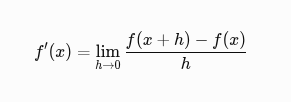
What traits can you look for in Limit Definition (using h)
h approaches 0
answer says f’(x)
denominator is h
contains f(x+h) and f(x)
no numbers in the parenthesis
Limit Definition (using x and a)


What traits can you look for in Limit Definition (using x and a)
x approaches a
answer says f’(a) [a specific point / value, not x]
denominator is x - a
contains f(x) and f(a) [a specific point / value, x]
numbers in the parenthesis
Limit Definition (using h and a)


What traits can you look for in Limit Definition (using h and a)
h approaches 0
answer says f’(a) [a specific point / value, not x]
denominator is h
contains f(a+h) and f(a) [a specific point / value, not x]
numbers in the parenthesis