muscle anatomy + physiology : A&P exam
 Call Kai
 Learn
 Practice Test
 Spaced Repetition
 Match
 Flashcards
 Knowt Play
1/88

There's no tags or description
Looks like no tags are added yet.
89 Terms
what is the resting membrane potential (RMP) of a skeletal muscle fiber?
approximately -90 mV (negative inside compared to outside)
What creates and maintains the concentration gradients for Na+ and K+?
Na+/K+ pumps (keep Na+ high outside, K+ high inside)
Which proteins establish and maintain the resting membrane potential (RMP)?
Ka+ Leak channels and Na+/K+ pumps
Where are Na⁺ and K⁺ more concentrated at rest?
Na⁺ is more concentrated outside the cell; K⁺ is more concentrated inside
What happens when a nerve signal reaches the synaptic knob?
Voltage-gated Ca2+ channels open, allowing Ca2+ to enter.
What causes acetylcholine (ACh) to be released?
Ca²⁺ triggers synaptic vesicles to release ACh by exocytosis.
Where does ACh bind?
ACh receptors on the motor end plate
What happens when ACh binds to its receptors?
Chemically gated channels open, allowing more Na⁺ to enter than K⁺ to leave, producing an end-plate potential (EPP).
What triggers an action potential in a muscle fiber?
The EPP reaches threshold (approximately −65 mV), opening voltage-gated Na⁺ channels.

What happens during depolarization?
Voltage-gated Na⁺ channels open, allowing Na⁺ to enter the muscle fiber.

What happens during repolarization?
Voltage-gated K⁺ channels open, allowing K⁺ to leave the muscle fiber.
How does an action potential travel along the sarcolemma and T-tubules?
Through the sequential opening of voltage-gated Na⁺ channels.

What are the phases and voltages of a muscle action potential graph?
Resting (−90 mV) → threshold (−65 mV) → depolarization (+30 mV) → repolarization (−90 mV).
What is the refractory period?
The brief period during which the muscle fiber cannot be restimulated.
What is excitation-contraction coupling?
The process linking muscle fiber excitation to contraction.
What happens when an action potential reaches a triad?
Dihydropyridine receptors change shape, causing ryanodine receptors to open.
What happens when ryanodine receptors open?
Ca2+ is released from the sarcoplasmic reticulum into the cytosol.
What protein does Ca²⁺ bind to?
troponin
What protein blocks the myosin-binding sites on actin?
Tropomyosin
How does Ca2+ allow myosin to bind to actin?
Ca2+ binds to troponin, causing tropomyosin to move and expose the binding sites.
What are the four steps of crossbridge cycling?
Attach → pull → release → reset
What happens during crossbridge formation?
Myosin heads attach to exposed binding sites on actin.
What happens during the power stroke?
Myosin pulls the thin filament toward the center of the sarcomere; ADP and Pi are released.
What causes myosin to detach from actin?
ATP binds to the myosin head
What resets the myosin head?
Myosin ATPase splits ATP into ADP and Pi.
What stops muscle fiber excitation?
Motor neuron signals stop, and acetylcholinesterase breaks down the remaining ACh.
What happens to Ca²⁺ during muscle relaxation?
ATP-powered Ca²⁺ pumps return it to the sarcoplasmic reticulum.
What prevents crossbridge formation during relaxation?
Ca2+ leaves troponin, allowing tropomyosin to cover actin's binding sites.
Why is ATP needed for muscle relaxation?
To power Ca2+ pumps and allow myosin to detach from actin.
What are the three main ways skeletal muscle produces ATP?
Creatine phosphate, anaerobic glycolysis, and aerobic cellular respiration.
How does creatine phosphate generate ATP?
Creatine kinase transfers a phosphate group from creatine phosphate to ADP.
How long does creatine phosphate provide energy?
Approximately 10–15 seconds during maximum exertion.
What are the main characteristics of anaerobic glycolysis?
Occurs in the cytosol, does not require oxygen, and produces 2 net ATP per glucose.
What are the main characteristics of aerobic cellular respiration?
Occurs in mitochondria, requires oxygen, and produces large amounts of ATP.
What are the three ATP sources?
creatine phosphate
glycolysis
aerobic respiration
When is creatine phosphate primarily used?
first 10-15 seconds of intense activity
When is glycolysis primarily used?
short intense activity (like a 400 meter sprint)
When is aerobic respiration primarily used?
sustained activity (becomes dominant after 1 minute)
What is recovery oxygen uptake (oxygen debt)?
Additional oxygen consumed after exercise to restore pre-exercise conditions.
Why is recovery oxygen uptake needed?
To replenish oxygen in myoglobin, restore ATP and creatine phosphate, and replenish glycogen stores.
What are the three types of skeletal muscle fibers?
Slow oxidative (SO), fast oxidative (FO), and fast glycolytic (FG).
What are the characteristics of slow oxidative (SO) fibers?
Slow contraction
aerobic ATP production
highest fatigue resistance
used for posture and endurance activities.
What are the characteristics of fast oxidative (FO) fibers?
Fast contractions
moderate fatigue resistance
mainly aerobic ATP production
used for walking and biking.
What are the characteristics of fast glycolytic (FG) fibers?
fast
powerful contractions
primarily glycolytic ATP production
low fatigue resistance
used for sprinting and lifting weights.
What is muscle tension?
The force generated when a muscle contracts.
What is a muscle twitch?
A brief contraction and relaxation of a muscle in response to a single stimulus.

What is the threshold stimulus?
The minimum voltage needed to trigger a muscle twitch.

What is a myogram?
A graph showing muscle tension over time.
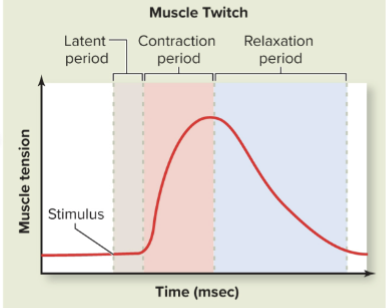
What are the three phases of a muscle twitch?
Latent period → contraction period → relaxation period
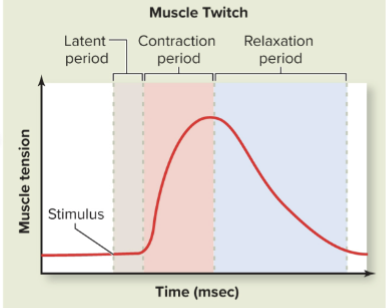
What happens during the latent period?
Excitation-contraction coupling occurs, but muscle tension has not increased yet
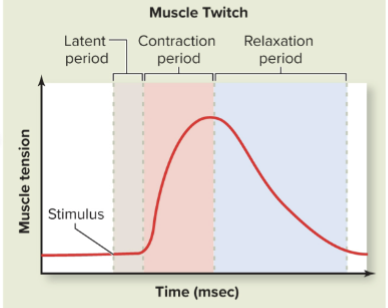
What happens during the contraction period?
Crossbridge cycling begins, and muscle tension increases

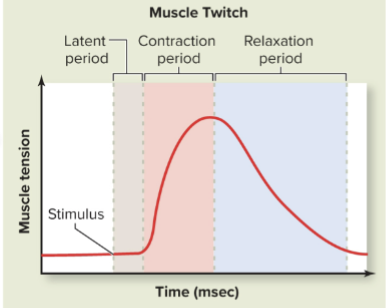
What happens during the relaxation period?
Ca2+ returns to the sarcoplasmic reticulum, and muscle tension decreases

How do you identify latent period on a myogram?
flat line after stimulus
How do you identify contraction period on a myogram?
rising curve
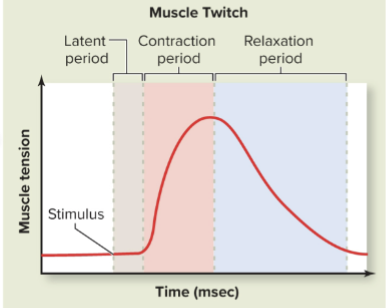
How do you identify relaxation period on a myogram?
falling curve
What happens when stimulus intensity (voltage) increases?
More motor units are recruited, increasing muscle tension.
What is motor unit recruitment?
Activation of additional motor units to increase muscle force.
In what order are motor units recruited?
Small motor units first, then larger motor units.
What happens when all motor units have been recruited?
Maximum muscle tension is reached; increasing voltage further does not increase tension.
How does increasing stimulus intensity affect a myogram?
The twitch peaks become higher until maximum tension is reached.
What happens when stimulus frequency increases?
The muscle has less time to relax between contractions, increasing tension.
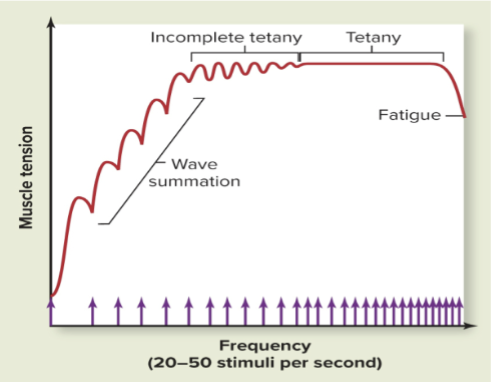
What are the three outcomes of increasing stimulus frequency?
Wave summation → incomplete tetany → tetany

What is wave summation?
Contractions add together because the muscle does not fully relax between stimuli.

What is incomplete tetany?
A sustained contraction with partial relaxation between stimuli.
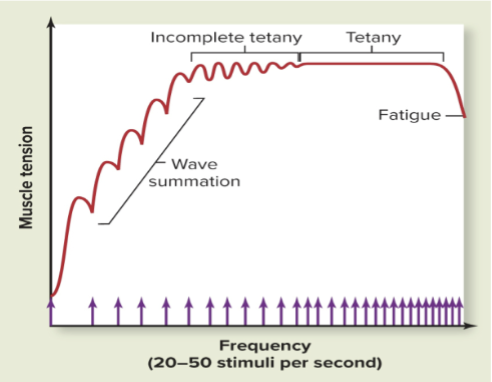
What is tetany?
A smooth, sustained contraction with no relaxation between stimuli.
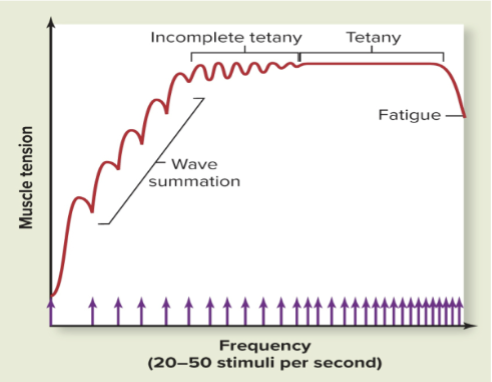
How do wave summation appear on a myogram?
increasing peaks

How do incomplete tetany appear on a myogram?
high tension with small waves

How do tetany appear on a myogram?
smooth, flat plateau at high tension
What is muscle tone?
The resting tension in a skeletal muscle, even when it is not actively moving.
How is muscle tone maintained?
Random stimulation of small numbers of motor units.
What are the purposes of muscle tone?
Stabilizes bones and joints and keeps muscles ready to respond.
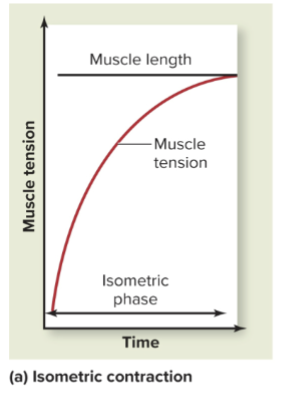
What happens during an isometric contraction?
Muscle length stays the same, tension increases, and no movement occurs.
What happens during an isotonic contraction?
Muscle tension stays relatively constant while muscle length changes, producing movement.

What happens during a concentric isotonic contraction?
The muscle shortens while generating tension (lifting a dumbbell).
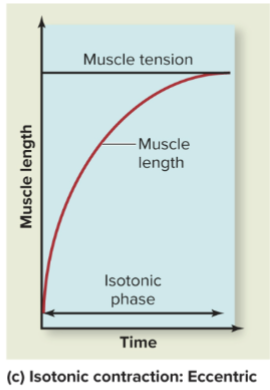
What happens during an eccentric isotonic contraction?
The muscle lengthens while generating tension (lowering a dumbbell).
How do muscle length and tension change during isometric contractions?
same length, increasing tension

How do muscle length and tension change during concentric contractions?
decreasing length, constant tension
How do muscle length and tension change during eccentric contractions?
increasing length, constant tension

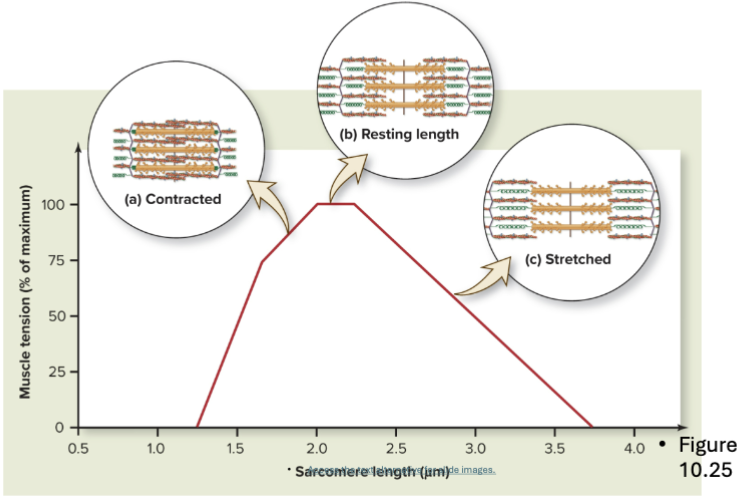
What is the length-tension relationship?
The amount of tension a muscle generates depends on its length when stimulated.
At what muscle length is maximum tension generated?
At resting length, because thick and thin filaments have optimal overlap.
Why do overly shortened muscles generate less tension?
thin filaments have limited room to move
Why do overly stretched muscles generate less tension?
Too little thick and thin filament overlap for crossbridges.
What is muscle fatigue, and what is its primary cause during prolonged exercise?
Reduced ability to produce muscle tension, primarily due to depleted glycogen stores.
What are the four main factors that contribute to muscle fatigue?
decreased glycogen stores
problems with excitation at the NMJ
problems with excitation-contraction coupling
problems with crossbridge cycling
How can problems with the NMJ cause fatigue?
less Ca2+ entry or fewer ACh vesicles reduce muscle stimulation
How can problems with the excitation-contraction coupling cause fatigue?
Altered Na+/K+ levels interfere with action potentials and Ca2+ release.
How can problems with crossbridge cycling cause fatigue?
Excess Pi or reduced available Ca²⁺ weakens contraction.
How do endurance exercise affect skeletal muscle?
More mitochondria and aerobic enzymes.
Increased ATP production and fatigue resistance.
Improved oxygen delivery through increased blood supply.
How do resistance exercise affect skeletal muscle?
Muscle hypertrophy (increased muscle size).
More contractile proteins (actin and myosin).
Increased muscle strength.
Increased glycogen stores and mitochondria.