Chapter 7: Alkenes & Alkynes
 Call Kai
 Learn
 Practice Test
 Spaced Repetition
 Match
 Flashcards
 Knowt Play
1/59

There's no tags or description
Looks like no tags are added yet.
60 Terms

What does this sheet show?
horizontal & vertical trends
Alkenes =
contain a carbon-carbon double bond
Alkynes =
contain a carbon-carbon triple bond
E/Z system is used for:
double bonds with two or more substituents
E =
the higher priority groups are on different sides
Z =
the higher priority groups are on the same side
Highest priority goes to the atom with:
the largest atomic number

What is used to measure the stability of alkenes?
Heat of hydrogenation
In general, the more substituted =
the more stable
Which alkenes have the highest & lowest heat of hydrogenation?
Lowest = RRRR — more stable
Highest = HHHH

Rings containing 5 or less carbons exist only in:
the cis form
Dehydrohalogenation =
remove hydrogen, remove halogen & put a double bone in its place
Which bases favor the zaitsev (more substituted alkene) product?
-OH
NaOH & KOH
RO-
NaOCH3
NAOEt
*small strong bases*
Which bases favor the Hofmann product (least substituted)?
KotBu — large strong base
Elimination E2:
takes place in one step
Two components leave at the same time (bimolecular reaction)
alkene that is formed follows Zaitsev’s rule
rate = k[alkyl halide][base]


What does the reaction graph look like?
image
Antiperiplanar =
opposite sides, sample plane

For E2, the base must push out the leaving group from:
the opposite side & in the same plane → this is called anti-coplanar (or anti-periplanar)
For newman, how do you know eclipse vs staggered?
Eclipse = Dashes pair or wedges pair are on same side
Staggered = pair is on different sides of bond you are looking down on

How do you do an E2 reaction?
look at all connected carbons, pick the hydrogen that is in the same plane but opposite side — that tells placement of double bond
When will Newman rotation need to be used for E2?
if the leaving group and hydrogen are on the same side but not same plane

E2 is:
stereospecific
To practice chair to ring look on slide:
21
Common bases that result in E2 reactions are:
–OH and –OR
Examples of bases: NaOH, KOH, NaOEt, and NaOMe
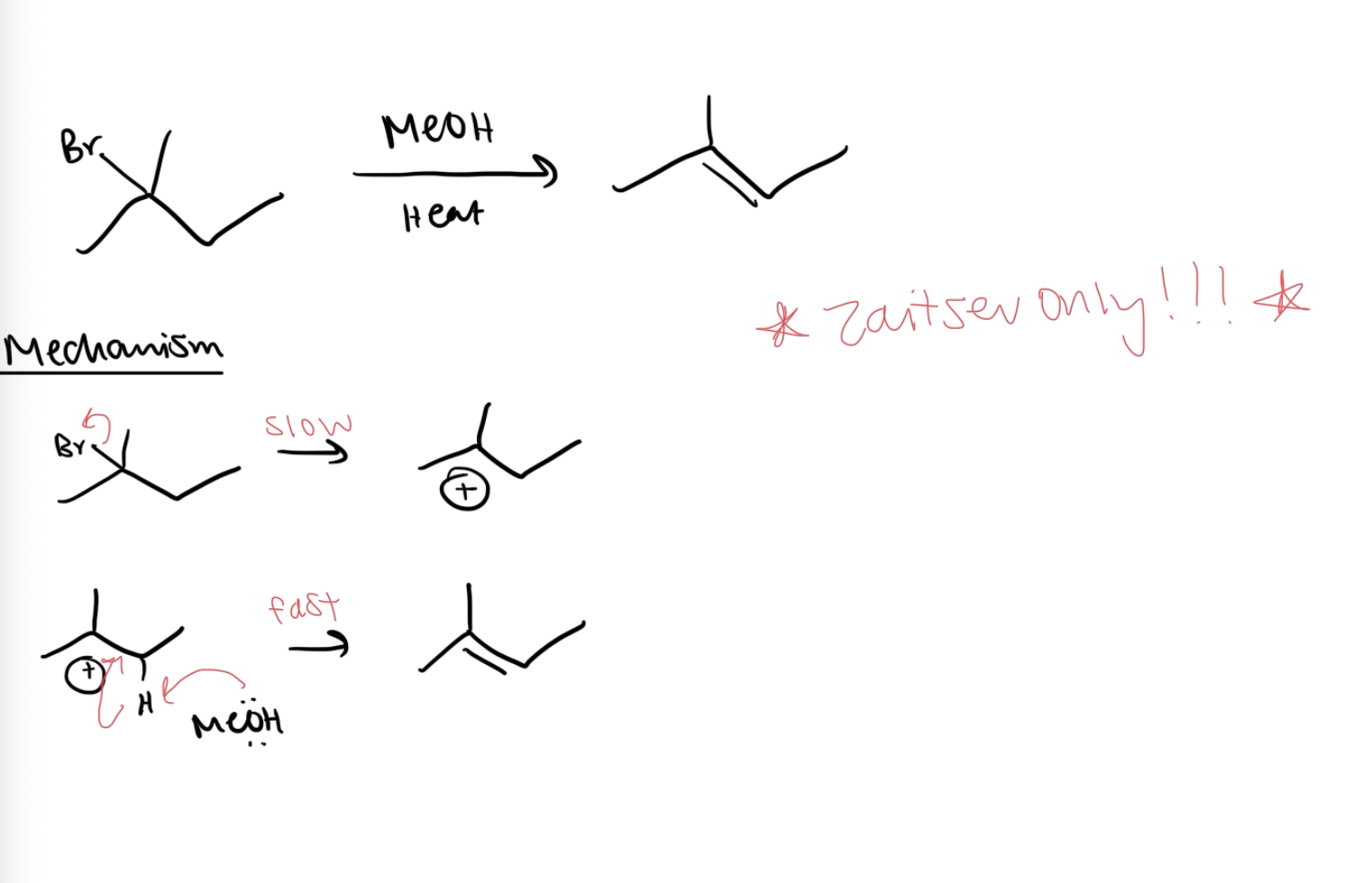
Elimination: E1
takes place in more than one step
A carbocation intermediate forms (same as with the SN1 reaction)
Tertiary alkyl halides work the best
Rate = k[alkyl halide]
same for SN1 and E1
Zaitsev only
What role does temperature play?
low temp = SN1
high temp = E1
H2O in E1:
if acting as a Nu, it attacks the carbocation directly
if acting as a base, it takes proton
For methyl halides:
Only SN2 possible
For 1° alkyl halides:
SN2 mainly
E2 if strong, sterically hindered base used (like potassium t-butoxide)
For 2° alkyl halides: SN2
with weakly basic nucleophiles
I–, Br–, CH3COO– = AcO–, –CN, or –N3
For 2° alkyl halides: E2
if a strong base is used
Zaitsev w/ NaOH, NaOMe, or NaOEt
Hofmann w/ KOtBu
For 2° alkyl halides: SN1 & E1
Low temp = SN1
High temp = E1
w/ solvents with H2O, MeOH, EtOH
For 3° alkyl halides: E2
No SN2 possible
E2 if a strong base is used (Zaitsev w/ NaOH, NaOMe, or NaOEt or Hofmann w/ KOtBu)
For 3° alkyl halides: SN1 or E1
Low temp = SN1
High temp = E1
w/ solvents with H2O, MeOH, EtOH
Dehydrohalogenation that proceeds by an ____ mechanism is the best for synthesizing alkenes?
E2
Dehydrohalogenation products?
can yield both Zaitsev’s and Hofmann products
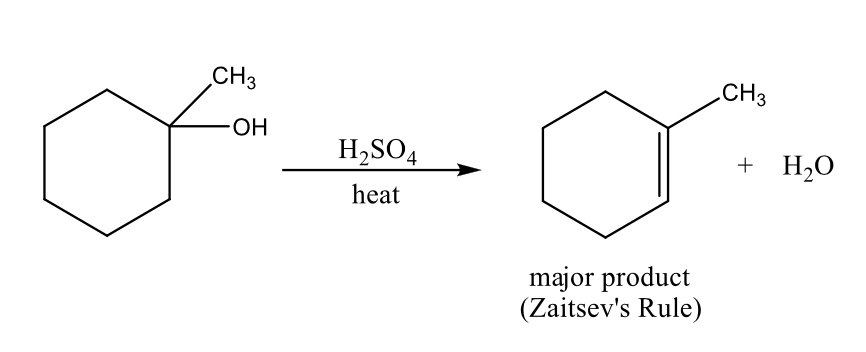
Acid Catalyzed Dehydration of Alcohols:
Alcohols undergo dehydration to give alkenes
The most substituted alkene will be the major product
If it’s a tertiary or secondary alcohol it will proceed by:
E1
if it’s a primary alcohol, it will proceed by:
E2
Acid Catalyzed Dehydration of Alcohols temperature trend:
primary will need very high heat, secondary is less, and tertiary is even lower
Some 1° & 2° alcohols can undergo:
rearrangement
Carbocations can move:
only once

Hydride shift?
A H shifts to make the carbocation more stable

Methyl shift:
methyl group shifts to make carbocat more stable

Ring expansions:
ring opens up and expands to make carbocat more stable
Ring expansions that can happen:
3C to 4C
4C to 5C
5C to 6C is maybe
Ring expansion that won’t happen:
6C to 7C
Once the carbocation is stabilized by the shift, what happens?
final double bond forms and gets rid of carbocation
Sodium amide (NaNH2) is used to:
deprotonate a terminal alkyne — this is how you lengthen carbon chains

After a terminal alkyne has been deprotonated:
use either a methyl or or primary alkyl halide to do SN2
Synthesis of alkynes method 1:
Start with a vicinal dibromide
Vicinal means adjacent or 3 bonds away
Do two E2 eliminations


Synthesis of alkynes method 2:
Prepare a geminal dihalide from a methyl ketone
then do 2 E2 eliminations

Hydrogenation of Alkenes:
addition of H2 across the double bond
syn addition
Syn addition =
same side
Anti addition =
opposite sides

Catalytic hydrogenation goes by:
syn addition; both hydrogens add to the same side (or face)

Halogens will add to an alkene via:
anti addition; both halogens add to opposite sides (or faces)
To convert an alkyne into a cis-alkene:
use lindlar’s catalyst

To convert an alkyne into a trans-alkene:
use Li or Sodium Metal, NHs(l)

To convert an alkyne to an alkane:
two equivalents of H2 must be used with Pt, Pd or Ni
this removes all pi bonds
