Blood Typing and Blood Transfusions - 8 :)
 Call Kai
 Learn
 Practice Test
 Spaced Repetition
 Match
 Flashcards
 Knowt Play
1/23

There's no tags or description
Looks like no tags are added yet.
24 Terms
When where the first blood transfusions carried out ?
1665 - by Dr Richard Lower with animal blood
1828 - James Blundell → blood transfusion method
1900 - Dr Karl Landsteiner → 4 MAIN BLOOD GROUP DISCOVERED
What is donated blood needed for ?
Blood loss due to:
→ injury and surgery (27%)
→ Maternity (6%)
→ Cancer care/ anaemia (67%)
5000 Unita needed every day in the UK.
6 days of blood stock aimed to keep

What factors are looked at for safety during blood donations /
good health
unpaid volunteers
excluding donors who have risk factors (jaundiced, travelled recently, recent tattoos or piercings, risk factors for HIV).
Screen blood
Screen for compatibility of donor and recipient
What are some of the tests done on blood to screen it?
ABO group
Rhesus group
Red cell Ab screening
Ab for HepC
Ab for HIV
Ab for syphilis
Ab for HTLV-I and HTLV-II (causes leukaemia)
Ab to West Nile Virus (USA)
What does each blood types antigen made of ?
SUGAR CHAINs attached on the RBCs
O → terminal (ends with) fuc (fucose)
A → fuc + galnac (N-acetyl galactosamine
B → fuc + gal (galactose)

How popular is each blood group ?
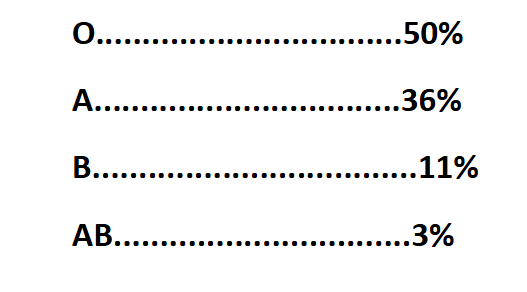
What 2 types of antibodies are important in donating blood?
IgG → only made after exposure to to a foreign Ag.
IgM → made without prior exposure to the Ag.

What antibodies are present in each blood type group ?
Notice the antibodies are IgM.

RHESUS GROUP
RHESUS GROUP
What is Rhesus?
A transmembrane protein on the surface of RBCs - an IgG antigen
Inherited by parents → NOT EVERYONE HAVE THEM (rhesus - positive )
Different groups:
d
D
c
C
e
E
The rhesus gene is autosomal recessive (MOST PPL ARE Rhesus positive )

Key facts about the rhesus antigens and antibodies
Rhesus antibodies are IgG
Present only in the plasma
If a person is exposed to a rhesus antigen (non-self) IMMUNE RESPONSE TRIGGERED.

How many different blood groups are there ?
44
Importance for donations:
MOST IMPORTANT - ABO group
Rh slightly less but still important (Rh D or d causes the most problems)

What happens when your body recognises a blood type which does not match enters its system ?
Natural immunity → IgM antibodies (large) are produced, they do not need prior exposure to ABO antigens (anti-A or anti-B)
Adaptive immunity → IgG antibodies (small) are produced, they are only produced when exposed to other RBC antigen e.g Rhesus (Rh)
Explain the acute reaction caused by incorrectly matched blood types
Acute Transfusion Reaction
Within minutes
Agglutination of IgM
Lysis of IgM
Haemoglobin released (heamoglobinuria)
Hb broken down to bilirubin → TOXIC
Fevers, chills, nausea, clotting, necrosis of kidneys

Explain the delayed reaction to incorrectly matched blood
Delayed transfusion reaction - 5 - 10 days after
Usually caused by a mismatch in Rh, Kidd, Kell and Fy
First time exposed to mismatch: IgG produced
Repeat exposure: IgG binds to RBc, breaks RBCs down
Symptoms: fever, low Hb, inc bilirubin, mild jaundice, anaemia.
Explain Haemolytic Disease of Foetus
Mum → Rh Negative
Baby → Rh positive
Mum → immune response: produces anti-Rh (IgG)
Blood from child and mum mixes through placenta
IgG from mum destroys RBCs in babies

Explain prophylactic treatment for haemolytic disease in newborns
First baby is born Rh+
After birth mum gets Anti-D antibody
This neutralises Rh+ from the baby
SO no anti-Rh+ raised in the mother
Second child (if Rh+) will not get the disease
Explain how to determine blood type via agglutination assay
Place blood on slide
Add a certain IgM antibody
Observe whether blood clumps (agglutinates) or not
Example
We are testing blood with IgM anti-A, If the blood is group A what will it show?
CLUMPS - anti-A binds to A antigens on RBCS, this causes agglutination

Explain how the microplate blood grouping works
same as agglutination assay but in a plate with a few extra tests
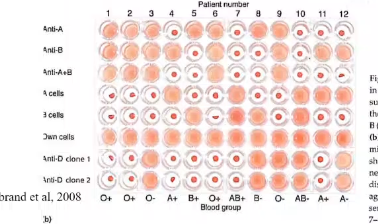
Top three rows: test for A, B or O
Bottom two rows: test for Rh- or Rh+
Own cell row: control nothing should happen
A cell and B cell row: If blood contain the antibodies against that blood type clumping will occur.
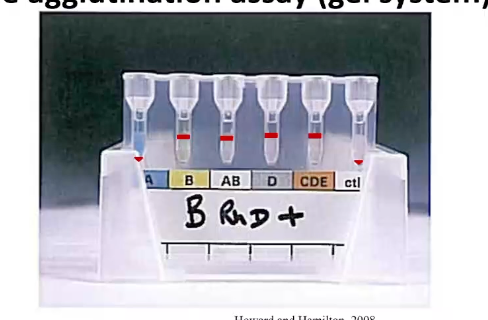
Explain the gell card system to identify blood group types
6 columns, blood added into, then centrifuged, if blood goes through the gel no agglutination.
Each column contains a different gel which contain as following:
Anti - A
Anti - B
Anti - A and anti - B
Anti D
Anti - CDE
Anti - ctl
Example : B RhD+
State compatibility of each blood type group when transfusing RED CELLS. (different for plasma)

What is the last test before transfusion ?
Cross matching
Take sample of patients blood
Take sample of donor blood
Mix
If agglutination occurs (one of the bloods contains antibodies that will attack donor blood).
NOT COMPATIBLE
Why would people who get repeat transfusions need blood that’s also screened for Kidd, Kell and Duffy aswell as ABO and Rh?
For example
Person gets transfusion, Duffy is not a match → patient produces anti-duffy → if that blood is transfused again patients immune response occurs now incompatible
Same happens with Kell and Kidd → blood is incompatible
This may also occur in patients that have been sensitised previously: received blood via pregnancy or transfusion
True / false


Last T/F : F bc antibodies in the patient’s blood attacks and causes lysis of the DONOR BLOOD not patient’s blood.