Topic 3: Gene mutations and variation (j&k)
 Call Kai
 Learn
Learn Practice Test
 Spaced Repetition
 Match
Match Flashcards
 Knowt Play
1/29

Earn XP
Description and Tags
30 Terms
What are mutations?
Rare and random changes in the structure of the DNA. They can happen in individual genes or in whole chromosomes
When do mutations usually happen?
When the DNA is being copied before a cell divides
How do mutations affect proteins?
They cause changes in the amino acid sequences of the protein, this can causes changes in the 3D shape of the protein, and ultimately mean it works differently or not at all
Give an example of a mutation
Sickle cell Anaemia
What is sickle cell anaemia?
A genetic disorder. It affects the haemoglobin - a protein that carries oxygen around the body. In sickle cell patients the haemoglobin doesn’t work properly, and it distorts the red blood cells, making them sickle shaped.
Give two symptoms of sickle cell anaemia
episodes of pain, swelling of hands and feet, vision problems, delayed growth or puberty
What does the mutation physically do to the haemoglobin? (in sickle cell)
the mutation changes one of the amino acids in the haemoglobin protein. This changes the shape of the haemoglobin, making the protein less good at carrying its role of transporting oxygen around the body
What are the four types of mutations?
Substitution, deletion, duplication and insertion
What is the mutation substitution
A base in the DNA sequence is randomly swapped for another base
it only changes one amino acid for the group of three bases which the mutation occurs. So will not have a knock on affect.
What is the mutation deletion
A base is randomly deleted from the DNA sequence.
Deletion changes the whole amino acid that would have been coded for. It affects every triplet (amino acid ) after the deletion
What is an insertsion mutation?
When a new base is randomly inserted into the DNA sequence.
An insertion changes the amino acids that would have been coded for by the group of three bases in which the mutation occurs.
It affects every mino acid as it changes the groups of three bases further on in the dna sequence
Fill in the gab: mutations can also occur in _______ regions of DNA.
Non-coding
Before transcription can happen RNA polymerase attaches to the DNA at a binding region at the start of the gene. Mutations in this binding region a stop RNA polymerase from binding. What effect will this have on the protein made by that gene?
It stop s transcription so the protein is not made
if the mutation occurs at a non-coding region it can stop a gene from being expressed
Why are mutations in egg and sperm cells potentially more significant than mutations that happen in other body cells(such as nerve or muscle cells)?
Because the sperm and egg cell fuse to made a new generation, therefore the mutation is passed on so every cell in the embryo will have the mutation
What are mutagens?
Agents that increase the likelihood of mutations.
Give examples of mutagens?
Chemicals; such as those in cigarette smoke, mustard gas etc
Ionising radiation; UV light, X-rays, Gamma rays
What is polygenic inheritance?
Most characteristics are controlled by many genes, rather than one, this is referred to as polygenic inheritance
What are some consequences of mutations?
Increased amounts of variation ( could be because it reproduced asexually)
Some mutations cause small changes to the protein, perhaps only one amino acid, and rarely mutation will cause huge changes in the protein and therefore genotype
Give examples of how protein change can result in a phenotype change
Albinism, sickle cell anemia and eye colour
why is it a beneficial to have variation in species?
So that the can adapt to their environment and evolve to changing environments to increase their chance of survial
What was the aim of the Human Genome project?
To find a new way to access and search the genome of different species.
Give 4 aims/ outcomes of the Human Gneome project
to find the positions of genes on chromosomes
To identify the alleles that cause mutations
To be used for genetic testing/ predicting diseases
What do you call mutations that will not change the protein produced in transcription/ translation?
Neutral mutations
Although there are differences in the DNA between different people, the people may look very similar. Explain why?
Because most mutations do not affect the genotype
Define genetic variation
Variation in different alleles
Define environmental variation?
How the environment affect the individual
What are the two types of variation?
-Continuous variation: where the characteristics can take any value in the dataset (e.g hair length)
-Discontinuous variation: where the characteristics can take only one of a limited set of values in a data set
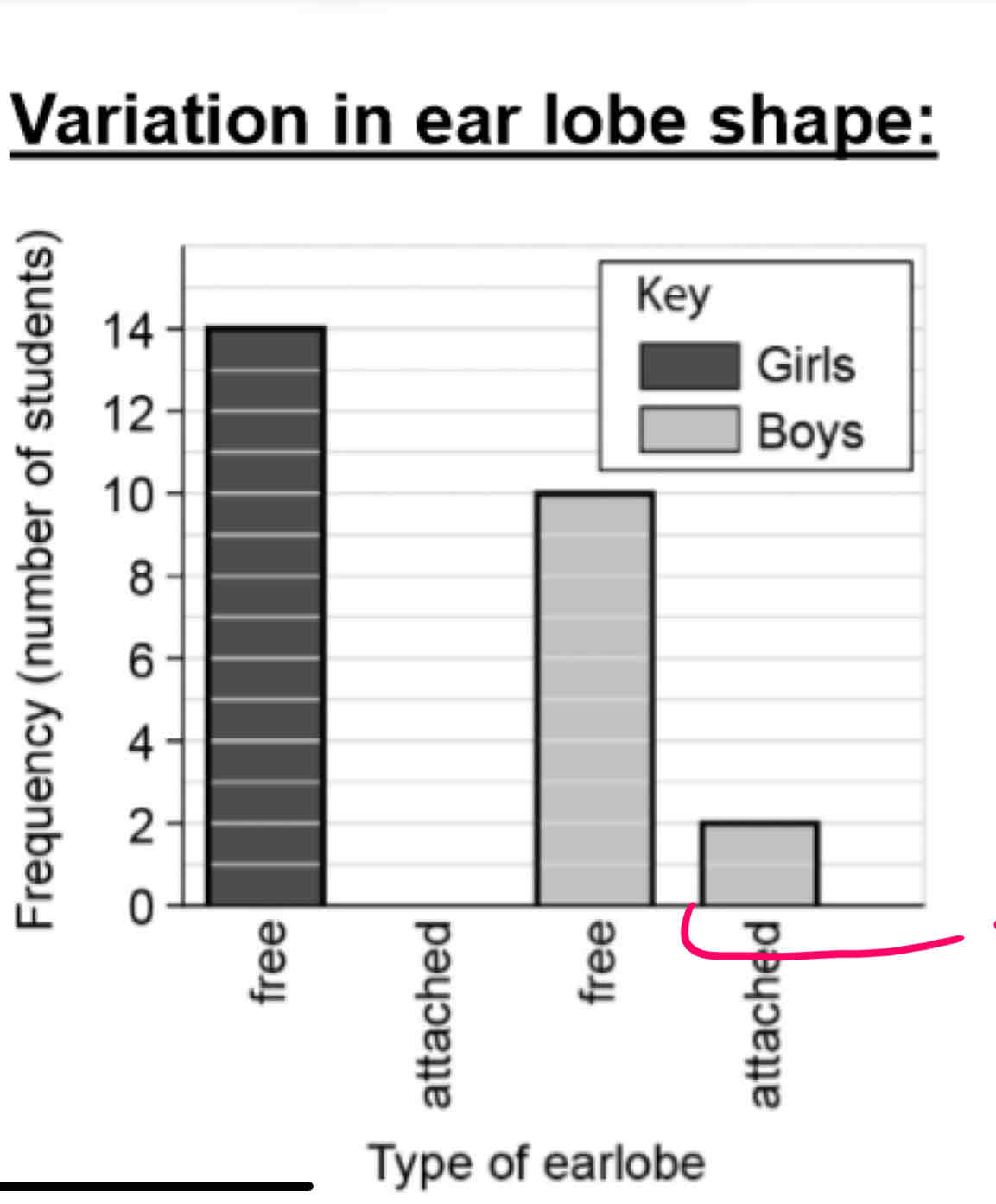
Does this graph show continuous or discontinuous variation?
Discontinuous
(The graph has spaces between the bars)
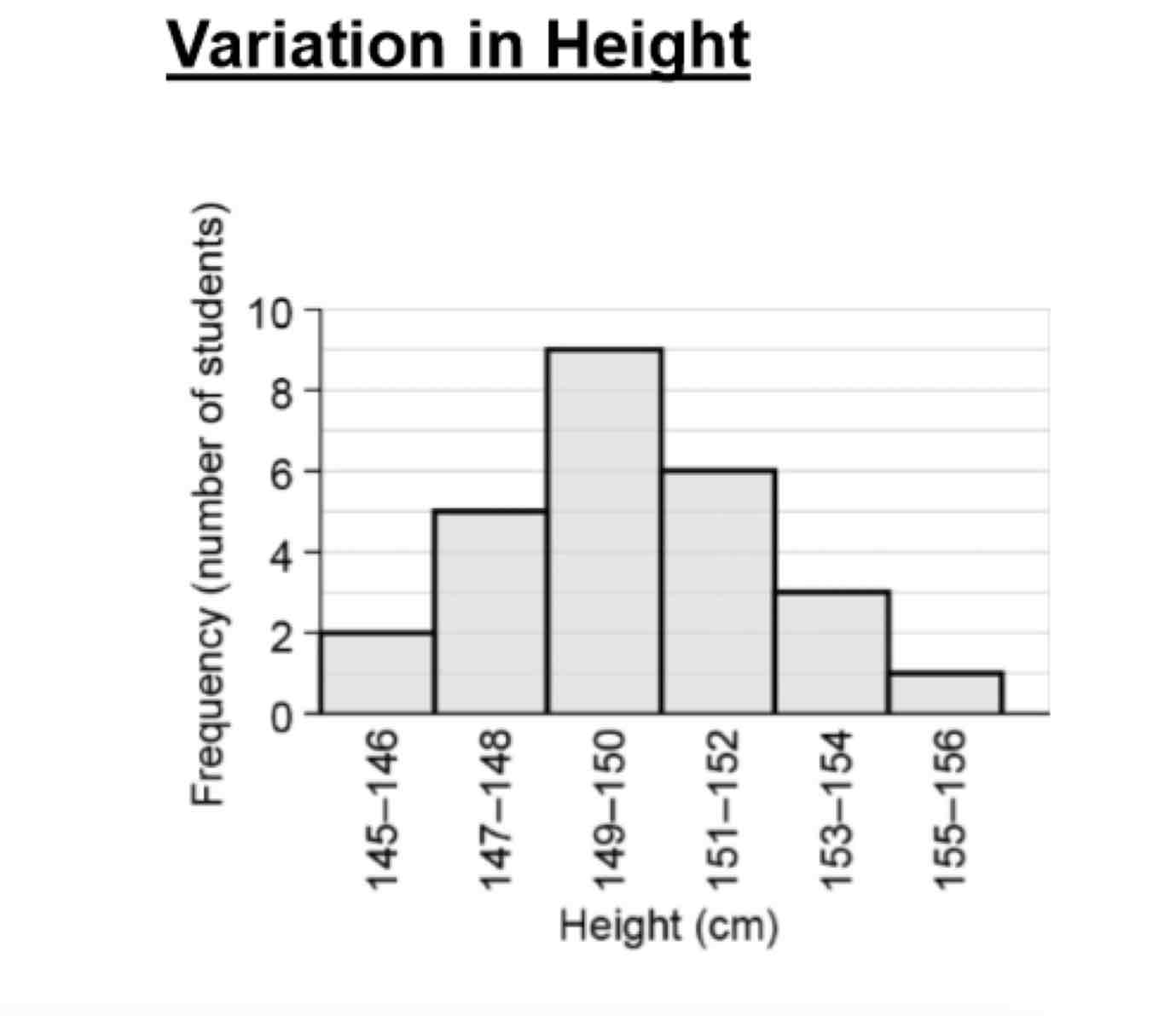
Does this graph show discontinuous or continuous variation?
Continuous
What is normal distribution?
When the most common value is the middle value in the whole range
The further a value is from the median, the fewer individuals have that value
Continuous variation form a bell-shaped curve, known as a normal distribution