Psychotherapy Exam 3
 Call Kai
 Learn
 Practice Test
 Spaced Repetition
 Match
 Flashcards
 Knowt Play
1/54

There's no tags or description
Looks like no tags are added yet.
55 Terms
Psychotherapy Orientations
Schools of thought that guide the theory & practice of psychological treatments
Psychotherapy Theory
The ideas, philosophies, &/or scientific principles that inform & underlie the psychotherapy
Therapeutic Techniques
Planned activity/skills used in therapy informed by psychological principles
Ex. Leaves on a stream, cognitive restructuring
Case Conceptualization
The working model of our client & how they function
The processes we think contributes to the development & maintenance of their psychopathology
Unified and Eclectic Approaches Background
Commonalities among diff orientations
Theoretical overlap
Psychological models & theories that inform the development of psychopathology & treatment
Similar therapeutic techniques
The skills & approaches actually used in therapy
Shared treatment mechanisms
The psychological processes treatment acts on to improve outcomes
Integrative psychotherapy
Broad approach that recognizes commonalities between diff orientations
Incorporates ideas & concepts from diff orientations
Rationale: Both clients & therapists may benefit from flexible use of therapeutic techniques compared to rigid systems
Orientation Overlap
Mind Body Awareness
Mindfulness; Downward Arrow; 5 Senses
Behavior Modification
TIPP
Cognitive Flexibility
Defusion; Downward Arrow; Cognitive Restructuring
Exploration of Past
Integrative Psychotherapy
Broad approach of combining diff psychotherapy orientations
Eclectic:
Selecting different psychotherapy techniques across 2 or more orientations based on what appears to be best for the current case/situation
Ex. Client learns to practice mindfulness in one session & to identify defense mechanisms in another session
Integration:
Merging psychotherapy theory and techniques of two or more orientations into one cohesive psychotherapy approach
Ex. Combining psychodynamic and behavioral theory into a single treatment with a blended theory & approach where clients engage in free association & exposures
Types of Integrative Psychotherapy
Eclectic: picking out diff pieces of individual psychotherapy orientations
Unsystematic eclecticism
Arbitrarily picking & choosing diff techniques w/little theoretical underpinning or integration
Poorly informed selection of therapy skills across orientations w/little consideration on how it addresses the client’s presenting problems
Technical eclecticism
Selecting skills that fit the need of the client
Doesn’t subscribe to a specific theory, but should be based in evidence-based techniques
Hard to determine what pieces of each orientation are helpful
Integration
Theoretical integration
Blends together theory & techniques of individual psychotherapy orientations into 1 cohesive approach (UP)
Synthesizing models of psychopathology & treatment mechanisms from multiple orientations
Unclear how merged theories translate to clinical practice w/out a lot of research, hard to test these theories
Technical Eclecticism
Eclectic approach
Most common psychotherapy orientation
Using multiple orientations to develop a case conceptualization to understand the client’s presenting problems & to select effective therapy skills to match those problems
Case conceptualization may not be grounded in a single orientation, but informed by multiple, well-established theories
As the clinical focus of therapy changes, new strategies or frameworks are introduced
Case example:
Social anxiety disorder & Major depressive episode
Relationship anxiety stems from an insecure attachment style from an inconsistent mother
Start with managing transference within the therapeutic relationship
Current avoidance may be due to the core cognition “I am unlovable”
Move to cognitive restructuring
Requires slow, deliberate shifts
Pros and Cons of Eclecticism
Pros:
Some research supports that matching client problems to specific techniques may be helpful
Easier to be attentive to client preferences
Simple to implement
Cons:
Difficult to study
Unstandardized, no manuals
Practices vary
See unsystematic v. technical eclecticism
Little research supports using eclecticism over single therapy approaches
Unified Protocol
Integrative approach (theoretical integration)
Integrates both theory & techniques
Primarily CBT-focused w/integration of ACT & DBT theory & techniques
Manualized approach blending the theory & therapy skills/techniques of multiple appraoches to address emotion regulation
Developed to treat a broad range of “emotional disorders,” E.g.,
Anxiety disorders
Mood disorders
Mild borderline personality disorder
Obsessive-compulsive disorders
Manualized
Focused on improving emotion regulation
The Triple Vulnerability Model
Multiple factors contribute broadly to the development of all emotional disorders
Biological vulnerabilities
Genetic factors that contribute to psychopathology
Generalized psychological vulnerabilities
Learning from early life experiences that increase negative emotions in general
Specific psychological vulnerabilities
Learning to associate specific thoughts, emotions, physical sensations w/danger
Unified protocal
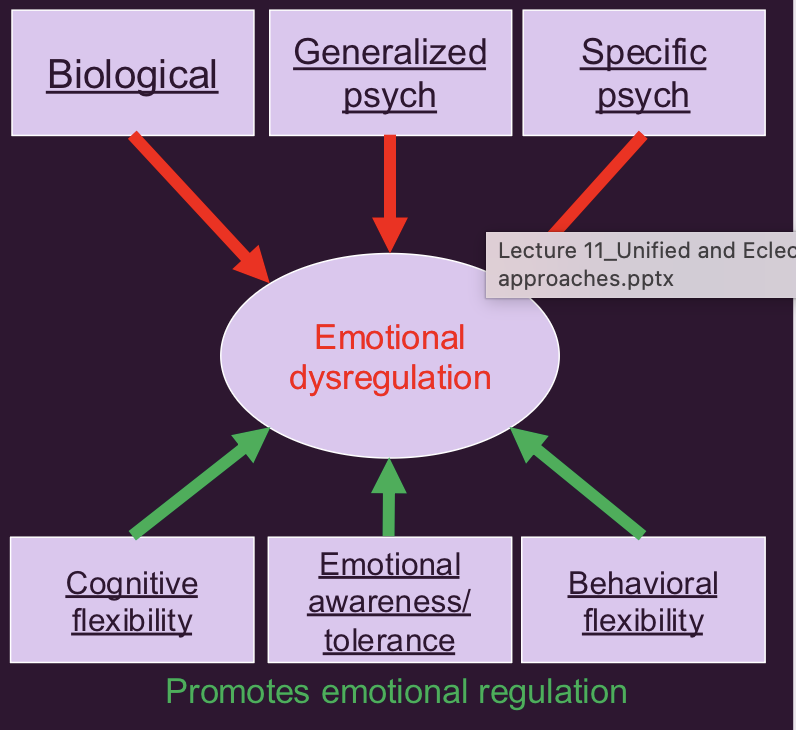
Unified Protocol Therapeutic Techniques
Core modules:
Present-focused emotional awareness
Cognitive flexibility
Addressing emotion tolerance & emotion-driven behaviors (reducing emotional avoidance)
Exposures
Present-Focused Emotional Awareness
Identify emotions & reactions to emotions
Develop a more nonjudgemental, present-focused experience of emotions
Based in acceptance-based approaches → contact with the present moment
Mindfulness practices
Unified protocal
Addressing Emotion Tolerance
Identify emotions the client avoids & behaviors they engage in to avoid these emotions
Emotionally driven behaviors
Develop greater acceptance, reduced avoidance of difficult emotions, reduce emotionally driven behaviors
Based in cognitive-behavioral and acceptance-based approaches
unified protocal

Cognitive Flexibility
Identify automatic thoughts & recurrent patterns of thinking
Develop more flexible thinking
Based in cognitive-behavioral approaches → Downward arrow, Thought records
Unified protocal
Exposures
Broad focus on situations that evoke specific, avoided emotions
Develop inhibitory learning, more flexible behaviors, & tolerance of negative emotions
Based in behavioral approaches
Interoceptive exposures
In-vivo exposures
Imaginal exposures
Behavioral activation
Pros and Cons of Integration
Pros:
Easier to study
Can develop testable theories
Create manualized treatments
More research supporting efficacy/effectiveness
Cons:
Difficult to create treatments
Merging theory is complex
Unclear which techniques to choose
Little evidence that blending treatments is more effective than focusing on a single treatment
Interpersonal Background
Interpersonal Psychotherapy (IPT)
Focused on depressive symptoms
Developed for randomized control trials (RCTs) for depression medications
Developed to be used in tandem with depression medication
Found evidence that combining medication and therapy is better than either alone
Social-interpersonal focus
Focuses on attachment and interpersonal domains
Medical Model of Depression
Depression is a treatable illness
Not a personal failing
Diathesis-Stress Model
Diathesis-Stress Model
Diathesis = Biological predispositions that contributes to the development of symptoms
Stress = Life events that contributes to the development of symptoms
Focus on the Gene X Environment interaction
Interpersonal Sources of Psychopathology
Biological sources like genetics, neurotransmitter imbalance
Environmental sources, specifically social/interpersonal issues including:
Grief
Role dispute
Role transition
Social deficits from isolation
Interpersonal Focus of Therapy
Improving social functioning to reduce depressive symptoms
Manualized
Active therapist
Focused
Time-limited
12-16 weekly sessions
Interpersonal Why Keep It Time Limited?
Therapy, especially earlier interventions, included no time limits
Catered towards wealthier clients, not those with the most need
Cost-benefit considerations
Economic burden
People with psychopathology more likely to experience financial strain
Low socioeconomic status associated with psychopathology
Dose-response curve
Identifying the “optimal” amount of treatment
13-18 sessions may be optimal for most people
Not a one-size approach
Interpersonal Therapeutic Techniques
Reducing stigma and normalization of experiences
The sick role
Linking mood and interpersonal contexts
Processing grief
The Sick Role
Applying a medical lens to the problem
Labelling psychopathology as a treatable illness
Temporary state
Recovery focused
Reduces self-stigma and blame
Linking Mood and Interpersonal Contexts
“How have things been since last session”
When the client talks about mood, link it to an event
When the client talks about an event, link it to a mood
“I spent the whole week in my room”
“I felt so lonely this week”
Processing Grief
“Grief” used broadly to apply to loss
Loss of a loved one
Loss of a role or identity
Encouragement of affect
Practicing emotional expression, awareness, and regulation
Understanding what emotions signal in interpersonal contexts
Experiencing feelings related to grief
Expressing negative emotions
Allowing positive emotions without guilt
Identifying unproductive mourning and introducing productive mourning
Cultivating new interests, relationships, roles
Interpersonal Treatment Mechanisms
Improved social functioning
Improved self-esteem
Decreased rumination
Reduced repetitive, depressive thinking
Improved emotional processing
Better able to identify and manage emotions
Systems-Oriented Therapies
Focused on “Systems” which are elements interacting within a group
Systems = elements interacting within a group
AKA how individuals interact within a social group
Parents and children within a family
Spouses within a marriage
Family system = Individual family members (parents, children) + all interactions across all individuals
Systems-oriented therapies typically focus on families or couples
Definitions of family and couples are expansive to account for different cultural/social norms
Therapy includes:
Understanding dynamics between individuals within the system
Improving individual and system functioning
i.e., improving healthy family functioning
Systems Approach to Child Psychotherapy
Children are typically not independent individuals
Child behavior is, in part, dictated by the family
Focusing psychotherapy exclusively on the individual (i.e., the child) does not address the effect of the system (i.e., the family) on behavior
A systems approach allows treatment to address both individual and system effects on behavior
Can change behavior across multiple people in the system
I.e., treating both the child and the parent
Variation in how much the psychotherapy focuses on the individual v. the system
Childhood Psychopathology
Psychological issues differ across the lifespan
Developmental disorders
Psychopathology emerging early in life, infancy or childhood
E.g., Attention deficit hyperactivity disorder (ADHD), autism spectrum disorder (ASD)
Non-developmental disorders also occur in childhood, but presentations differ compared to adults
E.g., Anxiety symptoms in childhood
Somatic symptoms like stomach aches
Nightmares
Irritability, tantrums
Difficulties with school
Developmental and other types of psychopathology are highly comorbid
About 1/3rd of children with ADHD also have an anxiety disorder!
Identifying and treating psychopathology in childhood is challenging
What is developmentally appropriate?
Difficulties verbalizing symptoms
Externalizing
Emotional and cognitive difficulties manifest externally
E.g., disruptive or destructive behavior
Internalizing
Emotional and cognitive difficulties manifest internally
E.g., depression or anxiety symptoms
Psychotherapy Approaches for Childhood Psychopathology
Child-focused
Directly targeting difficulties experienced by the child
Level of parental involvement depends on the problem, age of the child
Example: CBT for anxiety in adolescents
Parent-focused (or care-givers)
Focused on the parent-child relationship and how parents can address difficulties with the child
Building skills with the parent to improve parenting behavior
Also reduces the child’s symptoms and problem behaviors
Example: Parent Child Interaction Therapy (PCIT)
Family-focused
Child-focused Psychotherapy
Much of the session will only include the child
Focus on difficulties with the child
Caregivers will attend some sessions and/or join in for parts of the sessions
Parents take supportive, less active role in therapy
Adapted Interventions
Evidenced-based psychotherapies for adults → Tailored to be developmentally appropriate
Less technical, more kid-friendly
Fewer, less verbal, simplified psychotherapy techniques
Interactive activities
Pictures/drawings
Less emphasis on complex topics
Use of stories, metaphors, and acronyms to explain and remember harder concepts
Parent-reports if child-report not possible
CBT for Adolescent Anxiety
Traditional CBT adapted for children ages 12-17 years old
Simplified ABC model and functional analysis
Concrete examples using stories
Less focus on core beliefs due to limited cognitive capacity
More emphasis on behaviors
Focus on identifying emotions via physical feelings
Contingency management
Target behaviors are encouraged through positive reinforcement
Providing rewards
Modified therapy techniques example
ABC Model: Functional analysis
Challenges with Child-Focused Psychotherapy
Addressing only the child’s problems may not improve outcomes
Parents and family are key in treatment
Home environment is highly influential on symptoms and behavior
Low psychotherapy engagement for unmotivated children
Parent-Focused Psychotherapy
Session includes both a caregiver and the “target” child
Focus on difficulties between the parents and child
Parent active in therapy
Parent Child Interaction Therapy
Developed to address conduct problems or “antisocial” behaviors:
Tantrums
Physical violence
Rule breaking
Lying
Stealing
Reduces the likelihood of parental abuse
Initially developed for children ages 2 to 7 years old
Based in attachment theory, modeling, and operant conditioning
Play therapy
Using toys and games to practice therapy skills in real time
Overall therapy goals:
Decrease problem behaviors
Negative punishment
Increase prosocial behaviors
Positive reinforcement
Two stages of therapy:
Child-directed interactions
Goal: Increase positive parent-child interactions
Parent-directed interactions
Goal: Increase effective parent commands and child compliance
PCIT Therapeutic Techniques
Child-directed interactions
Teaches parents to build a warm and responsive relationship during child-led play
“Special time”
Foundational skills:
Praise
Verbal reflections
Imitation
Behavioral descriptions
Enjoyment
Ignoring inappropriate behavior
Parent-directed interactions
Teach parents to monitor child behavior and apply consistent consequences
Foundational skills:
Learning effective commands
Start with a brief “why” for the command
Direct
Calm
Specific
Positively stated
One at a time
Providing consistent, predictable consequences
Time-outs
PRIDE Rule
Praise appropriate behavior
“I like the way you’re being gentle with your toys”
Reflect appropriate talk
Child: “I’m mad, it’s broke”
Parent: “You’re mad because it isn’t working”
Imitate appropriate play
“You’re drawing a cat. I’m going to draw one too!”
Describe appropriate behavior
“You’re sharing your teddy with me.”
Enjoy
Make eye contact, physical touch, show happiness.
Systems Theory
Families seek to balance organization with growth and change
Family development: The family unit is constantly evolving including changes in relationships and roles
Balancing flexibility with stability and structure through specific behaviors
Family health
Behaviors within a family systems may create healthy or unhealthy family dynamics

Family Health Factors
Key features that influence family health include:
Attending to basic needs
Parent providing food and shelter for their children
Boundaries
Allowing for family members to have some privacy
Power dynamics
Parents serving as the authority figure
Autonomy
Encouraging older children to be independent
Interactions with outside community
Attending social events as a family
Rules
Parents establishing clear, consistent restrictions for the well-being of a child
Warmth and engagement
Spending enjoyable quality time as a family
Communication norms
Establishing how to express needs
Stress management
Strategies to handle family crises
Family Level Sources of Psychopathology
Psychopathology might be at the family and/or the individual level
Family-level
Family dysfunction occurs when features of family health are absent or extreme
Key feature:
Attending to basic needs
Childhood neglect
Boundaries
“Parentification” of children, enmeshment of child and parental responsibilities
Power dynamics
Parents asserting excessive control over children
Autonomy
Refusing age-appropriate freedom for teenagers
Interactions with outside community
Isolation of the family
Rules
Inconsistent or covert family rules that were not negotiated between family members
Warmth and engagement
Low emotional warmth, few family interactions
Communication norms
Difficulties listening and responding to other family members
Stress management
Maladaptive coping strategies like substance use, violence
Individual Level Sources of Psychopathology
Family therapies focus on the intersection of between:
An individual’s symptoms
The interpersonal context
Family context can increase the risk of psychopathology and worsen or prolong symptoms
Early family therapy focused on changing the family context for clients with schizophrenia
Toxic family stress
Frequent, continuous emotional stress
Expressed emotion:
Expression of emotions in unhelpful ways towards a family member with severe psychopathology
High levels of criticism
Hostility
Emotional overinvolvement
Overly protective or self-sacrificing
Historical Approaches
Rooted in psychodynamic therapy
Focus on the history of relationships within the family:
Childhood experiences for each member
Intergenerational transmission
Unconscious manifestation of unresolved conflicts
Defense mechanism
Transference, counter-transference
Treatment seeks to manage transference, promote insight, and create positive alliances between family members
Type of family therapy
Present-Oriented Approaches
Focus on repetitive behavioral patterns within the family system:
Overly broad application of behaviors
Rigidly applied behaviors
Treatment seeks to enhance family:
Collaboration
Problem-solving
Communication
Identify how unhelpful behaviors are maintained and modify behaviors
Type of family therapy
Functional Family Therapy
Present-oriented approach
Developed to address disruptive behavior problems in adolescents
Conduct problems
Substance use
Based in understanding family relationships and how behaviors function within the family
Influenced by systems theories and CBT
Understanding what is reinforced in the family that encourages specific behaviors
12-14 weekly sessions
Includes all family members
Treatment focuses on applying therapy skills across every family member relationship
E.g., Parent-child, child-sibling, parent-parent
Family Therapies Therapeutic Techniques
Five phases:
Engagement-Maximizing engagement to attend therapy sessions
Establishing trust, listening/recognizing family struggles
Motivation-Increasing alliance between members
Reducing feelings of blame/hopelessness
Relational assessment-Identifying how family behaviors interact and function as well as the thoughts and feelings they cause
Reframing behavior
Not just labelling an individual’s behavior as good or bad, but understanding intention
Moving from external attributions (it’s your fault!) to internal attributions (I take responsibility for my feelings and needs)
Behavior change
Skills training including improving communication, anger management, managing expressed emotions, improving parental supervision and parenting skills
Generalization
Extending behavioral skills to other situations and fostering independence with these skills outside of session
Couples Therapies Background
A systems-orientated therapy
Elements interacting within a group
Partners within a relationship
Focused on the health of the relationship system
Understanding the dynamics between the partners
Addressing the problems resulting from these interactions
Main goal is to reduce distress for the couple, but not necessarily maintain the relationship
Maintaining and improving the relationship OR'
Ending the relationship in a mutual and healthy way
When we use:
Partners are experiencing distress and/or major relationship problems
Secondary treatment for when a partner is experiencing psychopathology
Developing a support system
Repairing damage to the relationship from psychopathology
When we don’t use:
Domestic violence
Conflicting, irreconcilable goals
Couples Therapies Sources of Psychopathology
Neither partner is the problem, interactions between the partners are the problem
Understanding reciprocal cycles within the relationship, how behaviors interact
Example: Pursuer-distancer cycle
Imbalance of autonomy and closeness
Results in dissatisfaction with intimacy
4 horsemen of relationships
Criticism: Attacking the character of the other partner
Contempt: Holding moral superiority over the other partner
Defensiveness: Not taking responsibility, making excuses
Stonewalling: Withdrawing from or shutting down within interactions
Couples Focus of Therapy
Most sessions include both partners
Establish ground rules
What if anything will be confidential between partners
Taking turns talking
Being respectful
Therapist can’t play sides
Address split alliance
Building rapport and encourage participation with both partners
Couples Therapeutic Techniques
Behavior modification
Relational tools
Behavior Modification
Couples Therapeutic Technique
Developing a high ratio of positive to negative behaviors
Positive/negative exchanges
Interpersonal events that are perceived as either positive or negative
Simply creating structured positive exchange reduces the impact for the other partner
Sentiment override
The views or thoughts around a behavior are just as important as the behavior itself
Splitting: One’s partner is viewed as either all good or all bad
Positive or negative filters
Perception that reshapes a partner’s behavior as either positive or negative
Relational Tools
Couples Therapeutic Technique
Identify family of origin issues that contribute to relationship problems
Skills to improve relationship quality:
Communication skills
E.g., Reflective listening
Problem solving skills
E.g., Defining the problem and collaboratively developing a solution
Sexual skills
E.g., Identifying desire mismatch
Recognizing and working with behavioral patterns
E.g., Tracking patterns and enhancing positive reciprocally behaviors