unit 4 - skeletal system
 Call Kai
 Learn
Learn Practice Test
 Spaced Repetition
 Match
Match Flashcards
 Knowt Play
1/28

Earn XP
Description and Tags
skeletal
Name | Mastery | Learn | Test | Matching | Spaced | Call with Kai | Chat |
|---|
No analytics yet
Send a link to your students to track their progress
29 Terms
what are the functions of the bones?
they support, protect, add movement to the body, mineral storage, and hematopoisesis
how does the bone support the body?
by contributing to shape, alignment, and position of the body
how does the bone protect the body?
through the skull, ribs: for the brain and the lungs.
how does the bone provide movement to the body?
it allows for muscles to be anchored to act as levers.
how does the bone be mineral storage?
its a reservoir for calcium, phosphorus, others..
calcium moves into or out of bones to keep blood levels steady
What is hematopoiesis?
It is blood cell formation, occurring primarily in red marrow.
Hyoid Bone
Single U shaped Bone, just above larynx
Tongue muscles attached
Only bone to articulate on its own
Part of the axial skeleton
What are the 4 types of bones?
Long bones, short bones, flat bones, and Irregular bones.
long bones?
Long axis with unique shaped articular ends
ex: femur (thigh), humerus (arm)
short bones?
Cube or box shaped
ex: wrist(carpals) or ankle(tarsals) bones
flat bones?
broad and thin with often curved surfaces.
red marrow found in some flat bone like: sternum.
Irregular bones
Come in clusters and come in various shapes and sizes
Sesamoid bones are irregular bones that are found alone, like kneecap (patella).
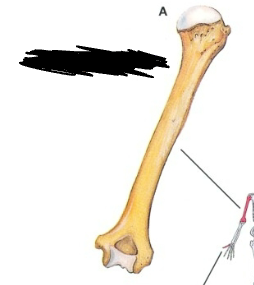
What is this?
Long Bones

What is this?
Short bones

What is this?
Flat bones

What is this?
Irregular bones
What are the parts of a long bone?
The diaphysis, the epiphyses, the epiphyseal plate, and the articular cartilage
Diaphysis
Main shaft portion of bone
Cylindrical and hollow
Very strong yet light
Epiphyses
Bulbous shape at end of bones
Site of muscle attachments
Made of spongy, cancellous tissue filled with red marrow
Epiphyseal plate
layer of cartilage seen in early development
separates epiphyses fromseparates epiphyses from
Diaphysis.
In mature bone is referred to as the metaphysis
Articular Cartilage
Thin layer of hyaline cartilage that
covers epiphysis.
Cushions jolts and blows
Periosteum
Dense white fibrous tissue, covers bone and joint surfaces
Periosteum fibers penetrate underlying bone
Muscle tendon fibers interlace with periosteal fibers anchoring them into place
Contains bone forming and destroying cells
Contains blood vessels that aid in born formation and repair of bone
Medulllary (marrow) cavity
Hollow space of diaphysis
Filled with fatty yellow marrow
Endosteum
Thin membrane that lines medullary cavity.
Bone tissue
made of cells, fibers, and extracellular fluid
extracellular material predominates and is hard and calcified
contains many collagen fibers
Tensile strength equal to iron with 1/3 the weight
Structure allows bone to carry out its supportive and protective function.
Bone Matrix
Inorganic Salts:
Hydroxypatite- specialized crystals of calcium and phosphate
Hardness of bone results from deposition of hydroxyapatite
other minerals found in bone are magnesium, sodium, sulfate, and flouride.
Osteopororsis
Age related disease which results on loss of bone mineral density
Causes bone fragility and susceptibility to fractures.
White women during the first 10 years of menopause are most susceptible.
Treatment:
Hormone replacement therapy
]Non-hormonal drugs
Calcium supplements
Weight bearing exercise
Bone Matrix
Organic Matrix:
Composite of collageous fibers and ground substance
Ground substance: gel like, made of protein and polysaccharides, provides support and adhesion, aids in growth, repair and remoldeling, and adds to overall strength.
Compact bone - Haversian systems or osteons
functional units of compact bone
main function is to provide nutrients and remove wastes from osteocytes trapped in bone.