cog psych exam 2
 Call Kai
 Learn
Learn Practice Test
 Spaced Repetition
 Match
Match Flashcards
 Knowt Play
1/94

There's no tags or description
Looks like no tags are added yet.
Name | Mastery | Learn | Test | Matching | Spaced | Call with Kai | Chat |
|---|
No analytics yet
Send a link to your students to track their progress
95 Terms
semantic memory
recalling meaning of words, concepts, etc.
associative memory
recalling relations among events, concepts, words, etc.
procedural memory
recalling how to perform skills
declarative memory
recollection of facts, definitions, etc.
episodic memory
recollection of events, both their content and their contextual details
autobiographical memory
recollections of events in one’s own life
Ebbinhaus (1885)
pioneered field of empirical research on memory
On Memory
for his book, he submitted himself to over 800 hours of memory experiments
forced himself to remember lists of CVCs strings
would learn a list, test himself intermittently b/w studying, until he could recite list perfectly
would record how many testing attempts it took him to reach 100% recitation accuracy, and how this changed when he tried to re-learn the list at various delays (e.g., minutes, hours, days, weeks)
Ebbinghaus’ findings
learning curve and forgetting curve
better at remembering in morning than evening
could remember about 7 items perfectly (i.e. working memory span)
memory is heavily associative in nature with temporal contiguity being heavily influential on memory
memory was variable, primarily due to his fluctuations in attention
Muller (1900)
brought some more experimental rigor to Ebbinghaus’ experiments
more people and with memory drum— device for showing items to people one at a time at consistent rate
__ and Pizlecker also used a paired-associate learning task
ex. study: horse - cabin; test: horse - ??
findings:
interference: later learning can interfere with earlier learning (retroactive)
just-experienced associations are easy to remember, as if it were ‘reverberating’ in one’s mind — concept similar to working or short-term memory
Muller’s findings
interference: later learning can interfere with earlier learning (retroactive)
just-experienced associations are easy to remember, as if it were ‘reverberating’ in one’s mind — concept similar to working or short-term memory
representation, process, storage
ways to think about memory
memory as representation
internal representations of things that have been learned/experienced
features of memory are multidimensional attributes
visual, tactile, auditory, olfactory, semantic, emotional, temporal, etc.
memory is associative; experiencing 1 feature triggers other attributes
ex. smelling cookies reminds you of Christmas
memory as process
memory is means by which we remember info
we acquire (learn/encode) info
then we store or maintain it
then we retrieve it
encoding —> storage —> retrieval
memory as storage
memory is the place where representations are stored
not just about the brain but in more conceptural terms, too
memory is where we ‘look’ for info we need
List learning paradigm
most common form of memory task
people given list of words to remember and asked to recall
free recall
people recall words in any order but they must do so without any hints or clues
immediate - no gap between presentation of last word and recall period
delayed - time delay between presentation of last word and recall period
serial recall
people must recall items in a particular order (usually forward or backward)
recognition memory test
people given words that either were or were not on list and asked to indicate the ‘old’ vs ‘new’ words

implicit memory tests
people given list of words and asked to do something else (ex. indicate whether something is word vs. non-word; say whether word represents something living or non-living; say whether word begins with letter or vowel)
when they see words first time, they don’t know their memory will be tested later
then asked to recall or recognize words in a surprise memory test
encoding is incidental rather than intentional
laws of memory
repetition
recency
Repetition
seeing info more than once leads to better memory for it than a single encoding instance
occurs even for incidental encoding
leads to better memory when encoding instances are spaced apart rather than ‘massed’ (i.e., given in close succession)
Singh et al. (1994)
massing vs. spacing
manipulation: experimental commercial was either repeated with either 1 or 4 commercials b/w repetitions, or only shown once
remembering commercials when spaced or massed together
result: when tested next day, there was minimal decrease in memory for experimental commercial (5%) compared to immediate testing when there were 4 intervening commercials vs. 1 (40% decline)
more likely to forget commercial if massed

recall
free response questions are an example of testing ___
recognition
multiple choice questions are an example of testing __
F
T/F: massed learning is better for memory than spaced
recency
info can be recalled more accurately when there is a shorter delay b/w when it is experienced (or encoded, or learned) and when it is recalled
retention interval
amount of time between initial exposure and recall attempt
extralist intrusion
error when word is not on list
repetition error
error when word was already reported
previous-list intrusion
error when word is from a prior study list
Murdock (1962)
among first to demonstrate what we now call the serial position effect
when asked to recall info, we tend to recall earliest info learned and most recent info we learned the highest probability

primacy effect
we tend to remember the earliest info we seer
recency effect
we tend to remember the most recent info we see
Atkinson & Shiffrin (1968)
most influential dual-component model
offers mathematical formula of memory output
short-term memory is capacity-limited and can only hold info briefly
we use control processes to operate on STM representations
LTM has an unlimited capacity and info is not ‘lost’ we just have a difficult time retrieving it, due to things like interference or search failures
the Modal Model

T
T/F: info stored in LTM stays there forever unless something is fundamentally wrong (ex. injury, cog. decline)
T
T/F: the sensory store is not really considered ‘memory’ but more related to sensation and perception
T
T/F: LTM has unlimited capacity
F
T/F: STM has unlimited capacity
structural components of the dual component model
sensory stores
Short term store
long term store
processing components of the dual component model
change depending on task
change based on whether you’re encoding or retrieving info
rehearsal
main control process that maintains info in the STM
T
T/F; the longer info is in STM, the more it transfers to LTM
7 ± 2
Miller (1956) estimate of STM
4 ± 1
Cowan (2001) estimate of STM
chunking
because capacity is limited we must take steps to __ info into discrete representations
ex. phone numbers
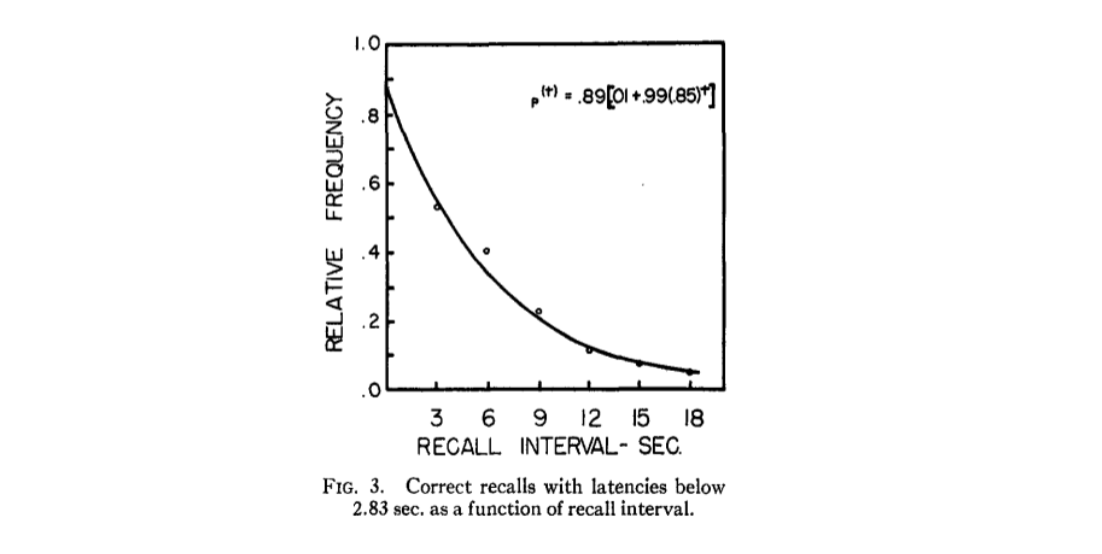
Brown-Peterson (1958/9)
examined how quickly info decays from STM
task: recall consonant trigrams after a delay
during delay they blocked active rehearsal (count backwards from 3)
delay was variable
result: info gets lost from STM quickly unless you control it (thru rehearsal)
Conrad & Wicklegreen (1964/5)
argue that verbal info is kept in acoustic code (subvocal rehearsal)
we often covertly (silently) rehearse info
use inner speech mechanism to rehearse it
Rundus (1971)
participants given list and asked to rehearse out loud a certain number of items
lists rehearsed either 3, 6, 9, or 12 times
expect: more rehearsal, better remembering long-term
results: divergence at end of list
end of list still being recalled even though it was rehearsed less
why? because this info was still in STM

Glanzer and Cunitz (1966)
removed recency effect from Rundus’ experiment
manipulated delay b/w end of list and initiation of recall (retention interval)
15 words to freely recall
end of list if saw:
# —> write/recall
digit —> count (prevent rehearsal) and then recall
shouldn’t affect encoding but how info gets outputted
results:
immediate recall = recency effect
10s delay = recency effect reduced
30s delay = recency effect gone
end-list items are lost (via time-based decay) from STM
recency effect is because of output from STM
rehearsal; STM
Atikinson and Shiffrin’s modal model explains that primacy occurs because of __ and that recency occurs because of __
Bjork and Whitten (1974)
is the recency effect due to unloading of items from STM?
used a continuous-distractor free recall task (math b/w words)
still saw recency effect wen participants can’t rehearse items or store them in STM so…
…the recency effect can’t only be because of STM and primacy can’t only be because of rehearsal since doing math b/w words fills up STM and prevents rehearsal
primacy and recency are affected by what items participants choose to begin recall with

long-term recency
shows problem of modal model
not a list learning paradigm, but saw serial position curve and recency effect, so not b/c of rehearsal or STM
recency effect w/ memories that are not held in STM cannot be explained by unloading from STM
what else can explain the effect?
interference

proactive interference
old info interferes with new info
affects items at end of list
retroactive interference
new info interferes with old info
affects items at befinning of list

Baddeley & Hitch’s (1974) model of working memory
system for temporary maintenance and manipulation of info, necessary for performance of such complex cognitive activities as comprehension, learning and reasoning
multiple storage systems
visuo-spatial sketchpad
central executive
phonological store
dual-task studies
participants asked to keep info in STM and overtly rehearse it (repeat out loud) while they do primary task
rehearsing verbal info increases time required to do a reasoning task, but no effect on errors
system for verbal info is not the same as the system for learning/reasoning

rehearsal; speech
Baddeley and Hitch (1977) found that performance on ___-based tasks involved a ___-based system
phonological loop
used to recycle info
holds small amount of speech based info
articulatory control process is the way in which we keep things in store
based on inner speech
accounts for:
phonological similarity effect
phonologically similar items interfere with one another
irrelevant speech effect
irrelevant speech gets into loop
word length effect
ACP can only rehearse items so fast
phonological similarity effect
words that sound the same are harder to rehearse than distinct words
4 lists: phonological similarity, semantically similar, control (unrelated words)
results: semantically similar and control lists are better rehearsed
phonologically similar words decreased recall performance
ex. PVCGE harder to recall than XRFYZ
creation of interference b/c of phonological similarity
visual; phonological
the articulatory control process (ACP) translates __ into __
irrelevant speech effect
performance on memory tasks is impaired if items are accompanied by other verbal material
Colle & Welsh 1976 - immediate recall of digits is impaired if accompanied by sound of someone reading German
unattended phonological material can gain access to phonological store
creates interference and takes up space in phono. store that would otherwise be used up by relevant info
Salame & Baddeley 1987 - spoken digits ‘one’ imair digit span to same degree as similar phonemes like ‘tun’
explanation: code is phonemic, not semantic
we rehearse how it sounds rather than what it means
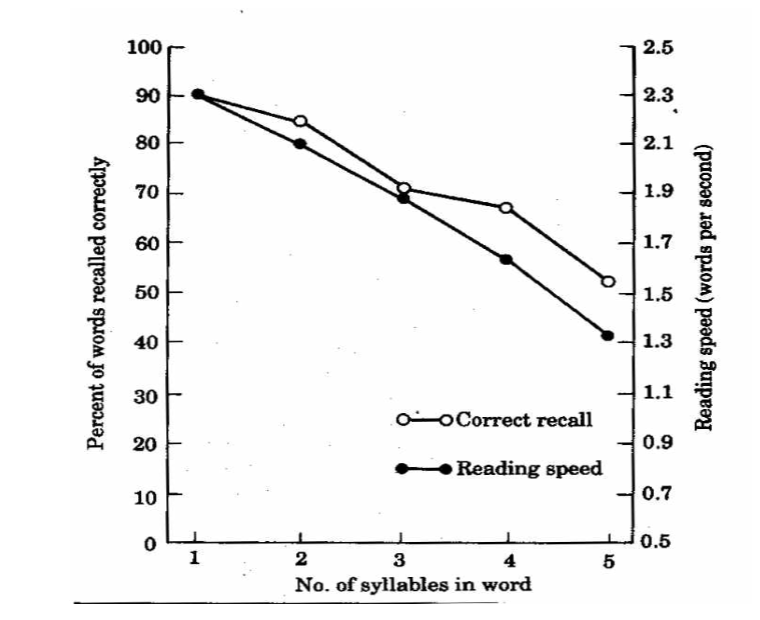
word length effect
finite amount of tape/space in loop
longer words use up more space
linear decrease in accuracy of recall and time to read each word out loud
fit fewer long words in loop
predicts memory better for shorter words
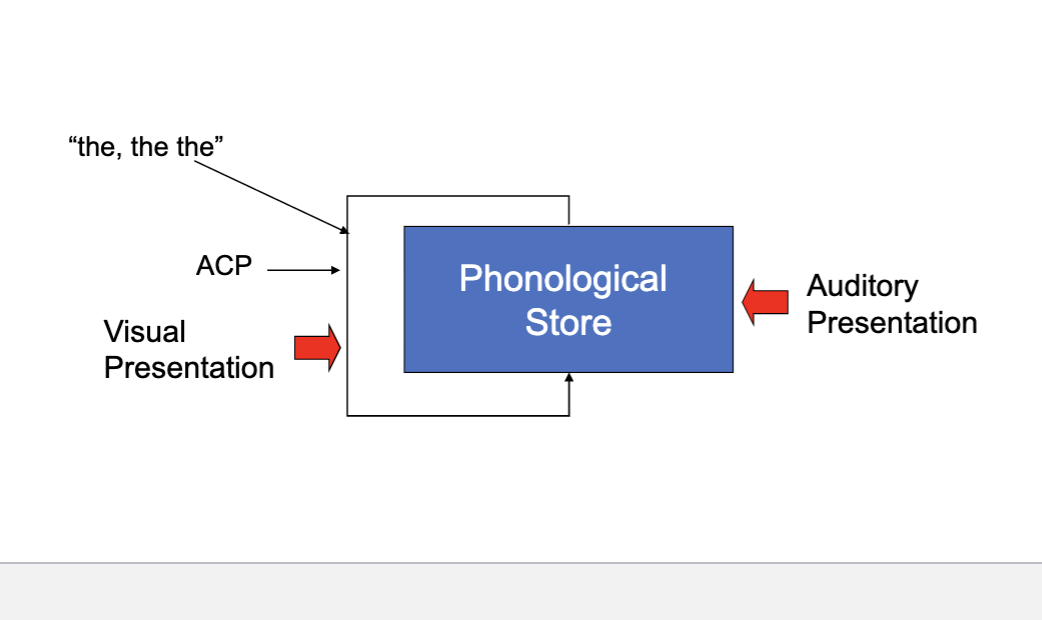
articulatory suppression
subject says ‘the the the the’ during list presentation or gets a tongue depressor to completely occupy ACP
ear and mouth have privileged access to phono. loop
disrupts ACP (loop used to rehearse info)
ACP is busy pronouncing the irrelevant words, it cannot be used to covertly rehearse the target information
word length effect is abolished
rehearsal is completely blocked for both long and short words, removing the advantage for short words
visuo-spatial sketchpad
stores and manipulates visual-spatial info
needed when info can’t be recoded into phono. representation
mental rotation of objects
other visual-spatial info interferes with it
verbal info does not
Brooks’ evidence for visuo-spatial sketchpad
___ (1968) -
1st experiment: patients read sentence and indicate whether each word is noun or non-noun
2nd: imagine a letter and make decisions about whether corner was in extreme bottom or top of letter
3 response:
verbalization = ‘yes’ or ‘no’
non-verbal = point to Y or N
non-verbal = tap with left finger for Y, right for N
results:
verbal task: longer response time when using verbal response than visual response
visual task: longer response time when using visual response than vocal response
when response modality is same as task modality, response times increased
interference in sketchpad/phonological loop when participant had to use it to both make decisions and report decision
we store and process info differently based on whether it’s verbal or visual code

central executive
coordinates activity of two storage systems
other potential roles: coordinating retrieval strategies, selective attention, temporary activation of LTM, suppression of habitual responses
thought to be associated w/ frontal lobe
central executive
what is the least studied and understood component of the modal model?

episodic buffer
update to model by Baddeley in 2002
makes link b/w LTM and working memory more explicit
integrate multidimensional code
most controversial since it can do everything; what’s the point of VSSP and PL?
controlled by CE
ex. can convert language (verbal —> visual)
memory span
number of items (digits, letters, words, etc.) that a person could remember
digit span
asked to repeat digits in forward serial order
list gradually increases as they correctly recall
max number of items they could recall is their capacity/span
problems:
strict scoring criteria (no partial credit)
low reliability / not consistent
don’t predict other cognitive abilities, like IQ or reasoning
not much variability across people
Daneman and Carpenter (1980)
produced first ‘complex’ span task
must remember list of letters/digits while doing irrelevant processing task (ex. math or reading) in b/w coding
must report in correct serial order
partial credit given
more variability and validity
performance correlates with:
fluid intelligence
reading comprehension
LTM abilities
attention control abilities

work
some argue that simple span tasks don’t make people ‘__’ with the info. they simply store it then dump it
Luck & Vogel (1997)
designed ‘change-detection’ task
presented with array of visual objects for short time
after brief delay, shown second array
indicate whether the array (or single item within array) has changed
results:
set size 1-3 = near perfect
set size > 4 - performance drops dramatically
no difference w/ cue, orientation, color, shape, or adding more features; so not about complexity
verbal load did not impair performance
verbal load = Participants were given a verbal load of four digits to hold in memory (rehearsing them continuously) while completing a visual change-detection task
conclusions:
visual working memory has about same capacity (4 ± 1) as verbal working memory
visual memories are stored as conjunctions of visual features (an object that has distinct features [color, orientation, shape] and belongs to a certain region of space)
![<ul><li><p>designed ‘change-detection’ task</p><ul><li><p>presented with array of visual objects for short time</p></li><li><p>after brief delay, shown second array</p></li><li><p>indicate whether the array (or single item within array) has changed</p></li></ul></li><li><p>results:</p><ul><li><p>set size 1-3 = near perfect</p></li><li><p>set size > 4 - performance drops dramatically</p></li><li><p>no difference w/ cue, orientation, color, shape, or adding more features; so not about complexity</p></li><li><p>verbal load did not impair performance</p><ul><li><p>verbal load = Participants were given a <strong>verbal load</strong> of four digits to hold in memory (rehearsing them continuously) while completing a visual change-detection task</p></li></ul></li><li><p>conclusions:</p><ul><li><p>visual working memory has about same capacity (4 ± 1) as verbal working memory</p></li><li><p>visual memories are stored as conjunctions of visual features (an object that has distinct features [color, orientation, shape] and belongs to a certain region of space)</p></li><li><p></p></li></ul></li></ul></li></ul><p></p>](https://assets.knowt.com/user-attachments/b97b123e-60f8-4715-8fc8-5b8d73debe11.png)
recall initiation
how do people begin recalling in free recall?
people tend to begin recall with end-list items (recency) in immediate free recall
this tendency is reduced for delayed free recall
__ __ curve

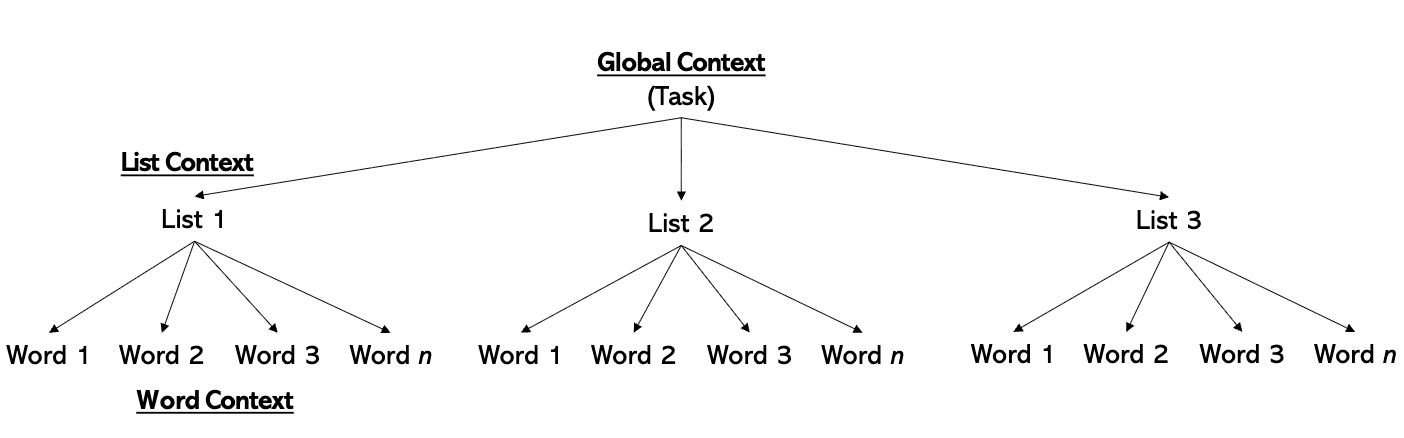
cue dependent retrieval process
global context (task) —> list context —> word context
self-generate a cue
use cue to narrow search
search processes produce a response
response serves as next cue
may need to generate a different cue if that cue is unhelpful
temporal-contextual cue dependent retrieval process
items encoded near each other within a list will have strongest associations
items encoded in lists near each other will have weaker associations
words never encoded will have weakest associations
search monitoring
after search process, ___ must be performed

F
T/F: unlike in search processing, errors in search monitoring can not lead to errors in recall

lag
temporal distance (during encoding) b/w two consecutively recalled words
ex. +1, -3, etc.

conditional response probability (CRP)
estimate how likely someone is to transition between items in recall at each lag
people are more likely to transition recall b/w near neighbors (low absolute lags)
curbe is asymmetrical (forward leg is much more pronounced than backward)
peaks around +1 and -1
tight temoporal contextual association

conditional response latency (CRL)
estimate how quickly someone is to transition b/w items in recall at each lag
people are faster to recall words at shorter absolute lags (+1, -1)
curve is asymmetrical (forward transitions much faster than backward transitions)
IRT = inter-response time

temporal clustering
recall transition lags of 1 or -1 represent strong ____ ___
larger lags represent weaker ___ ___
people with higher ___ ___ scores (tendency to output recall in temporal structure) achieve better recall (recall more words on average), so recalling with temporal structure is beneficial
Sederberg et al. (2010)
people who recalled more words tended to have higher ___ ___ scores
T
T/F: using temporal context and recalling in this organized way leads to better and faster recall of information
semantic clustering
Sederberg found that high ___ ____ alone does not drive overall list recall success the way temporal clustering does
no relationship b/w ___ ____ and recall success
guides transitions from word to word, it doesn't anchor items as strongly (doesn't boost total list recall capacity) the way temporal contextual cues do
graphs show semantic relatedness influences local retrieval dynamics during free recall
graphs don’t show accuracy
__ ___ can even lead to errors (previous and extra list intrusions)

false memories
using semantic relatedness among items as a cue can lead to ____
Deese (1959)
list of words either semantically related or unrelated
high relatedness results in people likely to falsely recall related words
ex. best, rest, nap, pillow, slumber…
people recall ‘sleep’ incorrectly
DRM
follow up
semantically related words with an unstudied ‘lure’
ex. floor, desk, seat, cushion, … [chair]
free recall and recognition test
40% of critical lures were recalled on free recall
84% false alarm rate on recognition
critical lures remembered with just as much confidence as studied words!
Search termination
how do people deicide when to stop recalling words
IRTs = inter response time
error
people tend to terminate their search after __. could be because word just recalled is an ineffective retrieval cue
PLI or ELI
verbal fluency tasks
another way of understanding recall dynamics
recall without encoding
ex. name all animals you can think of
clustering & switching
ppl tend to recall items in clusters then they switch to new cluster when current one has been exhausted
seen in relatedness among responses and IRTs
T
T/F: verbal fluency is a cue-dependent retrieval process
T
T/F: for fluency tasks, individual differences diminish when given a retrieval cue (instead of forcing people to self-generate)
Unsworth et al. (2014)
experiment 1: 5 min to recall as many animals as you can think of then report which strategies used:
random - 81%
semantic - 71%
personal - 45%
alphabet - 23%
rhyme - 6%
experiment 2: assigned to recall animals either freely, by using a visualization strategy (imagine a zoo), using semantic similarity, by size, in alphabetical order
visual, free recall
semantic
alphabetic, size
experiment 3: name facebook friends and report strategies
location - 68%
random - 65%
personal - 59%
activity - 59%
forward chronological - 29%
backward chronological - 21%
alphabetic - 15%
rhyme - 6%
experiment 4: name facebook friends under one of 6 instructions:
location, activity, free recall
chronological
alphabetical

Unsworth’s findings
memory retrieval involves both controlled (Strategic) and random components
search may initially generate several (or even many) items without much effort (Random/uncontrolled) but then needs to proceed with more effortful (Strategic/controlled) search
forcing people to use ineffective strategies is worse than allowing them to self-generate strategies
free > visual > semantic > chronological > alphabetical (ineffective)
changing password
example of proactive interference
move to new house and forget old address
example of retroactive interference