Language Typology Midterm
 Call Kai
 Learn
 Practice Test
 Spaced Repetition
 Match
 Flashcards
 Knowt Play
1/84

There's no tags or description
Looks like no tags are added yet.
85 Terms
Part of speech
Syntactic category, where a word can appear in a clause
Open word classes
New words can be added to this category (coined)
Closed word classes
Has a finite # of lexical items
Noun-noun compounds
Compound words, second noun is the head (tells us what the word means)
Borrowing
From another language
Lexical categories
Meanings refer to particular objects/concepts (content words)
Functional categories
Serve grammatical roles, perform logical roles in a sentence (function words)
Phonetics
The study of language sounds; how they are produced by the vocal tract, their acoustic properties, and how they are perceived
Phonology
The study of sound systems, especially in the more abstract sense as a component of grammar
Segmental
The individual speech sounds (vowels and consonants) that combine to form syllables and words
Suprasegmental
Features (such as stress, intonation, tone, and rhythm) that span across multiple segments, syllables, or phrases
Phoneme
The smallest meaning-distinguishing units of spoken language
Phoneme inventory
A complete list of all the distinct physical sounds an individual can produce or that can occur in a specific language/dialect
Minimal pair
Pair of words that differ by only one phoneme and have completely different meanings
Allophone
A predictable phonetic variation that does not change the meaning of a word
Vowels
Speech sounds with no particular restriction of the vocal tract (no turbulence in airstream)
Two dimensions = “backness” and “height”; rounded or unrounded
Diphthongs
Vowels that move through the vowel space (rather than occupying a single point)
Nasal vowels
Produced with the velum lowered so that air can escape from both the nose and the mouth
Consonants
Speech sounds involving greater constriction of the vocal tract
Place of articulation, manner of articulation, voicing, airstream mechanism
Place of articulation
Where in the mouth you make the articulation
Bilabial
Speech sound by bringing both lips together
Alveolar
Tip of tongue touches the alveolar ridge
Velar
Back of the tongue touches the soft palate at the back of the roof of the mouth
Manner of articulation
The way in which the articulators constrict or occlude the airstream to produce a consonant sound
Stops (aka plosives)
Involve complete occlusion of the vocal tract at the place of articulation, can be aspirated or not
Fricatives
Incomplete occlusion of the vocal tract at the place of articulation, noisy airstream with turbulence
Affricates
Start from a stop but, rather than quickly releasing, release to the ‘noisy’ fricative position
Flaps (aka taps)
Involve the articulators meeting one, very quickly, with no buildup of pressure
Trills
Use the airstream to vibrate the articulators together at the place of articulation
Approximants
Articulators come close together, but not close enough to create turbulence, tend to be something like the consonantal realization of certain vowels
Coarticulation
A consonant uses two different places of articulation simultaneously
Secondary articulation
Involves a lesser degree of closure at a second place of articulation
Airstream mechanism
The means by which airflow is created
Pulmonic egressive
Most common airstream mechanism, air is pushed from the lungs (all speech sounds in English)
Glottalic egressive
Consonants which use the glottis to force air out, called ejective consonants
Glottalic ingressive
Airflow involves the movement of the glottis downwards with articulation of the consonant, implosive consonants
Nasal articulation universal
The number of places of articulation for nasals is always less than or equal to the number of places of articulation for non-nasal stops (oral)
Markedness
Being less default/less common
A more marked articulation is presupposed by the presence of a less marked articulation
Consonant inventories, featural economy
Contrasting features, voicing distinctions
If a language makes a voicing distinction among stops at one place of articulation, it usually will at other places of articulation
Avoidance of Isolated Sounds
Language rarely use a distinctive feature to distinguish just two sounds from each other
Articulatory pressures
Things related to the actual production of the sound
Example: Voices fricatives are crosslinguistically rare because they are physically difficult to produce
Vowel inventories
The vowels able to be articulated in a certain language/dialect
Draw the 3-vowel configuration

Draw the 4-vowel configurations

Draw the 5-vowel configuration

Draw the 6-vowel configuration
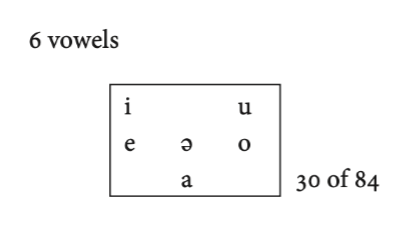
Draw the 7-vowel configuration

Articulatory ease vs. perceptual distinctness
Ease of saying something vs. ability to distinguish between sounds
Assimilation
Feature spreading from one segment to another, making sounds more similar to each other
Increases articulatory ease at the cost of perceptual distinctness
Dissimilation
Changing a feature so it’s not shared by two segments
Epenthesis
Inserting a segment between two existing ones
Progressive
Feature spreads from a phoneme on the left to one on the right
Regressive
Feature spreads from a phoneme on the right to one on the left
Vowel harmony
Features of a vowel spread to other vowels
Dominant-recessive
Dominant vowels control the harmony, changes the vowels in the stem itself
How syllabification works
Breaking words down into syllables, drawing the syllable boundaries is largely a matter of analysis; we always syllabify to maximize onsets when possible (except where it would imply the existence of syllables that are otherwise unattested)
Onset
Start of syllable
Coda
End of syllable
Flapping
Boat eye vs. Bowtie example
Nucleus
Usually vowels (but not always)
Margins universal
If a language has onsets/codas of a particular length, then it also has all shorter onsets/codas
A more marked onset/coda means there can be a less marked (simpler) one
Languages with 1-consonant codas also have 0-consonant codas (“open syllables”)
But 1-consonant onsets do not imply 0-consonant onsets
Empty margins
No onset or coda
Sonority hierarchy
A syllable must increase its sonority toward the nucleus
Typology
The study of linguistic universality
Absolute universal
True of all the world’s languages
Statistical universal
True of overwhelmingly most of the world’s languages
Unrestricted universals
Every language is X
Implicational universals
If a language is X, then it is also Y
Paradigmatic universals
Relate two kinds of constructions or phenomena
If Y, then X: Where Y and X are features of different constructions of the same language
Syntagmatic universals
Relate two features of the same construction or phenomena
If Y, then X: Where Y and X are features of different constituents co-occurring in the same construction
Reflexive universals
Statement about just one feature in one construction (or phenomenon)
If Y, then X: Where Y and X are features of the same constituent
What are some problems with confirming universals?
Sampling: it’s impossible to know the correct distribution
Contact: Close languages influence each other, make them look more similar than they are
Major language families of Eurasia
Afro-Asiatic
Dravidian
Indo-European
Mongolic
Sino-Tibetan
Tungusic
Turkic
Uralic
Genetic relationship
Languages that share an origin
What causes a language to evolve?
Contact with other languages
Random changes
Proto languages
Hypothetical reconstructed ancestor language to a language family
Language genus
Sub family under the proto language
Comparative method steps
Collect cognates
Find regular correspondences of sounds among languages
Reconstruct the proto-language
Identify where the innovations arise
Construct a family tree
Language isolates
Languages that bear no genetic relation to any other language
Examples of Afro-Asiatic languages
Semitic languages (Arabic and Hebrew)
Chadic languages (northern Nigeria)
Examples of Dravidian languages
Telugu, Tamil, Kannada
Examples of Indo-European languages
Romance
Spanish, French
Germanic
German, English
Slavic
Russian, Polish
Indo-Iranian
Hindi, Farsi
Examples of Sino-Tibetan languages
Chinese, Tibetan
Examples of Turkic languages
Turkish, Uzbek, Azerbaijani
Examples of Uralic languages
Hungarian, Finnish, Estonian