Intro to adaptive imm.
 Call Kai
 Learn
Learn Practice Test
 Spaced Repetition
 Match
Match Flashcards
 Knowt Play
1/26

There's no tags or description
Looks like no tags are added yet.
Name | Mastery | Learn | Test | Matching | Spaced | Call with Kai | Chat |
|---|
No analytics yet
Send a link to your students to track their progress
27 Terms
What are antibodies? What produces them? What can human antibodies do?
produced by B cells
soluble polypeptides made of 2 heavy and 2 light chains that bind together
humans can generate antibodies that recognize any substance
What did Macfarlane Burnet’s Clonal Selection theory explain?
explains how the body produces tailored B and T lymphocytes to destroy specific invading antigens
What are the postulates of clonal selection theory?
Each lymphocyte has one unique receptor that recognizes one specific target.
Foreign molecule (ex. antigen) binds to the lymphocyte receptor → lymphocyte is activated.
Activated lymphocyte makes effector cells with the same receptor/specificity.
Lymphocytes that recognize the body’s own molecules are removed early → prevents self-attack.

explain clonal selection role here
Without Clonal Selection: body wouldn't know which specific lymphocyte to replicate
Primary Response: Selects 1 matching naive lymphocyte cell and expands it into a small army + memory cells.
Secondary Response: Selects from thousands of memory cells and expands them instantly into a massive army.
Primary:Antigen+1–2 Naive CellsSlow ExpansionSmall Army+Memory Cells
Secondary:Antigen+Thousands of Memory CellsInstant ExpansionMassive Army
Where do T cell come from and get their name from?
Location: Thymus
Name: from the Thymus
Where do B come from and get their name from?
Come from the bone marrow of human
Get their name from the Bursa of birds
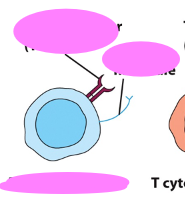
What is the receptor, co-receptor, and primary function of a Helper T cell?
Receptor: TCR (T-cell receptor)
Co-receptor: CD4 (binds MHC Class II)
Function: Coordinates the immune response

What is the receptor, co-receptor, and primary function of a Cytotoxic T cell?
Receptor: TCR (T-cell receptor)
Co-receptor: CD8 (binds MHC Class I)
Function: Directly destroys infected cells
What is the formal definition of an antigen?
Any molecule that is specifically recognized and bound by a B-cell receptor (BCR), antibody, or T-cell receptor (TCR)
What is an epitope
The specific site of an antigen that makes direct physical contact with a BCR, antibody, or TCR
→ one antigen can have multiple epitopes
What chains compose a standard T-cell receptor (TCR), and how are they held together?
two transmembrane glycoprotein chains:
alpha chain
beta chain
Held together by disulfide bond

What are the major functional regions found on each TCR chain alpha and beta?
Variable region
Constant region
Stalk segment
Transmembrane region
Cytoplasmic tail
What is the relationship between a B-cell receptor (BCR) and a secreted antibody from the same B cell lineage?
→ They are membrane-bound vs. secreted forms of the exact same molecule.
→ share the same antigen specificity (bind to identical epitopes)
→ Both bind antigens directly without requiring MHC presentation
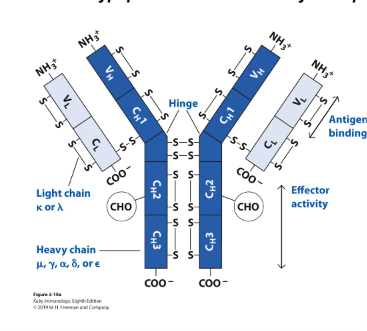
How many polypeptide chains make up an antibody/BCR monomer, and how are they divided?
Composed of 4 polypeptide chains arranged in a Y-shape:
2 identical Light (L) chains
2 identical Heavy (H) chains
What do disulphide bonds do in the antibody molecule?
Connect light chains to heavy chains
and connect heavy chain to each other in the hinge region

What does this diagram explain
B-cell receptors (BCRs) and antibodies can be generated to recognize virtually any type of antigen of any shape or size
the variable region VH and VL are customizable
How do T-Cell Receptors (TCRs) differ from B-Cell Receptors (BCRs)/antibodies in how they recognize antigens?
BCRs/Antibodies: Bind directly to free, native, unprocessed antigens of any shape or chemical type.
TCRs: Cannot bind free antigens; they only recognize short linear peptides that are processed and "presented" on MHC molecules on the surface of another cell.
What two components must a TCR simultaneously recognize to become activated?
The foreign peptide fragment.
The self-MHC molecule holding the peptide.

What is the role of the CD4 co-receptor during T-cell antigen recognition on an APC?
Stabilizes the TCR–MHC interaction
How many different epitope specificities does a single individual B or T cell express on its surface?
Only one single specificity
All receptors on a given lymphocyte are identical clones designed to recognize the exact same targe
What defines the target specificity of an individual B cell?
Each B cell makes a BCR specific for one unique epitope
can be for any type of molecule
What defines the target specificity of an individual T cell?
Each T cell makes a TCR specific for one unique epitope
must strictly be a processed peptide presented on a self-MHC molecule.
When does BCR and TCR gene rearrangement occur relative to pathogen exposure, and what is its purpose?
Timing: During early lymphocyte development, before the cells ever encounter an antigen.
Purpose: This builds a massive variety of receptors in advance.
What happens to B cells that bind to self-antigens during development?
They are killed (deleted) to prevent autoimmune attacks
this happens before the cell encounters the antigen
How does B-cell clonal deletion explain why you don't produce antibodies against your own blood type?
B cells that recognize self antigens (aka. our own bodies molecules) are killed early in development in the bone marrow so that they don’t produce antibodies that could target our own cells
For Blood Types A, B, and AB, what antigens are on the red blood cells, and what antibodies are in the plasma?

What antigens and antibodies are associated with Blood Type O?
Antigens on RBCs: None
Antibodies in Plasma: Both Anti-A and Anti-B antibodies