WK 8-Repeated Measures Factorial ANOVA- Traditional and Multivariate Approaches
 Call Kai
 Learn
 Practice Test
 Spaced Repetition
 Match
 Flashcards
 Knowt Play
1/11

There's no tags or description
Looks like no tags are added yet.
12 Terms

also F ratio is gonna be bigger bc error gonna be smaller?
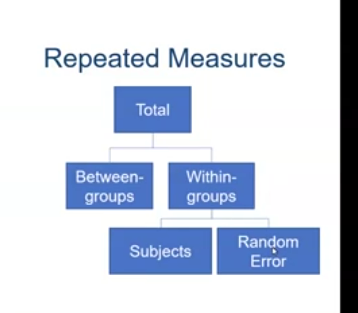
two approaches
traditional and multivariate approach
1.Traditional approach
•We calculate a main effect of Subjects (just another effect in the analysis)
•This captures the variances due to individual differences
•The error term is smaller
•There is a new assumption (‘Sphericity’)
Traditional approach: Reduces individual differences by modelling them directly, but assumes sphericity.
2.Multivariate approach
•We (or rather the computer) create a number of contrasts between the conditions, each of which just result in a set of difference scores – like a single sample t-test
•These t-tests are combined to form an ‘overall’ multivariate F test
•Since each comparison is just on difference scores, individual differences are removed
Multivariate approach: Uses condition differences to remove individual differences and does not require sphericity.
should spherecity be sig or not sig?
one of those ‘upside’ down ones, should be NOT sig
what is sphericity and what test to measure it with
measures the variance of two pair scores, the difference? and says that any two other pairs should have the same amount of variance
maulchy’s test
What if it's violated? which test to use for adjustment
use adjusted F-tests to correct for violations
Green-house geisser , the f-ratio will be the same but the df will be adjusted
maxwell and dawney recommend what?
•Maxwell & Delaney recommend that we always assume the sphericity assumption has been violated to some extent and use an ε (epsilon) correction.
•If you use the traditional approach, ALWAYS use an adjusted F test for repeated measures factors (with >2 levels).
assumptions of traditional approach
•Normality:
•Scores on the dependent variable come from populations which are normally distributed.
•Independence of errors:
•Although the scores are not independent in a within-subjects design it is assumed errors in the model are independent because individual differences between subjects have been partialled out.
•Sphericity or Homogeneity of treatment-difference: i.e., homogeneity of variance (scores at each treatment level have the same variance), and homogeneity of covariance (the co-variation or consistency in scores observed for any pair of treatment levels is the same for all possible pairs of treatment levels). So essentially each participant responds in the same way to the IV conditions.
✅ Normality: Scores are roughly bell-shaped.
✅ Independence of errors: After removing individual differences, the leftover error is independent.
✅ Sphericity: The differences between conditions are equally variable. Participants respond to the conditions in a similar and consistent way.
info about greenhouse-geisser

what is Holm test
Holm test is a serial test that tests the largest difference at p < .05/#comparisons, then the next largest at p < .05/(#comparisons – 1) and so on.
Applies a somewhat less conservative adjustment to Bonferroni.