ecology 2600 communities and ecosystems (7)
 Call Kai
 Learn
 Practice Test
 Spaced Repetition
 Match
 Flashcards
 Knowt Play
1/26

There's no tags or description
Looks like no tags are added yet.
27 Terms
Community
an association of interacting species living in a particular area
Ecosystem
the biotic community plus its abiotic environment
• “the system composed of physical-chemical-biological processes active within a space-time unit of any magnitude” – Lindeman 1942 Ecology
Species abundance and diversity
• Most species are moderately abundant; few are very abundant or extremely rare
• A combination of the number of species and their relative abundance (ie evenness) defines species diversity
• Functional diversity is a key trait of communities
• Species diversity is higher in complex environments
• Species abundance distributions follow lognormal distribution
Guild
group of organisms that all make their living in a similar way • What are some examples?smth like feeding patterns
Functional group
: species that perform similar functions in a community; typically have similar life history traits
• What are some examples?
• A species’ range has — areas of very high abundance
few
• Species diversity is defined on the basis of two factors
• The number of species in a community (ie species richness)
• The relative abundance of species (ie species evenness)
The Shannon-Wiener index
H’ : the value of the Shannon-Wiener diversity index
pi : the proportion of the ith species
loge : the natural logarithm of pi
s : the number of species in the community
1. Determine the proportions of each species in the study community, pi
2. Take the log of each pi
3. Multiply each pi times logepi
4. Sum the results for all species from species 1 to species s, where s = the number of species in the community

Functional diversity
• Some species are redundant (i.e. they perform similar functions in a community)
• Functional diversity is an important measure of communities
• Functional diversity: physiological and morphological differences
• Legumes, grasses, woody plants, forbs
• Species diversity is higher in complex environments • Why?
• More “habitats”, more resources, greater niche diversity
Environmental complexity

Ecological network
a description of the interactions that occur among co-occurring species in a community
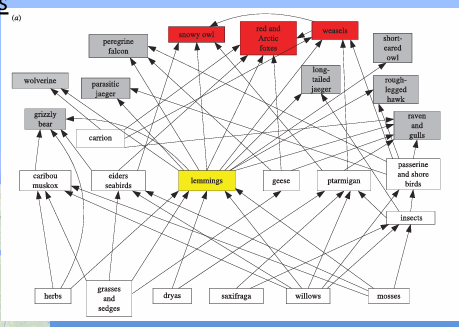
Trophic networks ( ie food web)
describe interactions based upon feeding relationship
Host-parasitoid network
describe the interconnectedness of host and their parasites, diseases, and parasitoids
Mutualistic networks
: focus on interactions such as pollination and mycorrhizae
Spatial trophic network

Host-parasitoid networks

Mutualistic networks

Common things about ecological networks
• Difficult to resolve some species groups
• Basal resources are often not well defined (e.g. insect, plants, etc)
• Links/connections among species are common representation of interactions
• Number of links per species and connectance (# links/(Number of species)^2 are important traits of ecological networks
• Networks usually depict “green” webs not “brown” webs
• Networks often depict STRONG interactions more than WEAK interactions
• Strong interactions are more visible and easier to study but both are important for network dynamics
What happens to Newfoundland’s terrestrial mammal food web when we add all the non-native mammals?

Ecological networks across ecosystem boundaries
• Most ecosystems are open to exchanges of energy, materials and nutrients
• Ecological networks are a useful way to show interactions across ecosystem boundaries
Strong interaction
: interactions where there is a large exchange of energy/nutrients/materials
Weak interaction
: interactions where there is a small exchange of energy/nutrients/materials
Weak vs strong interactions
• Removal of strong interaction will have large effect on ecosystem BUT
• Weak interactions are important for spreading out consumer pressure
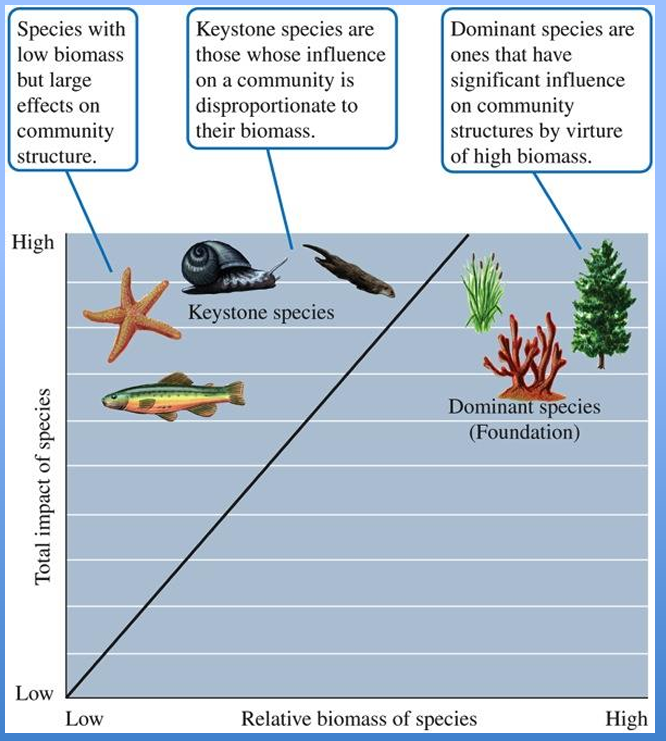
Keystone species
species that, despite low biomass, exert strong effects on the structure of the communities they inhabit
• Robert Paine’s intertidal research
• Removed top predator (Pisaster)
• After 2 years the community had simplified with mussel and gooseneck barnacle dominating
• What are some other examples of keystone species -
species that, despite low biomass, exert strong effects on the structure of the communities they inhabit?