⚡ Lecture 7: Energy

0.0(0)
Studied by 1 person
call kaiCall Kai
learnLearn
examPractice Test
spaced repetitionSpaced Repetition
heart puzzleMatch
flashcardsFlashcards
GameKnowt Play
Card Sorting

1/38

encourage image

There's no tags or description

Looks like no tags are added yet.

39 Terms

1
New cards

Energy Terminology

Energy

  • Capacity of a physical system to perform work

Forms of Energy

  • Mechanical energy

  • Chemical energy

  • Light energy

  • Heat energy


<p>Energy</p><ul><li><p>Capacity of a physical system to perform work</p></li></ul><p>Forms of Energy</p><ul><li><p>Mechanical energy</p></li><li><p>Chemical energy</p></li><li><p>Light energy</p></li><li><p>Heat energy</p></li></ul><p></p>
2
New cards

Food Energy

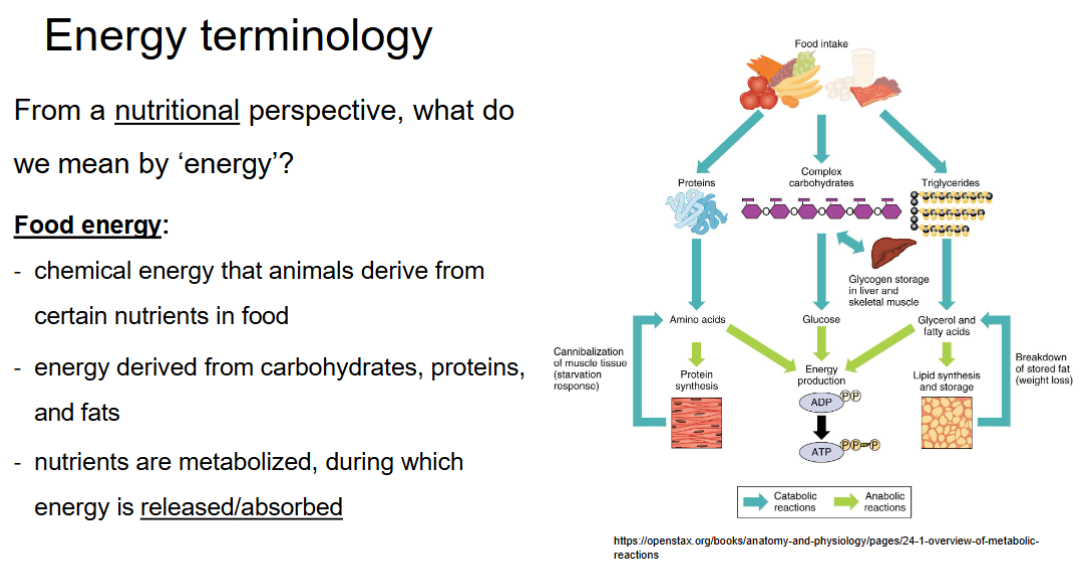
Definition of Food Energy

  • Chemical energy that animals obtain from certain nutrients in food

Sources of Food Energy

  • Carbohydrates

  • Proteins

  • Fats

Energy Release

  • Nutrients are metabolized (broken down and processed by the body)

  • During metabolism, energy is released or absorbed

<p>Definition of Food Energy</p><ul><li><p>Chemical energy that animals obtain from certain nutrients in food</p></li></ul><p>Sources of Food Energy</p><ul><li><p>Carbohydrates</p></li><li><p>Proteins</p></li><li><p>Fats</p></li></ul><p>Energy Release</p><ul><li><p>Nutrients are metabolized (broken down and processed by the body)</p></li><li><p>During metabolism, energy is released or absorbed</p></li></ul><p></p>
3
New cards

Energy Terminology – Heat of Combustion and Energy Transfer

Heat of Combustion

  • Heat of combustion: energy released as heat during the combustion (burning) of a substance, such as food

Catabolic Reaction

  • Breaks down complex molecules into simple molecules

  • Transfers energy from complex molecules to ATP

  • Heat is released

  • Complex molecules: starches, proteins, lipids

  • Simple molecules: monosaccharides, amino acids, glycerol, fatty acids

Anabolic Reaction

  • Transfers energy from ATP to form complex molecules

  • Heat is released (energy is used from ATP)

ATP and ADP

  • ATP: involved in energy transfer

  • ADP: involved in the ATP energy cycle


<p>Heat of Combustion</p><ul><li><p>Heat of combustion: energy released as heat during the combustion (burning) of a substance, such as food</p></li></ul><p>Catabolic Reaction</p><ul><li><p>Breaks down complex molecules into simple molecules</p></li><li><p>Transfers energy from complex molecules to ATP</p></li><li><p>Heat is released</p></li><li><p>Complex molecules: starches, proteins, lipids</p></li><li><p>Simple molecules: monosaccharides, amino acids, glycerol, fatty acids</p></li></ul><p>Anabolic Reaction</p><ul><li><p>Transfers energy from ATP to form complex molecules</p></li><li><p>Heat is released (energy is used from ATP)</p></li></ul><p>ATP and ADP</p><ul><li><p>ATP: involved in energy transfer</p></li><li><p>ADP: involved in the ATP energy cycle</p></li></ul><p></p>
4
New cards

Functions of Food Energy

Energy Requirements

- Food energy is required to sustain an animal’s metabolism during:

  • Maintenance — maintaining normal body functions

  • Growth — increasing body size

  • Reproduction — gestation (pregnancy) and/or lactation (milk production)

  • Physical activity — energy used for movement and activity


<p>Energy Requirements</p><p>- Food energy is required to sustain an animal’s metabolism during:</p><ul><li><p>Maintenance — maintaining normal body functions</p></li><li><p>Growth — increasing body size</p></li><li><p>Reproduction — gestation (pregnancy) and/or lactation (milk production)</p></li><li><p>Physical activity — energy used for movement and activity</p></li></ul><p></p>
5
New cards

Energy Requirements

Factors Affecting Energy Needs

  • What an animal’s metabolism needs to support

  • How long those needs must be supported


<p>Factors Affecting Energy Needs</p><ul><li><p>What an animal’s metabolism needs to support</p></li><li><p>How long those needs must be supported</p></li></ul><p></p>
6
New cards

Thermoregulation: Endotherms vs Ectotherms

Endotherms

- Regulate body temperature primarily using heat produced by their metabolism

Ectotherms

- Rely primarily on external environmental heat sources to regulate body temperature

<p>Endotherms</p><p>- Regulate body temperature primarily using heat produced by their metabolism</p><p>Ectotherms</p><p>- Rely primarily on external environmental heat sources to regulate body temperature</p>
7
New cards

Endotherms

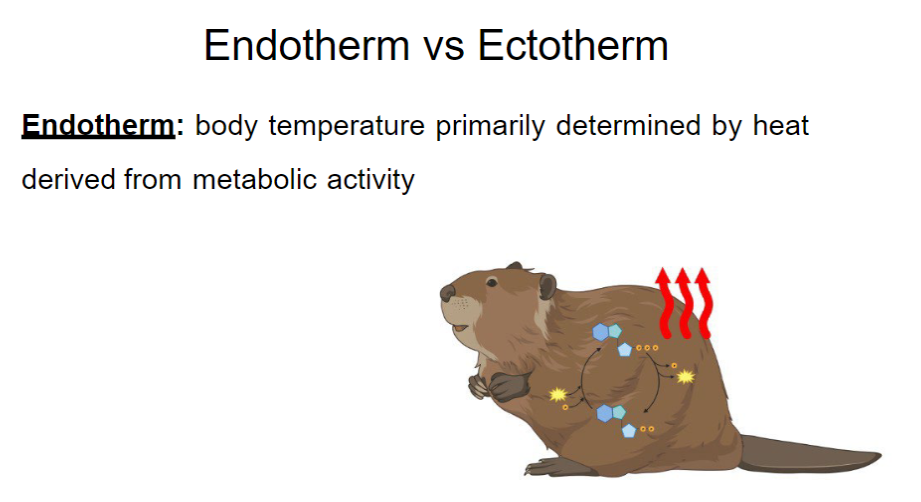
Endotherms

- Body temperature primarily determined by heat derived from metabolic activity
<p>Endotherms</p><p>- Body temperature primarily determined by heat derived from metabolic activity</p>
8
New cards

Endotherm Characteristics

Metabolism and Food Requirements

  • Generate body heat through metabolic activity

  • Higher mitochondrial density per cell than ectotherms

    • More mitochondria → higher metabolic rate → more energy needed → more food required


<p>Metabolism and Food Requirements</p><ul><li><p>Generate body heat through metabolic activity</p></li><li><p>Higher mitochondrial density per cell than ectotherms</p><ul><li><p>More mitochondria → higher metabolic rate → more energy needed → more food required</p></li></ul></li></ul><p></p>
9
New cards

Endotherm Thermoregulation

Cooling Mechanisms

  • Eating less → reduces heat produced during digestion and metabolism

  • Reducing physical activity → decreases heat produced by muscles

  • Panting and sweating → evaporative cooling as water evaporates and removes heat

  • Vasodilation → blood vessels near the skin widen, increasing heat loss to the environment


<p>Cooling Mechanisms</p><ul><li><p>Eating less → reduces heat produced during digestion and metabolism</p></li><li><p>Reducing physical activity → decreases heat produced by muscles</p></li><li><p>Panting and sweating → evaporative cooling as water evaporates and removes heat</p></li><li><p>Vasodilation → blood vessels near the skin widen, increasing heat loss to the environment</p></li></ul><p></p>
10
New cards

Thermoregulation

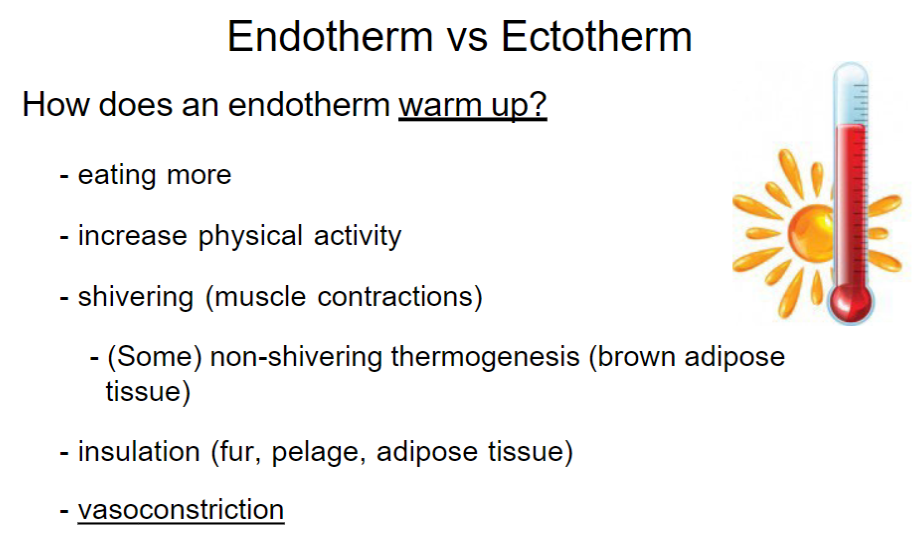
Endotherms

  • Body temperature primarily determined by heat produced through metabolic activity

  • Higher mitochondrial density per cell than ectotherms → higher metabolic rate → greater food requirements

<p>Endotherms</p><ul><li><p>Body temperature primarily determined by heat produced through metabolic activity</p></li><li><p>Higher mitochondrial density per cell than ectotherms → higher metabolic rate → greater food requirements</p></li></ul><p></p>
11
New cards

Ectotherms

Ectotherms

- Body temperature primarily determined by heat derived from the environment

<p>Ectotherms</p><p>- Body temperature primarily determined by heat derived from the environment</p>
12
New cards

Ectotherms: Environmental Temperature and Metabolism

Body Temperature

  • Depends primarily on heat from the environment

  • Fluctuates with environmental temperature

Metabolic Activity

  • Metabolic heat production is minor or negligible

  • Lower metabolic rate than endotherms


<p>Body Temperature</p><ul><li><p>Depends primarily on heat from the environment</p></li><li><p>Fluctuates with environmental temperature</p></li></ul><p>Metabolic Activity</p><ul><li><p>Metabolic heat production is minor or negligible</p></li><li><p>Lower metabolic rate than endotherms</p></li></ul><p></p>
13
New cards

Ectotherm Cooling Mechanisms

Reducing Body Temperature

  • Reduce physical activity → limits heat produced by movement

  • Seek shade, shelter, or water → avoids heat or transfers heat to cooler surroundings

  • Vasodilation → widens blood vessels, increasing heat transfer to the environment

  • Mucus secretions → moisture evaporates from the body surface, helping remove heat
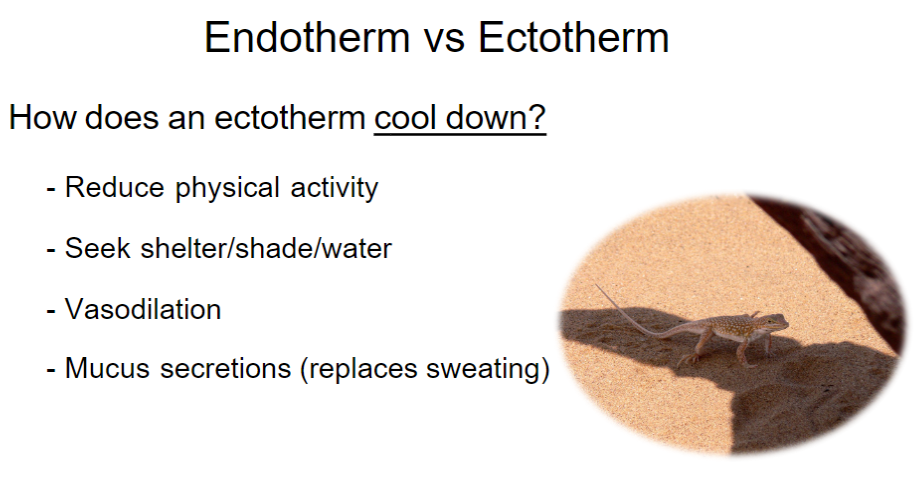

<p>Reducing Body Temperature</p><ul><li><p>Reduce physical activity → limits heat produced by movement</p></li><li><p>Seek shade, shelter, or water → avoids heat or transfers heat to cooler surroundings</p></li><li><p>Vasodilation → widens blood vessels, increasing heat transfer to the environment</p></li><li><p>Mucus secretions → moisture evaporates from the body surface, helping remove heat</p></li></ul><p></p>
14
New cards

Ectotherm Temperature Regulation

Warming Mechanisms

  • Increase physical activity → generates some metabolic heat

  • Seek external heat sources → bask in sunlight or contact warm surfaces

  • Countercurrent heat exchange → transfers heat from warm blood in arteries (from core) to cooler blood in veins, reducing heat loss


<p>Warming Mechanisms</p><ul><li><p>Increase physical activity → generates some metabolic heat</p></li><li><p>Seek external heat sources → bask in sunlight or contact warm surfaces</p></li><li><p>Countercurrent heat exchange → transfers heat from warm blood in arteries (from core) to cooler blood in veins, reducing heat loss</p></li></ul><p></p>
15
New cards

Countercurrent Heat Exchange

How Heat Is Conserved

  • Warm arterial blood flows toward the cold tail, flipper, or foot

  • Cool venous blood flows back toward the body

  • Heat transfers from the warm artery to the cool vein

  • Returning blood warms up before reaching the body → reduces heat loss to the environment
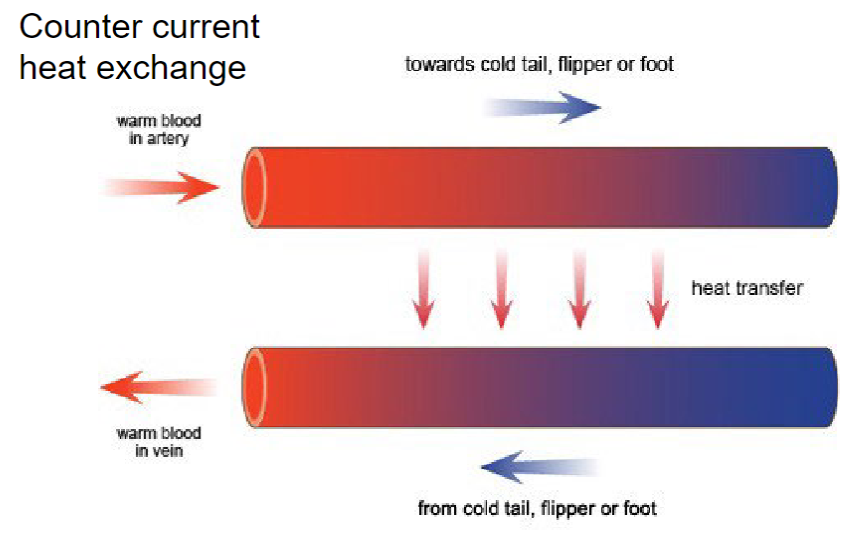

<p>How Heat Is Conserved</p><ul><li><p>Warm arterial blood flows toward the cold tail, flipper, or foot</p></li><li><p>Cool venous blood flows back toward the body</p></li><li><p>Heat transfers from the warm artery to the cool vein</p></li><li><p>Returning blood warms up before reaching the body → reduces heat loss to the environment</p></li></ul><p></p>
16
New cards

Ectotherms: Advantages and Disadvantages

Pros

  • Require less food due to lower metabolic rates

  • Higher carrying capacity → more individuals can be supported in the same environment (since they don’t consume as much food since they don’t need it for heat)

Cons

  • Less functional in cold temperatures because body temperature and activity depend on environmental heat


<p>Pros</p><ul><li><p>Require less food due to lower metabolic rates</p></li><li><p>Higher carrying capacity → more individuals can be supported in the same environment (since they don’t consume as much food since they don’t need it for heat)</p></li></ul><p>Cons</p><ul><li><p>Less functional in cold temperatures because body temperature and activity depend on environmental heat</p></li></ul><p></p>
17
New cards

Body Temperature vs. Environmental Temperature

Endotherms

  • Maintain a relatively stable body temperature despite changes in environmental temperature

  • Temperature regulation works up to a limit

Ectotherms

  • Body temperature fluctuates with environmental temperature

  • Body temperature rises or falls as environmental temperature changes
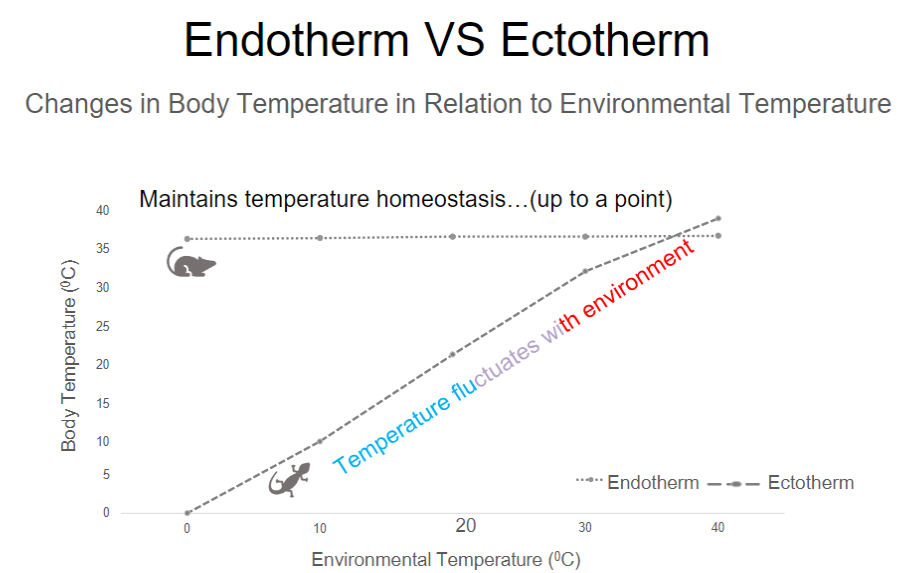

<p>Endotherms</p><ul><li><p>Maintain a relatively stable body temperature despite changes in environmental temperature</p></li><li><p>Temperature regulation works up to a limit</p></li></ul><p>Ectotherms</p><ul><li><p>Body temperature fluctuates with environmental temperature</p></li><li><p>Body temperature rises or falls as environmental temperature changes</p></li></ul><p></p>
18
New cards

Stability of Body Temperature

Homeotherms vs. Poikilotherms

  • Homeotherms → maintain a relatively constant body temperature

  • Poikilotherms → body temperature fluctuates with environmental temperature

Memory Cue

  • Homeo = same → stable body temperature

  • Poikilo = variable → changing body temperature


<p>Homeotherms vs. Poikilotherms</p><ul><li><p>Homeotherms → maintain a relatively constant body temperature</p></li><li><p>Poikilotherms → body temperature fluctuates with environmental temperature</p></li></ul><p>Memory Cue</p><ul><li><p>Homeo = same → stable body temperature</p></li><li><p>Poikilo = variable → changing body temperature</p></li></ul><p></p>
19
New cards

Maintaining Body Temperature

Homeotherms

- Maintain a relatively constant body temperature, regardless of environmental temperature, up to a point

<p>Homeotherms</p><p>- Maintain a relatively constant body temperature, regardless of environmental temperature, up to a point</p>
20
New cards

Body Temperature Stability

Homeotherms

  • Maintain a relatively constant body temperature, regardless of environmental temperature, up to a point

  • Colloquially called “warm-blooded”

  • Includes mostly mammals and birds

Normal Body Temperatures

  • Birds → 40°C

  • Placental mammals → 37–38°C

  • Marsupials → 34°C

  • Monotremes → 30°C

Scientific Terminology

- “Warm-blooded” and “cold-blooded” are not scientifically precise terms

<p>Homeotherms</p><ul><li><p>Maintain a relatively constant body temperature, regardless of environmental temperature, up to a point</p></li><li><p>Colloquially called “warm-blooded”</p></li><li><p>Includes mostly mammals and birds</p></li></ul><p>Normal Body Temperatures</p><ul><li><p>Birds → 40°C</p></li><li><p>Placental mammals → 37–38°C</p></li><li><p>Marsupials → 34°C</p></li><li><p>Monotremes → 30°C</p></li></ul><p>Scientific Terminology</p><p>- “Warm-blooded” and “cold-blooded” are not scientifically precise terms</p>
21
New cards

Homeothermy vs. Endothermy

Homeotherms Are Not Always Endothermic

  • Homeotherms maintain a relatively constant body temperature

  • Endotherms generate body heat primarily through metabolism

  • Some fish in tropical or very deep waters can maintain a relatively constant body temperature without relying primarily on metabolic heat production

<p>Homeotherms Are Not Always Endothermic</p><ul><li><p>Homeotherms maintain a relatively constant body temperature</p></li><li><p>Endotherms generate body heat primarily through metabolism</p></li><li><p>Some fish in tropical or very deep waters can maintain a relatively constant body temperature without relying primarily on metabolic heat production</p></li></ul><p></p>
22
New cards

Body Temperature Variation

Poikilotherms

- Body temperature fluctuates considerably, usually according to environmental temperature

<p>Poikilotherms</p><p>- Body temperature fluctuates considerably, usually according to environmental temperature</p>
23
New cards

Variation in Body Temperature

Poikilotherms

  • Body temperature fluctuates considerably, usually according to environmental temperature

  • Colloquially called “cold-blooded”

  • Includes mostly fish, reptiles, and amphibians


<p>Poikilotherms</p><ul><li><p>Body temperature fluctuates considerably, usually according to environmental temperature</p></li><li><p>Colloquially called “cold-blooded”</p></li><li><p>Includes mostly fish, reptiles, and amphibians</p></li></ul><p></p>
24
New cards

Exceptions to Mammalian Temperature Regulation

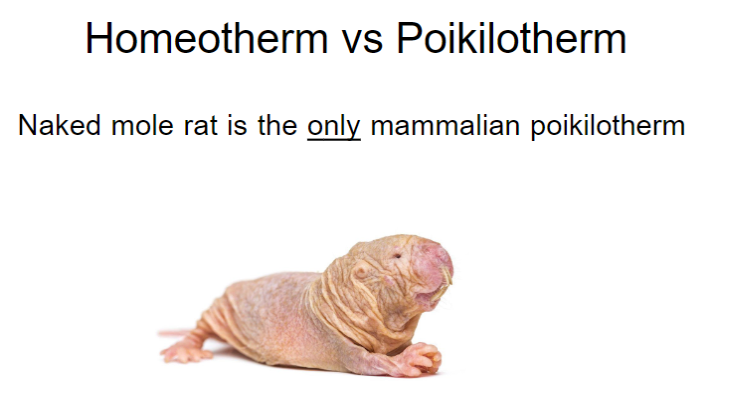
Naked Mole-Rat

  • The naked mole-rat is considered a mammalian poikilotherm

  • Its body temperature varies with environmental temperature

<p>Naked Mole-Rat</p><ul><li><p>The naked mole-rat is considered a mammalian poikilotherm</p></li><li><p>Its body temperature varies with environmental temperature</p></li></ul><p></p>
25
New cards

Thermoneutral Zone (TNZ)

Environmental Temperature Range

  • Range of environmental temperatures where endotherms do not need to actively warm or cool themselves

  • Body temperature is maintained without additional energy expenditure for thermoregulation


<p>Environmental Temperature Range</p><ul><li><p>Range of environmental temperatures where endotherms do not need to actively warm or cool themselves</p></li><li><p>Body temperature is maintained without additional energy expenditure for thermoregulation</p></li></ul><p></p>
26
New cards

Factors Affecting the Thermoneutral Zone

Animal Characteristics

  • Body composition → adiposity (body fat) affects insulation

  • Fur/pelage → reduces heat loss

  • Life stage → affects thermoregulatory needs

  • Body size (surface area-to-volume ratio, SA/V) → affects heat exchange with the environment

    • Smaller animals have a higher metabolic rate and lose heat more quickly relative to their size

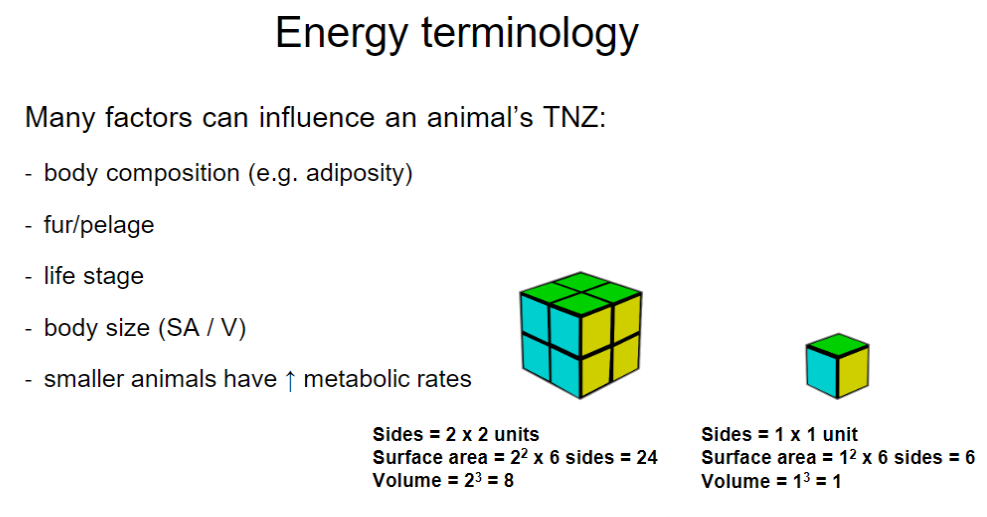
Surface Area-to-Volume Ratio

Comparing Different Body Sizes

- Cube with sides of 2 units

  • Surface area = \(2^2 \times 6 = 24\) square units

  • Volume = \(2^3 = 8\) cubic units

  • SA/V = \(24/8 = 3\)

- Cube with sides of 1 unit

  • Surface area = \(1^2 \times 6 = 6\) square units

  • Volume = \(1^3 = 1\) cubic unit

  • SA/V = \(6/1 = 6\)

Key Relationship

  • Smaller animals have a higher surface area-to-volume ratio, so they lose heat more quickly relative to their volume

  • Larger animals have a lower surface area-to-volume ratio, helping them retain heat more effectively

<p>Animal Characteristics</p><ul><li><p>Body composition → adiposity (body fat) affects insulation</p></li><li><p>Fur/pelage → reduces heat loss</p></li><li><p>Life stage → affects thermoregulatory needs</p></li><li><p>Body size (surface area-to-volume ratio, SA/V) → affects heat exchange with the environment</p><ul><li><p>Smaller animals have a higher metabolic rate and lose heat more quickly relative to their size</p></li></ul></li></ul><p>Surface Area-to-Volume Ratio</p><p>Comparing Different Body Sizes</p><p>- Cube with sides of 2 units</p><ul><li><p>Surface area = \(2^2 \times 6 = 24\) square units</p></li><li><p>Volume = \(2^3 = 8\) cubic units</p></li><li><p>SA/V = \(24/8 = 3\)</p></li></ul><p>- Cube with sides of 1 unit</p><ul><li><p>Surface area = \(1^2 \times 6 = 6\) square units</p></li><li><p>Volume = \(1^3 = 1\) cubic unit</p></li><li><p>SA/V = \(6/1 = 6\)</p></li></ul><p>Key Relationship</p><ul><li><p>Smaller animals have a higher surface area-to-volume ratio, so they lose heat more quickly relative to their volume</p></li><li><p>Larger animals have a lower surface area-to-volume ratio, helping them retain heat more effectively</p></li></ul><p></p>
27
New cards

Surface Area-to-Volume Ratio (SA/V) *FROM CHAT

Effect of Body Size on Heat Loss

  • Surface area → area through which heat is exchanged with the environment

  • Volume → amount of space inside the body, related to body mass

  • Smaller animals have a higher SA/V ratio

    • More surface area relative to their volume → lose heat more quickly

    • Higher metabolic rates help replace lost heat

  • Larger animals have a lower SA/V ratio

    • Less surface area relative to their volume → retain heat more effectively


<p>Effect of Body Size on Heat Loss</p><ul><li><p>Surface area → area through which heat is exchanged with the environment</p></li><li><p>Volume → amount of space inside the body, related to body mass</p></li><li><p>Smaller animals have a higher SA/V ratio</p><ul><li><p>More surface area relative to their volume → lose heat more quickly</p></li><li><p>Higher metabolic rates help replace lost heat</p></li></ul></li><li><p>Larger animals have a lower SA/V ratio</p><ul><li><p>Less surface area relative to their volume → retain heat more effectively</p></li></ul></li></ul><p></p>
28
New cards

Upper Critical Temperature

Upper Limit of the Thermoneutral Zone

  • Environmental temperature at the upper limit of an endotherm’s thermoneutral zone (TNZ)

  • Above this temperature, the animal must use additional cooling mechanisms to maintain body temperature


<p>Upper Limit of the Thermoneutral Zone</p><ul><li><p>Environmental temperature at the upper limit of an endotherm’s thermoneutral zone (TNZ)</p></li><li><p>Above this temperature, the animal must use additional cooling mechanisms to maintain body temperature</p></li></ul><p></p>
29
New cards

Effects of Exceeding the Upper Critical Temperature

Heat Stress

  • Remaining above the upper critical temperature (UCT) for too long can cause heat stress

  • Anorexia → reduced appetite

  • Excessive sweating/panting → dehydration

  • Cellular dysfunction → occurs in severe cases

  • Death → possible if heat stress is severe and prolonged


<p>Heat Stress</p><ul><li><p>Remaining above the upper critical temperature (UCT) for too long can cause heat stress</p></li><li><p>Anorexia → reduced appetite</p></li><li><p>Excessive sweating/panting → dehydration</p></li><li><p>Cellular dysfunction → occurs in severe cases</p></li><li><p>Death → possible if heat stress is severe and prolonged</p></li></ul><p></p>
30
New cards

Lower Critical Temperature

Lower Limit of the Thermoneutral Zone

  • Environmental temperature at the lower limit of an endotherm’s thermoneutral zone (TNZ)

  • Below this temperature, the animal must use additional mechanisms to produce or conserve heat to maintain body temperature


<p>Lower Limit of the Thermoneutral Zone</p><ul><li><p>Environmental temperature at the lower limit of an endotherm’s thermoneutral zone (TNZ)</p></li><li><p>Below this temperature, the animal must use additional mechanisms to produce or conserve heat to maintain body temperature</p></li></ul><p></p>
31
New cards

Effects of Falling Below the Lower Critical Temperature

Cold Stress

  • Remaining below the lower critical temperature (LCT) for too long can cause cold stress

  • Excessive shivering → produces heat through muscle contractions

  • Bodily processes may slow

  • Cellular dysfunction → occurs in severe cases

  • Death → possible if cold stress is severe and prolonged


<p>Cold Stress</p><ul><li><p>Remaining below the lower critical temperature (LCT) for too long can cause cold stress</p></li><li><p>Excessive shivering → produces heat through muscle contractions</p></li><li><p>Bodily processes may slow</p></li><li><p>Cellular dysfunction → occurs in severe cases</p></li><li><p>Death → possible if cold stress is severe and prolonged</p></li></ul><p></p>
32
New cards

Basal Metabolic Rate (BMR)

Minimum Daily Energy Requirements

  • Minimal amount of energy required by an endothermic animal each day to maintain homeostasis

  • Measured in the absence of factors that affect energy expenditure

Total Energy Expenditure

  • BMR → 70% of total energy expenditure

  • Physical activity → 20%

  • Thermogenesis → 10%


<p>Minimum Daily Energy Requirements</p><ul><li><p>Minimal amount of energy required by an endothermic animal each day to maintain homeostasis</p></li><li><p>Measured in the absence of factors that affect energy expenditure</p></li></ul><p>Total Energy Expenditure</p><ul><li><p>BMR → 70% of total energy expenditure</p></li><li><p>Physical activity → 20%</p></li><li><p>Thermogenesis → 10%</p></li></ul><p></p>
33
New cards

Determining Basal Metabolic Rate (BMR)

Conditions for Measuring BMR

  • At rest → awake but not physically active

  • Post-absorptive state → after a 12-hour fast

  • Thermoneutral environment → within the thermoneutral zone (TNZ), without needing to warm or cool the body

  • No physical or psychological stress

  • Measured in kcal/day


<p>Conditions for Measuring BMR</p><ul><li><p>At rest → awake but not physically active</p></li><li><p>Post-absorptive state → after a 12-hour fast</p></li><li><p>Thermoneutral environment → within the thermoneutral zone (TNZ), without needing to warm or cool the body</p></li><li><p>No physical or psychological stress</p></li><li><p>Measured in kcal/day</p></li></ul><p></p>
34
New cards

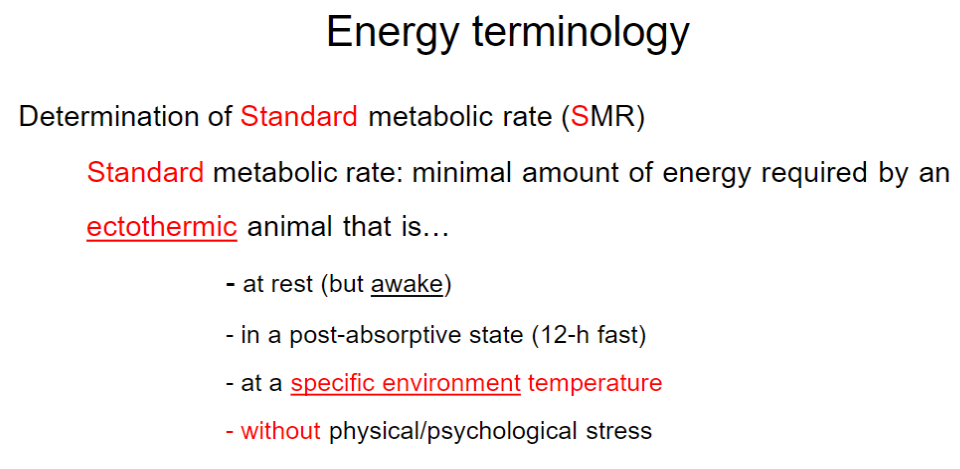
Determining Standard Metabolic Rate (SMR)

Conditions for Measuring SMR

  • At rest → awake but not physically active

  • Post-absorptive state → after a 12-hour fast

  • Specific environmental temperature → measured at a defined temperature

  • No physical or psychological stress

  • Measured in kcal/day


<p>Conditions for Measuring SMR</p><ul><li><p>At rest → awake but not physically active</p></li><li><p>Post-absorptive state → after a 12-hour fast</p></li><li><p>Specific environmental temperature → measured at a defined temperature</p></li><li><p>No physical or psychological stress</p></li><li><p>Measured in kcal/day</p></li></ul><p></p>
35
New cards

Metabolic Body Weight

Definition

  • Body weight raised to a power, typically BWX, to account for differences in metabolic rate between animals of different sizes

  • Used to scale energy requirements relative to body size


<p>Definition</p><ul><li><p>Body weight raised to a power, typically BW<sup>X</sup>, to account for differences in metabolic rate between animals of different sizes</p></li><li><p>Used to scale energy requirements relative to body size</p></li></ul><p></p>
36
New cards

Energy Requirements and Body Size

Metabolic Body Weight (BWX)

  • Energy requirements do not increase directly with total body weight

  • A 100 kg animal does not require twice the energy of a 50 kg animal

  • Smaller animals generally require more energy per unit of body weight than larger animals

  • The graph compares animals from shrews and mice to horses and elephants, showing that energy expenditure per gram decreases as body size increases

Memory Cue

  • Smaller animal → more energy per kg

  • Larger animal → more total energy, but less energy per kg


<p>Metabolic Body Weight (BW<sup>X</sup>)</p><ul><li><p>Energy requirements do not increase directly with total body weight</p></li><li><p>A 100 kg animal does not require twice the energy of a 50 kg animal</p></li><li><p>Smaller animals generally require more energy per unit of body weight than larger animals</p></li><li><p>The graph compares animals from shrews and mice to horses and elephants, showing that energy expenditure per gram decreases as body size increases</p></li></ul><p>Memory Cue</p><ul><li><p>Smaller animal → more energy per kg</p></li><li><p>Larger animal → more total energy, but less energy per kg</p></li></ul><p></p>
37
New cards

Estimating Energy Requirements Across Body Sizes

Kleiber’s Law

  • Developed by Max Kleiber (1893–1976), a Swiss agricultural biologist

  • Estimates basal metabolic rate (BMR) for mature (non-growing) endothermic animals

  • Used because energy requirements do not increase linearly with body weight

Kleiber’s Equation

  • Y = 70BW0.75

  • Y = energy expenditure (kcal/24 hours)

  • 70 = constant

  • BW = body weight (kg), raised to the power of 0.75 to account for metabolic body weight


<p>Kleiber’s Law</p><ul><li><p>Developed by Max Kleiber (1893–1976), a Swiss agricultural biologist</p></li><li><p>Estimates basal metabolic rate (BMR) for mature (non-growing) endothermic animals</p></li><li><p>Used because energy requirements do not increase linearly with body weight</p></li></ul><p>Kleiber’s Equation</p><ul><li><p>Y = 70BW<sup>0.75</sup></p></li></ul><ul><li><p>Y = energy expenditure (kcal/24 hours)</p></li><li><p>70 = constant</p></li><li><p>BW = body weight (kg), raised to the power of 0.75 to account for metabolic body weight</p></li></ul><p></p>
38
New cards

Kleiber’s Law: Metabolic Body Weight

¾ Power Law

  • In most animals, metabolic body weight follows the ¾ power of body weight

  • Metabolic body weight = BW0.75

  • This accounts for the fact that energy requirements do not increase proportionally with body weight


<p>¾ Power Law</p><ul><li><p>In most animals, metabolic body weight follows the ¾ power of body weight</p></li><li><p>Metabolic body weight = BW<sup>0.75</sup></p></li><li><p>This accounts for the fact that energy requirements do not increase proportionally with body weight</p></li></ul><p></p>
39
New cards

Daily Energy Expenditure (DEE)

Total Daily Energy Use

  • Total energy used to support essential body functions, digestion, metabolism, and physical activity

  • DEE = BMR + metabolic heat production + physical activity

    • BMR → energy for essential body functions at rest

    • Metabolic heat production → energy used to produce heat

    • Physical activity → energy used for movement


<p>Total Daily Energy Use</p><ul><li><p>Total energy used to support essential body functions, digestion, metabolism, and physical activity</p></li><li><p>DEE = BMR + metabolic heat production + physical activity</p><ul><li><p>BMR → energy for essential body functions at rest</p></li><li><p>Metabolic heat production → energy used to produce heat</p></li><li><p>Physical activity → energy used for movement</p></li></ul></li></ul><p></p>