Week 6 + 7: Cognitive development (Vygotsky, Info-processing, cross-cultural)
 Call Kai
 Learn
 Practice Test
 Spaced Repetition
 Match
 Flashcards
 Knowt Play
1/69

There's no tags or description
Looks like no tags are added yet.
70 Terms
Trend of study
________ -looking at cognitive development thru a real-world setting AKA school
Vygotsky vs Piaget
_________ - Vygotsky had a shorter career compared to Piaget. During their era, behaviourism was huge in NA, but Vygotsky’s theories took a awhile to get here cuz he was Russian—in this sense Vygotsky is considered “newer”, though he admired Piaget
Piaget: development = a child’s lone venture in the world
Vygotsky: development = a child’s acquisition of tools through interactions w/ others
Areas of difference (Vygotsky)
_______ - Vygotsky believed Piaget overlooked impact of cultural context on development
Interactions with adults and peers + instruction = essential for child development.
Children aren’t learning in a vacuum, everyone around them affects it, NOT a solo learner. Play a big parts
Human history = development of new “cultural” tools for dealing w/ the world
Cultural tools
____________ - Human history = development of new “_______” for dealing w/ the world
Vygotsky’s tools
Psycholgoical tools + new technological tools = people’s cognition
Vygotsky’s tools
Cultural tools
__________ - psychological tools + new technological tools = people’s cognition
Psychological tools
New technological tools
Psychological tools
Cultural tools (Vygotsky’s)
__________ - learning through childhood ways of cooperation, organizing, planning, communicating, calculation
Others also give access to new technological tools (Ex: parents give pencil and crayons)
New technological tools
Cultural tools (Vygotsky’s)
__________ - pencils, writing instruments, iPads, scissors, stick, a rock-- any tool you can use.
As a child learns, the tools they use become more and more sophisticated. (ex: from pencil to pen.
It takes time to acquire these skills
Vygotsky’s Sociocultural Theory
_______- states that cognitive growth is a social and cultural process driven by interactions with people, language, and cultural tools rather than isolated individual discovery.
Concepts, cognitive functions.
What form does knowledge take in a child’s mind?
Vygotsky’s Sociocultural Theory
__________ - 2 cognitive entities
Concepts
Cognitive functions
Concepts
Vygotsky’s Sociocultural Theory (two cognitive entities)
__________ - a class of things that has a label and can be defined by a set of criteria. NOT born with, need to gradually learn
Mature: True concept
Immature: Pseudoconcept + spontaneous concept
True concept (mature understanding)
Vygotsky’s Sociocultural Theory (2 cognitive entities) - concept
__________ - When you know ALL defining criteria— Understand the word for concept is arbitrary and conventional
Ex: Square is four sides. But also know “square” doesn’t mean the same worldwide language.
If they know both of things-- true concept (AKA scientific concept). A true concept has:
Generality: can generalize
Is abstract
Context-independent: doesn’t have to be attached to something (Ex: “there’s” is not context-independent. “Fraction” is independent.)
Generality, is abstract, context-independent
Vygotsky’s Sociocultural Theory (2 cognitive entities) - true concept
__________ - these are the three things a true concept
Immature understanding of concepts
Vygotsky’s Sociocultural Theory (2 cognitive entities) - concept
__________ - 2 types, can have one or both
Psuedoconcept
Spontaneous concept
1) Pseudoconcept
Vygotsky’s Sociocultural Theory (2 cognitive entities) - immature concept
__________ - child has label but not defining criteria.
Ex: can understand a square is a square but cannot define it—the defining criteria is very specific
2) Spontaneous concept
Vygotsky’s Sociocultural Theory (2 cognitive entities) - immature concept
__________ - concept constructed by child’s personal experience
Ex: What defines a dog? You know your dog is a dog, but not with generalizable criteria. If the child’s dog has 3 legs you will say dogs in general have 3 legs (they don’t)
5 cognitive functions
Vygotsky’s Sociocultural Theory (2 cognitive entities)
__________ - Vygotsky was interested in how children combine these functions, several or ALL to do something.
Ex: a children grabbing candy they’re not supposed to—they use multiple cognitive functions to do it.
Language
Thinking
Perception
Attention
Memory
Language
Vygotsky’s Sociocultural Theory (2 cognitive entities) - 5 cognitive functions
__________ - Important for Vygotsky—children would talk themselves thru a problem-solving issue, almost used ALL the time
Said ______ is what helps us gain control of the environment because it can be used to make an impact and communicate
Control environment
Mediator between stimulus and response
For animals, its only stimulus response, but for humans, language separates us from animals as we have language as the mediator.
problem-solving
Vygotsky - How do children acquire knowledge
_______ -Tendency to use symbols during ________ is acquired thru social interaction
Ex: Child has list to remember—they will repeat it to themselves over and over. Children don’t do this by themselves, but it is taught by social interaction
Every function in child development appears two times:
Social level
Individual level
Social level
Vygotsky - How do children acquire knowledge (tendency to use symbols during problem-solving)
__________ - learned at by someone teaching you, interpersonal—other ppl being involved.
Ex: a teacher teaching the kids how to do it.
Individual level
Vygotsky - How do children acquire knowledge (tendency to use symbols during problem-solving)
__________ - When the child learns to do the problem solving on their own, internalized.
Primary goal of instruction
Vygotsky - How do children acquire knowledge (tendency to use symbols during problem-solving)
__________ - to change spontaneous or pseudoconcepts into true scientific concepts
Piaget + Vygotsky interested in concepts but both agree learning about the world is a long process BUT
Piaget: children construct their own knowledge/constructivist
Vygotsky: adults/knowledgeable peers and siblings are needed—instruction NEEDED
Zone of proximal development (ZPD)
Vygotsky - How do children acquire knowledge (tendency to use symbols during problem-solving)
__________ - distance between actual developmental level as determined through problem solving and the level of potential development as determined through problem-solving under adult guidance or in collaboration with capable peers—distance of how they are actually doing on their own and their own potential development.
Challenging child to keep learning with help, but not enough to fail
Scaffolds
Scaffolds
Vygotsky - How do children acquire knowledge (tendency to use symbols during problem-solving)
__________ - teachers act as this. The more you build knowledge, the more scaffolding you need. To reach higher levels of knowledge, you need a foundation
If you have a scaffold helping, the child can reach their new level of knowledge
Ex: Vygotsky says for a child to build a brick wall, the children need ladders and scaffolds to do it. Piaget would say teachers toss the bricks, and children build the wall on their own.
Language
Vygotsky - How do children keep themselves on track when learning?
_________ - 3 components of language function
Communicative speech
Egocentric speech
Inner speech
communicative, egocentric, inner
Vygotsky - How do children keep themselves on track when learning?
_________ - Language, 3 components of language function
1) Communicative speech
Vygotsky - How do children keep themselves on track when learning? 3 components of language
_________ - talking to communicate
2) Egocentric speech
Vygotsky - How do children keep themselves on track when learning? 3 components of language
_________ - talking out loud to yourself. Children who were successful in problem-solving did that—when cognitively overloaded
3) Inner speech
Vygotsky - How do children keep themselves on track when learning? 3 components of language
_________ - talking to yourself internally
Vygotsky was interested in egocentric and inner speech, saying they help focus attention and guide behaviour.
Which is why we do it out loud when figuring out how to do stuff
Educational implications
Vygotsky - How do children keep themselves on track when learning?
_________ - If you want a child to learn, it needs to
Teachers should act as scaffolds
Instruction should always be “in advance” of child’s current level of mastery
To internalize a skill should be in 4 phases
Teachers
Vygotsky - How do children keep themselves on track when learning?
_________ - ______ should act as scaffolds: _______ need to give children a base
“in advance”
Vygotsky - How do children keep themselves on track when learning?
_________ - instruction should always be “__ _______” of child’s current level of mastery: in the zone of proximal development
internalize
Vygotsky - How do children keep themselves on track when learning?
__________ - To “______ “ a skill should be in 4 phases:
Teacher models skills and gives verbal commentary as to what they’re doing and why
Student tries to imitate teacher
Teacher progressively fades out
Repeated confrontation with true/scientific concepts to ensure moving away from spontaneous or pseudoconcepts
Ex: Not all grandmas are let you sit on the lap and bake cookies. Not all cats have 3 feet. Not all moms have dark skin
Information-processing theory
_________ - views the human mind as a biological computer that receives, encodes, stores, and retrieves data through continuous, gradual maturation. Minds are like computers
2 types of knowledge
Info-processing theory
________ - What form does knowledge take in child’s mind?
Declarative knowledge
Semantic networks
Procedural knowledge
Production systems
1) Declarative knowledge
Info-processing theory - What form does knowledge take in child’s mind? (Knowledge)
__________ - formed of facts/factual knowledge—“what knowledge”
Semantic networks
Semantic knowledge
Info-processing theory - What form does knowledge take in child’s mind? (Knowledge)
__________ - building up connections with interconnect with other information. Can start with one word “dog” and end with a whole seemingly unrelated word “airpods”
2) Procedural knowledge
Info-processing theory - What form does knowledge take in child’s mind? (Knowledge)
__________ - how-to concepts. How do we tie our shoes
Production systems
Production system
Info-processing theory - What form does knowledge take in child’s mind? (Knowledge)
__________ - if-then. Firing depends on strength of associative bond between conditions and actions. Done through practice and repetition
Ex: for math facts, seeing 2+2=4, there is a very high likelihood in firing 4 because the associative bond is so strong. Such a well-learned bond, the production system is very strong after a long tim
Information processing
Info-processing theory - how do children acquire knowledge and skills?
__________ - how info from environment becomes stored in memory
Sensory store
STM/WM
Chunking
LTM
Sensory store
Info-processing theory - how do children acquire knowledge and skills? (info-processing)
__________ - fairly short duration, stuff from our senses like feeling.
Short-term memory/working memory
Info-processing theory - how do children acquire knowledge and skills? (info-processing)
__________ - what we pay attention to, or info retrieved from LTM. Limited capacity but can be increased via chunking
Chunking
Chunking
Info-processing theory - how do children acquire knowledge and skills? (info-processing)
__________ - You memorize things in STM more via meaningful groups of information. Children need to learn this.
Long-term memory
Info-processing theory - how do children acquire knowledge and skills? (info-processing)
__________ - the permanent or semi-permanent storage system that holds vast amounts of information, facts, skills, and experiences over extended periods, ranging from hours to an entire lifetime.
Learning
Info-processing theory - how do children acquire knowledge and skills?
__________ - paying attention to info using strategies to transfer info into STM/WM/LTM.
Developmental aspects
Metamemory
Developmental aspects of learning
Info-processing theory - how do children acquire knowledge and skills? (learning)
__________ - Across development, children get better at attention and using strategies. Information-processing increases/attention and strategies increase to help way find. Declarative and procedural knowledge increases, and metamemory does too.
Ex: A child got lost in an Edmonton forest and they couldn’t find it, and no one knew. So they studied, and learned children usually don’t pay attention to the right information.
Ex: a child might look for a bird—but as kids grow they learn more and
IPers: becoming better info-processors
Metamemory
Info-processing theory - how do children acquire knowledge and skills? (learning)
__________ - Meta is knowledge about memory—as we get older we make more effort to remember things, and strategies to do it.
strategies; cognitive monitoring
Info-processing theory - how do children keep on track while learning?
__________ - these are the two ways how children stay on track while learning
1) Strategies
Info-processing theory - how do children keep on track while learning?
__________ - actions performed to attain goal—like a factory worker hired to make widgets
Ex: Remembering to wake up, you need to set an alarm. To do well on a tests, study beforehand. Gets better as we get older. Maybe chunking, mnemonics etc.
2) Cognitive monitoring
Info-processing theory - how do children keep on track while learning?
__________ - processes used to decide WHICH strategy to use—some strategies are effective but take too long, some are quick but not right for the situation. The supervisor who says which process to use, and whether it actually worked
limited; exposure/practice
Info-processing theory
__________ - IP has these two education implications:
Teachers need to recognize that children are naturally ______ in amount of info they can process and remember
Lots of ______/______to build up easily accessible and large store of declarative and procedural knowledge
limited
Info-processing theory (educational implications)
__________ - Teachers need to recognize that children are naturally ______ in amount of info they can process and remember
Need to put things into smaller portions, and more time to learn
Use strategies to help deal with info
Organize info into chunks
exposure/practice
Info-processing theory (educational implications)
__________ - Lots of ______/______ to build up easily accessible and large store of declarative and procedural knowledge
The more you practice, the more successful you will be in retrieving info from LTM.
Basic facts, good declarative knowledge, good systems in terms of procedural knowledge—they do better
Cross-cultural differences in academic achievement
____________ - there have been indicators that the U.S. was falling behind in reading, writing and mathematics. Issues in basic literacy and numeracy can call them to fall behind, so this was studied as it can be expensive for an economy.
Stevenson, Lee, & Stigler (1986) study
Stevenson, Lee, & Stigler (1986)
Cross-cultural differences
__________ - Gr 1 (right at beginning of schooling) and 5 (4-5 yrs of schooling) students in three cities (Minneapolis, Sendai, Taipei).
n=240/grade in each city. Very homogenous at the time, gave a reading and math test.
Reading results
Math results
Other differences
Reading results
Cross-cultural differences - Stevenson, Lee, & Stigler (1986)
__________ - No cross-cultural differences from both age groups
Math results
Cross-cultural differences - Stevenson, Lee, & Stigler (1986)
__________ - American kids scored much lower in Gr 1, and by Gr 5. American kids did much worse, while Taiwan and JP worst.
Top 100: in gr 1 only 15 are American, in gr 5, only 1 is.
Bottom 100: gr 1-- 58 Americans, gr 5-- 67 Americans.
Other differences
Cross-cultural differences - Stevenson, Lee, & Stigler (1986)
__________ - classroom observations, teacher and parent questionnaires—very high responses from fathers in the Asian countries, while fathers rarely responded in America.
Life in school
Homework
Paternal evaluations
Paternal beliefs
Teachers
Outside assistances
Children’s attitudes
Life in school
Cross-cultural differences - Stevenson, Lee, & Stigler (1986) - other diffs.
__________ - Classroom time (academic activities) in the US was much less compared to the Asian countries – not as much time learning.

Homework
Cross-cultural differences - Stevenson, Lee, & Stigler (1986) - other diffs.
__________ - American mothers said homework is not very important in how the kids did, while in Asian countries they said it was very important. It is not just the amount of time, because Japanese students don’t do as much time but score just as well as Taiwanese

Parental evaluations
Cross-cultural differences - Stevenson, Lee, & Stigler (1986) - other diffs.
__________ - American moms were very satisfied with children’s performance in school, while Japanese and Taiwanese said they were unsatisfied.
Asian moms were concerned with more room for improvement for education quality and their children’s performance
Parental beliefs
Cross-cultural differences - Stevenson, Lee, & Stigler (1986) - other diffs.
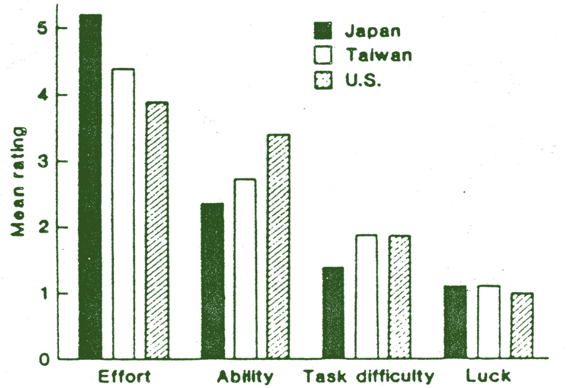
__________ - parents were asked if the child does well, is it based on effort, ability, task, difficulty, and luck on achievement.
American moms are more likely to say its because they’re smart, not hard work, vice versa for Asian moms.
Teachers
Cross-cultural differences - Stevenson, Lee, & Stigler (1986) - other diffs.
__________ - North American teachers are more multi-tasked and do a range of tasks, versus Asian teachers are more teaching focused, less parental and discipline issues. More dedicated teacher prep time for Asian teachers.
Outside assistance
Cross-cultural differences - Stevenson, Lee, & Stigler (1986) - other diffs.
__________ - Cram school is only for teenagers in Asian countries, not for young children, so no effect on this study
Children’s attitudes
Cross-cultural differences - Stevenson, Lee, & Stigler (1986) - other diffs.
__________ - American children were 52% enjoyed doing school, versus Asian children were 86% happier with school. Asian kids do better and are happier with school
TIMSS
Cross-cultural differences
__________ - has anything changed since 1986? Trends in International Mathematics and Science Study. 2019 data, Gr 4 students. Study includes data from multiple kids in diff. countries (4,000 students from 57 countries)
Rankings
Cross-cultural differences (TIMSS differences)
__________ - Taiwan/Taipei was #4, Japan #5, U.S. #15, Canada #32 – Canada has the largest boys doing way better than girls.
less
Cross-cultural differences (TIMSS differences)
__________ - life in school:
Teacher satisfaction: teachers most happy was Kosovo, Canada was #30 and US #32 out of 57. But Japan and Taiwan were dead last in happiness.
Time spent teaching math: #1 country was Portugal, U.S. #5, Canada #9, Japan #23, Taiwan #32
American kids now getting more time spent on math, but still scoring ____!
satisfaction; attitudes
Cross-cultural differences (TIMSS differences)
__________ - parents:
Parent ________ w/ schools: U.S. parents didn’t respond, but in Canada 94% were satisfied with school, and now in Taiwan it’s the same (used to be 6%). Japanese parents 77% satisfied, still least satisfied
Math resources at home:
Parent ____ toward math and science (2015 data): 99% of Canadian parents think math and science are super important, Japan is only 82%
You might think where they score higher they would do better but that’s not the case
confidence: like
Cross-cultural differences (TIMSS differences)
__________ - children:
Confidence in math: 76% Canadian kids, 74% American kids, 76% Japanese, 65% Taiwanese.
Not widely diverging cross-culturally, but confidence in very vs simply confident—NA are more VERY confident, not Asian
Like learning math: 76% Canadian kid positive, 73% American kids, jumps down dramatically 60% Japan and Taiwan.
Japanese and Taiwanese dislike it a ton.
Conclusions on cross-cultural diffs
Cross-cultural differences (TIMSS differences)
__________ - include…
Sample size differences: Stevenson study was big but TMSS study is huge
Era differences
Canadians have positive attitudes, happy teachers, parents and kids. However, still not doing extremely well.
Must be a lot of factors as to what is going on in cognitive development, cuz there are lots of differences.