Study pack vol1 Phys/ chem passage 6 + extra q's
 Call Kai
 Learn
 Practice Test
 Spaced Repetition
 Match
 Flashcards
 Knowt Play
1/11

Earn XP
Description and Tags
Phys/ chem passage 6 + extra q's
12 Terms
Passage 6 (Questions 41-46)
Lysozyme is an enzyme that kills gram-positive bacteria by cleaving N-acetylglucosamine oligosaccharides (NAGx). One product, NAG3 has a high affinity for hen egg white (HEW) lysozyme: affinity constant KNAG3 = 1.3 × 10⁵ M–1, ΔH° = –50 kJ/mol, ΔG° = –30 kJ/mol. Structural studies indicate that NAG3 makes hydrogen bonds with D59, W62, W63, D101, N103, and A107 in a cleft in HEW lysozyme that is adjacent to the catalytically active D52 and E35 residues.
Unlike NAG3, NAG monomer interacts weakly with HEW lysozyme, and it is not possible to measure KNAG or ΔH° of its interaction directly. Researchers used competition isothermal titration calorimetry (CITC) to measure the heat of interaction of NAG with HEW lysozyme. HEW lysozyme (1.0 mL, 0.1 mM) was titrated with 25 injections of NAG3 (10 µL, 2.5 mM) in the presence of various amounts of NAG and the heat associated with each injection was measured. Modeling of the heat per injection curves (Figure 1) gives the apparent association constant Kapp.
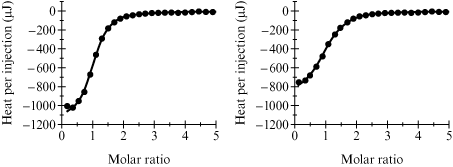
Figure 1 | CITC graphs of NAG3 with HEW alone (left) and HEW in the presence of 20 mM NAG (right) |
Kapp is mathematically related to the affinity constant of NAG KNAG by Equation 1.
KNAG3/Kapp = 1 + KNAG[NAG]
Equation 1
By plotting KNAG3/Kapp versus [NAG] (Figure 2), the value of KNAG could be determined.
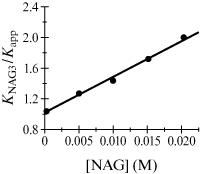
Figure 2 | Plot of KNAG3/Kapp versus [NAG] |
Adapted from C.-C. Wei et al., “Isothermal Titration Calorimetry and Macromolecular Visualization for the Interaction of Lysozyme and Its Inhibitors,” Journal of Chemical Education ©2015 The American chemical Society.
_
Null
According to the passage, what type of bond is cleaved by lysozyme?
A
Peptide
B
Phosphate ester
C
Glycoside
D
Pyrophosphate
This is an Organic Chemistry question that falls under the content category “Structure, function, and reactivity of biologically-relevant molecules.” The answer to this question is C because the bond that links monosaccharides together in an oligosaccharide is a special type of acetal linkage known as a glycoside bond. It is a Knowledge of Scientific Concepts and Principles question because you are asked to recognize and identify the type of bond broken in a reaction.
What is the approximate value of ΔS° for binding of NAG3 to HEW at 27°C?
A
–200 J/K
B
–67 J/K
C
67 J/K
D
200 J/K
Solution: The correct answer is B.
This is a General Chemistry question that falls under the content category “Principles of chemical thermodynamics and kinetics.” The answer to this question is B and can be arrived at by using the data supplied in the passage and the relation ΔG = ΔH – TΔS. Solving for ΔS gives –(ΔG – ΔH)/T = –(–30,000 J + 50,000 J)/300 K = –67 J/K. It is a Scientific Reasoning and Problem Solving question because you are asked to determine and use a formula to solve a scientific problem.
Based on the structural studies, when NAG3 interacts with amino acids in HEW, it can hydrogen bond to the side chains of the amino acids at all of the positions described EXCEPT for the amino acid at which position?
A
62
B
101
C
103
D
107
Solution: The correct answer is D.
This is a Biochemistry question that falls under the content category “Structure, function, and reactivity of biologically-relevant molecules.” The answer to this question is D. NAG3 interacts with the amino acids at positions 59, 62, 63, 101, 103, and 107. The side chains of the amino acids at all of the positions contain sites for potential hydrogen bonding with the exception of alanine which is at position 107. It is a Scientific Reasoning and Problem Solving question because you are asked to bring together theory, evidence, and observations to draw a conclusion.
What quantity of NAG3 was required to reach the equivalence point in the titration?
A
25 nmol
B
100 nmol
C
25 µmol
D
100 µmol
Solution: The correct answer is B.
This is a General Chemistry question that falls under the content category “Unique nature of water and its solutions.” The answer to this question is B because the graphs in Figure 1 both imply a 1:1 mole ratio of NAG3 was added at the equivalence point and the solution contained 1.0 mL of 0.10 mM = (1 × 10⁻³ L)(0.10 × 10⁻³ mol/L) = 1.0 × 10⁻⁷ mol = 100 nmol. It is a Data-based and Statistical Reasoning question because you are asked to analyze and interpret data presented in Figure 1 to arrive at the conclusion.
hat was the experimentally determined value of KNAG from the study described in the passage?
A
0.02 M–1
B
0.10 M–1
C
20 M–1
D
50 M–1
Solution: The correct answer is D.
This is a Biochemistry question that falls under the content category “Structure, function, and reactivity of biologically-relevant molecules.” The answer to this question is D since, according to Equation 1, the slope of the graph in Figure 2 is the value of KNAG. The slope is Δy/Δx = (2 – 1)/(0.020 – 0.00) = 1/0.020 = 50. It is a Data-based and Statistical Reasoning question because you are asked to analyze and interpret the graph presented in Figure 2 to arrive at the conclusion.
An ITC experiment is conducted by injecting Compound 1 into a solution of Protein A giving large measured heats and a high affinity constant K1. A CITC experiment under identical conditions but in the presence of 10 mM Compound 2 gives the same heat curve and Kapp = K1. What change to the experimental conditions can result in measurable heat differences and Kapp < K1?
A
Dilute all of the solutions.
B
Increase the concentration of Compound 1 in both titrations.
C
Increase the concentration of Protein A in both titrations.
D
Increase the concentration of Compound 2 in the second titration.
Solution: The correct answer is D.
This is a General Chemistry question that falls under the content category “Unique nature of water and its solutions.” The answer to this question is D since the experiment depends on Compound 2 successfully competing for the binding sites available on Protein A and this is the only response that will improve the chances of this happening. It is a Reasoning about the Design and Execution of Research question because you are asked to reason about the features of a research study that suggests relationships between the variables.
Kapp and K1 are analogous to Km, they refer to substrate’s affinity for the enzyme. K1 refers to the affinity constant for compound 1 and Kapp is referring to compound 2.
If the goal is to go from Kapp=K1 to Kapp<K1, then the question is asking how you could increase the affinity for the second compound (since a lower Km value is associated with higher affinity).
Diluting would have no effect, adding the same protein to both titrations would cause the same magnitude of change in both, and adding compound 1 will increase the affinity of that compound by lowering K1 rather than Kapp as the question asks.
Thus, if you wanna lower Kapp, adding compound 2 increases the affinity associated with this compound relative to compound 1, hence Kapp<K1
The principle behind this question is actually really simple but as usual the AAMC makes it insanely complicated, mostly by avoiding using familiar terminology. Instead of "enzyme" they call it "protein A," instead of competitive inhibitor vs. substrate they just call them compounds 1 and 2, and instead of Km they use Kapp. Fundamentally this is a basic enzyme kinetics question.
Competition isothermal titration calorimetry (CITC) has the word COMPETITION, so you are using competitive compounds to find out the affinity of the target compound based on the amount of heat liberated when [ES] is formed. The passage says that this method is used when the primary (target) compound you're investigating can't be analyzed directly. You need a competitor substrate whose Km values are known in order to indirectly determine the target compound's unknown Kapp.
This question took so much time because I just didn't understand what Kapp meant. Somehow I didn't learn this in my original enzyme kinetics training, or I forgot completely. I just kept calling all half-way points Km. Here is the difference:
Km is the substrate concentration at which an enzyme reaches half its maximum velocity (Vmax) under IDEAL CONDITIONS.
Kapp (K apparent) is also half of Vmax but measured under specific, NON-IDEAL CONDITIONS (like different pH, temperature, or inhibitors present), so it may differ from Km, reflecting how those conditions affect affinity.
Trial 1: Compound 1 in a solution of Protein A gives large measured heats and a high affinity constant K1.
- protein A has to be the enzyme
- K1 is probably equal to Km (ideal conditions) because there is no competitor for compound 1, so it has free reign
Trial 2: A CITC experiment under identical conditions but in the presence of 10 mM Compound 2 gives the same heat curve and Kapp = K1.
- no change because trial 2 did not really add enough of compound 2 to compete with compound 1 for the enzyme binding site, which is why the constants are still Kapp=K1
What change to the experimental conditions can result in measurable heat differences and Kapp < K1?
If you want Kapp to drop from ideal conditions (K1), you would have to increase competition for its enzyme binding site, so you would increase the concentration of compound 2.
A - Diluting all of the solutions
- It might or it might not, since we don't have enough kinetic data to know either way
B - Increasing Compound 1.
- No. In competitive inhibition, increasing the amount of substrate is how you overcome its competitive inhibition, and the goal is to decrease Kapp
C - Increase protein A.
- No. Increasing the amount of enzyme gives the substrate more active sites to bind to, which increases velocity.
D - Increase Compound 2.
- This is the only logical answer..
he idea that enzymes undergo conformational changes upon substrate binding in order to bring specific functional groups into the correct catalytic orientation is described as the:
_
A
transition-state model.
B
active-site model.
C
lock-and-key model.
D
induced-fit model.
Solution: The correct answer is D.
This is correct. This Biochemistry question falls under the content category “Principles of chemical thermodynamics and kinetics.” The answer is D because the induced-fit model of enzyme catalysis states that the active site of the enzyme changes shape upon substrate binging and only the proper substrate causes a change that initiates catalysis. This is a Knowledge of Scientific Concepts and Principles question because you must recall the concept of substrate binding models.
When performing experiments to measure the kcat of an enzyme, the substrate concentration should be:
_
A
limiting.
B
equal to 1/2 KM.
C
equal to KM.
D
saturating.
Solution: The correct answer is D.
This is correct. This Biochemistry question falls under the content category “Principles of chemical thermodynamics and kinetics.” The answer is D because the kcat is used to describe the rate-limiting step of catalysis under saturating conditions of substrate. This is a Reasoning about the Design and Execution of Research question because you must understand the design of an experiment used to measure the maximum velocity of an enzymatic reaction.
When experiments are performed on enzymes that display traditional Michaelis–Menten kinetics, what shape does the graph of V0 versus substrate concentration [S] have?
_
A
A hyperbolic dependence on [S]
B
A linear dependence on [S]
C
A sigmoidal dependence on [S]
D
A parabolic dependence on [S]
Solution: The correct answer is A.
This is correct. This Biochemistry question falls under the content category “Principles of chemical thermodynamics and kinetics.” The answer is A because traditional Michaelis–Menten kinetics describes a hyperbolic dependence of V0 on substrate concentration. This is a Knowledge of Scientific Concepts and Principles question because you must recall the shape of a typical Michaelis–Menten plot.
Hyperbolic shape: In Michaelis–Menten kinetics, as substrate concentration increases, the initial reaction velocity (V0) initially rises rapidly, but then the rate slows down and gradually approaches a maximum velocity (Vmax) at high substrate concentrations. This creates a curve that resembles a hyperbola
Which experimental results confirm that Compound 1 is an uncompetitive inhibitor of a particular enzyme? In the presence of Compound 1:
_
A
the KM increases and Vmax decreases.
B
the KM decreases and Vmax increases.
C
both the KM and Vmax decrease.
D
both the KM and Vmax increase.
Solution: The correct answer is C.
This is correct. This Biochemistry question falls under the content category “Principles of chemical thermodynamics and kinetics.” The answer is C because the presence of an uncompetitive inhibitor results in a lower apparent KM and Vmax of the enzymatically catalyzed reaction. This is a Knowledge of Scientific Concepts and Principles question because you must recall the effect of an uncompetitive inhibitor.
At pH 7, which of the following peptides will bind to an anion-exchange column and require the lowest concentration of NaCl for elution?
_
A
AVDEKMSTRGHKNPG
B
YPGRSMHEWDIKAQP
C
HIPAGEATEKALRGD
D
EAPDTSEGDLIPEVS
Solution: The correct answer is C.
Solution: The correct answer is C.
This is correct. This Biochemistry question falls under the content category “Separation and purification methods.” The answer is C because the anionic peptides bind to anion-exchange columns. The strength of the binding depends on the overall charge of the peptide. Of the options given, only C and D have a net negative charge. The net charge of peptide C is –1, whereas the net charge of peptide D is –5. Peptide C would elute at a lower salt concentration than Peptide D. This is a Reasoning about the Design and Execution of Research question because you must understand the design of an anion-exchange experiment and the role of elution in that design to determine the appropriateness of a technique.
whihc aa give off + and neg charge
neg
Aspartic acid: Asp (or D)
Glutamic acid: Glu (or E)
pos
Arginine: Arg (or R)
Lysine: Lys (or K)
Histidine: His (or H). Histidine is considered basic, though it has a pKa near neutral pH, so its charge can shift depending on the specific environment.