The distribution of income and wealth: poverty and inequality
 Call Kai
 Learn
 Practice Test
 Spaced Repetition
 Match
 Flashcards
 Knowt Play
1/94

There's no tags or description
Looks like no tags are added yet.
95 Terms
What is income?
A flow of money earned over time from work or assets
What is wealth?
A stock of assets owned at a point in time
What is distribution of wealth/income?
how income/wealth is divided between rich and poor, or between different groups in society
What is income inequality?
the unequal distribution of household or individual income (flow) across an economy, including wages, interest, and dividends.
What is wealth inequality?
the unequal distribution of accumulated assets (stock), such as property, shares, and savings.
Give a key example of inequality in America
the richest 32 million ppl in America have nearly 80% of the wealth
Jeff Bezos (owner of Amazon) is worth more than $1 billion
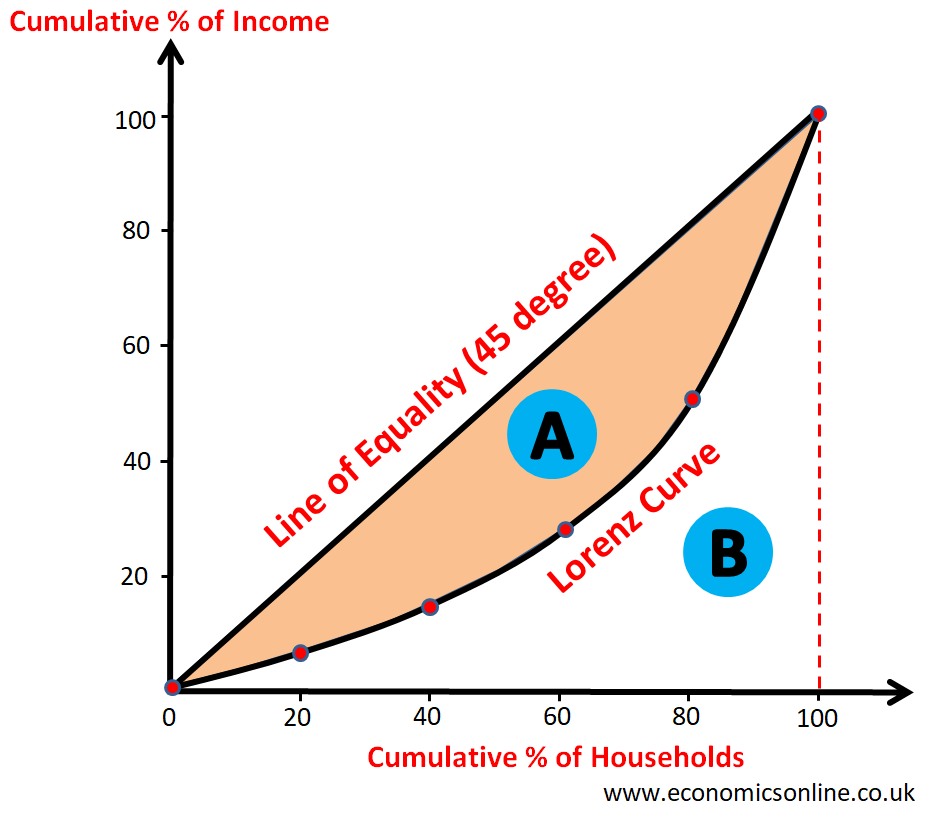
What is the Lorenz curve?
a curve that shows the cumulative percentage of income/wealth earned by cumulative percentages of the population
Draw the Lorenz curve
straight line shows perfect income inequality - workers earn and own the same
the further the Lorenz curve is from the straight line, the greater the inequality
What can the Lorenz curve be used to calculate?
the gini coefficient
What is the gini coefficient
A numerical measure of inequality between 0 and 1
What does a gini coefficient of 0 mean?
Perfect equality
What does a gini coefficient of 1 mean?
Perfect inequality
What are the factors affecting income distribution?
education and skills
types if employment
trade union power
discrimination
tax and welfare system
globalisation and technology
national minimum wage
How do education and skills affect income distribution?
Higher skills → higher productivity → higher wages
Education inequality reinforces income inequality
How does types of employment affect income distribution?
Full-time vs part-time
Secure vs zero-hours contracts
How does trade union power affect income distribution?
Strong unions → higher wages and better conditions
Decline in unionisation increases wage inequality
How does discrimination affect income distribution?
Gender, ethnicity, age discrimination can reduce incomes
How does the tax and welfare system affect income distribution?
Progressive taxation reduces inequality
Benefit cuts increase inequality
How does globalisation and technology affect income distribution?
Increased demand for high-skilled labour
Low-skilled workers face wage stagnation
How does national minimum wage affect income distribution?
higher cost for business owners, less profit, lower salary and dividends for managers, improves income inequality by narrowing the gap
What are some of the factors affecting wealth distribution?
inheritance
asset ownership
savings ability
house price inflation
social assortative mating
‘r>g’ hypotheses
How does inheritance affect wealth distribution?
Wealth is often passed down generations
Leads to entrenched (established) inequality
Picketty - 90% of wealth is inherited
How does asset ownership affect wealth distribution?
Property and shares rise in value
Those without assets miss out on capital gains
How does savings ability affect wealth distribution?
Higher-income households can save more
Compounding increases wealth gaps over time
How does house price inflation affect wealth distribution?
Homeowners gain wealth
Renters fall further behind
How does social assortative mating affect wealth distribution?
talented, rich and successful people mate and have children with other talented, rich and successful people. They can afford the best for their children e.g private school and clean environments and can grow up to be rich and successful as well
What is the r>g hypothesis and how does it affect wealth distribution?
Piketty said that starting off with lots of wealth makes it easier to get more wealth. Assets can be used to buy more assets and increase wealth quickly. Wealth grows faster than incomes worsening inequality
Is wealth or income more unequal in the UK?
Wealth
What is equality?
Everyone receives the same income or wealth
What is equity?
Distribution based on fairness and need
Why is equity a value judgement?
because it’s not an objective fact
How is UK income and wealth distribution?
Income inequality in the UK is moderate to high compared to other developed economies
Wealth inequality is much higher than income inequality
The top 10% own a very large share of total wealth
Regional inequality is significant (London & South East vs North)
What are the benefits of more equality?
Reduced poverty
Improved social cohesion - reduces social exclusions and tensions
Better health and education outcomes
Lower crime rates
Reduced market failure
Improves access to merit goods
What are the costs of more equality?
Reduced incentives
High taxes may discourage work and entrepreneurship
Efficiency loss
Deadweight welfare loss from taxation
Government failure
Poorly targeted redistribution
What are benefits of inequality?
Incentives to work and innovate
Higher investment and entrepreneurship - Wealthy individuals are more able to invest in physical capital and fund start-ups
Dynamic efficiency - when economy improves over time through innovation - inequality increases profit motive an encourages firms to invest in r and d
What are the costs of inequality?
Poverty and social exclusion
Reduced social mobility (ability of individuals or households to move up or down the income and wealth distribution over time) - unequal access to education, healthcare and houses
Under-consumption
Lower marginal propensity to consume
Market failure
Positive externalities of education under-consumed
What is absolute poverty?
Income below the level required to meet basic necessities for survival (food, shelter, heating, clean water and basic healthcare)
What is the world bank definition of absolute poverty?
living on between $2.15 and $3 a day
How many people are living in absolute poverty in 2025?
700 million people
What is relative poverty?
Income significantly below the average in society, limiting participation in normal activities.
How is relative poverty measured in the UK?
Income below 60% of median household income
Compare absolute and relative poverty
Absolute Poverty | Relative Poverty |
|---|---|
Fixed standard | Changes with average income |
Survival-based | Lifestyle and participation-based |
Common in developing countries | Common in developed countries |
Can be eliminated | Always exists |
What are some of the causes of poverty?
low income and unemployment
inequality of income and wealth
education and skill gaps
health problems
damaging effects of civil wars and natural disasters
absence of basic public services
high cost of living
family circumstances
How does unemployment cause poverty?
Loss of earned income increases reliance on insufficient welfare benefits
How does inequality cause poverty?
Wealth generates income, while poor households lack assets, reinforcing disadvantage
How does education affect poverty?
Low skills reduce productivity and wages, limiting income potential
Why does ill health increase poverty?
It reduces employability and raises living costs
How do civil wars and natural disasters cause poverty?
Destroy physical capital (homes, factories, infrastructure)
Reduce productive capacity (AS falls)
Increase unemployment
Lower household incomes
How does the absence of basic public services cause poverty?
Poor education → low skills → low wages
Poor healthcare → lower ability to work
Weak infrastructure → fewer jobs
Weak institutions → low investment
How do family circumstances cause poverty?
Single-parent households
Larger families
Dependence on one income
How does high cost of living cause poverty?
Housing costs (rent, mortgages)
Energy prices
Food inflation
Especially affects low-income households
What are the specific causes of poverty in the UK?
old age
unemployment
low wages
What are some of the effects of poverty?
lower living standards
worse health outcomes
poor educational outcomes
lower productivity and economic growth
higher government spending
social problems
How does poverty lower living standards?
Poor housing, food insecurity
Fuel poverty
Limited access to digital services
How does poverty lead to worse health outcomes?
Higher obesity and malnutrition
Mental health issues
Shorter life expectancy
Increases NHS costs (negative externality)
How does poverty lead to poor educational outcomes?
Lower attendance and attainment
Limited access to tutoring or resources
Reduces future earning potential
Leads to persistent poverty
How does poverty lower productivity and economic growth?
It lowers productivity and human capital, reducing potential output (unutilised labour)
How does poverty higher government spending?
More welfare payments
Higher healthcare and policing costs
Greater fiscal pressure → higher taxes or borrowing
How does poverty lead to social problems?
Higher crime rates
Social exclusion
Reduced social cohesion
Is poverty an example of market failure?
Yes — poverty can be seen as market failure where free markets lead to unequal income distribution, under-consumption of merit goods, and poverty traps.
However, poverty is not always market failure because markets prioritise efficiency rather than equity, and inequality may result from differences in skills, productivity, or choices, not inefficiency.
What is progressive taxation?
A tax system where higher-income earners pay a higher proportion of their income in tax e.g income tax
How does progressive taxation reduce poverty and inequality?
Raises government revenue
Funds welfare benefits and public services
Narrows the post-tax income gap
What are some good evaluation points for progressive tax?
✔ Reduces income inequality
✔ Raises funds for public spending
What are some evaluation points against progressive tax?
✖ May reduce incentives to work or invest
✖ Risk of tax avoidance and evasion
✖ High earners may relocate abroad
✖ Fiscal drag = when raises in tax thresholds in progressive tax systems o not keep pace with inflation
What are welfare benefits?
Payments from the government to individuals with low income or special needs e.g housing and disability benefits
How doe welfare payments reduce poverty?
Increase disposable income
Provide a safety net
Reduce absolute and relative poverty
What are some good evaluation points for welfare benefits?
✔ Directly targets low-income households
✔ Reduces inequality
What are some evaluation points against welfare benefits?
✖ Costly to the government
✖ Risk of benefit dependency
✖ May reduce incentives to work (poverty trap)
What is national minimum wage?
A legal minimum hourly wage
Living wage aims to reflect cost of living
How does national minimum wage alleviate poverty?
Raises incomes of low-paid workers
Reduces in-work poverty
Lowers reliance on benefits
What are some good evaluative point of NMW?
✔ Improves income distribution
✔ Increases consumer spending
What are some evaluative points against NMW?
✖ May increase unemployment if firms cut jobs
✖ Higher costs for businesses → inflation
What are some examples of provision of free or subsidised public services?
Healthcare (NHS)
Education
Social housing
Free school meals
How does provision of free or subsidised public services reduce poverty?
Reduces cost of living
Increases real income
Improves long-term opportunities
What are good evaluative points for provision of free or subsidised public services?
✔ Long-term reduction in inequality
✔ Improves social mobility
What are some evaluative points against provision of free or subsidised public services?
✖ Expensive to fund
✖ Benefits may not be well targeted
What are some examples of education and training policies?
Free education
Apprenticeships
Skills training programmes
How do education and training policies reduce poverty?
Improve human capital
Increase employability
Break the cycle of poverty (poverty trap)
What are some good evaluative points for education and training policies?
✔ Long-term solution
✔ Improves productivity and growth
What are some of the evaluative points against education and training?
✖ Time lag before effects seen
✖ Does not help those currently in poverty
What is the poverty trap?
People on low incomes face very weak incentives to increase their earnings because any rise in income leads to higher taxes and withdrawal of benefits, leaving them little or no better off.
Outline the step-by-step of the poverty trap?
1⃣ Individual receives welfare benefits
2⃣ They earn more income (e.g. extra hours / promotion)
3⃣ Benefits are withdrawn
4⃣ Income tax and National Insurance increase
5⃣ Net income rises very little — or may even fall
6⃣ Individual is discouraged from working more
What are some of the consequences of the poverty trap?
Persistent relative poverty
Reduced labour supply
Lower productivity
Increased long-term welfare dependency
Higher government spending
What are some evaluative points of the poverty trap?
✔ Welfare benefits reduce absolute poverty
✖ Poorly designed systems reduce work incentives
The poverty trap highlights the trade-off between equity and efficiency.
What are means-tested benefits?
benefits that may only be claimed depending on a person’s income (e.g housing)
What is universal benefit?
benefits that are available to all, regardless of their income level (e.g child benefit)
What is the unemployment trap?
Individuals are financially no better off - or worse off - if they move from unemployment into work because wages are similar to unemployment benefits once costs are considered
Outline the unemployment trap
1⃣ Individual receives unemployment benefits
2⃣ Offered a low-paid job
3⃣ Benefits are lost when employment begins
4⃣ Additional costs arise:
Transport
Childcare
Work clothing
5⃣ Disposable income is unchanged or lower
6⃣ Individual chooses to remain unemployed
What are some consequences of the unemployment trap?
Higher structural unemployment
Reduced labour market participation
Skills atrophy
Lower potential output
Increased welfare spending
What are positive economic consequences of redistribution policies?
Reduced poverty
Lower income inequality
Improved living standards
Greater social cohesion
Higher marginal propensity to consume → demand growth
What are some negative economic consequences of redistribution policies?
Higher taxes
Increased government spending
Potential disincentives to work
Deadweight welfare loss
Budget deficits
What is an interventionist view on poverty and inequality?
Government has a moral duty to reduce inequality
Poverty is a market failure
Supports:
Progressive taxation
Welfare state
Redistribution
What is the free-market view on poverty and inequality?
Inequality provides incentives
Redistribution reduces efficiency
Poverty best reduced through economic growth
Supports:
Lower taxes
Limited welfare
What does the effectiveness of these redistribution policies depend on?
Size of intervention - e.g how much money (NMW)
Targeting - how accurately does it reach people who acc need help e.g is it aimed at the poorest
Economic context - whether the state of the economy makes the policy more or less effective e.g boom, unemployment, inflation etc
What are some of the impacts of high rates of extreme poverty and deep inequality?
low life expectancy
low access to healthcare
low school enrolment