Exam 2 Review
 Call Kai
 Learn
 Practice Test
 Spaced Repetition
 Match
 Flashcards
 Knowt Play
1/393

There's no tags or description
Looks like no tags are added yet.
Name | Mastery | Learn | Test | Matching | Spaced | Call with Kai | Chat |
|---|
No analytics yet
Send a link to your students to track their progress
394 Terms
What initial name was given to the PRRSV agent isolated in the Netherlands in 1990?
Lelystad virus
What viral family does PRRSV belong to?
Arteriviridae
What type of genome structure does PRRSV possess?
Single-stranded, positive-sense RNA polycistronic molecule
Which specific cell type in the lungs does PRRSV primarily infect and replicate within?
Alveolar macrophages
What are the two major distinct genotypes of PRRSV?
Type 1 and Type 2
What clinical signs are seen with PRRSV?
Respiratory disease, still-births, poor growth, immunosuppressive and death
What is the economic problem with PRRSV?
High commercial impacts and losses
Within how many hours post-infection does PRRSV viremia typically begin?
6 to 12 hours post-infection
Where does PRRSV replication localize during the persistent phase (Phase 3) of infection?
Lymphoid tissues, including tonsils and lymph nodes
Which cellular receptor knockout or removal renders gene-edited pigs resistant to PRRSV?
CD163
What genomic characteristic differentiates highly pathogenic PRRSV (HP-PRRSV) from classical PRRSV strains?
Specific deletions in non-structural protein 2 (NSP2)
How long can an infected pig continue to transmit PRRSV?
Up to 100 days
What is the minimum estimated infectious dose required for PRRSV transmission?
As little as 10 virus particles
What is the most common way that the PRRSV virus is introduced into a population of pigs?
Through shedding carriers
At what stage of gestation does PRRSV cross the placenta to cause transplacental infection?
Third trimester
What are the clinical signs of reproductive disease caused by PRRSV?
Increased stillborn piglets, mummified fetuses, premature farrowings, weak-born piglets, embryonic death, late-term abortions, lethargy, cyanosis, agalactia, and preweaning mortality
What are the clinical signs of respiratory disease caused by PRRSV?
Dyspnea, tachypnea, open-mouth breathing, lethargy, depression, reduced appetite and poor growth, coughing, sneezing, fever and aural cyanosis
What is the characteristic microscopic lung lesion caused by PRRSV?
Severe necrotizing interstitial pneumonia
During which seasons is the incidence rate of PRRSV highest in swine herds?
Fall and winter
What is the optimum MOSS (monitoring and surveillance system)? What kind of samples is the swine industry using for this? (PRRSV)
Fast, practical, affordable and effective, The swine industry is increasingly using population-based samples (oral and processing fluids)
How many days post-infection are non-neutralizing IgG antibodies typically detectable by ELISA? (PRRSV)
7 to 10 days post-infection, but may not appear until 28 dpi
What tests can you use for virus detection? (PRRSV)
PCR, virus isolation, IHC
Which type of commercially available vaccine is primarily used to control PRRSV outbreaks?
Modified live virus (MLV) vaccine
Why do PRRSV Type 2 MLV vaccines fail to protect against PRRSV Type 1 challenge?
Incomplete heterologous protection due to antigenic heterogeneity
What population-based fluid sample collected from 3-day-old piglets is used for herd-level PRRSV monitoring?
Processing fluids
What are some strategies to prevent infection and implement control measures? (PRRSV)
Testing replacement gilts and boars, isolation/acclimatization of incoming animals, and test on arrival to isolation facility and 45-60 days later
How do you eliminate an endemic PRRSV infection?
Whole herd depopulation
How does the PRRSV virus mutate?
Recombination
Which recombinant variant strain of PRRSV emerged in the US in late 2020 and spread rapidly?
RFLP 1-4-4 Lineage 1C (L1C) variant
What is the genome of the porcine parvovirus?
Single-stranded, DNA virus, nonenveloped
What is the porcine parvovirus highly resistant to?
Disinfection, temperature and pH
How long is porcine parvovirus shed in secretions/excretions after infection?
2 weeks
How does transplacental infection of porcine parvovirus occur?
It's the result of dams failing to develop active immunity prior to pregnancy
What signs of porcine parvovirus are seen if there is transplacental infection between 30-70 days of gestation?
Not all fetuses are infected at the same time, death at different stages of pregnancy -> "stairstep" typical
What are the clinical symptoms and lesions associated with porcine parvovirus?
Mummified fetuses, returns to estrus, small little size, failure to farrow, and prolonged gestation
What is the hallmark of porcine parvovirus?
Litters with dead fetuses of varying sizes, including mummified fetuses, along with stillborn and healthy pigs born to first-parity gilts
What tissue sample can you use to diagnose porcine parvovirus?
Lung tissue from several mummified fetuses
How can you control porcine parvovirus?
Vaccination!
What is the vaccination protocol for porcine parvovirus?
Vaccinate all susceptible breeding stock twice (2 weeks apart) several weeks before breeding, using killed vaccines
What causative agent family is responsible for swine influenza?
Orthomyxoviridae (type A influenza virus).
What are the three main swine influenza virus subtypes circulating in U.S. pigs?
trH1N1, trH3N2, and trH1N2.
What designation is given to swine influenza viruses when detected in humans?
Variant viruses (denoted by adding "v", e.g., H1N1v).
What is the genome morphology of Orthomyxoviridae?
Single-stranded, negative-sense, RNA virus, enveloped
What is a clade?
A group of viruses with a common ancestor
How many RNA segments make up the influenza virion genome?
8 segments of negative-sense single-stranded RNA.
How is the influenza virion classified?
Based on hemagglutinin and neuraminidase
What is the primary function of Hemagglutinin (HA) in viral pathogenesis?
Binds sialic acid receptors on host cells to facilitate viral entry.
Which glycoprotein of the influenza virus is a target of vaccines?
Hemagglutinin
What is the primary function of Neuraminidase (NA) in viral infection?
Cleaves sialic acid to release virus particles from host cells.
How many subtypes of HA and NA exist for influenza A viruses?
18 HA subtypes and 11 NA subtypes.
What is the dominant Ag recognized by the immune system? (Swine Flu)
Hemagglutinin
What mechanism causes rapid major genetic changes via gene segment exchange? (Swine Flu)
Antigenic shift (genetic reassortment).
What mechanism involves gradual point mutations in HA and NA over time?
Antigenic drift.
What mechanism of genetic reassortment can cause pandemics?
Antigenic shift
Why are pigs considered intermediate mixing-vessel hosts for influenza A?
They express both α2-3 (avian) and α2-6 (human) sialic acid receptors.
What sialic acid receptor linkage is preferred by human influenza viruses?
α2-6 sialic acid receptors.
What sialic acid receptor linkage is preferred by avian influenza viruses?
α2-3 sialic acid receptors.
How is swine influenza primarily transmitted between pigs?
Aerosolization and direct pig-to-pig contact via short-distance nasal secretions.
How long after infection do you see clinical signs? (Swine Flu)
1-3 days post-infection
How long does shedding of swine influenza last?
First seen at 1-2 dpi and continues for 5-8 dpi
How does SIV gain access into the body?
Via the nasopharyngeal route, and then replicates in the epithelial cells of the nasal mucosa, tonsils, trachea, and lungs
What does an SIV infection lead to?
Influx of neutrophils and other inflammatory cells leading to epithelial cell necrosis and obstruction of airways
What are the typical morbidity and mortality rates for swine influenza?
High morbidity (up to 100%) and low mortality (1-4%).
How is the severity of the SIV infection mitigated?
By the quantity of homologous circulating Ab
What gross lung lesion distribution is characteristic of swine influenza?
Cranioventral bronchointerstitial pneumonia with well-demarcated lobular consolidation.

What microscopic lesion forms the core basis of pathology in SIV infection?
Epithelial necrosis in the bronchi and bronchioles.

When should you suspect SIV in a herd?
History of sudden onset severe respiratory illness affecting most animals, along with typical signs and lesions
What diagnostic tests should you run to diagnose SIV?
Hemagglutination inhibition assay, nasal swabs, PCR and sequencing
Within what optimal timeframe post-clinical onset should diagnostic samples be taken? (Swine Flu)
Within 24 to 72 hours.
What kind of vaccine is used for SIV?
Commercial killed vaccines or autogenous killed vaccines
What phenomenon occurs when SIV vaccines combined with mismatched strains worsen disease?
Vaccine-associated enhanced respiratory disease (VAERD).
What are human SIV cases typically due to?
Infections acquired from pigs at agricultural fairs
What gene target knockout using CRISPR-Cas9 reduced SIV replication in gene-edited pigs?
TMPRSS2 protease gene.
What rapid nucleic acid detection method is most commonly used to diagnose SIV?
Reverse transcription-polymerase chain reaction (RT-PCR).
What is the most common strategy to control influenza infections?
Vaccination
What family of viruses does Pseudorabies virus belong to?
Herpesviridae.
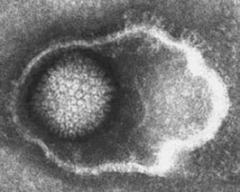
What type of genome does Herpesviridae possess?
Double-stranded DNA (dsDNA) with an envelope.
What is the Herpesviridae family known for?
Their ability to establish lifelong infections, immune evasion and latency
What is another common name for Pseudorabies disease?
Aujeszky's disease.
What species acts as the natural host and only reservoir for Pseudorabies (PRV) virus?
Swine.
What are the dead end hosts for PRV?
A diverse group of vertebrates
How do carnivores get infected with PRV?
Consuming infected carcasses
How is PRV transmitted?
Direct contact, aerosol, AI, fomites, transplacental, ingestion of infected tissue or milk
What primary site does Pseudorabies virus initially replicate in upon infection?
Nasal, pharyngeal, or tonsillar epithelium.
What tissues does PRV have a tropism for?
Neural and respiratory tissues; and it can cross the placenta
Where is Pseudorabies virus harbored during latent infection in domestic pigs?
Trigeminal ganglia.
What is the incubation period for Pseudorabies virus infection?
2 to 6 days.
What factors can trigger the reactivation and shedding of latent Pseudorabies virus?
Stress, illness, transport, crowding, poor husbandry, or farrowing.
What is the primary disease manifestation and mortality rate in infected nursing piglets? (Pseudorabies)
Neurologic disease with up to 100% mortality in piglets under 2 weeks old.
What is the primary clinical manifestation of Pseudorabies virus in weaned piglets?
Respiratory disease with 5-10% mortality.
What is the primary clinical manifestation of Pseudorabies virus in grower/adult pigs?
Mild or subclinical infection with 1-2% mortality
What reproductive signs occur in pregnant sows infected with Pseudorabies virus?
Resorption, abortion, stillbirths, mummified fetuses, and weak piglets.
What is the characteristic histopathological lesion of Pseudorabies virus in pigs?
Nonsuppurative meningoencephalitis.
What gross lesions would you see with PRV?
Necrotic foci in liver, keratoconjunctivitis, pulmonary edema, congestions, serous or fibrinonecrotic rhinitis, etc

What are common clinical signs of PRV in non-porcine hosts?
Sudden death, local pruritus, CNS signs, circling, paralysis, etc
What characteristic clinical sign occurs in non-porcine dead-end hosts infected with PRV?
Intense local pruritus ("mad itch") and fatal encephalitis.
When did commercial swine farms in the United States obtain PRV-free status?
In 2004.
What current reservoir poses a constant threat of re-introducing PRV into U.S. commercial herds?
Feral swine.
What diagnostic tests can be used for PRV at this time?
ELISA GP1 and gB-gB ELISA
What is the default serological method used for PRV antibody detection?
gB ELISA.