L8 Sturgill Cancer Immunotherapy and Tox
 Call Kai
 Learn
 Practice Test
 Spaced Repetition
 Match
 Flashcards
 Knowt Play
1/80

There's no tags or description
Looks like no tags are added yet.
81 Terms
Cancer immunosurveillance is the normal ongoing function of a health immune system. SEQ cancer immunosurveillance.
tumor cell elimination
equilibrium
tumor escape
MP/DC activation by DAMPs via TLRs
DC activation of CD4 helper T cells and CD8 cytotoxic T cells (CTLs) in draining lymph node
Tumor destruction by CTLs (MHC-I/TAA)
tumor cell elimination
where resistance develops
ongoing tumor destruction by CTLs
persistent tolerogenic antigen
equilibrium
decreased MHC-expression
appearance of inhibitory cytokines and checkpoint ligands
appearance of inhibitory immune cells (MDSCs, Tr
tumor escape
What are checkpoint ligands?
when T cell binds and turns off; transform to Treg → anti-inflammation
What type of cells are the major antigen presenting cell to helper T cells and is only activated by APC?
dendritic cells
What happens when dendritic cells mature and migrate to the nearest lymphnode?
increased expression of MHC I/II and B7
dendritic have both MHC I and MHC II antigen processing pathways. CC them. This prevent inappropriate activation of T cells (which leads to cytokine syndrome)
MHC I: expressed by tumor cells; only CTL
only CD8 T cells and NK cells can bind
MHC II: only helper cells
Only CD4 T cells can bind
Only APCs express MHC II
What are the 3 signals required for CD4 helper T cell activation and polarization?
antigen specifc: TCR (T cell) + MHC II (hold TAA) on DC
co-stimulatory: CD28 (T cell) + B7 on DC
polarizing: y-IFN and IL-12 promote Th-1 polarization; IL10 promotes Th-2 polarization
Activated Th-1 cells provide the third activating signal for
CD8 cytotoxic T cells (CTLs)
SLIDE 5
CTLs use lytic and non lytic mechanisms to destroy what?
destroy target cells expressing TAA bound to MHC I
non-lytic (not bolded)
secretion of y-IFN, TNF-a, IL-17 CCL5 (multiple inflammatory and regulatory effects)
lytic (not bolded)
cytotoxic enzymes (granzyme B, perforin
death receptors (promote apoptosis
binding of FasL (CTL) to Fas (tumor cel)
binding of TNFa to TRAIL (TNF-related apoptosis inducing ligand) on tumor cell
What are the FDA approved cancer immunotherapies?
ICI
adoptive T cell therapies: CAR-T cells, TCR-T cells, TILs
Preventative and therapeutic cancer vaccines
mAbs
Oncolytic virus thearpy
bispecific antibodies: blinatumomab
Toll-like receptor agonists
modulation of tumor microenvironment (TME)
Which cancer immunotherapy is associated with CRD and ICANs?
most common w CAR-T cells, rare with ICIs
also: TCR-T cells and bispecific antibodies
which cancer immunotherapy is associated with immune related adverse effects (irAEs)?
ICIs
ICI block inhibitory receptors on what? inhibitory receptors are only expressed by what?
T cells: PD-1, LAG-3, CTLA-4
Tumor cells: PD-L1
expressed by TAA-activated T cells (enhanced by chronic antigen exposure “tolerogenic”)
PD-1 is expressed by all activated T cells, Tregs, activated B cells, and activated NK cells. CC normal activity vs Anti-PD1 mAb activity
NORMAL: PD-1 binds to PD-L1 on tumor cells: CTL activity inhibited; Treg activity enhanced
BLOCK PD-L1 or PD-1: T cell killing of tumor cell
FDA approved PD-1 blockers
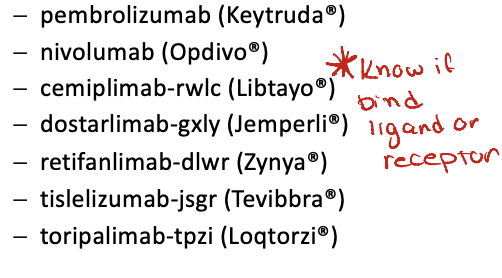
PD-L1 is normally expressed by T-cells, B cells, MPs, DCs, neutrophils, and various tissues, including tumor cells. How do Anti-PD-L1 mAbs downregulate cancer?
binding fo PD-1 inhibts T cell activation
What are the FDA approved PD-L1 blockers
atezolizumab, duravlumab, avelumab, cosibelimab-ipdl
CTLA is expressed by activated CD8 T cells (CTLs) which competes with CD28 for binding to B7 on DC. What does this promote?
development and inhibitory activity of regulatory T cells (Tregs)
What are the FDA approved CTLA-4 blockers?
ipililumab, tremelimumab
How does CTLA-4 inhibition work?
CTLA-4/B7 binding inhibits T cell activation, CTLA04 block alllows T cell killing of tumor cell
LAG-3 is expressed by activated CD4 and CD8 T cells and is constitutively expressed by Tregs (always). What does it bind to?
binds to stable MC II on DC and prevents CD4 T cell activation
What are the FDA approved LAG-3 blockers?
nivolumab (anti-PD-1) and relatlimab-rmbw (anti-LAG-3); aka Opdualag
How do LAG-3 blockers work?
bind to LAG-3 receptor on T cell; prevents binding to stable MHC II, allow CD4 t cell activation and cause an antitumor response
What are the most common immune related AEs associated with ICIs? How should you monitor patients on ICIs?
enterocolitis, hepatitis, dermatitis, (toxic epidermal necrolysis), neuropathy, and endocrinopathy
assess for S/S, eval LFTs, ACTH level, and thyroid function test at baseline before each dose
If a patient on ICIs experienee irAEs, what should you do?
if this happens permanently d/c therapy and start high dose corticosteroid therapy
may also occur weeks-mo after d/c
Which ICI is most likely to cause immune related AEs?
ipilimumab and severe AEs
Dermatology irAEs are associated with better overall and progression free survival. What are the more common ones?
maculopapular rash, itching, vitiligo (melanoma only)
DRESS and SJS/TEN more common with combo CTLA/PD-1 blockers
if pt on ICI exerpeinces grade 1 dermatologic irAEs, what should you give them?
topical corticosteroid, oral anthistamine
if pt on ICI exerpeinces grade 2 dermatologic irAEs, what should you give them?
systemic corticosteroid
if pt on ICI exerpeinces grade >=3 dermatologic irAEs, what should you give them?
hold therapy, derm consult; systemic corticosteroid 1-2mg/kg/day
T/F Colitis has a higher overall incidence and incdience of Grade 3-4 colitis with combination CTLA/PD-1 blockers.
true
If patient on ICI has colitis >= grade 2 irAE, what should you do?
hold therapy, GI consult; systemic corticosteroid 1-2mg/kg/d; rule out infection
consider infliximab or vedolizumab if no result after 3-5 days
T/F hepatitis irAE from ICI is dose dependent with ipilimumab and is more common with combination with CTLA/PD-1 blockers
true
At week 6-14 of ICI therapy, how does hepatitis irAE present itself?
usually asymptomatic increase in LFTs, rarely acute liver failure
If pt on ICI has Grade 1 hepatitis irAE, what should you give them?
continue therapy with close monitoring of LFTs
If pt on ICI has Grade 2 hepatitis irAE, what should you give them?
hold therapy; systemic corticosteroid
If pt on ICI has Grade 3 hepatitis irAE, what should you give them?
hold therapy; hepatology consult
systemic corticosteroid 1-2mg/kg/d
consider mycophenolate mofetil if no result after 3-5 days (NO INFLIXIMAB CUZ HEPATOTOX RISK)
When are thyroid irAEs in ICI therapy more common? When is onset usually?
ICI in combo with CTLA/PD-1 blockers; more common with PD-1 blockers than ipilimumab
hypothyroidism > hyperthyoidism (onset 4wks of therapy)
If patient on ICI has asymptomatic thyroid irAEs, what should you give them?
levothyroxine if TSH >10 mIU/L; rule out adrenal insufficiency
If patient on ICI has symptomatic thyroid irAEs, what should you give them?
levothyroxine; rule out adrenal insufficiency
If patient on ICI has hyperthyroidism irAEs, what should you give them?
endocrine consult; propanolol for symptom control
When are pituitary irAEs from ICI most common?
can result from thyroid, adrenal, or gonadal axis dysfunction
most common w combo CTLA/PD-1 blockers; dose dependent with ipilimumab
If patient gains adrenal insufficiency from ICI pituitary irARs, what should you give them
typically permanent; lifelong hormonal replacement therapy (levothyroxine and steroid replacement)
When treating hypophysitis/adrenal insufficiency irAEs from ICI treatment, how should you initiate treatment? how should you avoid/treat adrenal crisis?
begin steroid replacement prior to levothyroxine to avoid adrenal crisis
corticosteroid 1-2mg/kg/d to treat adrenal crisis
Chimeric antigen receptor (CAR) T cells do not require what
do not require antigen processing and presentation by APCs
SEQ how CAR T cells are engineered
remove blood from pt to get T cells
make CAR t cells in lab
grow CAR t cells and infuse into pt
CAR t cells bind to cancer cells and kill them
What are the common ADE of CAR T cells? (20%)
Cytokine release syndrome(CRS)
encephalopathy
hypogammaglobulinemia, infection, fever, cough
dec appetite, HA, n/v/d/f
bleeding eps and tachycardia
What are the problems with CAR T cells?
poor penetration of solid tumors
T cell exhaustion (apoptosis) mediated by tumor microenvironment
TAA loss (tumor stops expressing CD19) and increased heterogeneity
What are the BBW of CAR-T cells?
cytokine release syndrome
neurologic toxicities
Describe cytokine release syndrome (CRS) due to CAR T cell toxicity. What causes it, onset, symptoms, treatment
due to CAR T cell activation and release of inflamm cytokines IL-6 and IFNy
during first 2 wks; flu-like symptoms to severe sepsis-like syndrome requiring ICU management (HoT, organ dys, coag, pancyto, infection)
treat w corticosteroids and toxilizumab
Describe neurologic toxicities due to CAR T cell toxicity. What causes it, onset, symptoms, treatment
25-50% of pts usually accomp w CRS
mild confusion and somnelence to encephalopathy syndome (seiz, focal def, cerebral edema (fatal), coma)
treatment: corticosteroids only w supportive care

Anti-CD19 CAR T cells
What are the Anti-BCMA CAR T cells?
idecabtagene vicleucel and ciltacabtagene autoleucel
What is Cytokine release syndrome?
run-away immunse system activation resulting from any immune therapy involving target cell engagement and activation of endogenous or infused T cells that begins 1-14 days after drug admin
pt recently began CAR T cell therapy (within 1-14 days), and is experiencing cold like symptoms (fever, malaise, myalgias, fatigue, rash).
Later on, they experience a capillary leak (hypoxia, peripheral/pulmonary edema), HoT, and multiorgan dysfunction/failure.
What ADE are they experiencing?
cytokine release syndrome (CRS)
What are the risk factors of CRS from CAR T cell therapy?
ALL, high tumor burden, higher CAR T cell dose
LOOK AT THIS SLIDE: CRS symptoms

Pt has
Fever: Temperature ≥38°C
Hypotension: None (no hypotension symptoms)
Hypoxia: None (no hypoxia symptoms / "good O2 stats")
What CRS grade is this and what should you treat them with
Grade 1;
supportive care: Fluids, antipyretics, analgesics
consider
metoprolol to block IL-6 synthesis
leveitracetam for seizure prophylaxis
pt has a temperature ≥38°C plus not requiring vasopressors (for HoT) and/or requiring low-flow nasal cannula or blow-by (for hypoxia)
What CRS grade is this and what should you treat them with
Grade 2
same supportive care as grade 1
begin levetiracetam (Keppra)
Toclizumab max 4 doses; (if refractory HoT)add dexmethasone 10mg IV q 12hr
if no improvement within 24 hr escalate to grade 3 guidelines
Pt has
Fever: Temperature ≥38°C
Hypotension: Requiring a vasopressor
Hypoxia: Requiring high-flow nasal cannula, facemask, nonrebreather mask, or Venturi mask
What CRS grade is this and what should you treat them with
Grade 3
same supportive care as grade 1
ECHO
Vasopressors as indicated
toclizumab + dexamethasone; if refractory, escalate to Grade 4 guidelines
If pt has
Fever: Temperature ≥38°C
Hypotension: Requiring multiple vasopressors
Hypoxia: Requiring positive pressure (e.g., CPAP, BiPAP, intubation and mechanical ventilation)
What CRS grade is this and what should you treat them with
Grade 4;
same supportive care as grade 1
add mechanical ventilation prn
Toclizumab + methylprednisolone 500mg IV q3hr 3 d then 250mg IV q12 hr for 2 days, then 125mg IV q12 for 2 days, then 60mg IV q12 hr until back to CRS grade 1
What are additional therapies with limited evidence for grade 4?

What is toclizumab?
humanized mAb that targets IL-6 receptor (receptor that drives CRS tox); 69% response rate, resolution within 14 days, no more than 2 doses
fever usually resolves within hours of admin
What is the BBW of toclizumab?
serious infections leading to hospitalization or death (TB, bacterial, invasive fungal, viral, other opportunistic infections)
DO NOT ADMIN IN PT WITH ACTIVE INFECTION
Recommended dose for toclizumab? (dont think we need to mem)
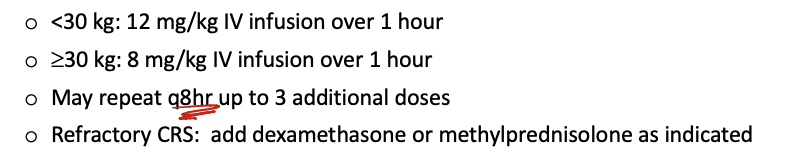
pt recently started receiving CAR-T cell therapy. They started experiencing difficulty speaking or naming objects (expressive aphasia) but over a few hours-days it has progressed to global asphasia (awake but unable to communicate or follow commands). If untreated it can lead to obtundation, coma, seizures, cerebral edema. What does the patient have?
immune effector cell-associcate neurotoxicity syndrome (ICANS)
CAR T-cell related encephalopathy syndrome (CRES)
If ICANS is associated with CRS, what should you consider?
toclizumab
If patient has Grade 1 ICANs, how should you treat the patient?
aspiration precautions; IV hydration
avoid CNS depressants
seizure prophylaxis: Levetiracetam 750mg q12h
agitation: Lorazepam -.25-0.5mg IV q8h or Haloperidol 0.5mg IV q6h
Neuro consult
fundoscopic exam to rule out papilledema
daily EEG until symptoms resolve
If pt has Grade 2 ICANS, and if not assoc w CRS or refractory to toclizumab if CRS Present, how should you treat them?
Dexamethasone 10mg IV q6h OR Methylprednisolone 1mg/kg q12
If pt has Grade 2 ICANS, and is associate with grade >=2 CRS, how should you treat them?
ICU transfer
If pt has Grade 3 ICANS how should you treat them?
transfer to CU
continue corticosteroids(dexamethasone or methylprednisolone from grade 2)
repeat CT or MRI every 2-3 days for persistent grade >=ICANS
If pt has Grade 4 ICANS how should you treat them?
ICU monitoring; consider mechanical ventilation for airway protection
continue corticosteroids (dexamethasone or methylprednisolone from grade 2)
How can you minimize the risk of CRS/ICANS with CAR T cell therapy?
SQ admin: atezolizumab
gradual use of escalating SQ administration over several days
gradual introduction to desensitive patient’s immune system to therapy
third, fourth, fifth gen CAR-T cells
Describe third gen CAR-T cells
2 costimulatory molecules:
CD28: rapid activation/tumor killing but faster T-cell exhaust
4-1BB: slow cell prolif, longer duration of fx, promote memory T cells, long term pt survival
Describe fourth gen CAR-T cells
“T cells redirected for universal cytokine mediated killing” (TRUCKs)
secrete cytokines (IL) or anti-IL 6/anti-TNDa scFvs that modify tumor microenvironment to enhance tumor kill
Describe fifth gen CAR-T cells
IL-2 receptor B signaling domain that enhances IC cytokine signaling (STAT3/5 pathway)
most resistant to T cell exhausation
lower risk CRS/ICANS