Chapter 12 A&P - Nervous Tissue
 Call Kai
 Learn
 Practice Test
 Spaced Repetition
 Match
 Flashcards
 Knowt Play
1/135

136 Terms
What is included in the nervous system?
The brain, spine, receptors in sensory organs (eyes, ears, mouth, etc.), and nerves that connect to other body systems
Nervous tissue includes what kinds of cells?
Neurons and neuroglia cells
What do neurons do?
Neurons transmit electrical signals throughout the nervous system, facilitating communication between different body parts.
What do neuroglia cells do?
Neuroglia cells support and protect neurons, providing them with structural and metabolic assistance, and playing crucial roles in maintaining homeostasis and the overall function of the nervous system.
What are the two divisions of the nervous system?
The CNS (central nervous system) and PNS (peripheral nervous system)
What makes up the CNS?
The brain and spinal cord, it consists of nervous tissue, connective tissue, and blood vessels.
What makes up the PNS?
The PNS is made up of all the nervous tissue outside the CNS, including cranial and spinal nerves, as well as sensory and motor neurons.
If you were to stub your toe against an object, what would be the path the signal would take throughout your body?
The signal would travel from the toe through sensory neurons to the spinal cord, where it would synapse with interneurons and then relay signals through motor neurons back to the affected muscle for a reflex action.
Special sensory receptors do what?
They monitor smell, taste, vision, and hearing
What do the visceral sensory receptors do?
They monitor internal organs and sensations such as hunger, thirst, and visceral pain.
What do somatic sensory receptors do?
They monitor sensations from the skin, muscles, and joints.
What are the receptors found inside the afferent division?
Special sensory, visceral, and somatic receptors.
Define the afferent division
The afferent division of the nervous system is responsible for transmitting sensory information from sensory receptors throughout the body to the central nervous system for processing.
Is the afferent division part of the PNS or CNS?
PNS
Is the efferent division part of the PNS or CNS?
PNS
What are the two types of efferent divisions?
The somatic nervous system and the autonomic nervous system
What does the somatic nervous system control?
It controls voluntary and involuntary (reflex) movements of skeletal muscles.
What does the autonomic nervous system control?
It controls involuntary functions, such as heart rate, digestion, and respiratory rate. It controls smooth muscle, cardiac muscle, glands, and adipose tissue.
What are the two subdivisions of the autonomic system?
The sympathetic division and parasympathetic division
What does the sympathetic division control?
It prepares the body for "fight or flight" responses, increasing heart rate and energy availability. It has a stimulating effect
What does the parasympathetic division control?
It promotes "rest and digest" activities, conserving energy and decreasing heart rate. It has a relaxing effect
What is the CNS’ job?
It processes sensory information and coordinates responses by integrating data and controlling the body's movements and functions.
What is the PNS’ job?
It delivers sensory information to the CNS and carries motor commands to the peripheral nervous system.
Define nerves
Nerves are bundles of axons in the peripheral nervous system that transmit signals between the CNS and the rest of the body, facilitating communication throughout the nervous system.
What is the afferent division's job?
The afferent division is responsible for transmitting sensory information from the peripheral organs to the central nervous system, allowing the body to perceive stimuli.
What is the efferent division's job?
The efferent division is responsible for carrying motor commands from the central nervous system to peripheral organs and muscles, enabling responses to stimuli.
Define receptors
Receptors detect changes or respond to stimuli, they could be neurons or specialized cells, and they could be single cells or complex sensory organs (eyes, ears, mouth, etc.)
Define receptors
Target organs that respond to motor commands
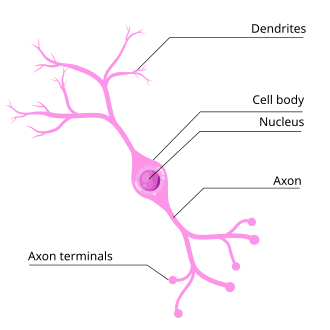
What are the three general regions of a neuron?
Body, dendrites, and the axon
What are dendrites?
Dendrites are branched projections of a neuron that receive signals from other neurons and convey this information to the cell body. CNS neurons receive the most information here.
What is in the cell body?
The nucleus, mitochondria, neurofilaments, a cytoskeleton, other organelles, and it is also filled with perikaryon.
What does the axon do?
It carries information received from the dendrites towards the axon terminals and transmits signals to other neurons or muscles.
Where are the teledendria?
They are located at the endpoints of an axon and branch into synaptic terminals, facilitating communication with other neurons.
What is perikaryon?
The cytoplasm found in the cell body of a neuron, surrounding the nucleus and containing organelles. It provides energy and synthesizes (makes) neurotransmitters.
Where does the action potential start?
The action potential typically starts at the initial segment, where the membrane potential of the neuron reaches the threshold level to trigger an electrical impulse.

What is D?
The initial segment

What is C?
The axon hillock
What does the cytoskeleton of the neuron cell body contain?
Neurofibrils and neurofiliments
What are neurofilaments and neurofibrils? What do they do?
Neurofibrils are bundles of neurofilaments that give structure and shape to axons and dendrites
Define axolemma
The axon’s plasma membrane
Define axoplasm
The cytoplasm of the axon. Its contains neurofibrils, neurotubules, vesicles, lysosomes, enzymes, and mitochondria.
What are neurotubules?
Neurotubules are hollow, tube-like structures made of tubulin that support the axon and help transport materials within the neuron.
What are telondendria?
Fine extensions at the end of the axon terminals (synaptic terminals)
What is axonal (axoplasmic) transportation?
Movement of materials between cell body and axon terminals, the materials move along tubules within axon
What are the structure classifications of neurons?
Anaxonic (small nerve cells that lack a true axon), bipolar, unipolar, and multipolar
What is the resting membrane potentials mV?
-70 mV
What voltage is the membrane potential during depolarization?
-55 mV to -60 mV
What voltage is the membrane potential during repolarization?
+ 30 mV
What is the membrane potential’s voltage during hyperpolarization?
Anything past the resting membrane potentials mV, but typically around -90mV
Define local current
Local current refers to the flow of ions across the membrane in a localized area, resulting from depolarization or hyperpolarization. This movement helps propagate action potentials along the neuron.
Define hyperpolarization
Hyperpolarization is a change in a neuron's membrane potential that makes it more negative than the resting membrane potential
Define repolarization
Repolarization is the process by which a neuron's membrane potential returns to its resting state after depolarization, typically following an action potential. This involves the influx of potassium ions and the efflux of sodium ions.
Define depolarization
Depolarization is a change in a neuron's membrane potential that makes it less negative (or more positive) than the resting membrane potential, often due to the influx of sodium ions.
Define action potential
An action potential is a rapid, temporary change in a neuron's membrane potential that occurs when a stimulus reaches a threshold, resulting in the depolarization and subsequent repolarization of the membrane.
What is the threshold for an axon?
Between -60mV and -55mV
What is the all-or-nothing principle of an axon
States that once a threshold level of depolarization is reached, an action potential will fire at full strength, or not at all, ensuring consistent transmission of electrical impulses along the axon.
What is the refractory period?
The refractory period is the time during which a neuron is incapable of generating a new action potential, following the completion of an action potential.
What are the two types of refractory periods? Define them
Absolute and relative refractory periods.
Define the absolute refractory period
The absolute refractory period is the phase during which a neuron cannot initiate another action potential, regardless of the strength of the stimulus, due to the inactivation of sodium channels.
Define relative refractory period
The relative refractory period follows the absolute refractory period and is the phase during which a neuron can initiate another action potential, but only if a stronger-than-normal stimulus is applied, as some sodium channels have reset.
Depolarization results from an influx of…
Sodium ions (Na+), this makes it more positive
Repolarization results in a loss of…
Potassium (K+)
What is the sodium-potassium exchange pump?
The sodium-potassium exchange pump is a membrane protein that actively transports sodium ions (Na+) out of the cell and potassium ions (K+) into the cell, maintaining the electrochemical gradient essential for nerve impulse transmission.
Define propagation
Propagation refers to the process by which an action potential travels along the axon of a neuron, allowing for the transmission of signals from one part of the nervous system to another. Think domino effect or chain reaction.
What are the two types of propgation?
Continuous propagation and saltatory propagation.
Define continous propagation
A method of impulse transmission along unmyelinated axons, where the action potential regenerates itself at every segment of the membrane, creating a wave-like flow of electrical signals, traveling continuously along the axon without jumping.
Define saltatory propagation
Saltatory propagation is a method of impulse transmission along myelinated axons, where the action potential JUMPS from one Node of Ranvier to the next, significantly increasing the speed of signal conduction. It is faster than continuous propagation, requires less energy, and depolarization occurs ONLY at the node.
Define the refractory period
The time from the beginning to the end of an action potential, when it goes back to its resting state. It is unable to respond to a normal stimuli.
Define propagation
The movement of an action potential across an axon. It is either continuous or saltatory.
Define continous propagation
A method of action potential transmission in which the signal travels along unmyelinated axons, depolarizing each segment of the membrane sequentially, resulting in slower conduction compared to saltatory propagation. Think a domino effect.
Define saltatory propagation
A method of action propagation in which the action potential jumps from one node to another along myelinated axons, allowing for faster transmission of signals compared to continuous propagation.
What are the different types of diameters found in axons?
There are three; type A fibers, type B fibers, and type C fibers
What are the characteristics of type A fibers?
Are large in diameter, myelinated, conduct impulses quickly due to their width, and process sensory information and motor impulses to skeletal muscles. They also process sensory information like position and balance.
What are the characteristics of type B fibers?
They are medium-diameter, myelinated, and transmit information at an intermediate speed
What are the characteristics of type C fibers?
They are small in diameter, unmyelinated, they transmit information slowly and transmit most sensory information
Define synapse
The specialized site where a neuron communicated with another cell
What are the two types of synapses?
Presynaptic and postsynaptic neurons
Define presynaptic neurons
The neuron that sends the message to the other cell or neuron at a synapse, releasing neurotransmitters. Example: interneurons.
Define postsynaptic neurons
The neuron that receives the signal from the postsynaptic neuron and receives the neurotransmitters. Example: motor neurons.
What is a chemical synapse? Name examples.
A chemical signal transmitted across a gap by neurotransmitters. The neuromuscular junction (a synapse between a neuron and a muscle cell) and a neuroglandular junction (a synapse between a neuron and a gland).
Define neurotransmitters
A chemical messenger contained in a synaptic vesicle in the axon terminals of a presynaptic cell that transmits signals across a synapse to bind to receptors on a postsynaptic cell, influencing its activity. It is also broken down by enzymes or reabsorbed into the presynaptic neuron for recycling.
The ability for a neurotransmitter to generate an action potential depends on…?
The amount of neurotransmitter releases and the sensitivity of the postsynaptic cell.
What is a CHOLINErgic synapse?
A junction between two neurons or a neuron and a muscle cell where acetylcholine is released. This is commonly found in the CNS, all neuron-to-neuron synapses in the PNS, and all of the neuromuscular/neuroglandular junctions in the parasympathetic division of the ANS.
What is a synaptic delay?
The brief period of time between the arrival of an action potential at the axon terminal and the effect on the postsynaptic membrane. This is mostly due to the time required for calcium ion influx and neurotransmitter release.
What are the two types of neurotransmitters?
Excitatory neurotransmitters and inhibitory neurotransmitters
What is important to mention about EPSP’s?
They promote action potentials; they make it goes towards the threshold. They increase the likelihood of neuronal firing by depolarizing the postsynaptic membrane.
What is important to mention about IPSP’s?
They decrease the likelihood of an action potential by hyperpolarizing the postsynaptic membrane, making it less likely for the neuron to fire.
What is information processing?
The integration of sensory information in the nervous system to create a response, leading to motor output and behavior.
Where does summation occur?
Summation occurs at the axon hillock, where EPSPs and IPSPs combine to determine whether an action potential is generated.
What are postsynaptic potentials?
Are changes in the membrane potential of a postsynaptic neuron in response to neurotransmitter binding, which can be either excitatory (EPSP) or inhibitory (IPSP). They play a crucial role in determining the likelihood of generating an action potential.
What are types of postsynaptic potentials?
Excitatory postsynaptic potentials (EPSP’s) which results in depolarization of the postsynaptic membrane and inhibitory postsynaptic potentials (IPSP’s) which result in hyperpolarization of the postsynaptic membrane.
If there is an increased number of EPSP’s compared to IPSP will the action potential be triggered?
Yes
What are the two types of summation?
Temporal and spatial
Define temporal summation
When the stimulus is being hit multiple times in the same spot.
Define spatial summation
When the stimulus is being hit in different locations at the same time.
Holding membrane potential above threshold is the same as…?
Has the same effect as a second, large stimulus

This is an example of what kind of neuron?
An anaxonic neuron
What is special to mention about an anaxonic neuron?
It has no axon, they are small, rare, and primarily found in the brain and special sense organs and they play a role in local communication between neurons.
This is an example of what kind of neuron?
A bipolar neuron
What is important to mention about bipolar neurons?
They are small, rare, consist of one dendrite and one axon (two poles), and are found in special sense organs (sight, smell, hearing, etc)