working memory model (stm)
 Call Kai
 Learn
 Practice Test
 Spaced Repetition
 Match
 Flashcards
 Knowt Play
1/13

There's no tags or description
Looks like no tags are added yet.
14 Terms
Developed by who (19___) and explains how what is organised and functions.
It views ____ an a____ store, used to t____ store information while it is being p____ and m____
Developed by Baddeley and Hitch (1974) and explains how STM is organised and functions.
It views STM as an active store, used to temporarily store information while it is being processed and manipulated
What 4 components is the WMM consisting of
the central executive
the three slave systems:
the visuo-spatial sketchpad
the phonological loop
the episodic buffer
draw diagram of the WMM
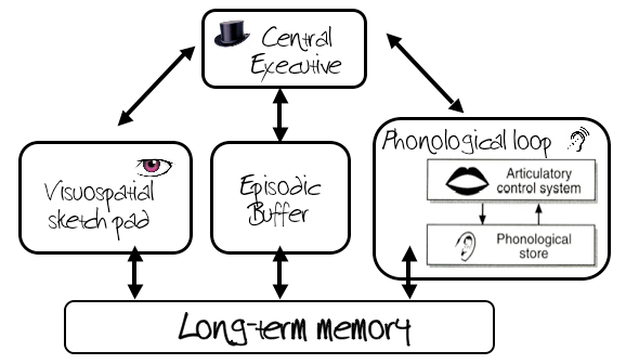
Central Executive
‘s______’ role
an a______ s_____ that monitors what , focuses and divides what
allocates the 3 s____ s____ to task
what is the capacity
what is the coding
Central Executive
‘supervisory’ role
monitors incoming data, focuses and divides our limited attention
allocates the 3 slave systems to task
capacity-Very limited storage capacity
coding-Any sensory modality
Phonological loop
a temporary storage system for what, which has two components:
a ________ p______ - allows m_____ r______- (repeating s_____ or words in a ‘loop’ to keep them in working memory model while they are needed). The capacity of this ‘loop’ is believed to be 2 seconds worth if what you can say
phonological store - which stores what
what is the coding of the Pl
Phonological loop
a temporary storage system for auditory information, which has two components:
articulatory control process - allows maintence rehearsal (repeating sounds or words in a ‘loop’ to keep them in working memory model while they are needed). The capacity of this ‘loop’ is believed to be 2 seconds worth if what you can say
phonological store - which stores the words you hear
coding of the PL- acoustic information
Visuo-spatial sketchpad
storage system which codes for what
Robert Logie (1955) subdivided it into what two components,
The inner scribe deals with what and the visual cache codes what
According to B____, it has a limited c____ of about t_____ or f____ objects
Visuo-spatial sketchpad
storage system which codes for visual and spatial information
Robert Logie (1955) subdivided into two components, the inner scribe and the visual cache.
The inner scribe deals with the manipulation of mental images and the visual cache codes visual and spatial information.
According to Baddeley, it has a limited capacity of about three or four objects
episodic buffer (added to the model in 2000)
temporary store for information which b____ and i____ information from where and passes the information to where and wider cognitive processes such as p____
also maintains what-helps us keep track of what
storage component for what
what did B____ 20___ say the capacity was
episodic buffer (added to the model in 2000)
temporary store for information which binds and integrates information from all of the components and passes the information to long-term memory and wider cognitive processes such as perception
also maintains a sense of time sequencing, -helps us keep track of the order in which events occur.
storage component for the central executive (the CE doesn’t have its own storage system)
a limited capacity of about 4 chunks (Baddeley 2012)
(mixes all the different information—like visual images, sounds, and personal experiences—into a meaningful whole. This allows you to understand situations, solve problems, or create memories.into a single "episode" or mental snapshot.)
Evaluation - evidence that supports the WMM (KF case study)
KF was studied by S____ and W_____ (19___) after what
Following his a____, he was able to recall what, but had issues with what. He was able to remember what, but was unable to remember what
His immediate recall of what was better when what than when they were r____ to him (a____)
what part of KF’s WMM was damaged and what part was intact
This supports the model as it suggests that there are what within STM,
Evaluation - evidence that supports the WMM (KF case study)
KF was studied by Shallice and Warrington (1970) after a motorbike accident damaged his brain
Following his accident, he was able to recall stored information from his LTM, but had issues with STM. He was able to remember visual images, including faces, but was unable to remember sounds (acoustic information).
His immediate recall of letters and digits was better when he read them (visual) than when they were read to him (acoustic)
KF’s phonological loop was damaged but his visuo-spatial sketchpad was intact
This supports the model as it suggests that there are at least two components within STM, one component for visual information and one for acoustic information.
Evaluation - evidence that supports the WMM- Dual tasks
Studies of dual-task performance support what
B____ et al (19___)- participants did what their performance on each was s____ to when they carried out the tasks separately
But when tasks were visual- what did they do performance d____
this is because both visual tasks do what whereas there is no c____ when performing a verbal and visual task together
this shows there must be a sperate subsystem (the VSS) that processes what and one for v____ processing ( PL)
Evaluation - evidence that supports the WMM- Dual tasks
Studies of dual-task performance support the separate existence of stores in the STM
Baddeley et al (1975)- participants carried out a visual and verbal task at the same time, their performance on each was similar to when they carried out the tasks separately
But when tasks were visual (tracking a light and describing the angles in a letter F) performance declined
this is because both visual tasks compete for the same subsystem (VSS) whereas there is no competition when performing a verbal and visual task together
this shows there must be a sperate subsystem (the VSS) that processes visual input and one for verbal processing ( PL)
Evaluation- criticisms
There is a lack of clarity over what
what did Baddeley (20___) say
The CE needs to be more clearly s____ then just simply being ‘a’ e.g____ what do some psychologists believe
This means that the CE is an u_____ component and this challenges the usefulness of the WMM
Evaluation- criticisms
There is a lack of clarity over the nature of the central executive
Baddeley (2003) recognised this and said ‘The central executive is the most important but the least understood component of working memory’
The CE needs to be more clearly specified then just simply being ‘attention’ e.g some psychologists believe the CE may consist of separate subcomponents
This means that the CE is an unsatisfactory component and this challenges the usefulness of the WMM
Evaluation- criticisms
what is wrong with the the studies supporting the WMM
Evaluation- criticisms
the studies supporting it lack ecological validity.-the tasks used in laboratory settings to test the model may not accurately reflect the complexity or demands of real-life situations as they involve artificial tasks, such as recalling random sequences of numbers, letters, or shapes, and engaging in controlled dual-task experiments.