Pharmocology, Veterinary Antimicrobials: Drug Classes, Uses, and Safety, Veterinary Pharmacology: ADME, Drug Trials & Antimicrobial Therapy
 Call Kai
 Learn
 Practice Test
 Spaced Repetition
 Match
 Flashcards
 Knowt Play
1/519

There's no tags or description
Looks like no tags are added yet.
520 Terms
Define Pharmacology
Study of how drugs affect a biological syster
Define Drug
any chemical agent which affects any biological process
List the 4 mechanisms of actions
1. Replace (act as substitute) for other chemicals (ex: K bromide, Hetastarch)
2. Increase or stimulate certain cellular activities
3. Depress or slow certain cellular activities
4. Interfere with function of foreign cells (ex: antimicrobial)
Drug classifications
- Chemical structures ( ex: macrocylic lactones)
- Main affect (ex: analgesics)
- Therapeutic use (ex: NSAID)
- Mechanism of action (ex: beta blocker)
3 parts of drug nomenclature
- Chemical name
- Generic name
- Trade name
Define dosage
Amount of drug to be administered, usually based on weight (ie: mg/kg)
Concentration
How the drug is formulated into a solution (ie: mg/ml, strength of pills or capsules)
Injection volume
A liquid measurement based on weight (ie: ml/kg)
Drug formulation
- Solids: grams, milligrams, micrograms
- Liquids: liter, milliliter, microliter
Stages of drug development
- Drug discovery and screening
- Pre-clinical safety and toxicity testing
- Evaluating drugs in humans
Stage 1: discovery and screening
Chemical development; in-vitro studies of function in cells, tissues, and at receptors.
Stage 2: pre-clinical safety and toxicity
In-vivo animal studies when no alternatives or non-animal replacements are available; pharmacology and behavioral pharmacology; potency/efficacy (ED50); tolerance; acute and chronic toxicity (LD50); teratogenicity; carcinogenicity
Stage 3: evaluating drugs in humans
FDA drug review process and clinical trials if approved to proceed.
ED50
Effective dose for 50% of population
LD50
Lethal dose for 50% population
Do you want a larger or smaller gap between ED50 and LD50
Larger gap = safer drug
Clinical Trials Phase 1
Healthy adult volunteers (20-80); safety, pharmacokinetics (PK), side effects.
Clinical Trials Phase 2
Patients (fewer than 300); efficacy, safety, PK, side effects; single-blind, placebo-controlled.
Clinical Trials Phase 3
Specific patient subpopulations (fewer than 3,000); efficacy for specific indications; randomized, double-blind, placebo-controlled.
Clinical Trials Phase 4
After FDA approval; efficacy for specific indication, drug utilization patterns, additional efficacy; monitor rare/severe side effects or toxicity.
Pharmacokinetics
what the body does to the drug; movement of the drug withing the body
Pharmacodynamics
What the drug does to the body
Pharmacotherapeutics
clinical purpose or indication
Pharmacognosy
Identifying crude materials as drugs
Drug sources
plants, animals, minerals, microbes, and synthetics
What factors influence drug effects
weight
age
gender
physiological and pathological factors
genetic factors
immunological factors
psychological factors
environmental factors
tolerance and cumulation
drug interactions
Pharmacodynamics relies on...
drug receptors
chemical interactions
effect and efficacy
toxicity/adverse effects
Types of Drug interactions
- drug-drug
- drug-alternative therapy
- drug food
drug-laboratory test
Where can drug interactions occur?
Interactions may occur at absorption, during distribution, during biotransformation, during excretion, or at the site of action
Dose
Amount administered
Frequency
How often the drug is administered
Efficacy
Greatest effect a drug can produce
Potency
Amount of drug needed to produce an effect; a more potent drug produces an effect at a lower dose.
Ceiling effect
A point beyond which increasing dose does not increase the effect
Safety
Considered in relation to therapeutic and toxic concentrations
Therapeutic index
Ratio of minimum toxic concentration to median effective concentration
What happens if you increase the dose of a drug with a low therapeutic index?
increases the likelihood of toxicity
What does a dose response curve tell us?
dose, frequency, efficacy and safety for a drug in population
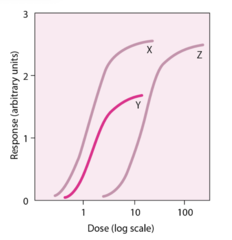
Which drug is the most potent?
Drug X

Which drug has the greatest efficacy?
Drug X and Z have equal efficacy

Is Y or Z more potent?
Y is more potent but less efficacious than Z
How to read a Dose-Response Cuve
Further left = more potent
Taller = more effective

Which is more potent?
Drug A. It takes a lower dose to reach the same efficacy
Factors that affect the response to drugs
Dosage, route of administration rate of absorption, rate of elimination, physiochemical properties of the drugs and the patients signalment
Enteral route options
PO, rectal, sublingual, buccal
Parenteral route options
Not within the alimentary canal. ie: inhalation, IM, SC, IP, topical
Central route options
Intrathecal and intracerebroventricular
Routes of administration from most rapid to slowest
IV > IN > intrarectal > sublingual > IM, SQ > IP > PO > topical
Which route of administration is the safest?
PO
Which route has the most likelihood of of toxic effects
IV
Which routes needs time to absorb?
IM, SQ, topical
3 immune privileged sites
brain, eye, testes
What is the blood brain barrier?
tight junctions of endothelial cells; not fully formed at birth
Function of the blood brain barrier
Protects the brain from foreign substances that may cause injury; protects it from hormones, neurotransmitters, and immune cells
Maintains a constant environment
ADME
Absorption
Distribution
Metabolism
Elimination
Bioavailability
The fraction o the active form of a drug that reaches systemic circulation unaltered
What influences absorption
route, time, dose, metabolism, age, sex, physical activity,, stress, concurrent diseases, previous surgery
What does distribution depend on?
lipid solubility, ionization, tissue perfusion, and protein binding
Half-life
Time required for plasma concentration of a drug to be reduced by 50%.
Helps determine dosing intervals, expected time to steady time, and expected wash-out
Critical concentration
Concentration needed to cause a therapeutic effect.
Loading dose
Higher dose than the dose needed for ongoing treatment
Dynamic equilibrium/steady state
Actual concentration a drug reaches in the body; at steady state, amount received equals amount eliminated in a given time.
Steady state and wash-out are each approximately five half-lives
Pharmacokinetic considerations in clinical practice
- onset of drug action
- drug half-life
- timing of peak effect
- duration of drug effects
- metabolism or biotransformation of drug
- site of excretion
Types of adverse drug reactions
- dose-related
- allergic
- idiosyncratic
Severity
> mild: no change to treatment
> moderate: alter medication
> severe: discontinue medication
> lethal
4 methods of drug molecule movement
- passive diffusion
- facilitated diffusion
- active transport
- Pinocytosis and Phagocytosis
Passive diffusion
moves high to low concentration; no ATP, fastest
facilitated diffusion
Requires a carrier molecule; high to low concentration; no ATP
Factors that affect the rate of movement
concentration gradient
drug molecule size
lipophilic vs hydrophilic
temperature (high temp = faster)
thickness of membrane
Ionized
hydrophilic
good perfusion to systemic tissue via fluid, cannot penetrate cell membranes as well
non-ionized
lipophilic
readily penetrates cell membranes
good GI absorption and blood brain barrier penetration
Lipophilic vs Hydrophilic IM or SQ
Hydrophilic move quickly to capillaries
lipophilic slowly (hors to days)
Lipophilic vs hydrophilic oral medications
lipophilic molecules absorbed well
hydrophilic not readily absorbed
pKa
acid dissociation constant; the pH at which concentrations of ionized and non-ionized forms are equal.
What happens when an acidic drug is placed in higher pH?
becomes ionized
What happens when an acidic drug is placed in a lower pH?
becomes nonionized
What happens when an alkaline drug is placed in a higher pH?
becomes nonionized
What happens when an alkaline drug is placed in a lower pH?
becomes ionized
How do you use the pKa and pH relationship information?
Used to determine the best method of administration (for bioavailability)
Aspirin in a pH of 3 is half ionized and half nonionized. What does this mean for absorption in the stomach and the duodenum?
Stomach pH = 1-3 so in stomach aspirin is 1:1
Duodenum pH = 6-7 so aspirin does not absorb well in the duodenum due to ionized drugs being hydrophilic
Difference between protein bound drug and unboudn drug
- protein bound molecules are not available to exert pharmacologic effects
- unbound drug allow for pharmacologic effect
How does low plasma protein levels affect drug absortion?
Lower protein levels make protein bound drugs more potent
Examples of when to reduce protein bound drugs
liver disease
protein losing enteropathy
protein losing nephropathy
sepsis
malnutrition
Ledgend drug
Drug that is made for veterinary medicine, and not necessarily controlled
- not OTC
What statement needs to be on drug labels for veterinary medicine?
"Caution: federal law restricts this drug to use by or on the order of a licensed veterinarian"
This is the legend
DEA
Drug Enforcement Administration
How many classes/schedules of controlled substances are there?
5
Example of Schedule I
marijuana, heroin, LSD
No currently acceptable medical use and high potential for abuse
Examples of Schedule II
Methadone, hydrocodone, fentanyl
High potential for abuse but has accepted medical use
Examples of Schedule III
Ketamine, buprenorphine, simbadol
potential for abuse but less than schedule I and II
Example of Schedule IV
Tramadol, midazolam, butorphanol
Low potential for abuse
Example of Schedule V
Lomotil
lowest potential for abuse
4 R's of drug therapy
Right drug
Right concentration
Right dosing
Right duration
Bacteriostatic
inhibit growth of bacterial and allows immune system to fight it off
Bactericidal
Kills bacteria
Zone of inhibition
where there is no bacterial growth on growth plate
What does zone of inhibition tell us?
resistance, intermediate susceptibility, and suseptible
How long do cultures incubate for?
24-72 hours
What types of cultures can be performed?
aerobic and anaerobic
MIC
Minimum inhibitory concentration
- the lowest concentration of an antibiotic which still inhibits bacterial growth
What is MIC used for?
used to determine whether the tested strain is susceptible or resistant to the antibicrobial