ASCI 200 Exam 2
 Call Kai
 Learn
 Practice Test
 Spaced Repetition
 Match
 Flashcards
 Knowt Play
1/99

There's no tags or description
Looks like no tags are added yet.
100 Terms
Fatter cattle dress lower than leaner cattle with similar muscle or ribeye areas.
Which of the following statements regarding factors that affect dressing percent is NOT true?
Choice
What would be a safe Quality Grade estimate for this steer?

That mud could add as much as 60 lbs of live weight, thereby reducing the dressing percentage by nearly 3%.
As discussed in class, to what degree could an extensive amount of mud affect the dressing percentage of a 1300-lb steer?
YG should be adjusted in a positive direction (increase the yield grade).
Using the "KISS" method of YG determination, how would you adjust the preliminary yield grade of a steer that appears lighter muscled than average?
1.1 in2 per 100 lbs of live body weight
What is a good "rule of thumb" for estimating the ribeye area of an average muscled beef-type market steer, weighing up to 1300 lbs?
True
True or False: Evaluation of how wide an animal walks, when viewed from behind, is critically important for determination of true muscle volume.
2.5%
What is the average KPH value of a beef steer in the industry today?
PYG=4.0
What would be a good PYG estimate for this steer?

A Holstein steer, possessing approximately 0.32 in fat cover.
Although only 10% of all cattle in the U.S. grade Prime, which of the following animals would be MOST LIKELY to get into that elusive PRIME quality grade?
YG 1
Without calculating, what is your best guestimate of the final Yield Grade for heavy-muscled, light-weight, Limousin steer?

Young bullock of continental breeding, extremely heavy muscled and underfinished (0.20 in fat cover) 1050 lbs.
Which of the following best describes an animal that would likely grade Standard.
The muddy steer will likely dress up to 3% lower (61 compared to 64%) because the mud will not contribute to carcass weight.
In the spring, because of the weather, cattle are often "muddy". How would you expect a steer, heavily covered with dried mud and manure to dress compared to a relatively clean steer of similar weight and composition?
14.0 square inches
Which of the following most closely represents the average ribeye area in the beef industry today
Prime, YG 1
Although extremely rare; which of the following provides the best combination of quality and yield?
65%
What dressing percent was most likely be associated with a heavy-muscled, finished (0.60 in fat), beef type steer that weighs 1400 lbs?
15.0 square inches
What is a good REA (and reasonable) estimate for a "heavy muscled", 1250-lb steer, given the rules of thumb provided during class.
10%
Approximately what percentage of all cattle in the U.S. grade Prime?
10.8 square inches
Given the REA estimation rules of thumb provided in class, what would be a good estimation of ribeye area for a 1200-lb Holstein steer?
Carcass Price, $/cwt
When estimating the value of cattle via live evaluation, which of the following are we NOT attempting to estimate?
13.2 square inches
What is a good REA estimate for an average muscled, 1200-lb steer, given the rules of thumb provided during class.
63%
What is the average dressing percentage of a typical, market-ready beef steer?
0.80 inch fat cover
A preliminary yield grade (PYG) of 4.0 is associated with how much fat cover?
58%
What dressing percentage would you estimate for an average Holstein, dairy steer?
0.60 inch
Currently, which of the following is closest to the average fat cover of a market beef today?
Holstein steer; 0.35 in fat cover.
For which of the following market animals, would it be "safest" to estimate a "high choice" quality grade?
2% KPH
What would be a good KPH estimate for an under-finished (0.32 in fat cover), heavy-muscled steer weighing approximately 1300 lbs?
Increased fat cover of an animal will increase the dressing percentage.
How does the amount of fat cover on a market beef animal affect the dressing percentage?
Subtract 0.6 YG units.
For an animal that is substantially heavier muscled than average; which of the following would be the most appropriate YG adjustment using the "KISS" method? He may only require a 13.4 REA, but you think he'll have a REA around 15.5.
YG 4
Which of the following Yield Grades would likely be associated with the fattest market animal?
0.60 inch fat cover
How much fat cover is associated with a steer that has a PYG (preliminary yield grade) of 3.5
Subtract 0.2 YG units
What yield grade ADJUSTMENT should be made for KPH for the average market-ready beef steer?
15.0
Using our live-weight guidelines, what would be a good REA estimate for a heavy-muscled steer weighing approximately 1250 lbs?
False
True or False: In evaluation of muscle in market beef, the widest part of a heavy-muscled animal is over their top.
.24 in
How much fat would you estimate this steer to have?
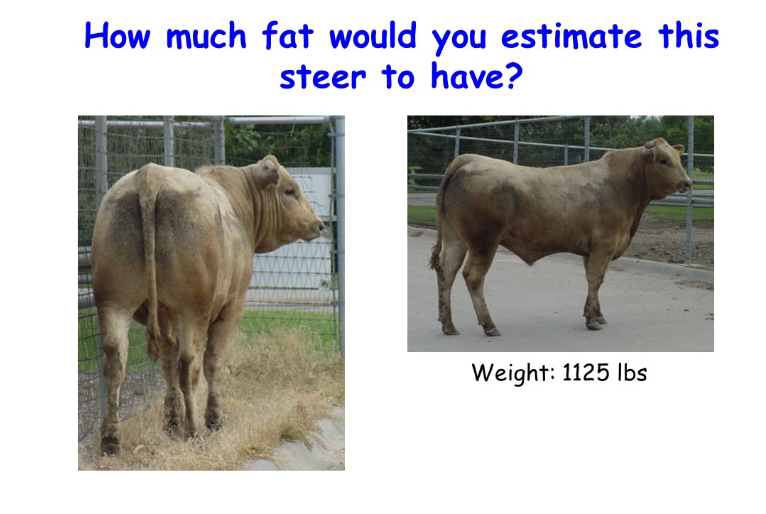
61%
What would be a good estimate of dressing percentage for a green (underfinished), light-muscled beef type steer?
Increased fill
Which of the following factors typically will NOT increase dressing percentage?
1,240
For a pen of cattle that have an average live weight of 1278 lbs, a 3.0% pencil shrink was negotiated. What is the pay weight for these cattle? Please answer to the nearest pound.
111.6
A group of cattle are expected to dress 62%, and the carcass bid is $180.00/cwt. What is the equivalent live bid? Please express your answer as $/cwt, and report to the nearest penny.
1,073.6
The carcass price is 160/cwtofhotcarcassweight. Thecattleweigh1100lbsandareexpectedtodress61/head) of these cattle when sold. Please record your answer to the nearest penny, total dollars per head.
1,523.2
The carcass price is 170/cwtofhotcarcassweight. Thecattleweigh1400lbsandareexpectedtodress64/head) of these cattle when sold. Please record your answer to the nearest penny, total dollars per head.
155
A pen of cattle expected to dress 63% were given a live weight bid of $97.65/cwt. What would be the equivalent carcass weight bid. Please express your answer as $/cwt, and report to the nearest penny.
169.9
Cattle were sold on the following grid with a base price of $170/cwt of hot carcass weight.
Prime = +16
Upper 2/3 Choice = +5
Low Choice = Base
Select = -10
YG 1 & 2 = +4
YG 3 = Base
YG 4 & 5 = -12
You expect that 10% of the cattle will grade prime, 30% average & high choice, 40% low choice, and 20% select. In addition, you expect 30% YG 1&2, 50% YG 3, and 20% YG 4.
Calculate the weighted average price for cattle in this pen. Please record your answer as $/cwt of hot carcass weight, recorded to the nearest penny.
113.4
A group of cattle are expected to dress 63%, and the carcass bid is $180.00/cwt. What is the equivalent live bid? Please express your answer as $/cwt, and report to the nearest penny.
3-4%
Which of the following would be the most commonly negotiated "pencil shrink" for determination of the pay weight of cattle?
161.1
Cattle were sold on the following grid with a base price of $160/cwt of hot carcass weight.
Prime = +12
Upper 2/3 Choice = +5
Low Choice = Base
Select = -10
YG 1 & 2 = +8
YG 3 = Base
YG 4 & 5 = -20
You do not expect any prime cattle, but you're estimating 10% average & high choice, 40% low choice, and 50% select. In addition, you expect 70% YG 1& 2, and 30% YG 3.
Calculate the weighted average price for cattle in this pen. Please record your answer as $/cwt of hot carcass weight, recorded to the nearest penny.
150
A group of light-weight, under-finished steers were given a live-weight bid of $91.50/cwt for a health-oriented market. If they are expected to dress 61%, what is the equivalent carcass weight bid? Please express your answer as $/cwt, and report to the nearest penny.
121.6
A group of cattle are expected to dress 64%, and the carcass bid is $190.00/cwt. What is the equivalent live bid? Please express your answer as $/cwt, and report to the nearest penny.
193.55
What is the equivalent carcass weight bid for a live-weight bid of $120.00/cwt, if the cattle dress 62%? Please express your answer as $/cwt, and report to the nearest penny.
True
True or False: Selling "in the beef" or on a carcass-weight basis should net more total dollars than selling on a live-weight basis, if the cattle have a high dressing percent (i.e., 64-65%).
True
True or False: If cattle are sold on a carcass-weight or grid basis, the producer will not be paid for any cattle that are condemned.
103.7
A group of cattle are expected to dress 61%, and the carcass bid is $170.00/cwt. What is the equivalent live bid? Please express your answer as $/cwt, and report to the nearest penny.
96
A group of cattle are expected to dress 60%, and the carcass bid is $160.00/cwt. What is the equivalent live bid? Please express your answer as $/cwt, and report to the nearest penny.
130
A group of cattle are expected to dress 65%, and the carcass bid is $200.00/cwt. What is the equivalent live bid? Please express your answer as $/cwt, and report to the nearest penny.
155.17
A group of dairy beef were given a live-weight bid of $90.00/cwt. If they are expected to dress 58%, what is the equivalent carcass weight bid? Please express your answer as $/cwt, and report to the nearest penny.
Live-weight pricing
Which of the following marketing programs provides for the least risk to the producer?
187.6
Cattle were sold on the following grid with a base price of $180/cwt of hot carcass weight.
Prime = +20
Upper 2/3 Choice = +10
Low Choice = Base
Select = -16
YG 1 & 2 = +5
YG 3 = Base
YG 4 & 5 = -8
You expect that 20% of the cattle will grade prime, 60% average & high choice, 15% low choice, and 5% select. In addition, you expect 80% YG 3 and 20% YG 4.
Calculate the weighted average price for cattle in this pen. Please record your answer as $/cwt of hot carcass weight, recorded to the nearest penny.
1,488
For a pen of cattle that have an average live weight of 1550 lbs, a 4.0% pencil shrink was negotiated. What is the pay weight for these cattle? Please answer to the nearest pound.
203.12
A group of straight-bred Angus were given a live-weight bid of $130.00/cwt. These well-fed, slightly over-finished cattle are expected to dress 64%. What is the equivalent carcass weight bid? Please express your answer as $/cwt, and report to the nearest penny.
1,409
For a pen of cattle that have an average live weight of 1460 lbs, a 3.5% pencil shrink was negotiated. What is the pay weight for these cattle? Please answer to the nearest pound.
1,984
The carcass price is 200/cwtofhotcarcassweight. Thecattleweigh1550lbsandareexpectedtodress64/head) of these cattle when sold. Please record your answer to the nearest penny, total dollars per head.
False
True or False: Upon inspection, if cattle are condemned, the producer will not be paid, regardless of how the cattle were sold.
Inability to produce carcasses with enough marbling to grade Choice
According to the "U.S. Standards for Grades of Feeder Cattle", why are double-muscled cattle graded inferior?
True
True or False: A steer that receives a feeder calf grade of "inferior" can be regraded at a later date once corrective actions have been implemented.
The heifer is projected to weigh 100 lbs less than the steer when finished.
On average, how does the projected finished weight of a similar frame size heifer compare to that of a steer?
1100-1250 lbs
What is the expected weight range for a finished, medium-framed steer?
Muscle Score and Frame Size
What two factors are used to determine USDA feeder cattle grades?
Thin cattle are worth more per lb than fleshy cattle.
How does flesh condition affect feeder calf prices?
< 1100 lbs
According to USDA feeder cattle grades, a "small-framed" steer should finish out at what weight? The weight range selected must allow for ALL small-framed cattle to be included.
Small, Medium, Large
What are the "frame" sizes associated with USDA feeder cattle grades?
1450 lbs
Which of the following is most likely associated with the finished weight of a L80 feeder steer calf?
2000
When were the feeder calf standards most recently revised?
Inferior
What official feeder cattle grade would be assigned to an extremely heavy muscled, double-muscled Belgian Blue calf that weighs 600 lbs but would be expected to weigh 1500 lbs when finished?
Inferior
What feeder cattle grade is assigned to cattle that have a condition that must be corrected before the animal can be expected to perform normally?
Grain-fed, young cow that would likely grade "Commercial"
What is a "premium white"?
~75%
What is the approximate red meat yield of culls cows that qualify as "breaking" beef?
75 lbs
On average, 1 body condition score is equal to approximately how much live weight?
True
True / False - Packer grades are really marketing categories designed to describe the functionality or likely use of cull animals.
False
True / False - According to the cull cow feeding trial, there was no change in lean color, firmness, and texture due to supplemental feeding of cull cows.
Boning Beef
The average cull cow, BCS = 5, would receive which packer grade?
True
True / False - According to results of the cull cow feeding trial, supplemental feeding of cull cows for 84 days enhanced tenderness as detected by sensory evaluation.
$120/cwt
Which of the following is most representative of current (October, 2020) cull cow, carcass-based prices?
~ 90% lean
What is the approximate lean beef yield of a cull cow that is categorized as "lean"?
Premium White
Per lb, which of the following typically sells for the greatest price ($/cwt)?
False
True / False -- When marketing cull cows, you should "feed them up" so they look "big volumed" and "full" when sold?
50%
Cull cows that typically fall into the "Boning Beef" category usually have a body condition score of 5. What would be the expected dressing percentage for such cattle?
13%
According to Stelzleni and Johnson, the harvest of cull cows account for approximately how much of the domestic beef supply?
False
True / False -- All "large-framed" feeder cattle will be physically bigger (taller and longer) than all "small-framed" feeder cattle when feeder calf grades are applied.
4
Most dairy cattle (Holsteins) would likely receive what feeder cattle muscle score?
4
What is the least desirable muscle score associated with feeder cattle grades?
1979
When were feeder calf grade standards first implemented?
To provide a common trade language
Why were feeder cattle grades developed?
Yellow
Unless a cull cow is grain-fed, what color will the fat on carcass likely be?
False
True / False - The middle meats from cull cows with a BCS of 1-3 are commonly fabricated into primal cuts (rib and loin) that can be made into steaks for economy-focused steakhouses.
52%
What is the approximately dressing percent of BCS 6-7 cows, identified as "breakers"?
May
Traditionally, when are cull cow prices the highest during the year?
70%
What is the approximate average red meat yield of a Premium White?
47%
What is the average dressing percentage for "Lean" cows that may would typically have a body condition score of 3?
False
True / False -- Both official USDA quality grades and packer grades specifically define meat quality.
False
True / False. Official USDA quality grades are commonly assigned to cow carcasses.