Tectonics
 Call Kai
 Learn
Learn Practice Test
 Spaced Repetition
 Match
Match Flashcards
 Knowt Play
1/45

There's no tags or description
Looks like no tags are added yet.
Name | Mastery | Learn | Test | Matching | Spaced | Call with Kai | Chat |
|---|
No analytics yet
Send a link to your students to track their progress
46 Terms
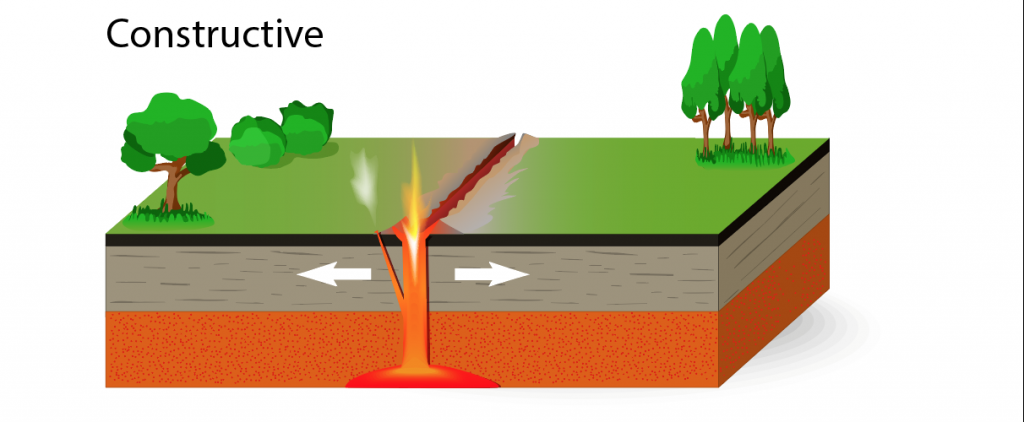
What happens at a Constructive plate margin?
The 2 plates are moving apart
This causes magma to rise up from the mantle and form new oceanic crust
This normally happens under oceans
It forms underwater volcanoes (some are so large you can see them above sea level such as Iceland)
What happens at a Destructive plate margin?
The 2 plates are moving towards eachother
The oceanic plate is being pushed under the continental plate as it is denser
This forms a deep sea trench
Oceanic crust is melted into magma by the mantle and rises along the fault lines to form volcanoes

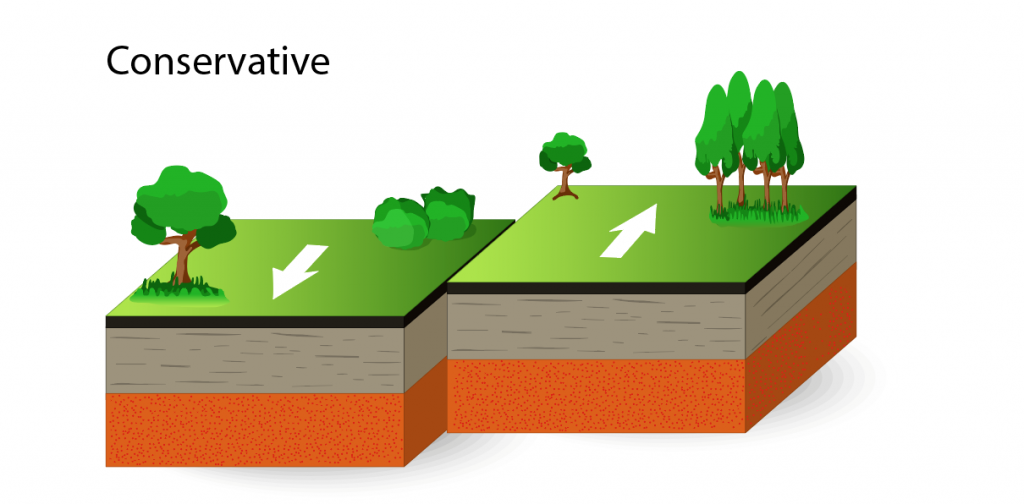
What happens at Conservative plate margins?
The 2 plates are sliding past eachother
When the plates stick it causes tension to build up
When this tension is released an earthquake occurs
The crust is neither created nor destroyed
Volcanic eruptions DO NOT occur
(San Andreas fault line in Los Angeles)
What happens at Collision plate margins?
The 2 plates are moving towards eachother BUT are both continental plates
Neither plate can be subducted so the crust is crumpled upwards to form Fold Mountains (Himalayas)

What are Infra-plate Earthquakes?
Earthquakes in the middle of plates on fault zones where the tectonic plate is being squashed, forcing the pressure to be released through the cracks.
Energy travels up cracks in the plate and causes an earthquake
(They’re usually weaker, lower energy but they’re shallow focus)
What are Infra-plate Volcanoes?
A hotspot is a plume of super-heated magma in the mantle.
As the plate moves over the hotspot, volcanoes and new crust are created. The plate moves, but the hotspots remain stationary.
How do tectonic plates move?
Convection Cycles, Slab Pull, Ridge Push
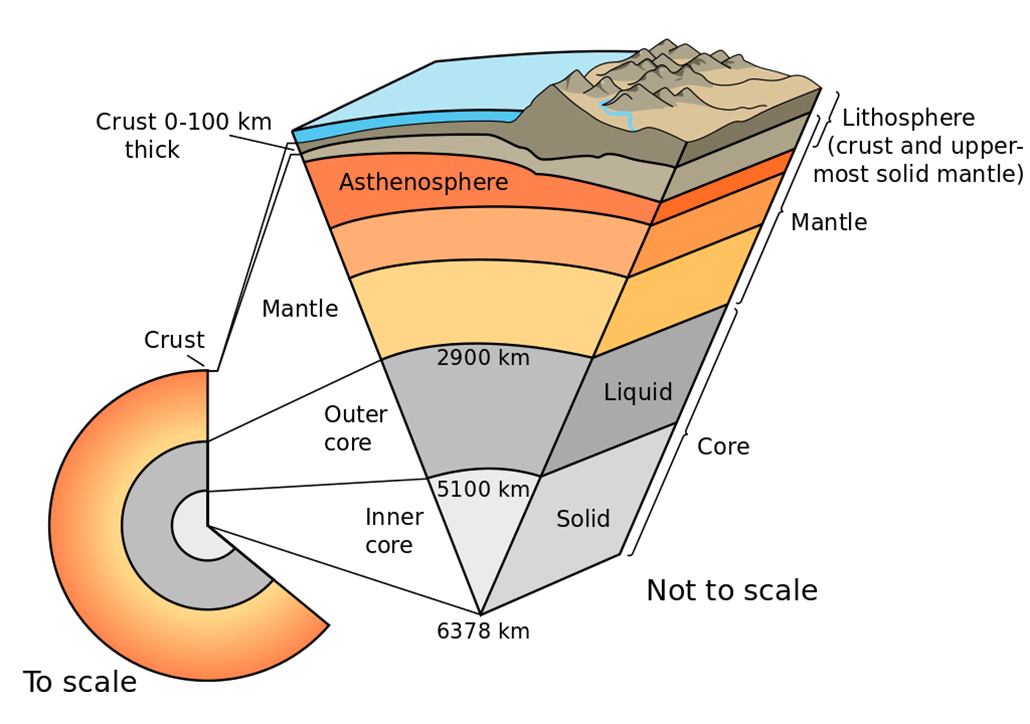
What are the properties of the Lithosphere?
~100km thick (varies a lot)
Strong, solid, rigid
Divided into tectonic plates
What are the properties of the Asthenosphere?
~100km thick (varies)
Several hundered km below surface
Rock is close to melting point
Solid mantle - can deform/ flow over long periods
What are the differences in Oceanic vs Continental crust?
Oceanic
Solid + rigid
6-10 km thick
balsatic rock
~3.0g/dm³ density
Continental
30-70km thick
~2.7g/dm³ density
Solid + rigid
mainly granatic rock
Diagram of the Earth:
What are Convection Cycles?
Hot magma rises, as it cools it sinks and moves apart.

What is Slab Pull?
Subduction zone at destructive margin
The further the subducted plate goes down, the more it will pull on the rest of the plate from the surface down into the mantle.

What is Ridge Push?
Construcive plate margin
The ocean ridge makes the plate heavier, gravity pulls down from the highest point.
Convection currents open the gap in the crust, the ridge causes it to widen.

What evidence is there of Continental Drift?
Fossils of the same plant/ animal found on different continents
What evidence is there of Paleomagnetism?
Rocks formed by underwater volcanoes in relation to Earth’s magnetic field
Mapping suggested the migration of sea floor rocks
What evidence is there of Sea- Floor Spreading?
Newest rocks near centre of Iceland and oldest at the coast
Suggested the crust was splitting, expanding in certain places
What are the different forms of Seismic Waves?
Body Waves
Surface Waves

What are Body Waves?
Waves that travel from the focus of the earthquake
(Primary and Secondary)
They can travel through liquid (mantle) but not through solid (crust)
They do NOT shake the ground
(They then turn into L and R waves)

What are Surface Waves?
Waves that travel form the epicenter along Earth’s surface. They arive after body waves.
(Long and Rayleigh)

When and how much of an earthquakes energy is released?
95% of an earthquakes energy is released in the first 10 seconds
What is Liquefaction?
The Earth shakes
Water under the ground gains energy and begins to move upwards
Water then penetrates through the sand/soil and onto the surface
What does the building code account for?
Earthquakes NOT Liquefaction
What are the consequences of Volcanic Activity?
Pyroclastic Flow
Tephra
Lava Flows
Volcanic Gases
Lahars
Jokulhaups
What type of Volcanoc does Pyroclastic Flow come from?
Stratovolcanoes
What are the characteristics of Pyroclastic flow?
Hot → 200-700°C
Fast moving → 100km/h
Consists of rock fragments, pumice, ash
Travels down volcano slopes
VERY large (~8km wide and ~1km high)
What are the Harmful Effects of Pyroclastic Flow?
Burns, Asphyxiation
What is a recent example of a Pyroclastic Flow?
Mount Merapi (2010, Indonesia)
What type of volcanoes have Volcanic Gases?
Any
What are the characteristics of Volcanic Gases?
Water Vapour (H2O), Carbon Dioxide (CO2), Sulfur (SO2, H2S)
What are the Harmful effects of Volcanic Gases?
Irritation of the: eyes, nose, throat
Breathing difficulties
Asphyxiation
What is a recent example of Volcanic Gases due to an erruption?
Mount Nyiragongo (DR Congo, 2002 + 2021)
Which type of volcanoes do you find Lahars?
Stratovolcanoes
What are the Characteristics of Lahars?
~90°C
30-80km/h
Follows river valleys
Happens during or after rain
It’s a mud flow of vlocanic material (rocky debris, water)
What are the Harmful Effects of Lahars?
Burial, Environmental damage, Infrastructure damage, High speed and force
What is a recent example of a Lahar?
Eyjafjallajökull (Iceland, 2010)
How does the UN define a Disaster?
“A serious disruption of the function of a community/ society involving widespred human, material, economic, or environmental losses and impacts, which exceeds the ability of the affected community or society to cope using its own resources.”
What is Insurance groups defiinition of Disaster?
“an economic loss of over $1.5 million.”
What is Degg’s Model of Disaster and Vulnerablity?
Hazardous event + Vulnerable population

What is Hazard Vulnerability?
The susceptability/ exposure to a degree of loss resulting from the occurance of a hazard.
What are some factors that affect Vulnerability?
Demographics
Population size/ density
Development
Governance
Preparedness
Infrastructure
Communication
What is the Risk equation?
Risk (R) = Hazard (H) x Vulnerability (V) / Capacity to Cope (C)
What is the Pressure And Releaser model?
PAR model looks at underlying causes of a disaster. Based on the idea that a disaster happens when two opposing ‘forces‘ interact.
Vulnerability starts with Root Causes, through a series of Dynamic Pressures, these root causes can lead to Unsafe Conditions.

What is Resilience?
The ability to protect lives, livelihoods, and infrastructure from destruction, and to restore areas aftera natural hazard has occurred.

What factors into an Increase in Resilience?
Good communication
Pre-planning
High quality health care
Member of a Trade Bloc
High GDP per capita
Stringent building regulations
Rehearsed emergency procedures
Low doctor to patient ratio (D:P 1:10 > 1:1000)
‘Open’ political regime
What factors into a Decrease in Resilience?
Government corruption
Poor emergency services
High population density
Low access to education
Foreign Debt repayments
High rural to urban migration
Lack of skills
Unmaintained roads
Energy insecurity
High unemployment
Rapid population growth