1
 Call Kai
 Learn
Learn Practice Test
 Spaced Repetition
 Match
Match Flashcards
 Knowt Play
1/94

There's no tags or description
Looks like no tags are added yet.
Name | Mastery | Learn | Test | Matching | Spaced | Call with Kai | Chat |
|---|
No analytics yet
Send a link to your students to track their progress
95 Terms
What is the standard anatomical position of the human body?
Standing in an upright position with eyes level and facing forward, feet parallel and close together, and arms at the sides with palms facing forward.
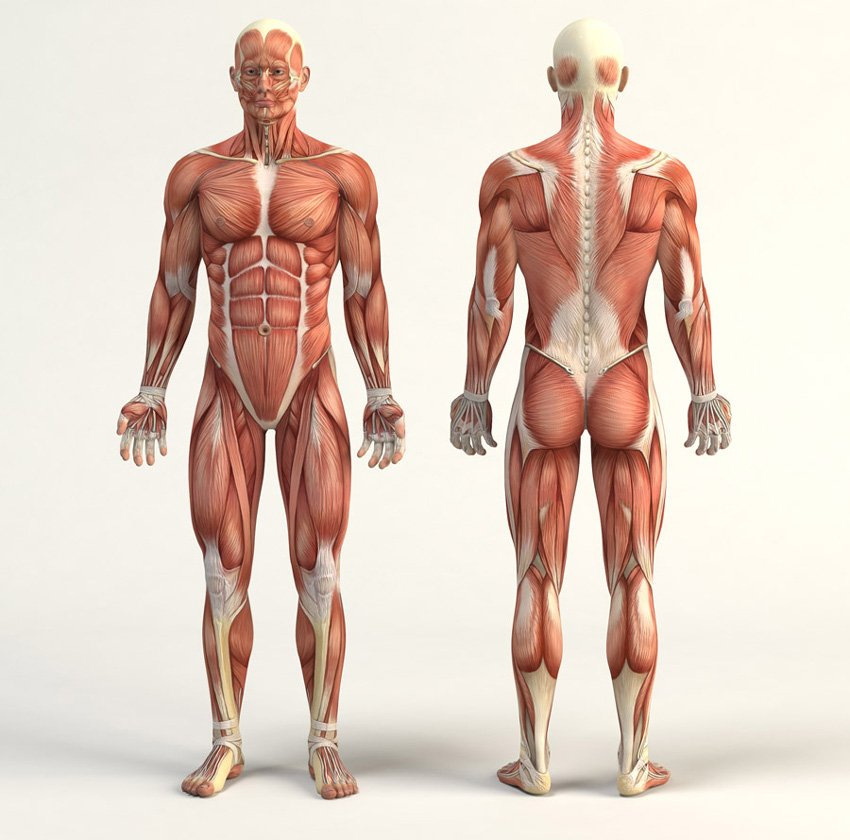
Which standardized position is depicted here for describing movement and limb relationships?
Anatomical Position
In anatomical terminology, _____ refers to the front of the body, while _____ refers to the back of the body.
anterior (or ventral); posterior (or dorsal)

What is the sagittal plane?
A vertical plane that passes through the body from anterior to posterior, dividing it into right and left portions.

What is the frontal (coronal) plane?
A vertical plane that passes through the body from side to side, dividing it into anterior and posterior portions.

What is the horizontal (transverse) plane?
A plane passing through the body horizontally, dividing it into superior and inferior portions.

Which plane divides the body horizontally into superior and inferior portions.
Horizontal (or Transverse) plane
What is a cardinal plane?
Any plane (sagittal, frontal, or horizontal) that passes directly through the body to divide it into equal halves.
Joint movements in the sagittal plane rotate around which axis?
Frontal axis
Joint movements in the frontal plane rotate around which axis?
Sagittal axis
Rotation movements in the horizontal plane occur around which axis?
Vertical (or Longitudinal) axis
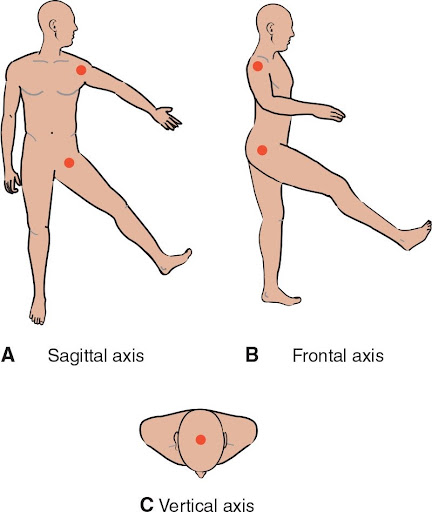
Which body axis is represented in B, around which flexion and extension occur?
Frontal Axis
How do thumb flexion and extension differ from standard anatomical plane orientation?
Thumb flexion and extension occur within a frontal plane and about a sagittal axis (unlike other joints where they occur in the sagittal plane).
How do thumb abduction and adduction differ from standard anatomical plane orientation?
Thumb abduction and adduction occur within a sagittal plane and about a frontal axis.
What is osteokinematics?
The movement of bones in space about a joint axis (e.g., flexion, extension, abduction).
What distinguishes active range of motion (AROM) from passive range of motion (PROM)?
AROM occurs when muscle contraction moves the joint; PROM occurs when an external force moves the joint without muscle contraction.
What is arthrokinematics?
The manner in which adjoining joint surfaces move on each other (e.g., roll, glide, spin).
In arthrokinematics, what defines a roll?
Rolling occurs when new points on one joint surface make contact with new points on the opposing surface.

Which type of arthrokinematic movement is depicted here?
Roll
In arthrokinematics, what defines a spin?
Spinning occurs when the rotation of a movable joint surface happens around a fixed longitudinal axis, such that the same point on the moving surface remains intact.

Which type of arthrokinematic motion is illustrated by this spinning top model?
Spin
In arthrokinematics, what defines a glide (or slide)?
Glide occurs when one point on a joint surface contacts new points on the opposing joint surface.

Which arthrokinematic joint motion is represented by this sliding block model?
Glide (or Slide)
According to the concave/convex rule, in what direction does a concave surface glide relative to bone movement?
A concave joint surface glides on a fixed convex surface in the SAME direction as the moving bone segment.
According to the concave/convex rule, in what direction does a convex surface glide relative to bone movement?
A convex joint surface glides on a fixed concave surface in the OPPOSITE direction of the moving bone segment.
What characterizes an open-packed (loose-packed) joint position?
Ligaments and capsule are lax, articular surfaces have decreased congruency, and joint play (arthrokinematic movement) is permitted.
What is angular (rotatory) motion?
Movement of an object around a fixed axis where all parts move at the same time and in the same direction, but not the same distance.

What type of motion is demonstrated by knee extension in sitting?
Angular (Rotatory) motion
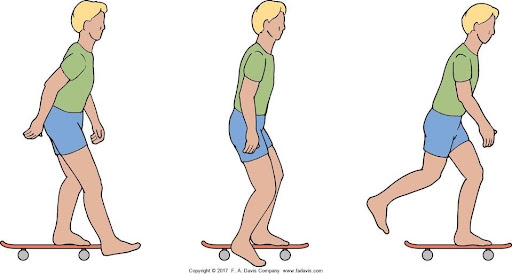
Which overall motion type is created by combining lower limb angular movements on a skateboard?
A combination of angular and linear motion
What are three clinical rationales for proper patient positioning?
1. Prevent soft tissue and joint contractures
2. Prevent prolonged pressure/skin breakdown
3. Provide comfort, stability, and modesty
Why must linens and clothing be smoothed out beneath a positioned patient?
To avoid folds that create high localized pressure points and cause skin breakdown.
Which bony prominences of the head and trunk receive greatest pressure in the supine position?
Occipital tuberosity, spine and inferior angle of scapula, vertebral spinous processes, PSIS, and sacrum.
Which upper extremity bony prominence is most vulnerable to pressure in the supine position?
Medial epicondyle of the humerus (and olecranon process).
Which lower extremity bony prominences are at risk for pressure injuries in the supine position?
Posterior calcaneus, greater trochanter, head of fibula, and lateral malleolus (especially with hip external rotation).
Which bony prominences of the head and trunk receive greatest pressure in the prone position?
Forehead, lateral ear, acromion process, sternum, and anterior superior iliac spine (ASIS).
Which lower extremity areas are at high pressure risk in the prone position?
Patella, tibial crest, and dorsum of the foot.
In the side-lying position, which bony prominences of the lowermost extremity bear the most pressure?
Greater trochanter, medial/lateral condyles of the femur, and medial/lateral malleoli.
In the side-lying position, which structure of the uppermost lower extremity is susceptible to pressure against the other leg?
Medial condyle of the femur and medial malleolus.
Which bony prominences bear the primary weight and pressure in the sitting position?
Ischial tuberosities (plus scapulae/spinous processes if leaning, and sacrum/coccyx if slouched).
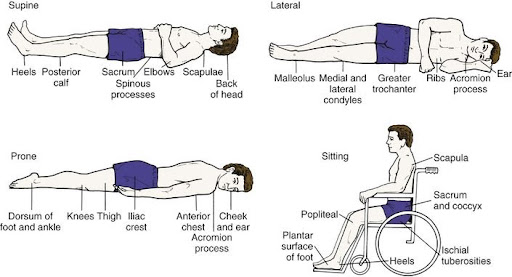
Based on this figure, name two common pressure sites in the lateral (side-lying) position.
Greater trochanter and lateral/medial malleoli (or ear, acromion process, lateral condyles).
What is a contracture?
the adaptive shortening, tightening, or fibrosis of soft tissue structures. (injury/burn/nonmovement of the muscle/tendon/joint causes break down, causes no communication between other muscles/tendo/joints/nervous system, initiates repair bc it assumes that segment has too much slack, it tightens by aggresivly depositing collagen to make it structurally stable to repair communication OR localized ischemia causing cell death causing gaps causing scar tissue formation)
What contracture pattern is associated with prolonged supine positioning?
Hip and knee flexion, plantar flexion, shoulder extension, adduction, internal rotation, and hip external rotation.
What contracture sites are most affected by prolonged sitting?
Hip flexors, knee flexors, hip adductors/internal rotators, shoulder adductors/extensors/internal rotators.
transfemoral aka
AKA, above knee amputation
For a patient with transfemoral amputation (AKA), sitting should be limited to _____ minutes per hour to prevent contracture.
40 WHY different postural habits (prolonged sitting), biomechanical imbalances (the iliopsoas, a powerful hip flexor, is attached at the lesser trochanter remain in tact, and the multi-joint hip extensors like the hamstrings are severed causing the iliopsoas continuously pulls the the residual limb into flexion bc the anatognist aka the extensors can no longer counter/balance the form), and loss of distal limb weight (loss of gravitational pull naturally pulling the leg flat).
transtibial aka
BKA, below knee amputation
Origin
the fixed, stationary anchor point of the muscle. It is usually located closer to the center of the body (proximal).
Insertion
the movable attachment point of the muscle located further from the center of the body, distal on the bone that travels during movement
What key joint position must be avoided following a transtibial amputation (BKA)?
Prolonged hip and knee flexion (extension should be encouraged). WHY causes soft tissue contracture, (placing pillow under in supine causes adaptive shorting of the hip flexors AND allowing residual limb to dangle adaptively shortens the hamstrings muscle), may compromise prosthetic fitting, affects overall ambulation) Why it shortens because origin and insertion are closer it is relaxed/slackened/shortened
what is hemiplegia
paralysis or severe motor weakness affecting one side of the body, commonly associated with CVA or Brain injury
ipsilateral
relating to the same side of the body.
subluxation
aka partial dislocation, the articulating bone surface partially slides out of their normal anatomical alignments, but remains partially in contact.
sulcus sign or subluxation gap
the palpable gap or depression between the acromion and the head of the humerus when the arm is subluxing
how to palpate sulcus sign
pressing horizontally into the depression directly below the lateral edge of the acromion. Then count finger in between documented in finger breadths
What upper extremity motions should be avoided during positioning of a hemiplegic patient?
Prolonged shoulder adduction, internal rotation, elbow flexion, forearm pronation/supination, and wrist/finger flexion.NEVER pull on affected UE to move guide or position patient (WHY contractures, shoulder subluxation, joint trauma bc paralysis deprived the glenohumeral joint of its muscular stability, pulling places excessive traction on shoulder, overstretching the joint capsule, causes severe pain and resulting in shoulder subluxation or dislocation)
Why must 'positions of comfort' be avoided in patients with burns or skin grafts?
Positions of comfort encourage scar tissue contraction and lead to severe joint contractures.
What is the definition of body mechanics?
The efficient use of one's body to produce movement that is safe, energy conserving, anatomically and physiologically efficient, and maintains body balance.
Where is an individual's center of gravity (COG) located in normal standing position?
Approximately at the second sacral segment (S2) in the center of the pelvis.
What is an object's center of gravity (COG)?
The point at which the object is heaviest to move or most difficult to adjust to a new position.
What is the vertical line of gravity (VLG)?
An imaginary vertical line that bisects, divide into two equal parts, the body in the sagittal plane, passing through the COG.
For a standing person to maintain balance and stability, where must the vertical line of gravity (VLG) fall?
It must fall within the person's base of support (between the feet).
What are four events that alter a person's center of gravity (COG)?
1. Adding ambulation aids (changes mass distrubition shifts towards the device)
2. Standing on one foot (shifts mass of lifted limb to planted limb, pull cog sideways and slightly upward)
3. Reaching for an object (moves extremities from midlin, pulls cog in direction of reach)
4. Adjusting the base of support (BOS) (alters foot placement, stance, hip.knee flexion, realigns COG relative to gravity and floor)
Why should a clinician position their center of gravity (COG) close to an object's COG when moving it?
It reduces the torque required to lift, move, or carry the object, preventing low back strain.
how does trunk flexion and rotation cause disc herniation?
bendin forward compresses the front of the intervertebral disc and pushes the nucleus pulopus, the gel like center, backward against the post. wall of the disc, annulus fibrouses. The rotation/twisting taustens only 50% of the concentric collagen fibers in the annulus fibrouses, and the other goes on slack. combined the backwards force against the annulus operating on half of its strength creates extreme force at the posterior/lateral corner of the disc where it bulges, annulus tears and herniation, gel like center pushes through that tear, occurs
Which spinal movement combination MUST be avoided when lifting heavy loads?
Simultaneous trunk flexion and rotation. WHY single most common cause of acute back injuries and disc herniations.
What is the primary action triggering the Valsalva maneuver during exertion?
Holding one's breath while performing physical activity.
Describe the cardiovascular sequence caused by the Valsalva phenomenon.
breath holding while attempting strenuous movement, air trapping increases intrathoracic (chest cavity) pressure -> high pressure reduces venous blood flow to right side of heart drops -> cardiac output drops and peripheral blood pressure surges →release of breath, sudden surge of blood flow/blood pressure risking stress to the cardiovascular system or cause a cerebral vessel to rupture.
Before positioning or moving a patient, what standard procedure must be performed first?
Introduce self, inform the patient, and verify identity using a 2-person identifier.
When draping a lower extremity during treatment, what specific item may be provided to maintain modesty?
An "in between sheet" (or specialized drape).
What is flexion?
A bone movement that decreases the angle between two body parts, occurs in the sagittal plane and rotates around the frontal (also called transverse or mediolateral) axis..
What is extension?
A bone movement that increases the angle between two body parts, occurs in the sagittal plane and rotates around the frontal (or mediolateral/transverse) axis
Abduction
Moves a segment away from the midline in the frontal planeunctions in the frontal (or coronal) plane and rotates around the sagittal (or anteroposterior) axis
Adduction
Moves toward the midline, functions in the frontal plane (also known as the coronal plane) and rotates around the sagittal axis
radial deviations
Wrist motion toward the thumb side, functions in the frontal (or coronal) plane around an anterior-posterior (or anteroposterior) axis
ulnar deviation
Motion toward the little finger side, functions in the frontal (or coronal) plane and around an anterior-posterior (sagittal/coronal-perpendicular) axis
In the foot and ankle, outward turning of the plantar surface functioning in the frontal plane (also known as the coronal plane) and rotates around an anterior-to-posterior axis (front-to-back axis)
eversion
In the foot and ankle, inward turning of the plantar surface functioning on the frontal (coronal) plane and rotates around the sagittal (anterior-posterior) axis
inversion
Palm facing posteriorly in anatomical standing position, forearm functioning in the transverse (or horizontal) plane and rotates around the vertical (or longitudinal) axis.
Pronation
palm facing anteriorly in anatomical position, forearm operates in the transverse (horizontal) plane and rotates around a longitudinal (vertical) axis
Soupination
To prevent excessive hip external rotation in a supine patient, where should a towel roll or sandbag be placed?
Against the lateral aspect of the soft tissue of the thigh and lower leg.
How does increasing the base of support (BOS) affect body stability?
Widen BOS increases stability by making it easier to keep the vertical line of gravity (VLG) inside the support area.
What is kinetics?
The branch of mechanics describing how forces and torques act upon and affect the body.
What is kinematics?
The branch of mechanics describing body motion without regard to the forces or torques producing that motion, incorporating factors of time, space, and mass.
When a convex femoral head moves inside a fixed concave acetabulum during hip flexion, in which direction does the femoral head glide?
Posteriorly (opposite direction of bone movement).
When a concave tibia moves on a fixed convex femoral condyle during open-chain knee extension, in which direction does the tibia glide?
Anterodorsally / Anteriorly (same direction as tibial movement).
How often should skin inspections be performed relative to patient positioning treatment?
Prior to, during, and immediately after treatment.
What rule governs the hanging of limbs over a supporting surface during patient positioning?
Extremities must NEVER hang beyond the supporting surface without support, WHY contractures, accidental traumas, edema prevention, subluxation,
What positioning precaution applies to patients with rheumatoid arthritis (RA)?
Avoid prolonged immobilization and perform careful range of motion exercises (except during acute inflammation) WHY the synovial membrane and joint capsules and surrounding soft tissues undergo severe inflammatory swelling, any force can disrupt tissue healing and cause more inflammation, intense pain, muscle spasms. HOW yk: swelling; redness, increased temperature, pain, loss or change of normal function
What assist technique minimizes shearing forces and friction during patient transfers and repositioning?
Using lift sheets, transfer boards, trapezes, mechanical lifts, and adequate caregiver assistance.
Where is the palpation landmark for the spinous process of S2 relative to pelvic surface anatomy?
In line with the posterior superior iliac spines (PSIS), designating the center o f gravity.
What surface anatomy landmark marks the distal anterior aspect of the pelvis susceptible to prone pressure?
Anterior Superior Iliac Spine (ASIS)
Which posterior pelvic prominence is a primary pressure site during slouched sitting or supine positioning?
Sacrum and Coccyx
What elbow landmark must be protected from prolonged pressure when a supine or sitting patient rests on a hard surface?
Olecranon process
To prevent dependent edema in a patient with a flaccid upper extremity, how should the arm be positioned?
The hand should be placed higher than the elbow.
What core technique action should precede lifting an object according to body mechanics rules?
Tightening the core (abdominal) muscles.