plants part 2: monocots and eudicots
 Call Kai
 Learn
 Practice Test
 Spaced Repetition
 Match
 Flashcards
 Knowt Play
1/49

Earn XP
Description and Tags
plant structure and growth
50 Terms
_____ are grouped into different cells that carry out functions for organisms
tissues
_____ are grouped into different tissues that carry out a function for the organism
organs
______ is the plant cell that makes up 90% of plant’s body
parenchyma
______ is a type of plant cell that is used for plant structure and support
collenchyma
T/F Parenchyma has evenly thick cell walls
True
T/F Collenchyma has evenly thick cell walls
False; unevenly
7 types of plant cells
parenchyma, collenchyma, sclerenchyma, vessel elements and tracheids (xylem), sieve cells and companion cells (phloem)
_______ are “lignified” which makes them _____ and ____. These cells are seen in seed coats. They are _____ at functional maturity.
Sclerenchyma; hard and tough; dead
Individual cells that must be stacked on one another, which are lignified and dead.
Vessel Elements
Elongated cells that keep individual cells stacked are called _______. They are ____ and prevent ______.
Tracheids; alive; cavitation
Two cells that make up the xylem
vessel elements and tracheids
Two cells that make up the phloem
sieve cells and companion cells
______ ______ are alive without organelles, making them empty inside for sugar to move in both directions
sieve cells
______ are next to sieve cells that keep them alive; makes all proteins and produces energy
companion cells
Which way does sugar move in the spring?
root to leaves
Which way does sugar move in the summer?
leaves to roots
Bidirectional movement is from ______ to the ______
source; sink
What bidirectional movement term is used for a cell that has sugar?
source
What bidirectional movement term is used for a cell that needs sugar?
sink
_____, _____, and _____ are found in roots, stems, and leaves
dermal; vascular; ground tissue
______ _____ covers or lines the plant body, which is the most exterior (epidermis), and includes stomata, guard cells, waxy cuticle. Give an example.
dermal tissue; ex. bark
______ is a tissue that moves water and sugar (xylem and phloem)
vascular tissue
______ is a tissue that is not dermal or vascular
ground tissue
Leaves and stems make up the ______, which takes up ____ and turns to sugar.
sheath; CO2
______ is primarily photosynthetic organ
leaves
_______ is an organ that supports and arranges leaves
stem
This organ is responsible for absorbing water and minerals from soil. Examples include: the nitrogen-fixation relationship and mycorrhizal fungal relationship.
Roots
_______ undergoes apoptosis during a process called abscission.
Petiole
______ is a process when leaves fall
Abscission
_____ is found at the node
axillary bud
_____ is found at the tip of the stem
apical bud
The _____ is known as the reproductive shoot
flower
______ is the space between nodes
internode
This type of bud gives more stems and makes them longer
apical bud
This type of bud gives new leaves
axillary bud
_______ allows for indeterminant growth, which occurs in plants.
meristem
T/F humans have indeterminant growth
False, we’d be dead
The ______ is a type of meristem known as the primary growth and makes plants taller (increase in length)
apical meristems
______ ______ — known as the secondary growth for plants and widens
lateral meristems
T/F You need both apical and lateral meristems to allow plants to continue to grow (as long as they’re alive)
True
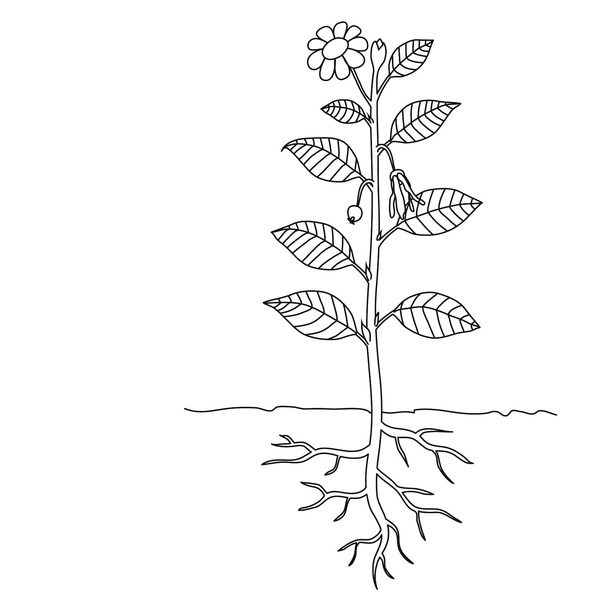
Label the external plant structure: apical bud, axillary bud, leaf, blade, petiole, reproductive shoot, node, internode, stem, taproot
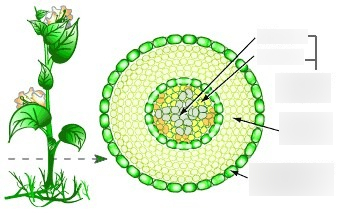
Label the tissues of this cross-section of a stem: vascular tissue, dermal tissue, and ground tissue

Is this a monocot or dicot root?
monocot; corn prop. root

Is this a monocot or dicot root?
dicot; ranunculus mature root

Is this a monocot or dicot stem?
Dicot; alfalfa young stem

Is this a monocot or dicot stem?
Monocot; corn stem

Is this a monocot or dicot leaf?
Dicot; privet leaf

Is this a monocot or dicot leaf?
Monocot; corn leaf (zea)
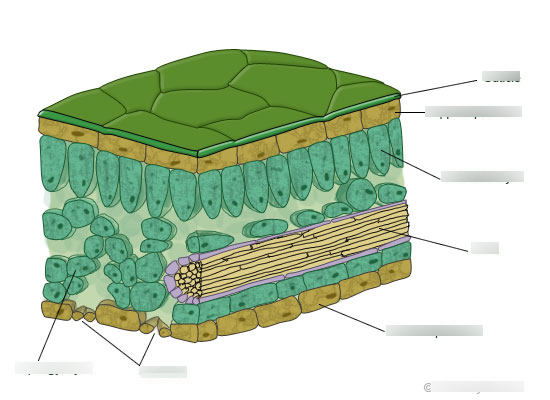
Label internal anatomy leaf structure using the following: waxy cuticle, upper epidermis, lower epidermis, palisade mesophyll cells, vascular tissue, spongy mesophyll cells

Label internal anatomy of a leaf structure, must include xylem and phloem.