Foundations - Clinical Judgment and Introduction to the Nursing Process
 Call Kai
 Learn
Learn Practice Test
 Spaced Repetition
 Match
Match Flashcards
 Knowt Play
1/39

There's no tags or description
Looks like no tags are added yet.
Name | Mastery | Learn | Test | Matching | Spaced | Call with Kai | Chat |
|---|
No analytics yet
Send a link to your students to track their progress
40 Terms
Important qualities for nurses:
Caring and compassionate.
Detail-oriented.
Organizational skills.
Speaking skills.
Listening Skills.
Patience.
Competence.
Emotional stability.
Physical stamina.
Critical-thinking skills.
Quality:
Superiority in kind.
What are the four types of Nursing Knowledge?
Self.
Ethical.
Practical.
Theoretical.
Nurses use _____ in every aspect of nursing care.
Critical thinking skills.
What skills do nurses use throughout their professional lives to manage all types of challenges?
Problem-solving skills.
What does clinical judgement require?
A strong, solid foundation of knowledge to manage all types of challenges.
Important Nurse: Ida Jean Orlando (1961).
First-generation nursing theorist.
Deliberated Nursing Process Theory.
Five-step problem solving process.
What is the Nursing process?
The five-step problem solving process that nurses use to guide professional actions.
What are the 5 steps of the nursing process?
Assessment ➡ Analysis ➡ Planning ➡ Implementation ➡ Evaluation.
What occurs during the analysis stage of the nursing process?
Diagnosis.
What does the assessment process involve?
Gathering data.
Data must be _____.
Factual information.
Clinical Judgment is defined as…
“the observed outcome of critical thinking and decision making.”
What does Clinical Judgment involve?
Involves recognizing cues, prioritizing hypotheses, generating solutions, taking action, and evaluating outcomes to determine if the individual’s condition has changed.
Careful consideration of an individual’s condition, medication, and treatment in the evaluation of their health status.
Clinical Judgment is an _____ process.
iterative decision-making process.
What does Clinical Judgment use nursing knowledge for?
To make observations and assess presenting situations.
To identify a prioritized client concern.
Generate the best possible evidence based solution to deliver safe client care.
What does the common factor nursing model involve?
The utilization of processes that promote safe client care.

What are the four aspects of the tanner model of clinical judgment?
Noticing.
Interpreting.
Responding.
Reflections.
in-action.
on-action.
What is noticing?
Performing an impression of the client situation based on nurse’s expectation; knowledge of the client, past experiences, textbook knowledge, the work environment.
What is interpreting?
Reasoning process used to make sense of initial clinical situations.
What is responding?
Course of action taken by the nurse.
What is reflection?
The process of examining actions implemented.
in-action: is a different course needed?
on-action: how do we refocus in the future?
The Clinical Judgment Action Model is part of…
The interpreting aspect of the CJ model ➡ Analytics ➡ Analyzing Cues.
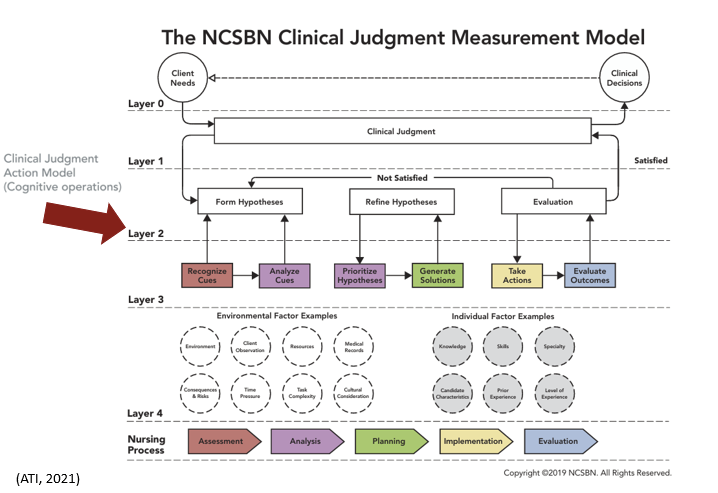
What does each model on the NCSB CJ Model describe?
Layer 0: clinical decisions.
Layer 1: comprises the outcome (clinical judgement).
Layer 2: form, refine hypotheses; evaluation.
Layer 3: contains the clinical judgment tasks (recognize cues, analyze cues, prioritize hypotheses, generate solutions, take action, evaluate outcomes).
Layer 4: context (individual and environmental factors that impact a nurse’s reasoning or cognitive process).
Go more in-depth on layer 0: clinical decisions.
Contains the clinical decisions made by the nurse to address the client’s needs.
Talk more about layer 1: comprises the outcome (clinical judgment).
Comprises the outcome, which is clinical judgment.
Layer 2…
Involves forming, refining, prioritizing, and evaluating hypotheses to achieve the desired outcomes. This may involve repeated cycles, depending on one’s experience level.
Layer 3…
Requires strong core knowledge to analyze cues, form/prioritize hypotheses, implement interventions, and evaluate client outcomes.
Layer 4 (the context layer)…
Identifies the individual and environmental factors that can impact the nurse’s reasoning or cognitive processes.
What is the purpose of the NCSBN CJ model?
Evaluates clinical judgment for safe practice.
Builds skills to analyze data and make safe care decisions.
Essential for NCLEX-RN prep.
65% of entry-level nursing errors were associated with…
Poor clinical decision-making.
What are the essential components of clinical judgement?
Clinical reasoning and critical thinking.
What is Clinical Reasoning?
Process that synthesizes knowledge, info, and experience to create a patient plan.
Uses personal knowledge to form a conceptual model of a patient's problem.
Applies data and experience to assess, generate/evaluate options, and choose the best action.
Why is Clinical Reasoning important?
Needed to develop CJ and practice safe care.
Ineffective reasoning has been linked to being a major factor in the failure of nurses to recognize and respond.
What is clinical thinking?
Collects and analyzes info to evaluate accuracy and weigh action options.
Not tied to a patient situation, but required for clinical reasoning.
Essential for developing clinical judgment (alongside clinical reasoning).