andrew fenton's lectures
 Call Kai
 Learn
 Practice Test
 Spaced Repetition
 Match
 Flashcards
 Knowt Play
1/57

There's no tags or description
Looks like no tags are added yet.
58 Terms
what is a genetic screen?
a series of experiments designed to discover the function of specific genes (or sets of genes)
what is the general way to do a genetic screen?
start off with a mutagenised library (usually random)
apply some sort of selection pressure to sort out the library into 2 groups, ones we are interested in (rare mutations) and others that are not going to be studied
when do scientists usually make mistakes in genetic screening?
When they fail to account for the true effects of the selection pressure they applied, leading to false assumptions (such as mistaking general growth rate changes for a specific phenotype)
in the lecture slide what strains were we trying to find via genetic screening?
strains that grow at 30°C but not at 42°C
further selecting for temperature sensitive mutants that elongate at higher temperatures
in 1979, what was the only 1 gene that was known to be involved in bacterial cell division?
ftsA
what are the basic eries of steps of carrying out a genetic screen?
hypothesis
mutagenesis
screen selection
hit validation
identify genotype
what is usually above hypothesis in the basic series of steps of a genetic screen?
presuppositons/ assumptions (often not stated)
we must assume there is always something else to find
chemical mutagenesis
an unmutated bacteria that is sensitive to antibiotics is exposed to nitrosoguanidine to introduce random mutations across the bacterial genome
eventually a rare, beneficial mutation, in this case it was for streptomycin resistance
why was streptomycin used to calibrate things back in the day?
because resistance could only be caused by a mutation in 1 protein in the ribosome (which was known)
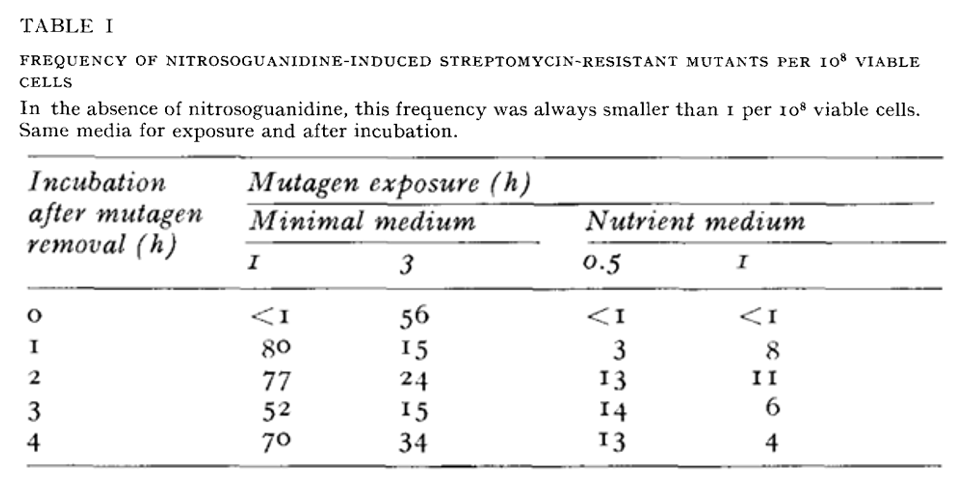
what conditions would you use to geneate the temperature sensitive mutant(s)?
we wnat to produce the highest number of mutants possible so incubating for 1 hour in minimal medium (1hr exposure) will produce the most
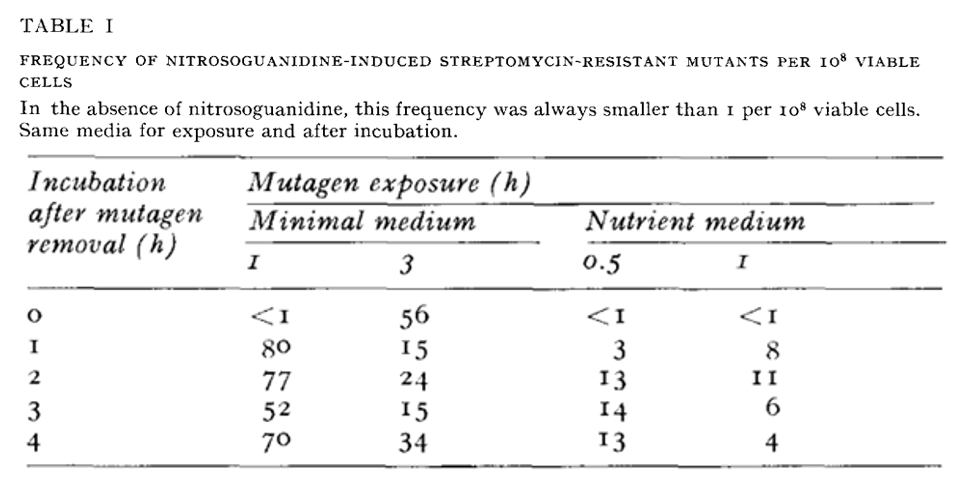
how many plates would you need to screen to identify 10 temperature sensitive mutants?
if 1 plate takes 5 mins to patch 100 colonies, how long would you need to idenitfy 10 temperature sensitive mutants? how many years is this?
if 108 cells would generate 80 mutants, then you need to screen 108/80 = 12500000 cells to identify 1 mutant
therefore to get 10, you need to screen at least 12500000 colonies
12500000/100 = 125000 plates
125000 × 5 mins = 625000 mins
625000/ 60/ 24/ 365 = 1.2 years

which temperature sensitive mutants are not worth pursuing?
83 and 86, because they have a lot of colonies when grown at 42°C
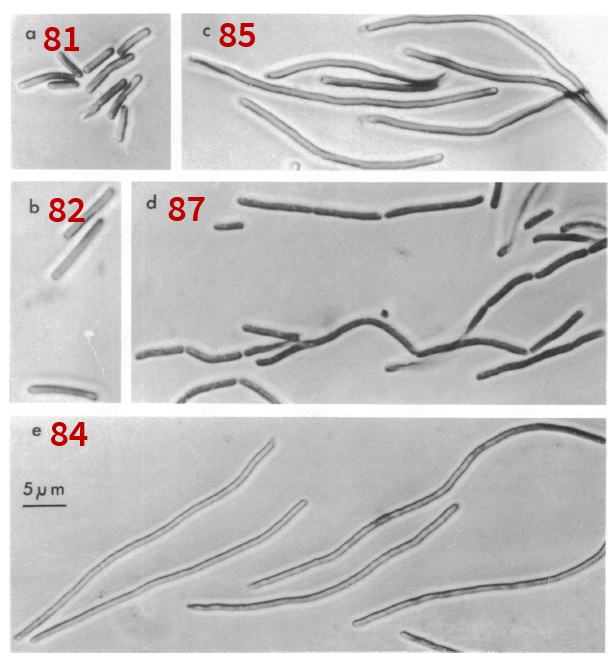
based on this microscopy data, which Ts mutant(s) are not worth pursuing? (the cells are grown at 42°C)
81 and 82 (and maybe 87) because they are not long enough
how do you know when to stop screening?
when you find something new or exciting
why are hit validation important?
To confirm that initial screening "hits" are genuine, reproducible, and not false positives or experimental artifacts
complementation (as a hit validation method)
a method for determining whether a phenotype is associated with a particular genotype or gene
explain some of the characteristics of the λ phage genome
AttP: where the circularised genome integrates into E.coli
B region: unimportant for growth so we can cut it out and insert our genes of interest
J region: where you need to stop (reading frame)
what would you expect the results (under 42°C) of the mutant cell that has not undergone complementation?
the cells would produce long filaments because it cannot split itself
what would you expect the results (under 42°C) of the mutant cell that has undergone complementation?
the cells will divide like normal because the functional gene has been restored

which strain contains ftsA temperature sensitive mutations?
#87 because When transduced 16-1 (which carries the mutant ftsA(ts) allele), the cell division defect is not rescued, so the cells continue to form long filaments.
When transduced with 16-2 (which carries the wild-type ftsA allele), the wild-type gene complements the mutation, restoring normal cell division and resulting in normal-sized cells.
what is the the difference in strain 84?
strain 84 contains a mutation in an unknown and undiscovered gene

explain what is happening in the graph
both cell mass and cell count increase at a steady rate at 28°C
when shifted to 42°C, the sell mass keeps rising because the cells are continuing to grow in lenngth and accumulate cellular material. however the cell count planteaus because cell division stops
when shifted back to 28°C, the accumulated cell mass divides rapidly, causing a vertical jump in the cell count until it catched back up to the mass curve
how did people used to map bacterial genomes and how was did it come about?
by starting at the 0 minute position
all gene mapping was done via conjugation. Bacterial cells can give information via an F plasmid which would break its dsDNA and feed it through a pilus into the recipient cell. They would feed the DNA through at the 0 minute position
how do you stop bacterial conjugation?
throw them in a blender to break the pili

where would the new fts gene be found on the E.coli genome?
between leu+ and nadC+
how can we identify where the new gene is in the phage?
the phage is treated with HindIII and EcoRI and ligated back together. this removed part of the E.coli gDNA insert
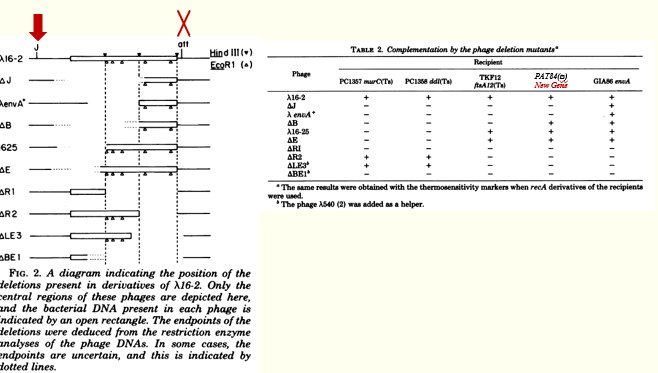
using the digestion and complementation information, identify the order of the genes in the 16-2 phage?
murC ddl - ftsA - new gene - envA
nowadays, instead of identifying a genotype, what step comes next after hit validation?
identifying gene function
what are the function of PBPs?
they are enzymes that bacteria use to build and maintain a peptidoglycan wall
what are the function of LpoA and LpoB?
these are embedded into the outer cell membrane and tightly regulate when the PBPs build the cell wall
what PBPs are in E.coli?
PBP1A and PBP1B
what PBPs are in S.pneumoniae?
PBP1A and PBP2A
why does S.pneumoniae not have LpoA/LpoB?
S.pneumoniae is a gram-positive bacteria so it does not have an outer cell membrane for the LpoA to attach to
what was the assumption that scientists made about the S.pneumoniae’s PBPs?
because they do not have LpoAs, then there must be other regulatory factors contributing to the regulation of PBPs
synthetic lethality
in order for the cell to grow, only one of the PBPs need to be intact otherwise the cell will die
by mutating PBP1A in S.pneumoniae…
the gene that allows PBP2A to function will become essential
if gene A becomes inactive…
gene B and any other genes that are required for the function of gene B become essential
transposons
a segment of DNA that can insert itself into different locations on the genome
what happens if the transposon inserts itself in an open-reading frame?
it disrupts the gene, the resulting protein will become truncated and non-functional
how does transposon mutagenesis work?
via gene disruption which is predicted to inactivate the gene it jumps into
how is TNseq done?
Transposons are randomly introduced into a bacterial population to create a saturated mutant library (bacteria with insertions in essential genes die and drop out).
The mutant pool is grown under a condition of interest.
DNA is extracted from the surviving mutants, and the transposon-genome junctions are amplified and read using next-generation sequencing.
Reads are mapped onto a reference genome to see which genes tolerate insertions (non-essential) and which lack them (essential)
what do the gaps in TNseq mean?
0 transposons were inserted into gene, meaning the cell died, hence that gene is essential for bacterial survival
how big do you need your TNseq transposon library to be if the S.pneumoniae genome size is 2,046,115 bp and the number of genes is 2069?
roughly 200,000 members (1 transposon per 10bp)
how many transposon members are required depending on the size of the genome?
you want to fully saturate the genome with as many transposons as possible
how do scientists mathematically prove that the gap is an important requirement for life and not just a fluke?
run TNseq on a wild-type and then on a mutant strain (i.e. the one that lacks PBP1A)
calculate the read count ratio
try to find a gene that has a read count ratio >10
remove culture bia via a man Whitney U test
perform a P-value
read count ratio =
number of insertions in the wild-type/ number of insertions in the mutant
what does a read count ratio >10 mean (p-value =<0.05)
there were more transposon insertions in the wild-type than in the mutant for that gene indicating that the gene may play a role in an essential function or survival
why is a Mann whitney U test used in TNseq?
assesses whether there are significant differences in the distribution of read counts between wild-type and mutant strains, helping to account for culture bias.
the test is less sensitive to outliers and can handle non-normally distributed data, making it suitable for read count analysis.
what is a p-value?
a probability that the null hypothesis is true
If the # genes in the S.pneumoniae genome = 2069, How many genes do we reasonably know are false positives using a p-value < 0.05?
103 (2069 × 0.05)
what is the number of experiments you should run if the predicted number of false positives are 103?
104
why should a stricter p-value be applied?
to make the size of the experiments smaller (so instead of 103 false positives with a p-value < 0.05, it will be 10.3 false positives with a p-value <0.005)
what does a volano plot show?
the log change in gene expression against the p-value
inverse volcano plot
y-axis = 1/p-value
how can you tell when the results are significant on an inverse volcano plot?
higher on the y-axis idicates stronger statistical evidence
farther from 0 indicates larger effect sizes
if there are 0 insertions in the mutant, what happens to the read-count?
an error occurs
how did scientists turn genes on and off at a transcriptional level to verify the syntehtic lethality (hit validation)
zinc was used to bind to the repressor on the promoter, allowing RNAP to bind so PBP1A can be transcribed

given the microscopy quantification data - what is the genetic relationship between SPD_0876, pbp1a and pbp2a?
SPD_0876 is not required for PBP1A function but is required for PBP2A function