astronomy week 3: astronomical instruments and analyzing starlight
 Call Kai
 Learn
 Practice Test
 Spaced Repetition
 Match
 Flashcards
 Knowt Play
1/25

Earn XP
Description and Tags
activies 3.1, 3.2, 3.3, and homework 3
26 Terms

Stars in the constellation are identified by Greek letters. Some of those stars are individual; others are binary or multiple star systems.
Alpha and beta Herculis have identical magnitudes of 2.78.
alpha Herculis is 254 light years from Earth.
beta Herculis is 105 light years from Earth.
Which star must be more luminous?
Alpha

Here are the exact apparent magnitudes of some of these stars. Rank them from brightest to dimmest.
tau Herculis, 3.91: [?]
pi Herculis, 3.16: in [?]
zeta Herculis, 2.81: [?]
Tau: dimmest, pi: in between, zeta: brightest

Rank the three stars tau, alpha, and pi in order of their luminosity, from highest to lowest.
Highest Luminosity: [?]
Middle Luminosity: [?]
Lowest Luminosity: [?]
Highest: alpha, middle: pi, lowest: tau

Rank the three stars tau, epsilon, and theta in order of their luminosity, from highest to lowest.
Highest Luminosity: [?]
Middle Luminosity: [?]
Lowest Luminosity: [?]
Highest: theta, middle: tau. lowest, epsilon
Star X is a star like our Sun, which has a low-density gaseous atmosphere surrounding a hot, dense core.
Star Y consists only of a hot, dense core, without a cool atmosphere surrounding it.
Which type of spectrum would you expect to see if you look at the light from Star X?
Which type of spectrum would you expect to see if you look at the light from Star Y?
Absorption, continuous
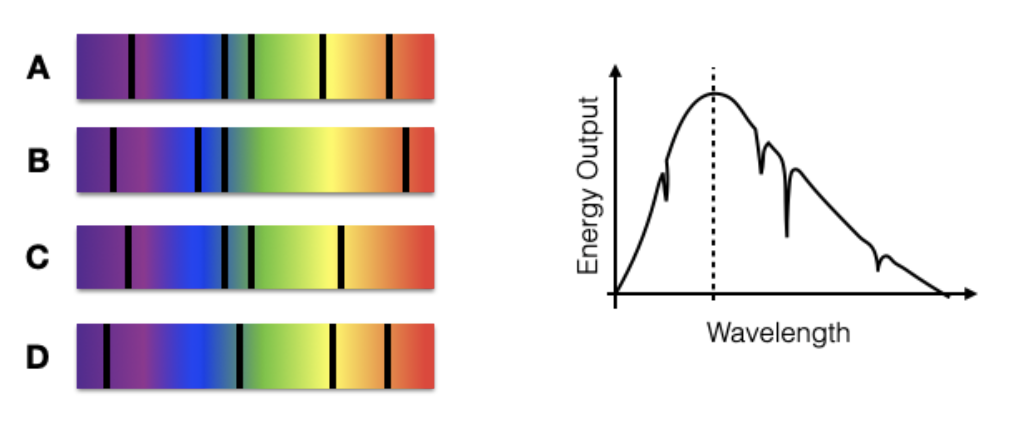
Which of these absorption spectrum could match the blackbody curve shown?
C
Why is an absorption spectrum especially useful for astronomers?
It has dark lines in it that allow astronomers to determine what elements are in the star's atmosphere
Astronomers arrange the stars into groups called spectral classes (or types) according to the kinds of lines they find in their spectra. These spectral classes (O, B, A, F, G, K, and M) are arranged in order of:
Decreasing surface temperature
How were those categories (OBAFGKM) originally developed?
By the location of spectral lines
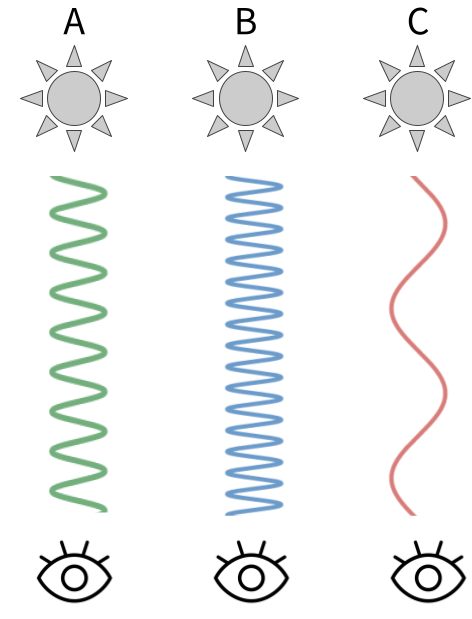
Suppose the source in Situation A is at rest with respect to the observer.
The frequency seen by an observer will look a little higher if a source of light and an observer are moving [toward or away from] each other, causing the observed wavelength to appear shorter. The observer would see a [blueshift or redshift] This is illustrated by situation [?].
Toward, blueshift, B
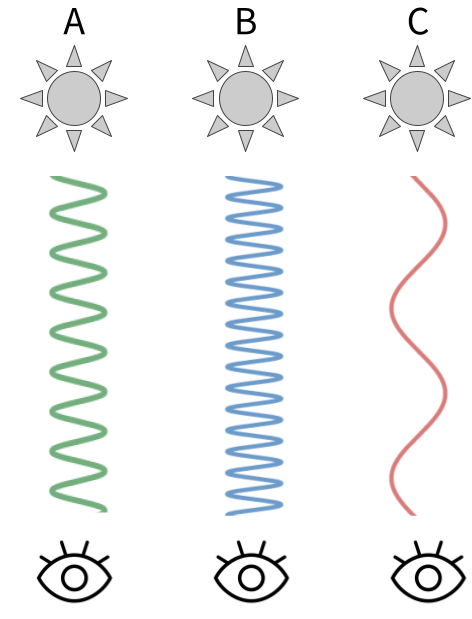
Suppose the source in Situation A is at rest with respect to the observer.
The frequency seen by an observer will look a little lower if a source of light and an observer are moving [toward or away from] each other, causing the observed wavelength to appear longer. The observer would see a [blueshift or redshift]. This is illustrated by situation [?].
Away from, redshift, C
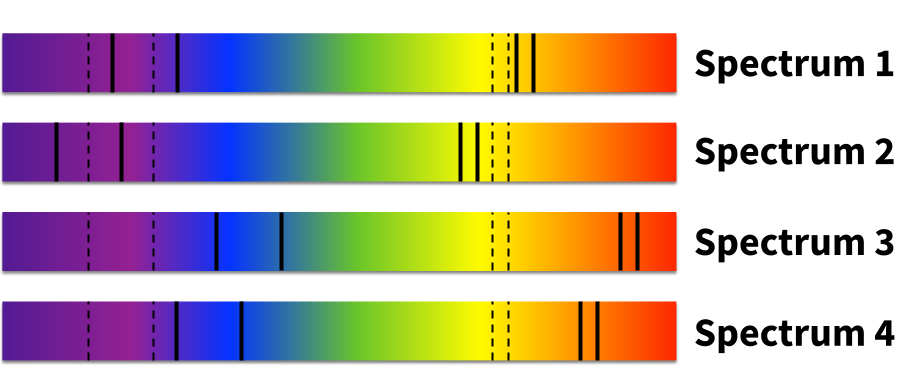
Which of the absorption spectra demonstrate a redshift?
Spectrum 1, 3, and 4
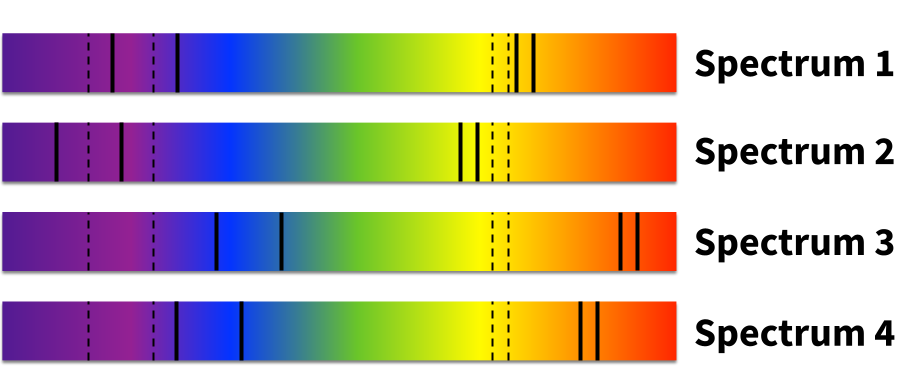
Which spectrum comes from the source moving the fastest?
Spectrum 3

Consider just Spectrum 2. Is the source of that spectrum moving toward us, or away from us?
Toward us
Rank their rotation speed from fastest to slowest.
Fastest rotation
Second-fastest rotation
Second-slowest rotation
Slowest rotation
Star D, Star A, Star B, Star C
To measure the speed of a star through space, we need to measure its [radial velocity or transverse velocity], its motion toward or away from us, using [its blackbody curve, its Doppler Shift, its magnitude, or a speedometer]. Then, we also need to measure its [transverse velocity, or radial velocity], which is the component of its motion across the sky.
Radial velocity, it’s Doppler shift, it’s transverse velocity
Two stars have the same luminosity, but star B is three times farther away from us than star A. Compared to star A, star B will look [?]
Nine times fainter

Rank the brightness of the stars (A – E) from brightest to dimmest.
Brightest
Next brightest
In the middle
Almost dimmest
Dimmest
Star A, Star D, Star C, Star E, Star B
Select which apparent magnitudes could match each star.
-1
0
+1
+2
+3
Star A, Star D, Star C, Star E, Star B
Which star is farthest from Earth?
Cannot be determined with this information

Spectra [? and ?] show different stars seen through the same cloud of gas.
Spectra [? and ?] show the same star seen through different clouds of gas.
A and B, B and C
If an object is moving towards you and releasing light, the light appears to have a [?] wavelength than if the object were at rest and releasing light.
Shorter
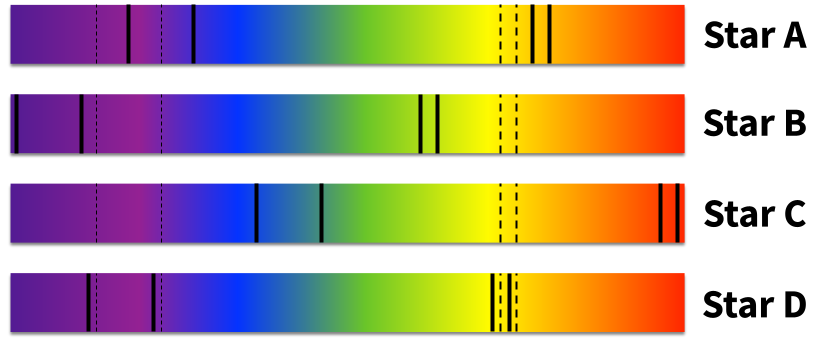
Moving away from Earth the fastest:
Moving toward Earth the fastest:
Moving the slowest (regardless of direction):
Star C, Star, B, Star D

Suppose Star B is at rest. In that case, what must be true of stars A and C?
Star A must be rotating [faster or slower] than Star B, and it is moving [away from or toward] Earth.
Star C must be rotating [faster or slower] than Star B, and it is moving [away from or toward] Earth.
Slower and toward, faster and toward
Consider a star at a known distance. To figure out the spatial velocity of that star, what measurements would be needed?
Doppler shift of spectral lines and the celestial sphere location at different times