M5 Wilson- Communities/Ecosystems I: Coevolution and competition
 Call Kai
 Learn
 Practice Test
 Spaced Repetition
 Match
 Flashcards
 Knowt Play
1/3

There's no tags or description
Looks like no tags are added yet.
4 Terms
what is the red queen analogy?
the red queen analogy (from alice in wonderland) is used to refer to systems where continual effort does not move you forward; it requires this effort merely to stay in the same place
this has been used to describe evolution under variable biotic conditions, and particularly coevolution
the biotic environment is continuously deteriorating due to natural enemies becoming better adapted, so every organism is forced to acquire better adaptations to keep up (or else die)
eg. mollusc shells evolved perpetually greater thickening and narrower apertures → this can be superimposed onto the emergence of shell-crushing sharks from the fossil record in this period→ consistent evolution of defensive traits and countermeasures
older taxa are not better at adapting to the environment than younger taxa are; they always have a constant probability of extinction because the environment is constantly changing
the alternative ‘court jester’ hypothesis describes the abiotic conditions, where the universe is arbitrarily and constantly changing conditions to make a mess of the existing systems
what is coevolution?

how do the different species interactions result in coevolution?
predator-prey:
most predator-prey interactions are non-specific and generalist, acting on a community (eg. marine food webs, broad-spectrum herbivory defenses), rather than in an isolated species pair
this leads to diffuse coevolution, since there are no tight relationships, so evolution tends toward generalism
competition:
competition leads to trait divergence/niche partitioning by coevolution
eg. beech-tree bacteria in monoculture adapt to use the same resources, whereas in polyculture (under competition) they each adapt to the complementary partitioning of different resources
this increases overall ecosystem productivity (eg. since more carbon sources can be used)
mutualism:
mutualism is the result of pairwise coevolution of two species to benefit each other
eg. Buchnera aphid obligate endosymbiont produces amino acids for the aphid and recieves nutrients in return → because of strict vertical transmission they have evolved together tightly
however there is a continuum to parasitism, which becomes most evident when transmission isn’t strictly vertical and is more horizontal, eg. in Wolbachia, which has less host fidelity and so is less mutualistic (distorts the sex ratio)
parasite/pathogen-host:
parasites and pathogens impose strong selective pressure/fitness costs on their host (to evolve immunity) and are under strong selection themselves (to infect them) → leading to coevolution
this coevolution speeds up molecular evolution
what are the two genetic models of coevolution?
escalating dynamics (arms race):
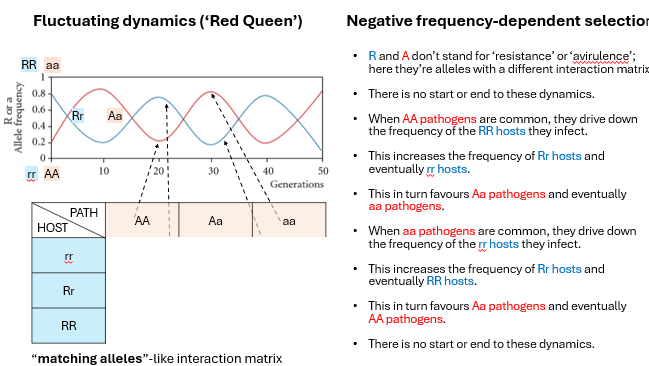
fluctuating dynamics (red queen):