Bio 109 Unit 2 Study Guide vocab
 Call Kai
 Learn
Learn Practice Test
 Spaced Repetition
 Match
Match Flashcards
 Knowt Play
1/251

There's no tags or description
Looks like no tags are added yet.
Name | Mastery | Learn | Test | Matching | Spaced | Call with Kai | Chat |
|---|
No analytics yet
Send a link to your students to track their progress
252 Terms
Gametophyte:
Main structure of the haploid stage
Sporophyte:
Main structure of the diploid stage
Tissue:
A group of cells with a common function, structure, or both
Organ:
Several types of tissues that together carry out particular functions
Epidermis:
Single tissue layer on the outside of a plant
Cuticle:
Waxy coating on epidermal surface of leaves and most stems
Periderm:
A protective tissue that replaces the epidermis in older regions of stems
Stele:
All vascular tissue of a stem or a root
Apical meristem:
-A bunch of cells that form a node at the top of the terminal bud
-A localized region at a growing tip of a plant body where one or more cells divide repeatedly. The dividing cells of an apical meristem enable the plant to grow in length.
-Permanently embryonic tissue that is developing new cells constantly
Lateral meristem:
A meristem that thickens the roots and shoots of woody plants. The vascular cambium and cork cambium are lateral meristems.
Sieve tube:
A living cell that conducts sugars and other organic nutrients in the phloem of angiosperms; also called a sieve-tube member. Connected end to end, they form sieve tubes
Companion cell:
A type of plant cell that is connected to a sieve-tube element by many plasmodesmata and whose nucleus and ribosomes may serve one or more adjacent sieve-tube elements.
Tracheid:
A long, tapered water-conducting cell found in the xylem of nearly all vascular plants. Functioning tracheids are no longer living.
Vessel element:
A short, wide water-conducting cell found in the xylem of most angiosperms and a few nonflowering vascular plants. Dead at maturity, vessel elements are aligned end to end to form micropipes called vessels.
What is meant by the term "alternation of generations"?
Alternation of generations, also called metagenesis or heterogenesis, in biology, the alternation of a sexual phase and an asexual phase in the life cycle of an organism. The two phases, or generations, are often morphologically, and sometimes chromosomally, distinct.
What is an angiosperm?
Angiosperms are plants that produce flowers and bear their seeds in fruits. genosperms
What is a root?
A root anchors the plant to the soil, absorbs minerals and water, may also store carbohydrates
What is the difference between a tap root and a fibrous root system?
Taproot: One main root with secondary roots
Fibrous: a bunch of roots with equal importance
What is the function of root hairs?
Root hairs increase the surface area of the roots and take up the water and minerals for the plant
What is an apical bud? axillary bud?
Apical bud: Where growth (elongation) is concentrated; sound at the shoot tip
Axillary Bud: Can form a lateral shoot (branch); found in the upper angle (axil) formed by each leaf and stem
What is meant by the term "apical dominance"?
Apical dominance is the inhibition of axillary buds by an apical bud
Simple Leaves:
Has one blade
Compound Leaves:
A single leaf is made of multiple leaflets
Doubly Compound Leaves:
Each leaflet is itself made out of leaflets
What are the three tissue types that comprise a plant?
Dermal Tissue System: Plants' outer protective covering
Vascular Tissue System: Moves things around in the plant Ground Tissue System: Everything else in the plant
What is the function of xylem?
Xylem: Move water and minerals that are dissolved in the water that have been absorbed by the roots to the upper part of the plant.
What is the function of phloem?
Phloem: Takes the sugars that have been made by photosynthesis to the roots of the roots and the places of the plant that are growing such as new leaves.
How are xylem and phloem similar and different?
Similar: Both transport things throughout the plant
Difference: Xylem moves things up and the Phloem moves things down
What is meant by the term "indeterminate growth"?
Can continue to grow throughout their whole life
What are the three zones of cells in which root growth occurs? Which zone is primarily responsible for pushing the root tip through the soil?
Zone of cell division: New cells being formed
Zone of elongation: Shoots through the soil
The primary zone responsible for pushing the root tip through the soil is the zone of maturation
Zone of maturation: Cells fully developed
What are the functions of the root cap?
Protects the meristems as the root is pushing through the soil
What is the function of the leaf stomata?
Allows carbon dioxide to go back and forth in the air and the photosynthetic cells
What is secondary growth and what tissue(s) is (are) responsible for its production?
Plants increase in diameter and gets wider around
The tissues responsible are the vascular cambium and the cork cambium
Explain how cell division and enlargement contribute to plant formation.
The cells divide and this takes up more area which in turn contributes to the enlargement of plants and their formation
Cells taking up water and enlarging. The central vacuole.
The plane in which a plant cell divides is determined during which stage of mitosis?
Late Interphase
Explain how the orientation of cellulose microfibrils in a plant wall can control the direction of cell expansion.
Expansion is always perpendicular to cellulose mirofibrils.
They are tough and do not stretch and if they are wrapped around the microfibrils it will force the plant to grow perpendicular
In what significant way do plant developmental phases differ from those observed with animals?
a. Plant cells do not migrate, as do bacteria or animal cells. Plant shape forms based on the rate of cell division and the direction of elongation. Although plants develop three basic tissue systems (dermal, ground, and vascular), they don't rely on gastrulation to establish this layered system of tissues.Plant development is continuous. New plant organs are formed throughout their life by clusters of embryonic cells called meristem.Plants have tremendous developmental plasticity. Lost plant parts can be regenerated by meristems, and even entire plants can be regenerated from single cells. In addition, environmental factors such as light and temperature can greatly influence overall plant form.
b. Plants show indeterminate growth. Animals developmentment changes occur for the whole animal
c. The plant develops based off the meristems
What are organ identity genes? How does the ABC model of flower formation explain the formation of the four types of floral organs?
a. Organ identity gens are genes that are responsible for specific parts of a plant such as the sepals, petals, stamens, and carpels
b. The ABC model describes how 3 genes interact to form the structure of a flower. When only A is activated the structure will become a sepal. When A and B are activated the structure will become a petal. When B + C are activated the structure will become a stamen and when only C is active the structure will become a carpel
Cotransport:
A transport protein that couples the passage of one solute to the passage of another. Lets multiple substances through. Can use diffusion of one substance to diffuse a different substance
Osmosis:
The net movement of water across a cell membrane. Net movement is from low concentration to high concentration
Solute potential:
osmotic potential pressure which needs to be applied to a solution to prevent the inward flow of water across a semipermeable membrane
Pressure potential:
How much physical pressure a solution is under
Turgor:
The internal stiffness that helps maintain the stiffness of the entire plant when the pressure is positive
Aquaporin:
Aquaporins, also called water channels, are channel proteins from a larger family of major intrinsic proteins that form pores in the membrane of biological cells, mainly facilitating transport of water between cells.
Symplast:
The things inside the cell walls. Symplast is the protoplasts present in plants, which are interconnected by the plasmodesmata. It is the inner part plasma membrane, which plays a vital role in transporting or free movement of water and other low-molecular-weight solutes such as sugars, amino acids, and other ions in between cells.
Apoplast:
Made of the cell walls
Apoplast is the space outside the plasma membrane within which material can diffuse freely. It is interrupted by the Casparian strip in roots, by air spaces between plant cells and by the plant cuticle.
Bulk flow:
When there is movement of fluid in the xylem and phloem that is driven by pressure differences at the opposite ends of the xylem velles and sieve tubes
Transpiration:
The loss of water vapor from their leaves and above ground plants due to evaporation
Guttation:
The excess water that has been shoved out of the plants leaves because the roots forced more water than the leaves could handle up the plant. Guttation is the secretion of droplets of water from the pores of plants
Sugar sink:
An organ that produces less sugar than it needs
What are the three scales of transport in vascular plants?
Individual Cells: Water moving from the soil into the cell in the root hair
Short-Distanced Transport: Tissues and Organs
Long-distance transport: The roots all the way up to the top of the plant
What is passive diffusion?
Diffusion of a solute across a membrane down its electrochemical gradient. Solutes move freely and move from the higher concentration to lower concentration
No energy or ATP needed
What is Active transport?
Pumping a solute against its electrochemical gradient
Requires energy in the form of ATP
Low concentration to high
What is a proton pump? What forms of potential energy does it create that can be used to do cellular work?
a. Proton pump: Use energy to move something in the opposite direction of diffusion. A protein Sits in the cell membrane and transfers protons from low concentration to area of high concentration
b. Protons have a positive charge and if they accumulate it makes the one side more positive and one side is more negative and that difference is used to do work
How can this energy be used for the active transport of different solutes like ions and sucrose?
a. This energy can be used to transport solutes like ions and sucrose because the proton pump can drive the ions and solutes into the cell due to this membrane potential
b. The "coattail" effect is responsible for the uptake of neutral solutes
Define the term "water potential"
The effects of solution concentration and the physical pressure of the cell wall
How does water potential determine the direction of water movement?
The water will move from low solute concentration to higher solute concentration. It will flow from higher water potential to lower water potential
Be able to use the water potential equation for determining the movement of water in a defined system, i.e. between a plant cell and its aqueous environment
a. y = ys + yp
b. y (psi) is measured in units of pressure called megapascals (MPa)
c. As you add solutes the ys becomes negative

What are the three major pathways of transport between plant cells?
Transmembrane route: Can go through both cell walls and cytoplasm
Symplastic route: Only goes through cytoplasm
Apoplastic route: Only goes through the cell walls
What is the function of the Casparian strip?
Part of the endodermis that blocks the apoplastic pathway so that the cell has some control of what goes in and out of the cell membrane. This gives the cell the chance to block harmful material from entering it
Endodermal wall
What process exerts the pulling force on water in the xylem of a plant that ultimately pulls water into the leaf?
Transpiration produces negative pressure (tension) in the leave and this pulls water in the xylem
Transpirational pull is facilitated by cohesion and adhesion of water molecules
What properties of water make the movement of the xylem sap against gravity possible?
Cohesion: Molecules stick to each other
Adhesion: Molecules stick to a surface
What are stomata? What is the mechanism responsible for their opening and closing?
a. The little pores in a leaf or stem of a plant that allows the movement of gasses in and out of the cellular spaces.
i. Regulate the rate of transpiration
b. The structure that opens and closes the stomata are the guard cells
i. The mechanism is the protons (H+) are pushed out of the guard cells
ii. The voltage-gated channels open and a lot of potassium (K+) enters the cell
iii. Water is then drawn in through osmosis and opens the stoma
What are the stimuli for stomatal opening and closing?
a. Light stimulates the guard cells to accumulate K+ and become turgid
b. Depletion of CO2 within a leaf's air spaces
c. The internal "clock" in the guard cells
i. Closing: Potassium out of the stomata
What is the effect of water deficiency on stomata?
Abscisic acid (plant hormone) made in the roots and leaves in response to water deficiency signals the guard cells to close
How does xylem sap differ from phloem sap?
Phloem sap moves sugar from sugar saps to sugar sinks...Positive pressure difference
Aqueous solution that is mostly sucrose
Xylem sap is a negative pressure difference in bulk flow, by pulling along the column
Why does sucrose uptake into the phloem at the leaves usually require active transport?
Sucrose concentration is very high inside the sieve tube member compared to the outside
Plants use ATP to transport sucrose against its concentration gradient
How does sap flow through a sieve tube element differ from that of sap flow through a tracheid or vessel element?
a. Xylem sap is in tracheids/vessel elements: Pulled by negative pressure exerted by transpiration occurring in the leaves. Moves in one direction roots to the shoots
b. Phloem: Under pressure and it is made at sights of sugar production so the sucrose concentration is high which pulls water from the xylem into the phloem
i. Sieve tubes are used for phloemTracheids and vessels are used for xylem(need more
ii. Can go in multiple directions
c. Sieve tube elements are living
d. Tracheid
Complete flower:
Have all 4 types of floral organs
Incomplete flower:
Lack one or more of the floral organs
Inflorescence:
Clusters of small flowers. Flowers in the middle produce seeds and the outside flowers have very large petals
EX: Sunflower
Micropyle:
A pore in the integuments of an ovule
Integument:
Layer of sporophyte tissue that contributes to the structure of an ovule of a seed plant
What is the dominant generation in an angiosperm?
The Sporophyte is the dominant generation. It is larger, more conspicuous, and longer lived than the gametophyte
Draw a flower and label all its parts.

Draw a diagram outlining the development of a male gametophyte.
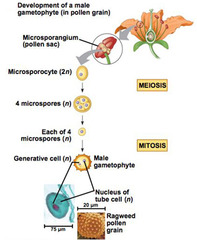
What cell types are present in the mature pollen grain?
Generative cell
Tube cell
What is a pollen tube? What cell does it develop from and what is its function?
On the receptive surface of the stigma, the tube produces this. As the tube elongates the generative cell divides and produces 2 sperm cells which remains inside the tube cell
Draw a diagram outlining the development of a female gametophyte.

What process is responsible for converting the microsporocyte to a microspore?
Meiosis
What is the primary difference between a microsporocyte and a microspore?
Within the microsporangia are many diploid cells called microsporocytes each microspotocyte undergoes meiosis forming four haploid microspores each of which eventually give rise to a haploid gametophyte
Microsporocyte = 2 nucleui, diploid ...
Microspores = 1 Nucleui, haploid
What process is responsible for converting the megasporocyte to a megaspore?
Meiosis
What is the primary difference between a megasporocyte and a megaspore?
Megasporocyte = 2 nucleui, diploid
Megaspore = 1 Nucleui, haploid
How many mitotic divisions are required for conversion of the megaspore to the female gametophyte?
3 rounds of mitosis produce 4 cells but only 1 survives
How many mitotic divisions are required to convert the microspore to the male gametophyte?
1 round of mitosis
What are the functions of the Generative Cell:
Produces sperm cell, or male gametes
What are the functions of the Tube Cell:
Produces the pollen tube
What are the functions of the Egg Cell:
The female reproductive cell
What are the functions of the Antipodal Cells:
3 (sometimes more) cells of mature embryo sac; located in at the end opposite of the micropyle
What are the functions of the Polar Cells:
2 nuclei in the center of the egg sac that become the triploid endosperm when joined with a sperm during double fertalization
What are the functions of the Synergids:
2 haploid cells that surround the egg cell; entered by the sperm and broken down so that the sperm may reach the egg cell
What is meant by the term double fertilization? What does double fertilization ensure?
One sperm is needed to fertilize the egg and the second sperm is needed to fertilize the polar nuclei ///2 sperm enter the ovary through the pollen tube. One fertilizes the egg and becomes a diploid zygote. The second combines with the 2 haploid polar nuclei and becomes a triploid nucleus. This becomes the endosperm that will surround and nourish the egg ... Ensures the endosperm will develop in ovules where the egg has been fertilized
What part of the female gametophyte gives rise to the endosperm? The fruit?
The combination of a sperm and polar nuclei which created a triploid cell that developes into an endosperm
The ovary develops into a fruit enclosing the seed
What is the function of fruit?
Protects the seed inside and aids in seed dispersal or it can help the seed get carried by the wind
What are the advantages and disadvantages of asexual versus sexual reproduction?
a. Advantages:
i. No need for a pollinator
ii. Plant can pass on all its genetic legacy intact
iii. Clones not as fragile as seedlings produced by sexual reproduction
iv. Hardy offspring
b. Disadvantages:
i. Variation in offspring that enables reproductive success in an unstable environment
ii. Seeds, which are almost produces sexually facilitate dispersal
iii. Limited Variation
iv. Limited Dispersal
What are the mechanisms utilized by plants to discourage self-fertilization?
a. Some plants are dioecious (male and female flowers)
b. Stamen or carpels mature at different times
c. Self-incompatibility: The plant can reject its own pollen
d. Structurally arranged to prevent pollen transfer by a pollinator from another to stigma in the same flower
Etiolation:
A process in which flowering plants grow in partial or complete absence of light
Plants growing in the dark do not turn green and they do not form leaves because they are not needed.
De-etiolation:
After being exposed to light the shoots and stems from green
Hormone:
Plant growth regulator
Plant growth factor:
Hormones?