Exam 2
 Call Kai
 Learn
Learn Practice Test
 Spaced Repetition
 Match
Match Flashcards
 Knowt Play
1/201

Earn XP
Description and Tags
NUR 240
Name | Mastery | Learn | Test | Matching | Spaced | Call with Kai | Chat |
|---|
No analytics yet
Send a link to your students to track their progress
202 Terms
Traditional Knowledge
Passed down from generation to generation
Authoritative Knowledge
Comes from an expert, accepted as truth based on person’s perceived expertise
Secientific knowledge
Obtained through the scientific method (research)
Nightingale influences
Demonstrating efficient and knowledgeable care
Defining nursing practice as separate and distinct
Differentiating between health and illness nursing
Societal Influences
Shift to planned educational curriculum
Women entering the workforce due to war
Shift of nursing to a science
Theory
group of concepts that describe a pattern of reality
can be tested, changed, or used to uide research
Concepts
Abstract impressions organized into symbols of reality; describe objectives, properties, and events and relationships among them
conceptual framework or model a group of concepts that follow an understandable pattern
Nursing theory
developed to describe nursing and differentiates it fro other disciplines and activities
Deductive reasonsing
examines general ideas and considers specific actions or ideas
Inductive reasoning
Builds from specific ideas or actions to conclusions about general ideas
Goals of theoretical frameworks
Holistic patient care
Individualized care to meet needs of patients
Promotion of health
Prevention or treatment of illness
Scientific inquiry
process that. uses observable and verifiable information (data), collected in a systemmic manner, to describe, explain, or predict events
Reasearch
conducted to validate and refine current knowledge or to develop new knowlege
Goals of research
Develop explanations (in theories)
Find solutions to problems
Qualities of a Community-based Nurse
Knowledgeable and skilled
Independent in making decisions
Roles of a Community-Based Nurse
Patient advocate
Coordinator of services
Patient and family educator
Continuity of Care
Ensures smooth transition between ambulatory or acute care and home health care or other types of health care in community settings
Care transitions
a continuous process in which a patient’s care shifts from being provided in one setting of care to another
Aim of Care coorination
link patients when resources in the community to enhance their well-being
improve information exchange
Reduced fragmentation and duplication of services
Nurse navigator
Identified and removed barriers to treatment
Clinically trained nurse
Central point of contact for patient care
Patient navigator
nurse, social worker, or lay person
Focuses on the support aspects of care
Vulnerable Populations
people with disabilities or multiple chronic conditions
Leaving AMA
Patient is legally free to leave
Choice carries a risk for increased illness or complications
Patient must sign a release form
Patient is informed of risks prior to signing form
Patient’s signature must be witness
Form becomes part of medical record
Critical thinking
Knowing how to focus your thinking to get the results you need (includes applying logic, intuition, standards, and evidence-based practice)
Critical reasoning
Throught processes that allow healthcare providers to arrive at a conclusion
Clinical judgement
The result of critical thinking
the skill of recognizing cues regarding a clinical situation, generating and weighting hypotheses, taking action, and evaluating outcomes for the purpose of arriving at the satisfactory clinical outcome
Situational awareness
the perception of the elements in the environment in a volume of time and space, the comprehension of their meaning and the projection of their status in the near future
Nursing Process
Mental Model - Assessment - Diagnosing/Identifying actual or potential problems - Planning - Identifying interventions and rationales - Evaluation
Reticular activating system (RAS)
Facilitates reflex and voluntary
Controls cortical activities relate to state of alertness
Hypothalamus
control center for sleeping and waking
Non-rapid eye movment (NREM) Stages I and II
5% to 50% of sleep, light sleep
Non-rapid eye movement (NREM)
10% of sleep, deep-sleep states (delta sleep)
Rapid eye movement (REM)
20% to 25% of a person’s nightly sleep time; pulse, respiratory rate, blood pressure, metabolic rate, and body temperature increase; skeletal muscle tone and deep tendon reflexes are depressed
insomnia
difficulty falling asleep, intermittent sleep, or difficulty maintaining sleep
Central disorders of hypersomnolence
constant or recurrent episodes of extreme sleepiness, particularly during the day
Circadian rhythm sleep-wake disorders
disruptions in the natural sleep-wake cycle, often resulting in insomnia or excessive sleepiness, due to misalignment between the internal clock and external environment, i.e. working night shift, jet lag
Parasomnias
Nightmares, sleep-walking
Idiopathic hypersomnia
characterized by excessive sleep, particularly during the day
Narcolepsy
Characterized by excessive daytime sleepiness and frequent overwhelming urges to sleep or inadvertent daytime lapses into sleep
up to 70% of people with narcolepsy also experience cataplexy, the sudden, involuntary loss of skeletal muscle tone lasting from seconds to one or two minutes
Restess leg syndrome (RLS) or Willis-Ekbom disease (WED)
sleep-related movement disorder that affects up to 15% of the population, most often middle-aged and older adults
Pharmacologic Therapy for Dyssomnias
Sedatives or Hypnotics
Nonpharmacologic Therapy for Dyssomnias
Cognitive behavioral therapy (CBT)
Cognitive Behavioral Therapy (CBT)
Progressive muscle relaxation measures
Stimulus control
Sleep restriction; sleep hygiene measures
Biofeedback and relaxation therapy
Epidermis
Protective waterproof layer of keratin
Cells have no blood vessels of their own
Regenerates easily and quickly
Dermis
Elastic tissue made primarily of collagen
Nerves, hair follicles, gland, immune cells, and blood vessels
Subcutaneous
Anchors the skin layers to underlying tissues
Functions of the Skin
Protection, Body temperature regulation, Psychosocial, Sensations, Vitamin D production, Immunologic, Absorption, Elimination
Causes of Skin Alterations
Fluid loss
Jaundice
Diseases of the skin
Very thin and very obese people are more susceptible
Types of Wounds
Intentional (Surgical) or unintentional (traumatic)
Neuropathic or vascular
Pressure related
Open or closed
Acute or cronic
Partial thickness, full thickness, complex
Avulsion

Amputation

Crush Injury

Puncture

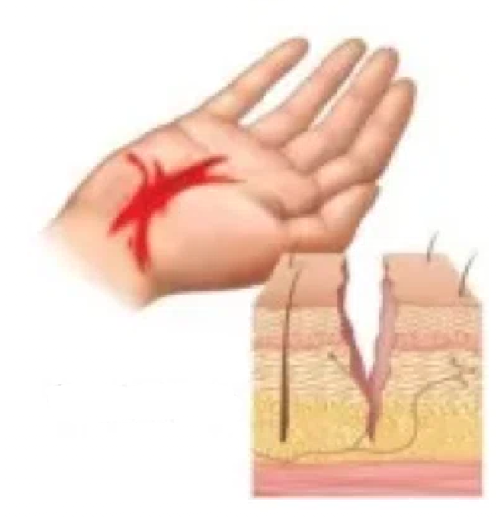
Laceration
Hemostasis
Occurs immediately after initial injury
Involved blood vessels constrict and blood clotting begins
Exudate is formed, causing swelling and pain
Increased perfusion results in heat and redness
Platelets stimulate other cells to migrate to the injury to participate in other phases of healing
Inflammatory stage
lasts 2 to 3 days
White blood cells, predominantly leukocytes and macrophages, move to the wound
Macrophages enter the wound area and remain for an extended period
Exudate is formed
the patient has a generalized body response
What do exudates cause to the body during the inflammatory phase?
cause pain, redness, and swelling at the site of injury
What do macrophages do during the inflammatory phase?
They ingest debris and release growth factors that attract fibroblasts to fill the wound
Proliferation Phase
Lasts for several weeks
New tissue is built to fill the wound space through the action of fibroblasts
Capillaries grow across the wound
A thin layer of epithelial cells forms across the wound
Granulation tissue forms a foundation for scar tissue development
Maturation Phase
Final stage of healing; begins about 3 weeks after the injury, possibly continuing for months or years
Collagen is remodeled
New collagen tissue is deposited, which compresses the blood vessels in the wound, causing a scar
Scar
flat, thin, white line; avascular collagen tissue that does not sweat, grow hair, or tan in sunlight
Local Factors Affecting Wound Healing
Pressure
Desiccation (dehydration)
Maceration (overhydration)
Trauma
Edema
Infection
Excessive bleeding
Necrosis (death of tissue)
Presence of biofilm (thick grouping of microorganisms)
Age
children and health adults heal more rapidly
Circulation and oxygenation
adequate blood flow is essential
Nutritional status
healing requires adequate nutrition
Wound etiology
Specific condition of the wound affects healing
Health status
corticosteroid drugs and postoperative radiation therapy delay healing
Systemic Factors Affecting Wound Healing
Age, Circulation and oxygenation, Nutritional status, Wound etiology, Health status, Immunosuppression, Medication use, and Adherence to treatment plan
Wound Complications
infection, Hemorrhage, Dehiscence and evisceration, and Fistula formation
Factors Affecting Pressure Injury Development
Aging skin, Chronic illness, Immobility, Malnutrition, Fecal and urinary incontinence, Altered level of consciousness, spinal cord and brain injuries, and Neuromuscular disorders
Microclimate
Temperature and moisture of the skin
Mechanisms in Pressure Injury Development
External pressure compressing blood vessels, friction or shearing forces tearing or injuring blood vessels, microclimate
Risks for pressure injury development
nutrition and hydration, immobility, mental status, and age
Psychological Effects of Wounds
Pain, Anxiety, Fear, Impact on activities of daily living, change in body image
When do you do a skin assessment on a patient in an acute care setting?
Every shift
When do you do a skin assessment on a patient in a long-term setting?
weekly for 4 weeks then quarterly
When do you do a skin assessment on a patient in a home health care setting?
every visit
Wound assessment
Assess for appearance and drainageas well as size, depth, and surrounding skin condition.
Serous
Yellow
Sanguineous
Bloody
Serosanguineous
yellow and bloody
Purulent
pus (foul oder)
Venous Ulcers
Brownish discoloration, Pulses present, swollen, warm; frequently have significant drainage
Arterial Ulcers
Dry, minimal drainage; may have black eschar; cool and pale
Types of wound dressings
those that maintain moisture
those that absorb moisture
those that add moisture
How often should a pressure injury/wound be cleaned?
With each dressing change
Bandages
Roller
Circular turn
Spinal turn
Figure-of-eight turn
Open Systems
Penrose drain
Closed systems
Jackson-Pratt drain
Hemovac drain
Binders
Slings
Abdominal
Chest
T
Red tissue
Protect
Yellow tissue
Cleanse
Black tissue
Debride
Mixed wound
contains components of Red, yellow, and black wounds
Factors Affecting the Response to Hot and Cold treatments
Method and duration of application
Degree of heat and cold applied
Patient’s age and physical condition
Amount of body surface covered by application
Applying Heat
Dilates peripheral blood vessels
Increases tissue metabolism
Reduced blood viscosity and increases capillary permeability
Reduces muscle tension
Helps relieve pain
Applying Cold
Constructs peripheral blood vessels
Reduces muscle spasms
Promotes comfort
Macro nutrients
Supply energy and build tissue: i.e., carbohydrates, fats, and protiens
Essential nutrients
not synthesized in the body or are made in insufficient amounts; must be provided in the diet or though supplements