Acute Module 2 EAQ Practice
 Call Kai
 Learn
Learn Practice Test
 Spaced Repetition
 Match
Match Flashcards
 Knowt Play
1/107

There's no tags or description
Looks like no tags are added yet.
Name | Mastery | Learn | Test | Matching | Spaced | Call with Kai | Chat |
|---|
No analytics yet
Send a link to your students to track their progress
108 Terms
When a client suddenly develops a second-degree heart block, type I, with a rate of 48 beats/minute, which action would the nurse take first?
Take the client's blood pressure.
Which nursing action has the highest priority when providing care for a client who has had an acute myocardial infarction (MI)?
Monitor for cardiac dysrhythmias.
When a client's cardiac monitor indicates ventricular tachycardia, which action would the nurse take after identifying an increased apical pulse rate from 100 to 150 beats/minute?
Administer amiodarone.
Which action would a nurse perform first for a client with a dysrhythmia?
Ensure airway-breathing-circulation (ABC).
When encouraging a client to seek testing and treatment for streptococcal pharyngitis, which complication will the nurse discuss?
Rheumatic fever
Which pain characteristic would the nurse expect to observe when a client is experiencing anginal pain?
Relieved by sublingual nitroglycerin
Which cause would a nurse suspect is responsible for warmth, redness, and tenderness identified at a client's intravenous (IV) site?
Phlebitis
Which intervention would the nurse perform when caring for a client in the emergency department reporting chest pain? (Select all that apply)
Providing oxygen if SpO2 is 90% or lower; Assessing vital signs; Obtaining a 12-lead EKG; Drawing blood for cardiac enzymes; Auscultating heart sounds; Establish IV access
Which clinical finding is the nurse most likely to identify when completing a history and physical assessment of a client with complete heart block?
Syncope
Which response would the nurse give when a client with syncope from a vagal response asks why it is important to avoid bearing down during a bowel movement?
"Bearing down stimulates a nerve response that decreases your heart rate and blood pressure."
Which response would a nurse give when a client with a prosthetic heart valve asks why it is important to take antibiotics before a dental procedure?
"The antibiotic is taken to prevent infection around your artificial heart valve."
Which finding in a client with a diagnosis of stable angina is most important for the nurse to communicate to the health care provider?
Angina episodes are occurring more frequently.
Which condition unrelated to cardiac disease is the major cause of right ventricular failure?
Chronic obstructive pulmonary disease (COPD)
Which explanation would the nurse give about the purpose of the procedure when a client with angina is scheduled to have a cardiac catheterization?
To visualize the disease process in the coronary arteries
Which finding about a client's angina is most important for the nurse to communicate to the health care provider?
Continues after rest and nitroglycerin
Which finding would the nurse expect when assessing a client admitted for elective endovascular repair of a large abdominal aortic aneurysm?
Visible pulsating abdominal mass
Which statement indicates the client requires further teaching after the nurse teaches a client with varicose veins about prevention of venous thromboembolism (VTE)?
"I will try to keep my legs lower than my heart."
Which clinical finding would the nurse expect when completing the admission assessment of a client with a large abdominal aortic aneurysm who is admitted for elective surgery?
Pulsating abdominal mass
Which action would the nurse take first in a client with an abdominal aortic aneurysm who is suddenly pale and reports feeling light-headed and having abdominal pain?
Check the blood pressure for hypotension.
Which activity might cause chest pain in a client with stable angina? (Select all that apply)
Walking outside on a cold day; Sexual activity; Smoking a cigarette; Use of an oral decongestant
Which object would the nurse teach the client with a newly implanted pacemaker to avoid?
Strong magnet
Which autoimmune disease can result in damage to the heart?
Rheumatic fever
An infant is prescribed an antibiotic after cardiac surgery. Which instruction would the nurse emphasize to the parents regarding administration of the medication?
Ensure that the antibiotic is administered as prescribed.
During an assessment, the client complains of tenderness when the nurse palpates the calf muscle. Which technique would be the nurse's next assessment?
To assess for swelling, warmth, and muscle firmness
After consistently obtaining a blood pressure of 140/76 mm Hg for a client, which stage of hypertension will the nurse document?
Stage 2
A child comes to the school nurse reporting a sore throat, and the nurse verifies that the child has a fever and a red, inflamed throat. Which illness is of most concern if the sore throat is not treated?
Rheumatic fever
Which findings would the nurse expect when examining the laboratory report of a preschooler with rheumatic fever?
Positive antistreptolysin titer
Which position would the nurse plan to use for the client who is having a hypertensive crisis and evolving stroke?
Side-lying
Which clinical finding would the nurse expect for a client with hypertensive emergency?
Severe pounding headache
Which physiological response explains why elevation in body temperature occurs in clients who experience acute coronary syndrome?
Inflammatory response
When assigned the care of a client arriving in the emergency department with possible acute coronary syndrome, which prescribed action would the nurse take first?
Obtain a 12 lead electrocardiogram (ECG).
Which response indicates that sublingual nitroglycerin prescribed for a client with unstable angina is effective?
Pain subsides as a result of arteriole and venous dilation.
Which statement by the client indicates the teaching about the prophylactic use of sublingual nitroglycerin prescribed to a client with a history of a myocardial infarction and atrial tachycardia was effective?
"I should take one tablet before attempting activity that has caused angina."
Which symptom would the nurse include when teaching a group of female clients about clinical manifestations of coronary artery disease that are more common in women? (Select all that apply)
Dyspnea; Indigestion; Unusual fatigue
Which information about a client who is being discharged 3 days after having an ST segment elevation myocardial infarction (STEMI) and coronary artery stent placement indicates that a home health referral may be needed at discharge?
Client reports frequently forgetting to take medications.
Which response by the nurse is best when a client who has had an ST segment elevation myocardial infarction (STEMI) asks about the resumption of sexual activity?
"Sexual activities can be safely resumed after an exercise stress test with no heart symptoms."
Which finding in a client seen in the emergency department with chest pain is most important to communicate to the health care provider?
ST segment elevation on electrocardiogram
Which laboratory result will the nurse expect when caring for a client who presents to the emergency department with an ST-segment-elevation myocardial infarction (STEMI)?
Elevated serum troponins I and T
Which information is most important to include when the nurse is teaching a client who has had an ST segment elevation myocardial infarction (STEMI) about the purpose of salt restriction?
Salt intake increases the work of the heart.
Which client in the emergency department would the nurse assess first?
Client with chest pressure and ST segment elevation on the electrocardiogram
Which action is nurse's priority when a client with severe chest pain and diaphoresis arrives in the emergency department?
Initiate electrocardiogram (ECG) monitoring.
Which action would the nurse take when a client on a telemetry unit demonstrates a sinus rhythm with an occasional premature atrial contraction (PAC)?
Continue to monitor the client.
Which manifestation in a client with heart failure indicates digoxin toxicity? (Select all that apply)
Nausea; Yellow vision; Irregular pulse
Which nursing action is important when a client with type 1 diabetes develops heart failure and digoxin is prescribed.
Monitor the client for cardiac dysrhythmias.
Which action is essential for the nurse to include in the plan of care for a client with atrial fibrillation?
Take pulse apically for a full minute.
Which condition would the nurse conclude that the client is experiencing when the monitor shows a PQRST wave for each beat, indicates a rate of 120 beats per minute, and the rhythm is regular?
Sinus tachycardia
Which description would the nurse use to document the rhythm when a client's cardiac monitor shows a PQRST wave for each beat with a regular rhythm and a rate of 120 beats per minute?
Sinus tachycardia
For a client arriving in the emergency department with a history of heart failure, which finding requires the most rapid action by the nurse?
Oxygen saturation 86%
Which intervention is the priority when the nurse in the coronary care unit (CCU) identifies ventricular fibrillation on a client's cardiac monitor?
Defibrillate the client.
Which action would the nurse take first after obtaining a radial pulse rate of 136 beats/minute in a client with chronic atrial fibrillation?
Take the client's apical pulse for a full minute.
Which of these clients in the emergency department would the nurse see first?
A client with ventricular fibrillation
Which action would the nurse anticipate taking when a client develops third degree atrioventricular block with a heart rate of 30 beats/minute?
Obtain the transcutaneous pacemaker.
Which action would the nurse perform when a client is in ventricular fibrillation? (Select all that apply)
Initiating CPR; Assessing the EKG; Using a defibrillator; Obtaining electrolytes; Administering epinephrine
Which rhythm is the client experiencing when the cardiac monitor shows sudden bursts of a regular heart rhythm with a rate of 220 beats/minute, normal QRS duration, and P waves that are difficult to see?
Paroxysmal supraventricular tachycardia (PSVT)
Which possible dysrhythmia would a nurse anticipate testing for after noting that a client in the clinic has an irregularly irregular pulse rhythm at a rate of 88 beats/minute?
Atrial fibrillation
Which intervention is the priority for the unconscious client in ventricular fibrillation?
Defibrillation
Which action would the nurse take first after noting a flat line on a client's cardiac monitor?
Assess the client's pulse.
Which finding will the nurse expect when analyzing the cardiac rhythm for a client with first degree atrioventricular (AV) block?
Every P wave is conducted to the ventricles.
Which finding on an electrocardiogram for a client reporting chest pain indicates possible acute myocardial infarction?
Elevated ST segments
Information about which vitamin would be included when teaching a client with atrial fibrillation about a new prescription for warfarin?
Vitamin K
Which is the priority nursing intervention immediately after a client has a ventricular demand pacemaker inserted?
Monitor the heart rate and rhythm.
Which finding in a client who has just been admitted indicates that the nurse will anticipate assisting with insertion of a temporary pacemaker?
Third-degree heart block
In what order does normal cardiac conduction occur through the heart?
- Sinoatrial node -> 2. Atrioventricular (AV) node -> 3. Bundle of His -> 4. Bundle branches -> 5. Purkinje fibers
Which nursing action is most important preoperatively for a client with an abdominal aortic aneurysm?
Maintaining a low blood pressure
Which type of shock would the nurse monitor for in a client with a ruptured abdominal aortic aneurysm?
Hypovolemic
Which throat manifestations are the key features in a client with acute viral pharyngitis? (Select all that apply)
Scant or no tonsillar exudate; Slight erythema of the pharynx and tonsils
When evaluating for response to treatment for a client with pharyngitis, which action will the nurse take?
Use a tongue blade to inspect the tonsils for swelling.
Which response would the nurse give to a client with tuberculosis who asks about the communicability of the disease?
"Untreated active tuberculosis is communicable."
Which action would the occupational health nurse take after a tuberculin skin test (TST) on a nurse working in the emergency department revealed an 11-mm induration?
Schedule the nurse for a chest x-ray.
After noting 9 mm of induration at the site of a tuberculosis skin test (TST) in a client with no tuberculosis risk factors, which information would the nurse give the client?
The result is negative, and follow-up is not needed.
Which topic would the nurse include when teaching a client who is being treated for active tuberculosis and has a productive cough?
Use of disposable tissues when coughing
Which finding by the nurse is the best indicator that measures to prevent postoperative atelectasis after abdominal surgery have been effective?
Vesicular breath sounds heard over both lungs
Which action will the nurse take when a client's chest x-ray shows atelectasis?
Encourage incentive spirometer use.
Which manifestation would the nurse expect when assessing a client with atelectasis?
Crackles at the bases
Which intervention would the nurse implement to help prevent atelectasis in a client with fractured ribs as a result of chest trauma?
Encourage coughing and deep breathing.
When palpating the chest during a respiratory assessment, which finding would the nurse expect in a client with pneumonia?
Increased fremitus over the affected area
After a bronchoscopy because of suspected cancer of the lung, a client develops pleural effusion. The nurse concludes that which condition is the most likely cause of the pleural effusion?
Extension of cancerous lesions
Nursing actions after a client has had general anesthesia are directed at preventing which postoperative respiratory complication?
Atelectasis
During a chest assessment of a client with idiopathic pulmonary fibrosis, the nurse hears bilateral short, discontinuous, high-pitched sounds in the lower lung lobes (fine crackles). Which respiratory disorders may also manifest these sounds as a pathophysiological sign? (Select all that apply)
Atelectasis; Pulmonary edema
Which pathophysiological process would the nurse recognize as leading to the clinical manifestations commonly seen in cystic fibrosis?
Excessively thick mucus obstructs airways.
Which condition is an example of a type IV hypersensitivity reaction? (Select all that apply)
Poison ivy allergic reaction; Sarcoidosis
Which information can be obtained from monitoring the pulmonary artery pressure?
Left ventricular functioning
While providing postoperative care for a client who had surgery to repair a deviated septum, the nurse would monitor for which complication associated with this type of surgery?
Expectoration of blood
Which language characteristics would the nurse expect when assessing a preschool-aged client? (Select all that apply)
Explaining opposites; Defining simple objects; Describing the use of an object; Verbalizing simple classifications
Which finding would be most important for the nurse to communicate to the health care provider after assessing a client with a nasal fracture?
Dipstick testing of nasal drainage positive for glucose
When a client is seen for follow-up in the clinic after rhinoplasty and reports several episodes of epistaxis, which client information indicates a need for further teaching?
Bearing down because of constipation
After the nurse completes discharge teaching for a client who has had rhinoplasty surgery, which client statement indicates the need for further teaching?
"I can take ibuprofen as needed for pain."
The nurse is caring for a client who underwent a rhinoplasty surgical procedure 5 hours ago. The nurse notes the client is swallowing frequently. Which reason for frequently swallowing by this client is correct?
Bleeding posterior to the nasal packing
When teaching a group of older adults about differences between the common cold and influenza, the nurse would educate the clients that it is most important to communicate with the health care provider about which symptom?
Elevated temperature
If the public health department issues a statement predicting a particularly difficult influenza season, how might this affect client care?
Staff may decide to stay at home instead of go to work.
Which collaborative action would the emergency department nurse anticipate when a client reports a bicycle accident followed by nasal pain and swelling with difficulty breathing through the nose?
Facial x-rays
Which action would the nurse include in the plan for care for a 6-month-old infant with respiratory syncytial virus (RSV) who is in respiratory distress?
Maintain droplet and contact precautions.
An infant is admitted to the pediatric unit with bronchiolitis caused by respiratory syncytial virus (RSV). Which intervention would the nurse provide for the infant? (Select all that apply)
Instilling saline nose drops; Maintaining contact precautions; Nasal suctioning to remove mucus
Which home management strategy would the nurse teach the parent of an infant with croup?
Warm mist humidifier
A 2-year-old child is brought to the emergency department with fever, drooling, and agitation. The child is not coughing and is sitting upright and leaning forward. Which intervention is the priority?
Procurement of a crash cart and emergency airway management tools to be kept on hand during examination of the throat
Which food can cause a hypertensive crisis in clients taking monoamine oxidase inhibitors (MAOIs)? (Select all that apply)
Figs; Pepperoni; Cheddar cheese
The nurse witnesses a visitor have a syncopal episode and collapse on the floor. After providing initial care, maintaining the visitor's safety, and providing report to the charge nurse, which action would the nurse take next?
Document the incident.
Which priority nursing intervention would the nurse include in the plan of care for an older adult who sustained a right hip fracture?
Venous thromboembolism (VTE) prevention

Which dysrhythmia is this client on the telemetry unit exhibiting?
Ventricular tachycardia
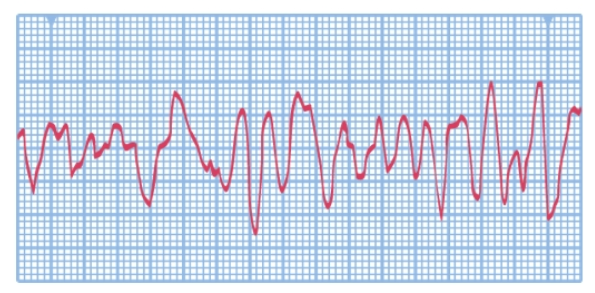
Which rhythm would the nurse document when observing the following dysrhythmia on a client’s cardiac monitor?
Ventricular fibrillation