BIOL 214 M7 Transcription & Translation
 Call Kai
 Learn
 Practice Test
 Spaced Repetition
 Match
 Flashcards
 Knowt Play
1/92

There's no tags or description
Looks like no tags are added yet.
93 Terms
What is transcription?
The process of using a DNA template to synthesize RNA (mRNA).
What is translation?
The process of using the codon sequence of mRNA to synthesize a polypeptide with a specific amino acid sequence.
What is the one gene–one enzyme hypothesis? How was the one gene–one enzyme hypothesis revised?
One gene-one enzyme hypothesis (Beadle and Tatum) = hypothesis that each gene specifies an enzyme that performs a particular biochemical reaction
Became the one gene–one polypeptide hypothesis because some proteins are not enzymes and some proteins contain multiple polypeptide chains.
What was Beadle and Tatum's work and what did it demonstrate?
Interpreted biochemical pathways and where they may be blocked by mutations (bread mold)
Found that each gene controls the production of a single enzyme that catalyzes a specific step in a metabolic pathway
Transcription Summary
Prokaryotes: Initiation, Elongation, Termination
Initiation:
Promoter (Pribnow box TATAAT at -10 and TTGACA at -35)
RNA polymerase (only one kind)
2 alpha, 1 beta, 1 beta’, 1 sigma factor
Core enzyme, holoenzyme
Sigma factor
Abortive initiation
Elongation:
Completed by core enzyme + elongation factors
Termination:
Rho-dependent
Rho-independent
Transcription Summary
Eukaryotes: Initiation, Elongation, Termination, RNA Processing
Initiation:
Promoter (TATA box TATAAA around -25)
General + specific transcription factors
RNA polymerase I, II, III
TFs bind to promoter
Elongation:
RNA polymerase moves along DNA, synthesizes 5’-3’
Assisted by elongation factors
Termination:
After RNA polymerase synthesizes 1000-2000 nucleotides beyond end of gene, completed RNA transcript is released
Extra RNA is removed by an enzyme that cuts it at the polyadenylation signal sequence
RNA Processing:
Add 5’ cap and poly-A tail
mRNA splicing - spliceosomes cut out introns and link exons to form functional RNA transcript
alternative splicing
Exons-intron junctions identified by consensus sequences
What is the Pribnow box?
A consensus promoter sequence in prokaryotes, TATAAT at -10 and TTGACA at -35
tells the sigma factor where to sit and what strand to read
where the sigma factor sits is not random, it is based on orientation of the promoter
Lots of variation in consensus sequences - TATAAT is rarely found

What is a strong promoter?
A promoter that allows transcription machinery to bind and initiate transcription more readily, often producing more transcripts
Efficiently recruits RNA polymerase & TFs to drive a high rate of transcription
Why are prokaryotic promoters asymmetric?
Their orientation ensures that RNA polymerase binds in one specific direction, determining which DNA strand is used as the template
What are the subunits of the prokaryotic RNA polymerase?
Two alpha (α) subunits, one beta (β) subunit, one beta-prime (β′) subunit, one sigma (σ) factor
Two alpha (α), one beta (β), one beta-prime (β′) = core enzyme
Core enzyme + sigma factor = holoenzyme
Prokaryotic RNA polymerase:
Role of two alpha subunits
Assemble the RNA polymerase
Prokaryotic RNA polymerase:
Role of beta subunit
Accommodates incoming nucleotides; handles them as they come into the molecule
Catalyzes phosphodiester bond formation during RNA synthesis
Prokaryotic RNA polymerase:
Role of beta’ subunit
Binds/holds RNA polymerase to the DNA template (non-specific)
Prokaryotic RNA polymerase:
Role of sigma factor
Recognizes specific sequences in the promoter and helps RNA polymerase initiate transcription at the correct location
recognizes the promoter (pribnow box) and sits down first
binds one strand of the double helix (coding strand), leaving the other to serve as template to be read by RNA polymerase
detaches during elongation

What does the holoenzyme do during transcription?
It opens up the double helix to form a transcription bubble of about 10 nucleotides
Transcription bubble = small region of locally unwound DNA that exposes the template strand for RNA synthesis
What is a consensus sequence?
A representative pattern of nucleotides commonly found at a particular functional DNA or RNA site.
sigma factor of prokaryotic RNA polymerase recognizes consensus sequences found in promoter region upstream of transcription start site
Draw 2 different consensus sequence promoter region of prokaryote

5’ splice site and 3’ splice site
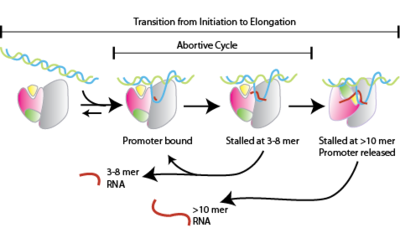
What is abortive initiation?
Early phase of transcription where RNA polymerase repeatedly synthesizes and releases short RNA fragments before managing to escape the promoter & begin productive elongation
RNA polymerase does not smoothly shift into elongation on its first try
in eukaryotes and prokaryotes
Prokaryotic transcription elongation
The core enzyme synthesizes RNA while elongation factors help RNA polymerase stay associated with the w/ template
sigma factor dissociates from RP, core enzyme continues elongation
RNA polymerase tracks along the DNA template
unwinds/rewinds DNA as it is read
synthesizes mRNA 5’ to 3’
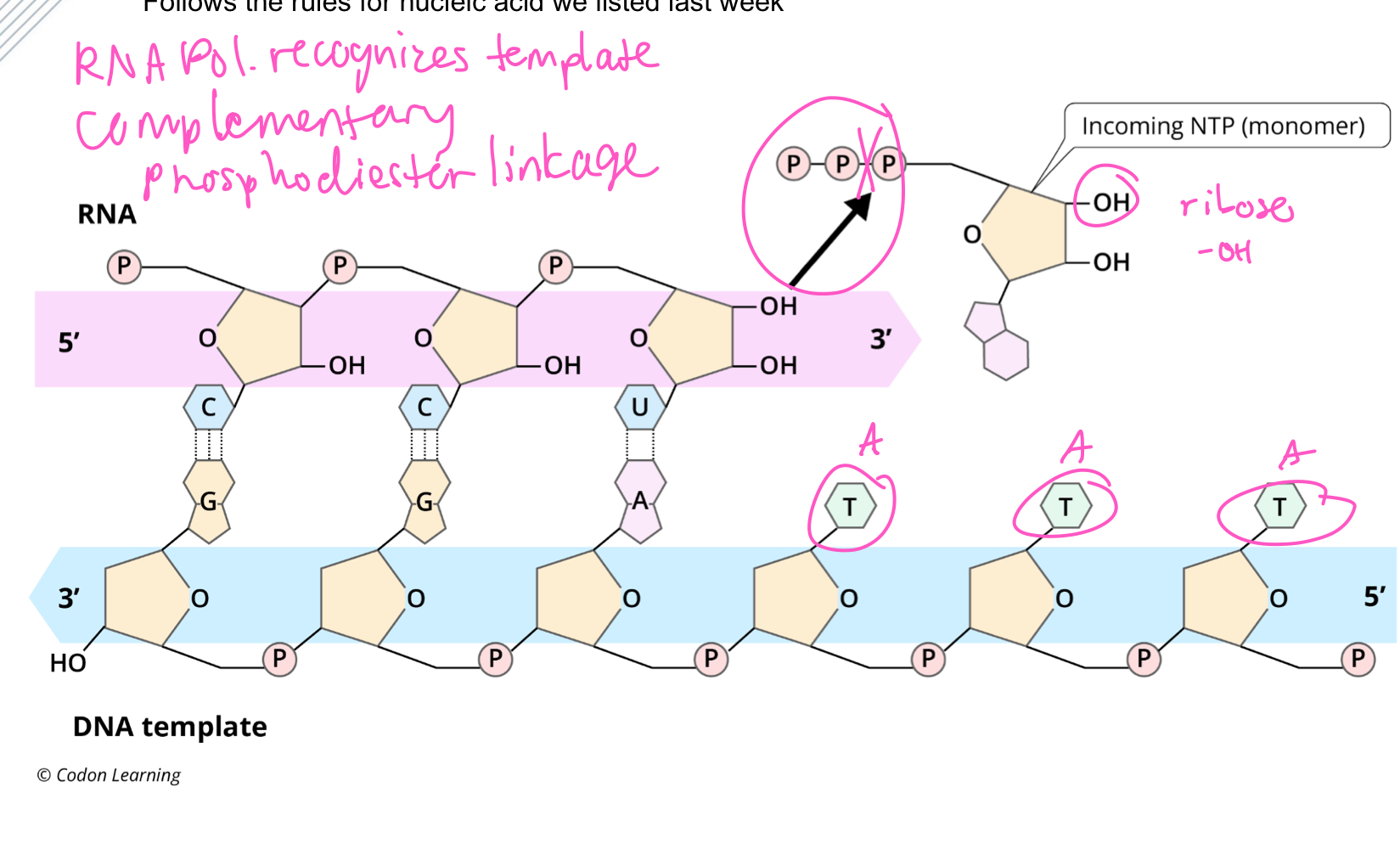
new nucleotide (NTP) pairs w/ DNA template, joins RNA by a phosphodiester bond, releasing PPi
Distinguish RNA from DNA.
RNA is single stranded
sugar = ribose
uracil, instead of thymine (A-U)
MORE REACTIVE due to its 2′-hydroxyl group (-OH) on the ribose sugar backbone
Prokaryotic transcription termination:
Rho-dependent termination
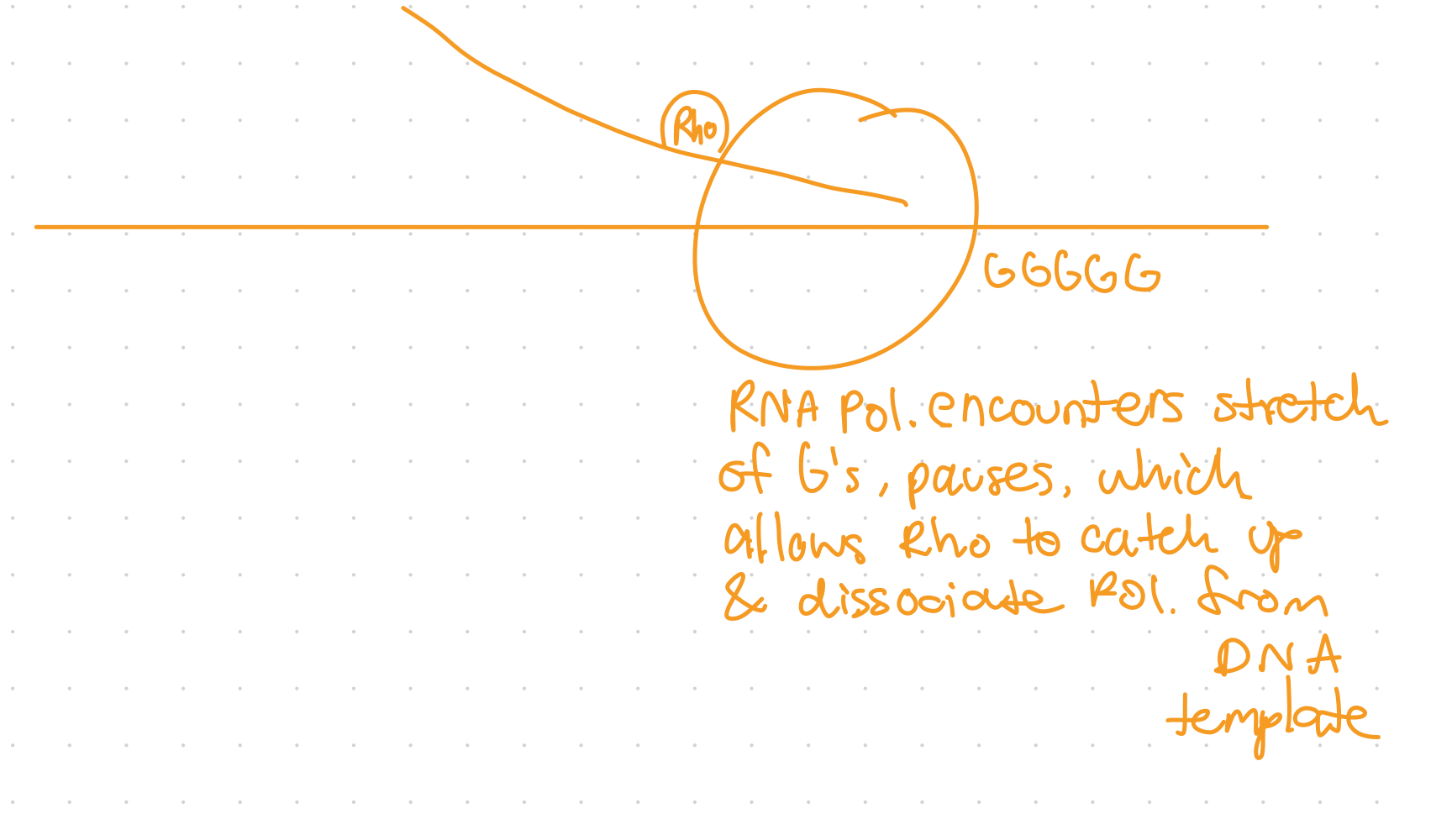
Controlled by Rho protein which tracks on the RNA polymerase
Polymerase stalls when it encounters a stretch of G’s. Rho protein catches up and runs into polymerase and knocks off DNA template
Prokaryotic transcription termination:
Rho-independent termination
Controlled by sequences in the DNA
GC-rich region of the new RNA forms a hairpin loop, which stalls RNA polymerase and destabilizes the complex
A U-rich region follows the hairpin (transcribed from A’s in the DNA template)
Weak U-A base pairs allow the RNA to dissociate, and the core enzyme falls off the template

What helps initiate eukaryotic transcription?
General transcription factors, specific transcription factors, and RNA polymerase.
What does eukaryotic RNA polymerase I synthesize?
Almost all rRNA (ribosomal RNA).
What does eukaryotic RNA polymerase II synthesize?
Protein-coding pre-mRNA, which is processed to produce mature mRNA.
mainly talking about this when talking about eukaryotic RNA polymerase
What does eukaryotic RNA polymerase III synthesize?
5S rRNA, tRNAs (transfer RNAs), and other small RNAs.
What happens during eukaryotic transcription initiation (general)?
Transcription factors recognize the promoter → RNA polymerase II binds and forms the transcription initiation complex → Additional general TFs join the party after RP sits down → Transcription begins
What is TFIID's role in eukaryotic transcription initiation?
It recognizes and binds the TATA box or associated AT-rich promoter region.
What is TFIIB's role in eukaryotic transcription initiation?
It binds alongside TFIID and helps position and recruit the transcription machinery.
What is the role of TFIIH in eukaryotic transcription initiation?
It contains helicase activity that helps open the DNA double helix and also participates in transcription initiation.
What happens during eukaryotic transcription initiation?
Transcription factors assemble at the promoter, recruit RNA polymerase, and help open the DNA so RNA synthesis can begin.
TFs + RNA polymerase must be in place before initiation is complete. If some are missing, maximum transcription is not obtained.
What happens during eukaryotic transcription elongation?
RNA polymerase moves along the DNA template and synthesizes RNA 5′ → 3′
Elongation factors help keep RNA polymerase associated w/ the DNA template.
When is a eukaryotic RNA transcript released according to the study guide?
RNA polymerase continues approximately 1,000–2,000 nucleotides beyond the end of the gene before the transcript is processed and released.
How does eukaryotic transcription termination occur? (how is each rna polymerase released)
RNA polymerase I requires a termination protein that recognizes a specific 18 nucleotide sequence
RNA pol III terminates transcription via hairpin formation (single strand molecule folds on itself and creates distortion)
RNA pol III transcribes 1k-2k nucleotides excess of gene template which are removed during mRNA processing
What is the purpose of the polyadenylation signal?
It directs processing of the RNA transcript, including cleavage that helps generate the 3′ end of the mRNA before the poly(A) tail is added.
Much of the “extra” RNA is removed when an enzyme cuts the RNA at the poyadenylation signal sequence.
mRNA processing: What is the 5′ cap?
A modified nucleotide structure added to the 5′ end of eukaryotic mRNA that
protects the RNA from digestion by enzymes
transports RNA out of the nucleus (where transcription occurs) into the cytoplasm for translation
supports ribosome recruitment during translation
What is the function of the 5′ cap during translation?
It helps the translation initiation machinery recognize and recruit the mRNA.
mRNA processing: What is a poly(A) tail?
A stretch of 50-250 adenine nucleotides added to the 3′ end of eukaryotic mRNA.
important for stability
protects mRNA from being digested by enzymes in cytoplasm
What is mRNA splicing? How does alternative splicing increase variation?
The removal of introns and joining of exons to produce a functional RNA transcript.
spliceosomes (composed of proteins & RNA molecules) recognize sequences at 5’ and 3’ end of the intron, cut out introns, and link remaining exons
Alternative splicing allows exons to be joined in different combinations, resulting in a variety of mRNA molecules from a single gene
this process greatly increases the number and variety of proteins encoded in the cell nucleus without increasing the size of the genome
different forms of protein work more or less efficiently in certain environments
What is a spliceosome?
A molecular complex that removes introns from eukaryotic pre-mRNA and joins the exons.
composed of proteins & RNA molecules
can recognize sequences at 5’ and 3’ end of the intron
How does alternative splicing increase protein diversity?
It allows a single gene to produce different mRNA versions that can encode different protein products.
Advantage for eukaryotic cells
What are the three major processing steps for eukaryotic pre-mRNA?
Addition of a 5′ cap, addition of a 3′ poly(A) tail, and RNA splicing.
What are the differences between prokaryotic RNA polymerase and eukaryotic RNA polymerase II?
Eukaryotic RNA polymerases need many general transcription factors to get started + has to deal w/ DNA that is packed into nucleosomes and higher order forms of chromatin
Prokaryotic RNA polymerase just needs the sigma factor to begin
Why is translation more challenging than DNA replication and transcription?
DNA replication or transcription are both nucleic acid to nucleic acid, while translation is nucleic acid to protein
What is the function of tRNA in translation?
It acts as an adaptor by carrying a specific amino acid and recognizing a complementary mRNA codon through its anticodon.
matches amino acids to codons in mRNA
What is an anticodon?
A three-nucleotide sequence on tRNA that pairs with a complementary mRNA codon.
Where does an amino acid attach to tRNA?
At the 3′ end of the tRNA.
Translation machinery
Ribosome
small & large subunits
E site (exit), P site (location of growing polypeptide), A site (location for next amino acid)
mRNA binding site
tRNA molecules
amino acid + anti-codon
What is a charged tRNA?
A tRNA with its corresponding amino acid attached.
Referred to as “charged” b/c the association requires ATP hydrolysis, energy of which is conserved in the charged tRNA
What enzyme attaches an amino acid to its tRNA?
An aminoacyl-tRNA synthetase.
What is the function of aminoacyl-tRNA synthetase?
It recognizes the appropriate amino acid and tRNA and attaches the amino acid to the tRNA.
Why is accuracy important when charging tRNA?
An incorrectly attached amino acid could be incorporated into a protein even if the tRNA anticodon correctly recognizes the mRNA codon.
How do aminoacyl-tRNA synthetases help maintain accuracy?
They recognize their substrates and can use editing mechanisms to correct certain errors.
Synthetase enzymes go through an editing process to make sure the correct amino acid is attached to the correct tRNA molecule
What is inosine in tRNA?
A modified nucleotide derived from adenosine that can allow flexible base pairing in certain codon–anticodon interactions.
What are ribosomes made of?
A small subunit and a large subunit, each containing rRNA and proteins.
What is the function of the small ribosomal subunit?
It binds and positions mRNA and helps ensure accurate codon–anticodon recognition.
What is the function of the large ribosomal subunit?
It contains the catalytic machinery that forms peptide bonds.
What is the E site of a ribosome?
The exit site, where an empty tRNA is positioned before leaving the ribosome.
What is the P site of a ribosome?
The peptidyl-tRNA site, which holds the tRNA carrying the growing polypeptide chain during elongation.
Peptide bond formation takes place
What is the A site of a ribosome?
The aminoacyl-tRNA site, where the next charged tRNA enters and recognizes the next codon.
Anticodon of tRNA binds to codon of mRNA
What does the acronym E-P-A represent?
E = exit, P = peptidyl-tRNA, A = aminoacyl-tRNA.
3 step sequence: A → P → E
What is the reading frame?
The way an mRNA sequence is divided into consecutive three-nucleotide codons.
What is the difference between a codon and an anticodon?
A codon is on mRNA and specifies an amino acid or stop signal; an anticodon is on tRNA and pairs with a codon.
What happens during translation initiation? (steps)
The ribosome assembles on mRNA, the initiator tRNA pairs with the start codon, and the correct reading frame is established.
mRNA attaches to the small ribosomal subunit.
Small ribosomal subunit scans along mRNA until it finds start codon of mRNA (AUG). tRNA with appropriate anticodon (UAC) to AUG attaches.
Eukaryotes: use 5’ cap to find out which end is on the mRNA molecule
Prokaryotes: look for sequence on RNA that signals start
Large ribosomal subunit comes in to form a complete initiation complex
How does prokaryotic translation initiation begin?
The small ribosomal subunit recognizes the Shine–Dalgarno sequence in the mRNA's 5′ untranslated region.
What is the Shine–Dalgarno sequence?
A sequence in the prokaryotic mRNA 5′ UTR that helps position the small ribosomal subunit at the correct translation start site.
What happens after the small ribosomal subunit is positioned in prokaryotes?
The large ribosomal subunit assembles with the help of initiation factors.
How does eukaryotic translation initiation begin?
The small ribosomal subunit associates with initiator Met-tRNA and initiation factors, then the complex is recruited to the mRNA's 5′ cap.
Which amino acid does the eukaryotic initiator tRNA carry?
Methionine (Met).
How does the eukaryotic initiation complex find the start codon?
It scans the mRNA from the 5′ cap until it identifies an appropriate AUG start codon.
assisted by presence of the Kozak sequence
What is the Kozak sequence?
A eukaryotic mRNA sequence context around the AUG start codon that helps the initiation machinery recognize the start site; a consensus example is 5′-ACCAUGG-3′.
It helps the ribosome identify an appropriate start codon for translation.
How is the reading frame established during translation initiation?
The initiator tRNA pairs with AUG in the P site, setting the grouping of subsequent nucleotides into codons.
What is the main difference between prokaryotic and eukaryotic translation initiation?
Prokaryotes use the Shine–Dalgarno sequence to position the ribosome; eukaryotes typically recruit to the 5′ cap and scan for AUG in a suitable Kozak context.
What happens during translation elongation?
The ribosome repeatedly brings in charged tRNAs, forms peptide bonds, and moves along the mRNA to extend the polypeptide.
next appropriate tRNA carrying appropriate amino acid comes in and occupies A site
peptidyl transferase forms peptide bonds b/w adjacent amino acids in P site
the ribosome translocates mRNA molecule down to the next codon
empty tRNA in E site is released
ribosome reaches stop codon UAG, UAA, or UGA
What is the first major event in an elongation cycle?
A charged tRNA enters the A site and pairs its anticodon with the mRNA codon.
What happens at the P site during peptide bond formation?
The growing polypeptide is transferred from the tRNA in the P site to the amino acid attached to the tRNA in the A site.
What is peptidyl transferase?
The catalytic activity of the large ribosomal subunit that forms peptide bonds between amino acids.
After a peptide bond forms, where is the growing polypeptide attached?
To the tRNA in the A site.
What is translocation?
The movement of the ribosome along the mRNA by one codon during elongation.
What happens to the peptidyl-tRNA during translocation?
It moves from the A site to the P site.
What happens to the empty tRNA during translocation?
It moves from the P site to the E site and is subsequently released.
What happens to the A site after translocation?
It becomes vacant and ready to accept the next charged tRNA.
What are the two major events that repeat during elongation?
Peptide bond formation and ribosome translocation, with charged tRNA entry and empty tRNA exit as part of the cycle.
What provides energy for ribosomal translocation?
GTP hydrolysis, facilitated by elongation factors.
What is the correct order of tRNA movement through the ribosome?
A site → P site → E site → release.
What happens to the growing polypeptide at each elongation cycle?
It is transferred to the amino acid carried by the incoming A-site tRNA, adding another amino acid to the chain.
What triggers translation termination?
The ribosome reaches a stop codon (UAA, UAG, or UGA) in the mRNA.
Why does a stop codon not recruit a normal tRNA? How does a release factor resemble tRNA?
No standard tRNA anticodon recognizes the stop codon as a translation signal; instead, a release factor recognizes it. The shape of the release factor mimics that of a tRNA, including regions that read the stop codons.
What does a release factor cause during termination?
It stimulates hydrolysis that releases the polypeptide from the tRNA in the P site.
Because there is no aminoacyl–tRNA in the A site for the polypeptide to be transferred to, the polypeptide is released.
After the polypeptide is released, the release factor and empty tRNA leave, and the ribosomal subunits separate from the mRNA.
How does translation termination differ from transcription termination?
Translation termination releases a polypeptide when a stop codon is reached; transcription termination releases an RNA transcript when RNA polymerase reaches a termination signal or region.
Since AUG is the only start codon, do all proteins begin with the amino acid methionine?
No, once protein is released from the ribosome, modification takes place, often the initial methionine is knocked off
Synthesis of protein begins w/ Met but fully mature functional protein does not always start w/ Met
What are the four types of base-pair-substitution mutations that affect protein-coding genes?
Missense | A base change alters a codon, producing a different amino acid | Protein changes; may or may not affect function (e.g., sickle cell anemia) |
Nonsense | A base change creates a premature stop codon | Protein is truncated/shortened, usually non-functional |
Silent | A base change still codes for the same amino acid (due to redundancy in the genetic code) | No change to the resulting protein |
Frameshift | Insertion or deletion of a base disrupts the reading frame (codons are read in fixed 3-letter chunks) | Scrambles every downstream codon; usually destroys protein function (sometimes fatal to the cell) — but occasionally produces a new, advantageous protein variant that can be selected for |