AP Environmental Science Midterm Exam Review
 View linked note
 Call Kai
 Learn
Learn Practice Test
 Spaced Repetition
 Match
Match Flashcards
 Knowt Play
1/241

Earn XP
Description and Tags
Name | Mastery | Learn | Test | Matching | Spaced | Call with Kai | Chat |
|---|
No analytics yet
Send a link to your students to track their progress
242 Terms
UNIT 1: LIVING WORLD
…
Tundra
A cold and treeless biome with low-growing vegetation
Boreal Forest/Taiga
A forest biome made up primarily of coniferous evergreen trees that can tolerate cold winters and short growing seasons
Temperate rainforest
A coastal biome typified by moderate temperatures and high precipitation
Temperate seasonal forest
A biome with warm summers and cold winters with over 1m (39 inches) of precipitation annually
Woodland/shrubland
A biome characterized by hot, dry summers and mild, rainy winters
Temperate grassland/cold desert
A biome characterized by cold, harsh winters, and hot, dry summers
Tropical rainforest
A warm and wet biome found between 20N and 20S of the equator, with little seasonal temperature variation and high precipitation
Tropical seasonal forest/savanna
A biome marked by warm temperatures and distinct wet and dry seasons
Subtropical desert
A biome prevailing at approximately 30N and 30S with hot temperatures, extremely dry conditions, and sparse vegetation
Major biogeochemical cycles
Nitrogen, carbon, water, phosphorus, and sulfur
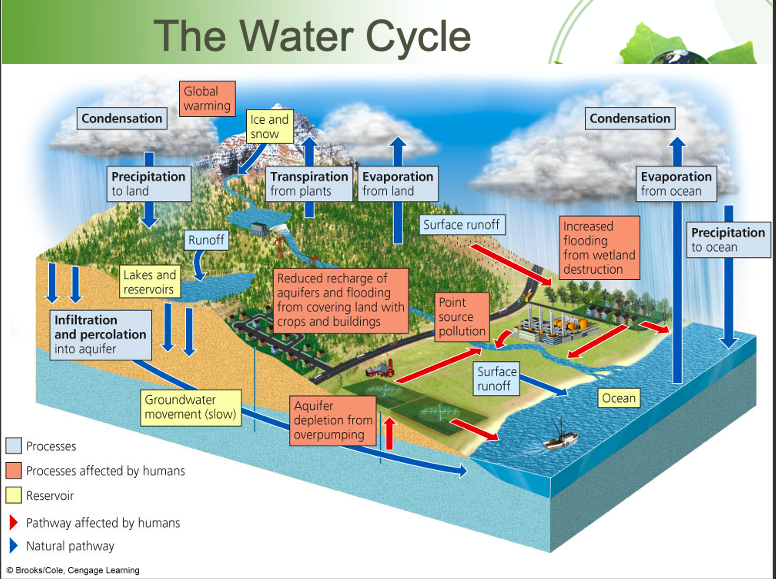
Water cycle
Reservoirs are the atmosphere and hydrosphere; Processes include Evaporation, Condensation, Precipitation, Transpiration; After precipitation water can take various paths including Surface runoff, Glaciers, Seepage, Aquifers/groundwater, Absorption by plants.
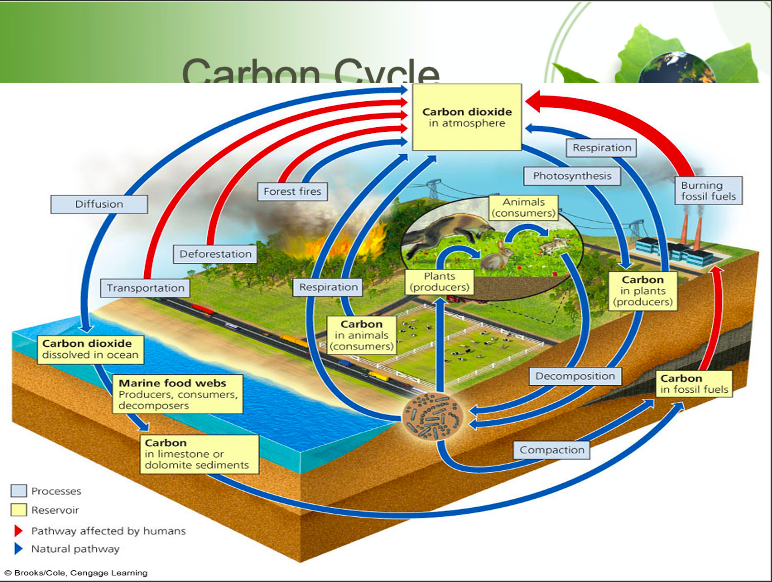
Carbon cycle
Reservoirs are the geosphere; Processes include photosynthesis, cellular respiration, deposition, lithification (converting loose C-containing sediment into rock)
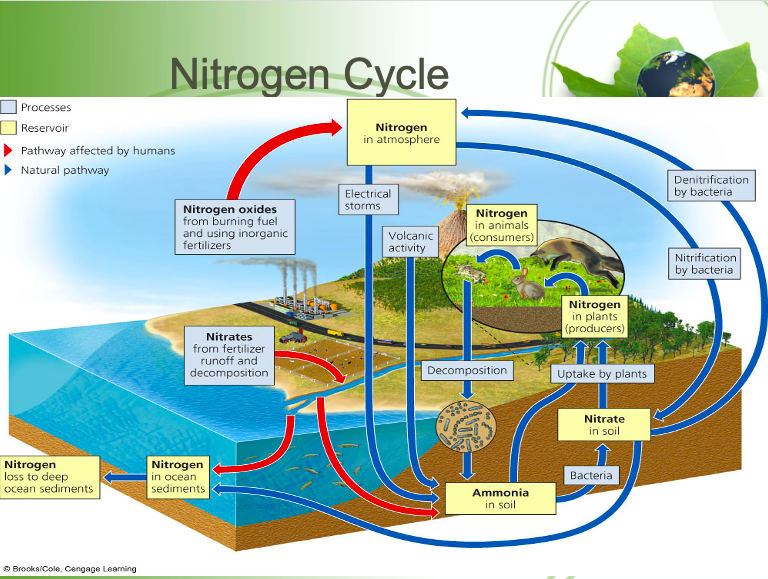
Nitrogen cycle
Reservoirs are the atmosphere; Processes include Nitrogen fixation, Nitrification, Assimilation, Decomposition, Denitrification
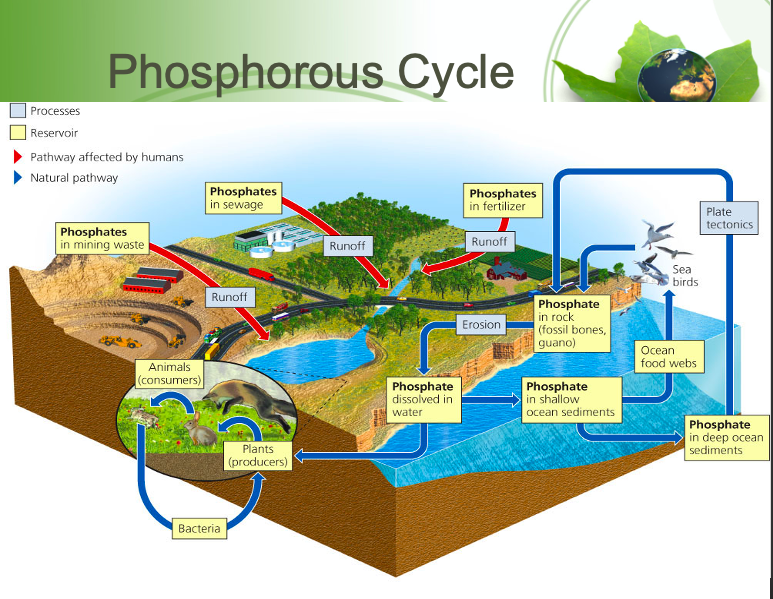
Phosphorous cycle
Reservoirs are the geosphere; Process is slow in which water runs over rocks and erodes away compounds containing Po4^3- and it can be lost from cycle for long periods when it washes from the land into the ocean.
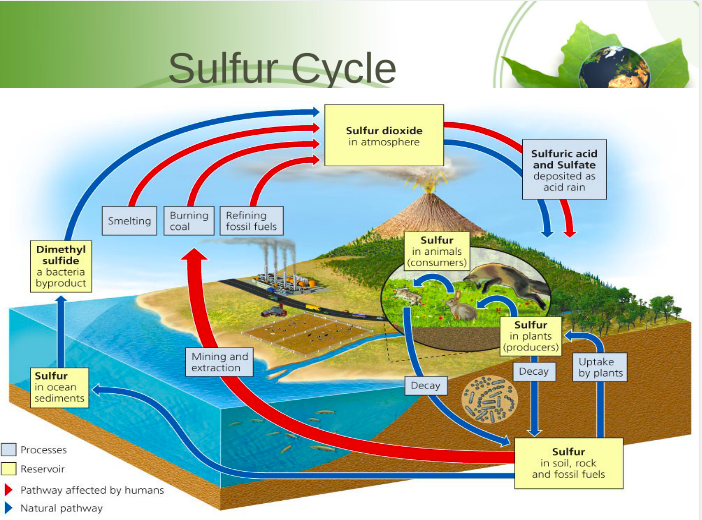
Sulfur cycle
Reservoirs are underground in rocks, minerals, and fossil fuels
A simple nitrogen cycle
…
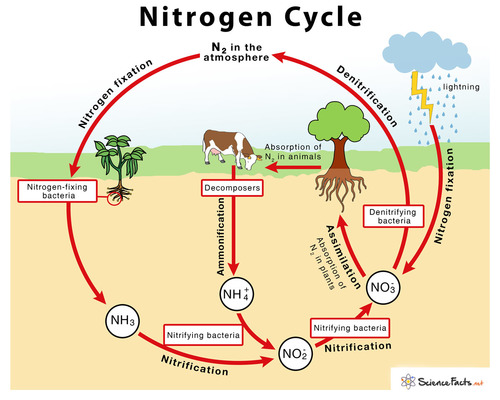
Nitrogen fixation
Nitrogen gas is converted to ammonia through bacteria absorption and lightning because plants and animals cannot absorb nitrogen.
Nitrification
Converts NH4 into NO2 then into NO3 for plants.
Assimilation
Converts the nitrogen into proteins or DNA
Decomposition
(Ammonification) As the bodies and wastes decompose, bacteria convert the nitrogen compounds into NH4
Denitrification
Bacteria converts NH4 into N2
What are ways carbon dioxide is taken out of the atmosphere and put back into the atmosphere?
Through deforestation, burning of fossil fuels and wood, and cellular respiration
Reactants and Products for photosynthesis
Carbon dioxide and Water → Sugar (glucose) and Oxygen
Reactants and Products for cellular respiration
Sugar (glucose) and Oxygen → Carbon dioxide and Water and ATP
Abiotic
Not derived from living organisms (Includes water, air, temperature, soil, light levels, precipitation, salinity)
Biotic
Derived from living organisms (Include producers, consumers, decomposers, plants, animals, bacteria/fungi)
Parasitism
One species benefits while one is harmed
Mutualism
Both species benefit
Commensalism
Where one species benefits while the other is unaffected
Competition
Neither benefits
Predation
One species benefits while the other dies
Order Levels for Ecosystems
…
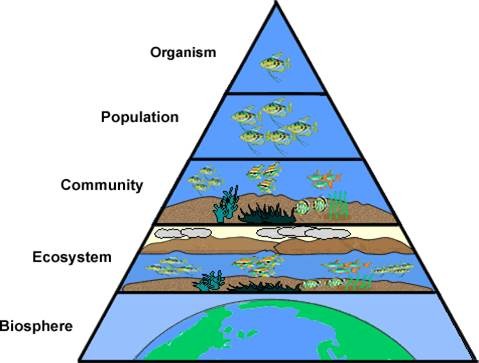
Individual/Organism
The lowest level of organization in an ecosystem
Population
Multiple individuals or organisms of a single species that live within a particular geographic area
Community
Two or more populations of different species that occupy the same space at the same time
Ecosystem
Both the biotic (living) and abiotic (nonliving) factors in a system
Biome
The plants and animals in a biome share common traits that are specific to the individual biome those plants and animals inhabit
10% rule for energy transfer in food chains
Each trophic level can only give 10% of its energy to the next level
Energy and biomass pyramid
…
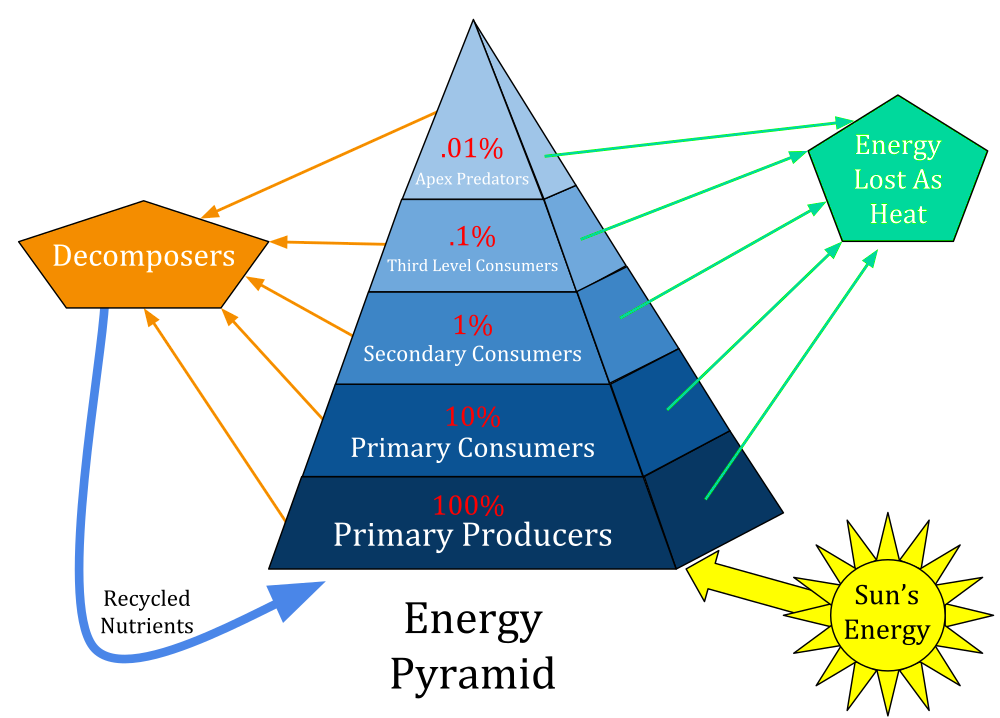
GPP
Gross primary productivity is the rate at which an ecosystem's producer converts solar energy into chemical energy in the form of biomass found in their tissues; Units are kcal/m^2/yr
NPP
Amount of energy potentially available to other organisms in the ecosystem
R
The energy used in respiration
Formula for NPP
NPP = GPP - R
Producers
Organisms that can make their own food through photosynthesis or chemosynthesis
Primary consumers
Organisms that eat producers
Secondary consumers
Organisms that eat primary consumers
Tertiary consumers
Organisms that eat secondary consumers
Scavengers
Organisms that feed
Detritivores
Animals that feed on dead organic material
Decomposers
Organisms that bread down dead or decaying organisms
Heterotrophs and Autotrophs
Heterotrophs are organisms that have to to consume food while autotrophs are organisms that make their own food.
Understand the effects of eliminating a species in a food chain.
Example: What would happen to the other species (increase or decrease?) if the desert fox was overhunted and eliminated?
Cacti à kangaroo rats à snakes à desert fox
UNIT 2: BIODIVERSITY
…
Biodiversity
the variety of different species
Genetic diversity
the variety of genes within a given species
Evolution
a change in the genetic composition of a population over time
Adaptations
a trait that improves an individual’s fitness
Artificial Selection
the process in which humans determine which individuals breed, typically with a preconceived set of traits in mind
Natural Selection
the process in which the environment determines which individuals survive and reproduce
Fitness
an individual’s ability to survive and reproduce
Mutation
a mutation can arise in a population and if it is not lost it may increase in frequency over time
Gene Flow
the process by which individuals move from one population to another and thereby alter the genetic composition of both populations. It can bring about genetic variation.
Genetic Drift
a change in the genetic composition of a population over time as a result of random mating
Bottleneck effect:
a reduction in the genetic diversity of a population caused by a reduction in its size. It can reduce genetic variation. It can create low diversity and could lead to decline or extinction.
Founders effect
A change in the genetic composition of a population as a result of descending from a small number of colonizing individuals
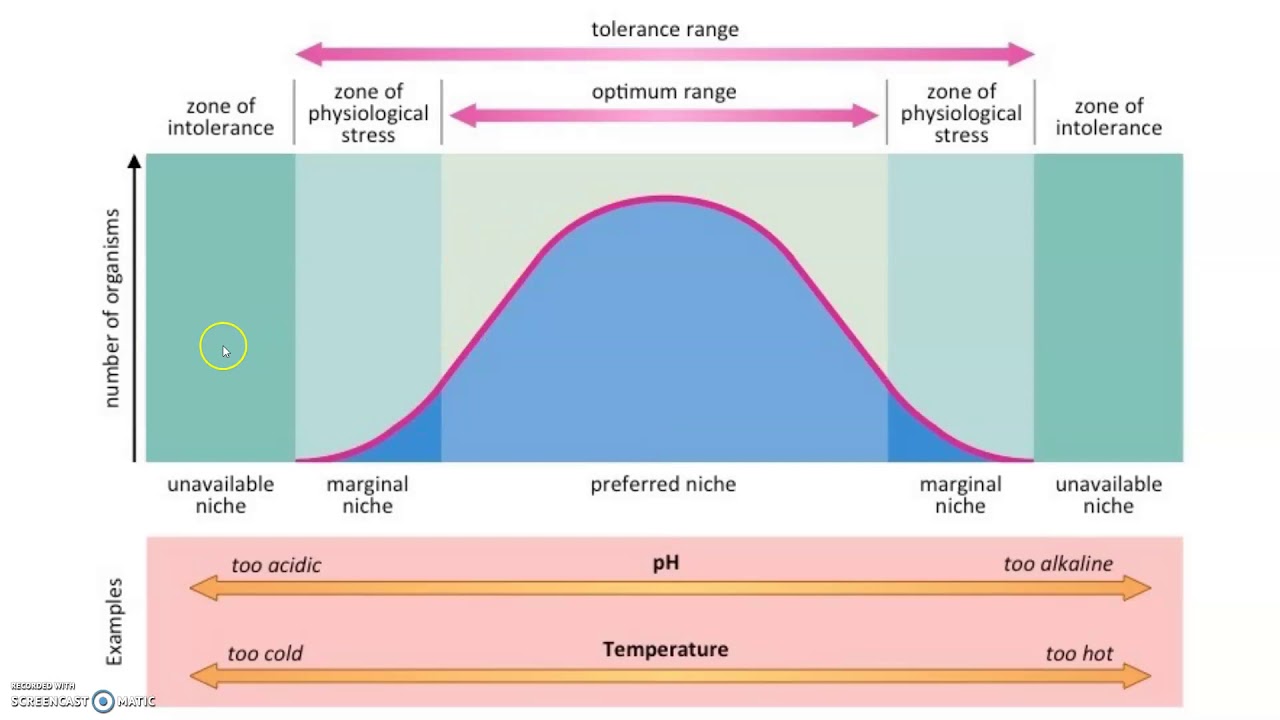
Range of ecological tolerance
the limits to the abiotic conditions that a species can tolerate such as humidity, temperature, salinity, and pH
Limiting factors
restricts growth, abundance, or distribution of a population
Realized Niche
the range of abiotic and biotic conditions under which a species actually lives
Fundamental Niche
The suite of abiotic conditions under which a species can survive, grow, and reproduce
Niche Generalists
A species that can live under a wide range of abiotic or biotic conditions. Fare better under changing conditions because they have a number of alternative habitats and food sources available.
Ex. Cockroaches
Niche Specialists
a species that is specialized to live in a specific habitat or to feed on a small group of species. Do well when environmental conditions remain relatively constant; however, loss of a favored habitat or food source leaves them with few alternatives for survival
Ex. Tiger Salamanders- must live in fishless ponds
Resource Partitioning
division of resources in an ecosystem
Ecosystem services
Goods that come from natural resources or services that ecosystems carry out that have measurable economic value to humans.
Provisioning
goods taken directly from ecosystems or made from natural resources (wood, paper, food)
Regulating
natural ecosystems regulate climate/air quality, reducing storm damage and healthcare costs
Cultural
money generated by recreation (parks, camping, tours) or scientific knowledge
Supporting
Natural ecosystems support processes we do ourselves, making them cheaper and easier (bees pollinate crops)
HIPPCO
Habitat Fragmentation/Loss, Invasive Species, Population growth, Pollution (Pollutants), Climate Change, Over Exploitation
Habitat Fragmentation/loss
Breaking of larger, continuous habitats into smaller, isolated patches; disrupts breeding, hunting migration.
Deforestation (lumber, cities, roads) Wetland draining (ag, urbanization) River water level decreased by dams.
Invasive Species
Invasives such as z. mussel and kudzu vine outcompete native species for food/space, lowering population
Population Growth
Human pop. growth drives habitat loss
Urbanization, ag. expansion to feed more people so remove/fragment habitats.
Pollution (Pollutants)
Oil spills reduce marine original population sizes
Pesticides (glyphosate, atrazine) kill non-target species
Climate Change
Shifts biomes and therefore species habitats ranges, can change temp. and precip. patterns too rapidly for a species to adapt or migrate, causing pop. decline or extinction
Over Exploitation
Excessive hunting or poaching (faster than reproductive rate) leads to pop. decline & potential extinction
Trophic cascade
ecological event triggered by adding or removing apex predators
Tropic level
Organisms that are same number of energy transfers from source
Food Web
A community of organisms where there are several interrelated food chains
Keystone species
species have a large effect on the types and abundances of other species in an ecosystem. They are low in number and are usually prone to extinction.
Loss of keystone species usually lead to a population crash and other extinctions.
Invasive species
Species not native to an area, introduced often by human transport.
No natural predators to control pop.
Highly competitive for resources
Generalist species are more likely to be invasive
Indicator species
species that serve as early warnings that an ecosystem is being damaged because they are affected by a change in one or more key abiotic factors in the environment.
Native species
Species that normally live and thrive in a particular ecosystem
Non-native species
Species that migrate into an ecosystem or are deliberately or accidentally introduced into an ecosystem.
Can be beneficial or invasive.
Species evenness
the relative proportion of individuals within the different species in a given area
Species richness
the number of species in a given area
Theory of Island Biogeography
a theory that demonstrates the dual importance of habitat size and distance in determining species richness
primary succession
occurs on surfaces that are initially devoid of soil and has bare rock
secondary succession
occurs in areas that have been disturbed but have not lost their soil
Pioneer Species
ability to colonize new areas rapidly and grow well in full sunshine
Ex. Aspen and cherry trees
Climax Community
Historically described as the final stage of succession.