Adaptations for gas exchange
 Call Kai
 Learn
Learn Practice Test
 Spaced Repetition
 Match
Match Flashcards
 Knowt Play
1/31

Earn XP
Description and Tags
Name | Mastery | Learn | Test | Matching | Spaced | Call with Kai | Chat |
|---|
No analytics yet
Send a link to your students to track their progress
32 Terms
What is gas exchange
Oxygen and carbon dioxide diffusing across a suitable body surface in respiring organisms
What is the rate of gas exchange effected by?
Area available for diffusion, length of diffusion pathway, concentration gradient across gas exchange surface and speed that molecules move through membranes
What characteristics do efficient gas exchange surfaces have?
Large surface area to volume ratio, thin, mechanisms for maintaining steep concentration gradient across themselves, permeable to gases
What affects the nature of the gas exchange surface?
The environment the organisms lives, the thickness of the organisms other surface, organism rate of respiration and size of organism
What effect does lipid solubility have on rate of diffusion
Increases rate because the molecules can diffuse through the phospholipid membrane
What is an organisms 0₂ requirement proportional to?
It’s total volume
What is an organisms absorption of O₂ proportional to?
The surface area of the organism
Amoebas adaptations to gas exchange
The cell membrane is the gas exchange surface (single-celled organism)
Large surface area to volume ratio
Thin, moist membrane
Short diffusion pathway
Flatworms adaptations for gas exchange
Increased surface area to volume ratio (flattened shape)
Short diffusion pathway
Earthworms adaptions to gas exchange
Elongated shape provides large surface area to volume ratio
Keeps its skin moist by secreting mucus
Do simple organisms or larger organisms have a faster metabolic rate?
Larger organisms
What does a faster metabolic rate require?
More energy and oxygen supply
What else do larger organisms need?
Ventilation to maintain the concentration gradient
Gill structure
Covered by the operculum which contains 4 gills supported by bony gill arches, each gill has many feathery gill filaments which each have many gill lamellae
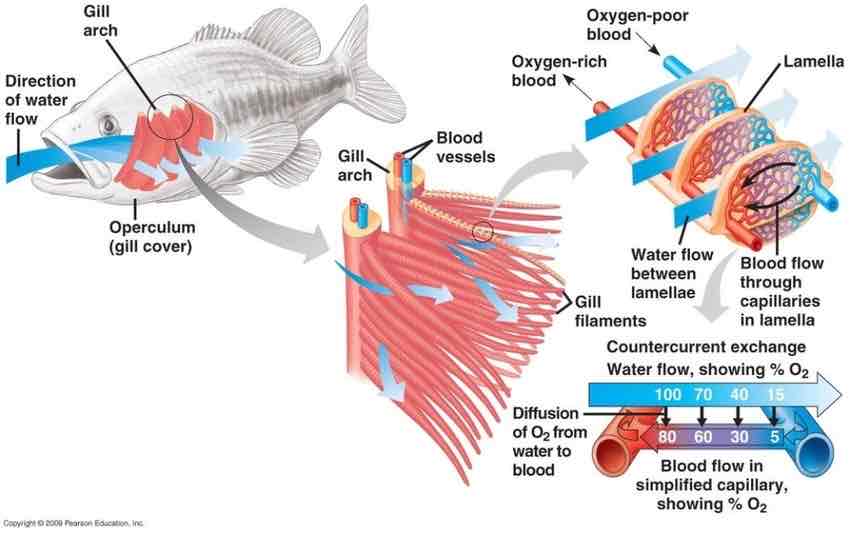
Gills adaptations
Large surface area from many gill filaments and lamellae
Short diffusion pathway (one squamous epithelial cell)
Good blood supply
Counter current flow
Why do gills have a counter current flow?
The blood and water moved in opposite directions because it maintains the concentration gradient across the whole gill lamellae which allows more oxygen to diffuse out of the water
Step 1 of ventilation in fish
Mouth opens lowering buccal cavity floor, increasing volume so water rushes in down pressure gradient
Step 2 of ventilation in fish
Operculur cavity expands raising the buccal cavity floor, increasing pressure which moves water over the gills from the buccal cavity into the operculur cavity
Step 3 of ventilation in fish
Mouth closed, opening operculum, sides of opercular cavity move inwards increasing pressure causing water to rush out of fish through the operculum
why do gills not function effectively on land?
when gills dry out they can no longer dissolve oxygen on their surface, also they may collapse, decreasing the surface area
inspiration
External intercostal muscles contract, ribs move up and out, diaphragm flattens, decreasing pressure pulling air in
expiration
External intercostal muscles expand, ribs move down and in, diaphragm relaxes to dome shape, pressure increases pushing air out
What do pleural membranes do?
Found between the ribs and lungs and also the thorax, they are filled with pleural fluid which prevents friction between lungs and ribs as the lung inflates and deflates
Adaptations of alveoli
Large surface area, short diffusion pathway, good blood supply, moist and surfactant (dosn’t collapse)
gas exchange in insects
air enters the trachea through an opening called a spiracle (found on thorax and abdomen), trachea branches into many tracheoles where it diffuses into body cells
why are spiracles closed for long periods?
to reduce water loss
what is the advantage of having internal lungs for gas exchange?
reduces water loss and mainiants moist gas exchange surfaces
Malate hypothsis
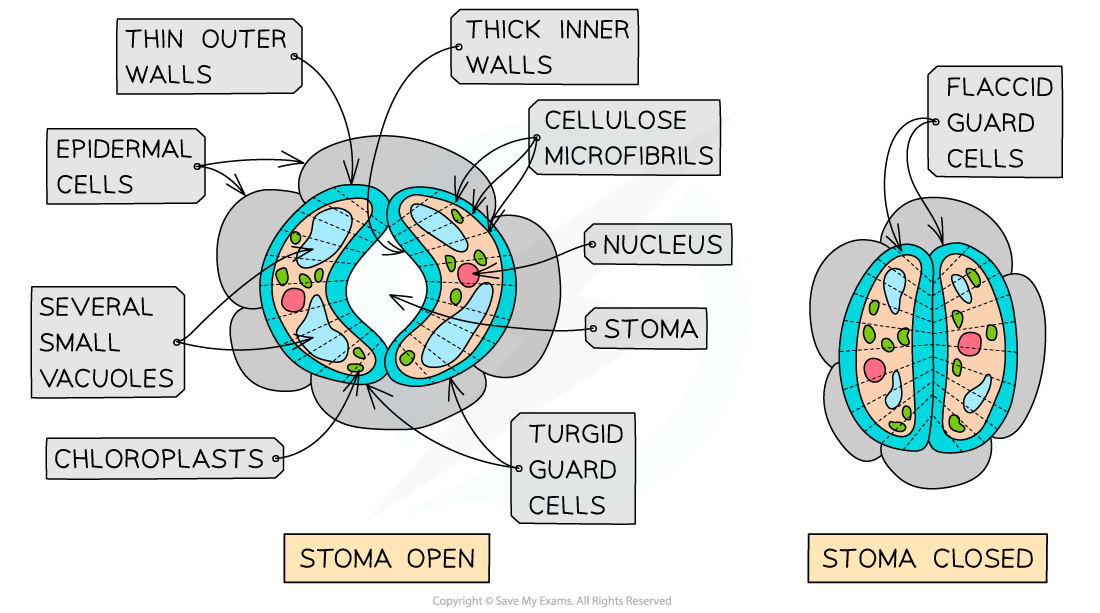
The sun transfers energy so that ATP can be synthesised, this is then used for active transport of potassium ions into the guard cell which triggers the conversion of starch into soluble malate, this decreases the water potential in the guard cell, meaning water can enter by osmosis. This causes the cell to become turgid and expand unevenly due to the different cell walls, forcing them apart opening the stomatal aperture
When and why do stomata close
At night because there’s no sunlight
In dry soil to reduce water loss
In high light intensities to reduce water loss due to the high temperature
Open and closed guard cell structure
Gas exchange in amphibians
Juveniles (tadpoles) live in water and use external gills
Gas exchange in adults occurs through the skin which is moist, thin and close to capillaries
Gas exchange also occurs in the lungs when active
open circulatory system
blood is not in vessels