Biology Exam 3 Study Guide
 Call Kai
 Learn
 Practice Test
 Spaced Repetition
 Match
 Flashcards
 Knowt Play
1/84

Earn XP
Description and Tags
Self-explanatory
85 Terms
What do vascular plants consist of?
Root System (anchors the plant/absorbs water and ions) and Shoot System (support for stems, leaves and flowers)
What is Dermal Tissue? (Root/Shoot)
It is the outer protective cover of a plant.
What is Ground Tissue?
It is for storage, photosynthesis, and secretion. They have support fibers to protect/support a plant.
What is Vascular Tissue?
They are for transporting fluids and dissolved substances. Xylem is for water, phloem is for sugar.
Apical Meristems
Located at the tips of stems/roots. Give rise to PRIMARY tissue.
Root Cap
Protects Apical Meristem
What are protoderm meristems? (Apical)
Forms the epidermis (dermal tissue)
What are protocambium meristems? (Apical)
They produce PRIMARY tissue (xylem/phloem).
What are ground meristems? (Apical)
Differentiates into ground tissues (parenchyma, collenchyma, sclerenchyma)
Lateral Meristems
Found in plants with secondary growth. Increases diameter of stems/roots.
Gives way to SECONDARY tissues.
What are cork cambiums? (Lateral)
They produce outer bark.
What are vascular cambiums? (Lateral)
They produce secondary xylem (main wood component), and phloem (close to outer bark).
Dermal Tissue
Forms the epidermis. Covered in a a cuticle; a layer of waxy, hydrophobic material called cutin. Contains guard cells, trichomes, and root hairs.
What are guard cells? (Dermal)
Paired, sausage-shaped cells that surround a stoma. They control the opening and closing of the stoma. The stoma is an epidermal pore that allows for gas exchange.
What are trichomes? (Dermal)
Hairlike growths of the epidermis that shades the stomata, keeping leaf surfaces cool and reducing evaporation. Some have glands that secrete toxic substances.
What are root hairs? (Dermal)
Extensions of epidermal cells. They increase root surface area and the efficiency of absorption.
What are parenchyma? (Ground Tissue)
Important for storage, photosynthesis, and secretion. Ex: Chloroplasts
What are collenchyma? (Ground Tissue)
Tough, flexible support for plants. They are alive at maturity. Ex: Celery
Whate are sclerenchyma?
They are rigid, strong support for plants; their cell walls are lined with lignin. They are dead at maturity.
What directions do xylem and phloem flow in?
Xylem goes from root to shoot in one direction through hollow dead cells.
Phloem goes from source to sink in both directions through living sieve tube elements.
What are the four vascular root regions from newest to oldest?
Root cap, zone of cell division, zone of elongation, zone of maturation
What is the root cap composed of?
The inner layer has columella cells, which contain starch-filled amyloplasts. Columella settle on the side of gravity, helping the plant stay upright
The outer layer has root cap cells, which are replenished by the apical meristem.
Where is the Zone of Cell Division and what does it do?
It is located behind the root cap, where the apical meristem is found.
Its function is to divide cells to produce daughter cells of the apical meristem for root growth.
What does the Zone of Elongation do?
It lengthens the roots. The daughter cells become longer than they are wide.
What does the Zone of Maturation do?
It makes daughter cells differentiate(mature) into dermal, ground and vascular tissue. It is also where the root hairs are formed.
What are the three types of modified roots?
Prop (originate from stem, help keep plant upright)
Aerial (obtain water from the air)
Pneumatophore (spongy outgrowths from underwater roots; faciliate oxygen intake in swamps)
What is the function of a stem?
They carry leaves/flowers and support the plant’s weight

What does the External Stem Structure consist of?
Node - Area where leaf attaches to stem
Internode - Area of stem between 2 nodes
Leaf (Blade: flattened, wide part; Petiole: stalk that attaches leaf to stem)
Axillary bud - Between petiole and stem (product of apical meristem)
Terminal bud - Extends shoot during growing season

What are monocots and dicots? (Internal Stem Structure)
Monocots - Form ONE cotyledon (seed leaf). Vascular bundles are scattered in stem
Dicots - Form TWO cotyledons. Vascular bundles in a ring
What are the three modified stems?
Tubers - Swollen tips of underground stems (stolon) that store carbs
Tendrils - Thin coling stems that wrap around supports
Cladophylis - Flattened photosynthetic stems resembling leaves (cactuses)
What is the function of leaves?
They are the main site of photosynthesis. They are an extension of the shoot apical meristem.
What does the external leaf structure consist of?
Veins that have both xylem and phloem, distributed throughout the leaf.
Monocots have parallel veins, and dicots have branched veins.
What is a type of modified leaf?
Spines from cacti. They reduce water loss and deter predators.
What are angiosperms?
Angiosperms are flowered plants. They have flowers, and an enclosed seed with an ovary.
What is a phase change?
When a plant goes from embryo to juvenile to adult, and gains the ability to produce flowers.
Which meristem makes flowers?
Apical Meristem
What are the four genetically regulated pathways for flower production?
Light-dependent, temperature-dependent, gibberellin-dependent, and autonomous
What are the two types of light-dependent(photoperiodic) plants?
Short day plants: Flowers when day is shorter than night
Long day plants: Flowers when night is shorter than day.
What is vernalization? (temperature-dependent)
It is the temp requirement for cold to induce flowering.
What is gibberellin?
It is a hormone that stimulates stem elongation, germination, and flowering.
Where are the sperm and ovules in a flower?
The sperm is in the pollen, and the ovules are in the ovary.
What are the three types of flower structures?
Monoecious - Male/female structures present on same plant at the same time
Dioecious - Male/female structures on different plants
Dichogamous - Male/female structures on same plant at different times
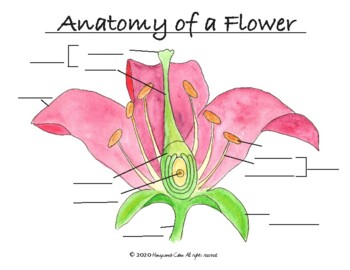
What are the parts of a flower?
Male - Stamen (anther, filament)
Female - Carpel (stigma, style, ovary, ovule)
Petal
Sepal
Receptacle

What ploidy are plants and what ploidy do they produce?
Diploid plants produce haploid gametes.
What are the two stages in the alternation of generations?
Haploid gametophyte - Produces gametes through mitosis. Pollen grain (male) produces sperm and embryo sac (female) contains an egg. Forms into diploid sporophyte
Diploid sporophyte (2n) - Produces spores through meiosis, spores develop into haploid gametophyte
What is pollination?
The movement of pollen produced by anthers to the stigma.
What are the 2 main methods of pollination?
Self-pollination: pollen from flower’s anther pollinates the same flower’s stigma. Stable environment, similar offspring.
Cross-pollination/outcrossing: pollen from flower’s anther pollinates another flower’s stigma. Variable environments, diverse offspring.
What is wind pollination?
It is a passive form of cross-pollination. There is a higher chance of pollination if the plants are closer together since pollen only travels <100m
What is insect pollination?
When insects transfer pollen from one flower to another in exchange for nectar. Bees are the most common example; some plants have indicators that show where the nectar is
What is animal pollination?
When an animal eats the seeds of a flowering plant and deposits them elsewhere.
How does fertilization work?
Pollen lands on a stigma and grows a pollen tube. Pollen tube pierces stigma and elongates until it reaches ovule
Pollen grain divides to form 2 sperm cells to perform Double Fertilization.
How does Double Fertilization work?
One sperm (n) fertilizes the egg, making a zygote (2n). This later forms into the embryo and the suspensor cell.
The other sperm fertilizes with 2 polar nuclei, forming a triploid endosperm (3n). This will be the nutrition source for the embryo.

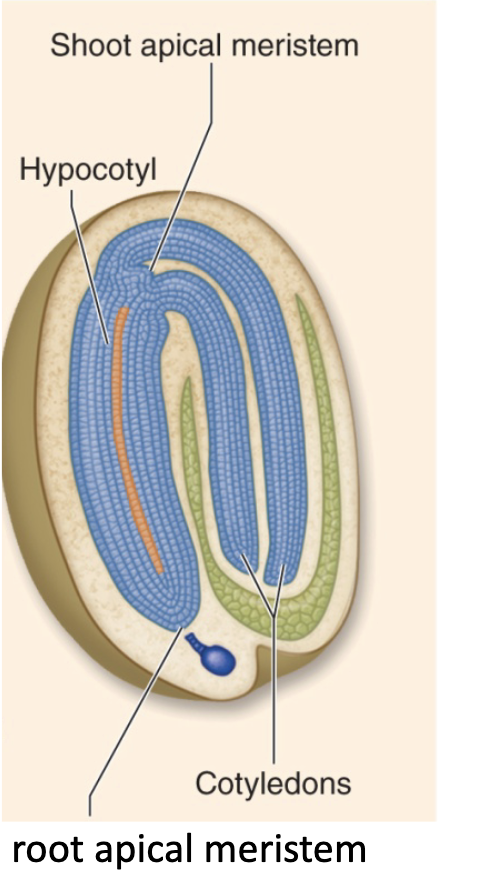
What are the key structures that form the embryo cell?
Cotyledons: Embryonic leaves
Apical Meristems: Sites of root/shoot growth
Hypocotyl: Embryonic stem that connects between cotyledon and roots
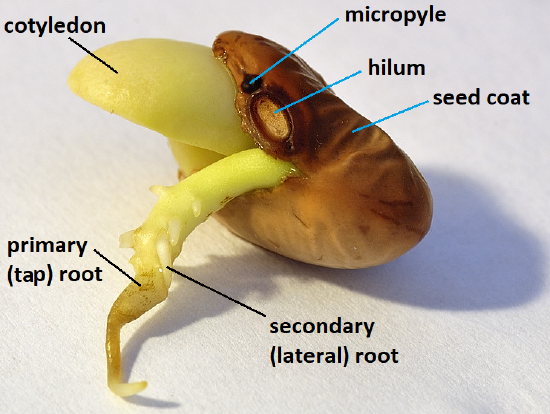
What is a seed coat and what is its function?
It is a leathery layer around a seed that encloses it with its stored nutrients and allows a seed to survive harsh conditions.
What are the four seed functions?
Dormancy - Seeds are dormant in harsh conditions and don’t develop until they’re better
Protection - They keep the vulnerable young plant protected
Food - Provides nutrients for the embryo until it can produce its own
Dispersal - Facilitates spreading of seeds into new habitats
What is a specialized seed?
A seed that has adapted to improve survival, and will only germinate after a condition is met.
What is Germination?
Th emergence of the first root (radicle) through the seed coat, triggered by the presence of water and oxygen.
The seed absorbs water, which reactivates its metabolism, then the water helps break the seed coat so the radicle can emerge.
What are some examples of external signal germination?
Light, temperature, and hormones
What is stratification?
The period of time some seeds are held at low temps until they germinate.
Germination requires energy from starches, proteins and fats. Where is this energy stored?
In the cotyledon and the endosperm
What is a fruit?
A mature ovary (carpel) that develops after fertilization. They are adapted for seed dispersal.
What does the ovary wall develop into and what are the layers of this product?
It develops into the Pericarp (fruit wall). It has 3 layers:
Exocarp (skin)
Mesocarp (flesh)
Endocarp (area that covers seed)
What are some methods of fruit dispersal?
Wind traveling, water traveling, latching spines, and animal dispersal.
What are perennial plants?
They live for several years and flower/reproduce each year. They are usually trees/shrubs, which can be either deciduous or evergreen.
What is a deciduous tree?
They shed all of their leaves once a year.
What is an evergreen tree?
They continuously shed leaves but are never fully bare.
What are annual and biennial plants?
Annual - Grow, reproduce, and die in one year
Biennial - Grow, reproduce and die in two years
How does water transport work?
Water is absorbed by the roots, travels up the plant body via xylem, and some is eventually lost through transpiration via the stomatas on leaves.
What are aquaporins and what are their function?
They are specialized proteins found on the cell membrane and tonoplast. They help water enter the plant and enhance osmosis.
What is Water Potential? (Ψw) What makes it increase and decrease?
It is the amount of water freely available in a substance or a solution, Adding solutes decreases potential, and adding water pressure increases it.
What potential (Ψw) does pure water have?
0 MPa
In which direction does water move potential-wise?
It moves from high to low potential.
What are turgid and plasmolyzed plant cells?
Turgid cells are when water enters a plant cell, causing it to swell. This makes a healthy plant.
Plasmolyzed cells is when water leaves a plant cell, causing it to shrink. This makes a wilted plant.
What are the four facets of Xylem Transport?
Root pressure - Root cells accumulate ions and causes water to enter root hair cells via osmosis
Cohesion/Adhesion of water - Water molecules stick together, and adhere to the inside of the plant
Transpiration at leaves - Evaporation of water at stoma
Soil water potential - Water potential of soil is more positive than potential of plant cell
How does Phloem transport work?
It is a source to sink method.
Source - Sucrose enters phloem by ATP across membrane. Increase of solute concentration makes water move away from xylem into phloem, moving the sucrose down to the sink. Turgor pressure of source increases
Sink - Sucrose unloaded into sink by ATP, phloem loses solutes. Decrease in potential makes water go from phloem to xylem. Turgor pressure in sink decreases
What is soil and what is it composed of?
It is the upper layer of earth that supports plant life. It it composed of minerals, organic matter, water, air, and micro-organisms(break down/recycle organic debris)
What pH does a plant grow best at? How can the acidity of soil affect plant growth?
Plants grow best at a neutral pH.
Soil affects the release of minerals from weathering rock; if a soil has low pH, it can release minerals and hinder plant growth.
What happens when soil gains a lot of salinity? (Addition of Na or Cl)
It will decrease water potential and cause turgor pressure to go down, making plants wilt as water goes back into the soil.
What compounds do plants absorb to build amino acids and what can they not absorb?
They absorb NH3 and NO3. They cannot absorb N2 gas, and require other organisms to do it for them.
What are the three nutritional strategies for plants?
Symbiotic Bacteria, Mycorrhizal Fungi, and Carnivory
How does the symbiotic bacteria strategy work?
Certain bacteria live in nodules, contained inside of plant roots. Bacteria performs nitrogen fixation, which makes N2 usable for plants, and the plant gives carbs to the bacteria for energy.
How does the mycorrhizal fungi strategy work?
Common in vascular plants. Fungi increases the surface area for phosphate/micronutrient intake, and the plant provides carbs to fungi for energy.
How does the carnivory strategy work?
Plants trap insects or small birds and use digestive enzymes to break them down into nutrients. Common in nutrient-poor environments.
What is Phytoremediation?
The use of plants to concentrate or break down pollutants from the soil.